


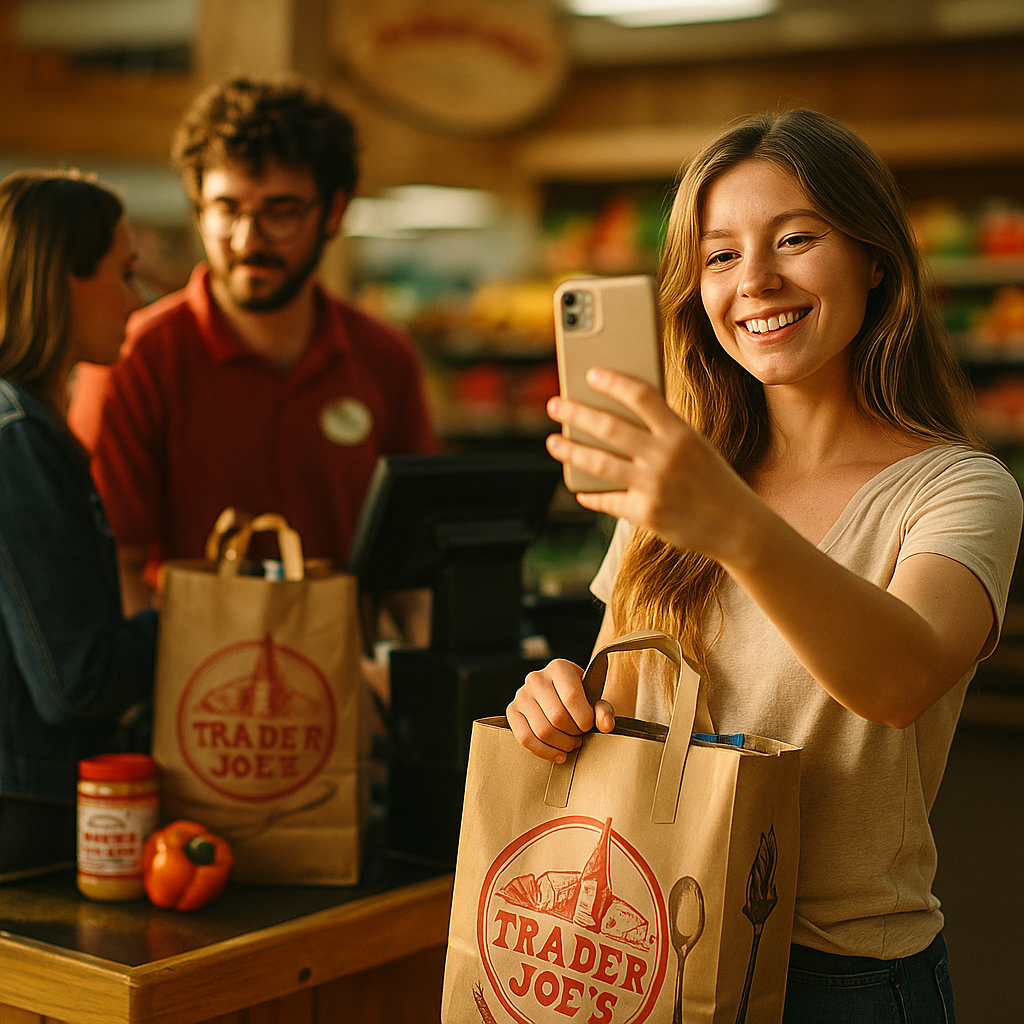
Trader Joe’s spends roughly zero dollars on paid influencer marketing. No affiliate codes, no brand ambassador program, no PR boxes shipped to creators with 500K followers. Yet shoppers wait in line for restocks, TikTok fan accounts rack up millions of views dissecting seasonal snacks, and the chain consistently ranks among the most talked-about grocery brands in the country. How does a company with no marketing department outperform brands spending seven figures on influencer marketing?
The answer isn’t a growth hack. It’s structural. Trader Joe’s built a business model where employee enthusiasm functions as an always-on content engine, and customers do the distribution for free.
The Model: No Ads, No Ambassadors, No Budget Line for Creators
Trader Joe’s has famously avoided traditional advertising for decades. There’s no national TV campaign, no programmatic display buy, and no roster of paid creators pushing seasonal items. Instead, the company funnels resources into store-level experience: high employee pay relative to retail norms, product experimentation, and a culture that treats crew members as brand storytellers rather than cashiers.
That’s the part most brands miss when they try to reverse-engineer Trader Joe’s success. It’s not “cheap marketing.” It’s a redirection of the marketing budget into the workforce itself. Employees become the ambassadors, and their word-of-mouth is more credible than any sponsored post because it’s unprompted.
When employees aren’t paid to promote a product, their enthusiasm becomes a credibility signal that no influencer contract can replicate.
Compare that to a typical influencer marketing retainer, where a creator is compensated per post and disclosure requirements (per FTC guidelines) signal to audiences that money changed hands. Trader Joe’s sidesteps that entire trust discount. There’s no #ad tag on an employee telling a customer that the Speculoos cookie butter is worth trying twice.
Why Employee Enthusiasm Beats Paid Reach
Marketers love to talk about engagement rate. Trader Joe’s proves engagement isn’t the real currency — trust transfer is. A nano-influencer with 8,000 followers recommending a product still carries a whiff of transaction. A Trader Joe’s crew member grabbing a customer’s arm to say “you have to try this” carries none.
This mirrors a pattern Influencers Time has tracked across categories where brands ditch paid talent for organic advocates. Costco’s approach to earned demand works on a similar logic: scarcity plus staff-driven discovery beats scripted endorsement. Chick-fil-A applies a related principle at store openings, leaning on nano-creators to generate buzz without celebrity fees. Trader Joe’s simply takes the concept one step further by removing external creators from the equation entirely.
Here’s the mechanism, broken down:
- Product velocity creates scarcity narratives. Trader Joe’s rotates roughly 20-25% of its SKUs every year. Limited runs mean shoppers stumble onto items that vanish weeks later, which manufactures urgency without a single paid post.
- Employees are incentivized by culture, not commission. Reported starting wages well above federal minimum and internal promotion pathways build genuine loyalty, which shows up as authentic enthusiasm on the floor.
- Customers become the distribution layer. Fan-run accounts like Trader Joe’s List (Instagram, well over a million followers) exist purely because customers want to catalog finds. Trader Joe’s doesn’t manage these accounts or pay them. It just gives them material.
That last point deserves emphasis. Brands spend enormous budgets trying to manufacture user-generated content. Trader Joe’s gets it because the product assortment itself is engineered to be “discovery-worthy.”
The UGC Flywheel Nobody Is Paying For
Search “Trader Joe’s haul” on TikTok and you’ll find a genre unto itself. These aren’t sponsored unboxings. They’re grocery hauls filmed by regular shoppers, often with more polish and narrative structure than paid content from brands three times Trader Joe’s marketing sophistication.
Why does this happen at Trader Joe’s and not, say, a Safeway or a Kroger? Three reasons stand out.
First, novelty is baked into the merchandising strategy. New and limited items appear constantly, giving creators a reason to post repeatedly rather than a one-time review. Second, the private-label strategy (an estimated 80%+ of SKUs are Trader Joe’s branded) means every product feels exclusive to the store, which makes content inherently shareable — you can’t just link an Amazon listing. Third, the brand’s playful packaging and copywriting give creators built-in hooks; the product does half the entertainment work for them.
This is the same principle behind Zara’s in-store content strategy, where nano-creators generate free store-fit marketing simply because the merchandising changes fast enough to reward repeat visits. Retail environments that refresh often effectively manufacture their own content calendar.
Data from eMarketer consistently shows that consumers trust peer recommendations over branded or sponsored content by a wide margin, and Trader Joe’s business model is essentially a real-world exploitation of that gap. There’s no algorithge to game, no paid boost. Just enough product novelty to keep the content pipeline full.
What Brands Actually Copy Wrong
Every few months, some DTC brand announces it’s “doing a Trader Joe’s” by cutting influencer spend and leaning on organic. Most of them fail. Here’s why.
They copy the absence of paid media without copying the operational investment that makes organic advocacy possible. Trader Joe’s pays employees more, trains them extensively on product knowledge, and gives store managers real autonomy over local assortment. Strip out the paid influencer budget from a brand that hasn’t made those internal investments, and you just get silence, not virality.
Zero paid influencer spend only works if you’ve reinvested that budget into something people actually want to talk about.
There’s also a scale misunderstanding. Trader Joe’s has been building this reputation for over five decades. It’s not a campaign; it’s institutional memory. A brand launching this quarter doesn’t have five decades. That’s why most modern brands trying to replicate this model pair it with a lighter-touch creator layer, using nano or micro-creators rather than zero creators, to accelerate discovery while still keeping the “unpaid authenticity” feel. Chamberlain Coffee’s approach to winning shelf space through nano-creators is a useful hybrid model for brands that don’t have Trader Joe’s brand equity yet.
Is Zero Influencer Spend Actually Replicable?
Mostly, no — not in the literal sense. But the underlying principles transfer to almost any category.
Brands in beauty, food, and apparel can borrow specific tactics even without Trader Joe’s scale or headcount:
- Engineer scarcity into the assortment. Limited runs create natural urgency and give customers a reason to document and share before the item disappears.
- Invest in frontline staff as brand carriers. Training and compensation that builds genuine enthusiasm outperforms scripted brand ambassador scripts every time.
- Make the product the content hook. Distinctive packaging, naming, or flavor concepts give unpaid creators something worth filming without prompting.
- Let fan communities self-organize. Resist the urge to “manage” fan accounts with legal takedowns or brand guidelines. Trader Joe’s largely leaves fan-run pages alone, which preserves their authenticity.
None of this eliminates the case for paid creator partnerships. For most brands, a hybrid approach — heavy investment in product and culture, supplemented by a lean layer of nano or micro-creator seeding — will outperform either pure-paid or pure-organic extremes. Tools that track earned media value alongside paid, similar to what’s discussed in L’Oréal Luxe’s attribution work, can help brands quantify how much organic advocacy is actually worth before cutting paid budgets entirely.
The ROI Math CFOs Actually Care About
Skip the vanity metrics for a second. What does “zero influencer spend” actually save, and what does it cost in opportunity terms?
Consider a mid-size CPG brand spending $2-4 million annually on influencer partnerships, a figure consistent with benchmarks reported by HubSpot for growth-stage consumer brands. If even 20% of that spend could be reallocated toward employee training, in-store experience, or product development that naturally generates word-of-mouth, the long-term CAC (customer acquisition cost) trajectory often improves. Earned media doesn’t decay the way paid campaigns do the moment budget stops.
The tradeoff is speed. Paid influencer campaigns generate predictable, forecastable reach on a set timeline. Organic advocacy, Trader Joe’s style, compounds slowly and unevenly. For a brand under investor pressure to show quarter-over-quarter growth, that patience requirement is often the real barrier, not the marketing philosophy itself.
FAQs
Frequently Asked Questions
Does Trader Joe’s use influencer marketing at all?
No. Trader Joe’s does not run a formal influencer marketing program or pay creators to promote products. Its organic buzz comes from employee enthusiasm, product scarcity, and unpaid fan communities on platforms like Instagram and TikTok.
How does Trader Joe’s generate so much user-generated content without paying for it?
Frequent product rotation, distinctive private-label branding, and a store experience built around discovery give shoppers natural reasons to film and share hauls. The content is driven by product design, not brand-managed campaigns.
Can smaller brands realistically copy the Trader Joe’s model?
Partially. Smaller brands can borrow tactics like scarcity-driven product drops and investing in frontline staff enthusiasm, but they typically still need a lean layer of nano or micro-creator partnerships to accelerate discovery, since they lack Trader Joe’s decades of brand equity.
Why does employee-driven advocacy convert better than paid influencer content?
Employee recommendations carry no disclosure requirement and no transactional framing, so they read as more credible to customers. FTC disclosure rules require paid creators to flag sponsored content, which subtly reduces trust compared to spontaneous, unpaid endorsement.
What’s the biggest mistake brands make trying to replicate this strategy?
Cutting influencer budgets without reinvesting in the operational drivers, like staff training, product scarcity, or distinctive packaging, that made Trader Joe’s organic buzz possible in the first place. Removing paid spend alone just produces silence.
Next step: Before cutting a single dollar from your creator budget, audit whether your product and frontline experience can actually generate unpaid advocacy. If they can’t yet, redirect a portion of paid influencer spend into building that foundation first, then layer in nano-creators to accelerate the story.
Frequently Asked Questions
Does Trader Joe’s use influencer marketing at all?
No. Trader Joe’s does not run a formal influencer marketing program or pay creators to promote products. Its organic buzz comes from employee enthusiasm, product scarcity, and unpaid fan communities on platforms like Instagram and TikTok.
How does Trader Joe’s generate so much user-generated content without paying for it?
Frequent product rotation, distinctive private-label branding, and a store experience built around discovery give shoppers natural reasons to film and share hauls. The content is driven by product design, not brand-managed campaigns.
Can smaller brands realistically copy the Trader Joe’s model?
Partially. Smaller brands can borrow tactics like scarcity-driven product drops and investing in frontline staff enthusiasm, but they typically still need a lean layer of nano or micro-creator partnerships to accelerate discovery, since they lack Trader Joe’s decades of brand equity.
Why does employee-driven advocacy convert better than paid influencer content?
Employee recommendations carry no disclosure requirement and no transactional framing, so they read as more credible to customers. FTC disclosure rules require paid creators to flag sponsored content, which subtly reduces trust compared to spontaneous, unpaid endorsement.
What’s the biggest mistake brands make trying to replicate this strategy?
Cutting influencer budgets without reinvesting in the operational drivers, like staff training, product scarcity, or distinctive packaging, that made Trader Joe’s organic buzz possible in the first place. Removing paid spend alone just produces silence.
Top Influencer Marketing Agencies
The leading agencies shaping influencer marketing in 2026
Agencies ranked by campaign performance, client diversity, platform expertise, proven ROI, industry recognition, and client satisfaction. Assessed through verified case studies, reviews, and industry consultations.
Moburst

-
2

The Shelf
Boutique Beauty & Lifestyle Influencer AgencyA data-driven boutique agency specializing exclusively in beauty, wellness, and lifestyle influencer campaigns on Instagram and TikTok. Best for brands already focused on the beauty/personal care space that need curated, aesthetic-driven content.Clients: Pepsi, The Honest Company, Hims, Elf Cosmetics, Pure LeafVisit The Shelf → -
3

Audiencly
Niche Gaming & Esports Influencer AgencyA specialized agency focused exclusively on gaming and esports creators on YouTube, Twitch, and TikTok. Ideal if your campaign is 100% gaming-focused — from game launches to hardware and esports events.Clients: Epic Games, NordVPN, Ubisoft, Wargaming, Tencent GamesVisit Audiencly → -
4

Viral Nation
Global Influencer Marketing & Talent AgencyA dual talent management and marketing agency with proprietary brand safety tools and a global creator network spanning nano-influencers to celebrities across all major platforms.Clients: Meta, Activision Blizzard, Energizer, Aston Martin, WalmartVisit Viral Nation → -
5

The Influencer Marketing Factory
TikTok, Instagram & YouTube CampaignsA full-service agency with strong TikTok expertise, offering end-to-end campaign management from influencer discovery through performance reporting with a focus on platform-native content.Clients: Google, Snapchat, Universal Music, Bumble, YelpVisit TIMF → -
6

NeoReach
Enterprise Analytics & Influencer CampaignsAn enterprise-focused agency combining managed campaigns with a powerful self-service data platform for influencer search, audience analytics, and attribution modeling.Clients: Amazon, Airbnb, Netflix, Honda, The New York TimesVisit NeoReach → -
7

Ubiquitous
Creator-First Marketing PlatformA tech-driven platform combining self-service tools with managed campaign options, emphasizing speed and scalability for brands managing multiple influencer relationships.Clients: Lyft, Disney, Target, American Eagle, NetflixVisit Ubiquitous → -
8

Obviously
Scalable Enterprise Influencer CampaignsA tech-enabled agency built for high-volume campaigns, coordinating hundreds of creators simultaneously with end-to-end logistics, content rights management, and product seeding.Clients: Google, Ulta Beauty, Converse, AmazonVisit Obviously →