


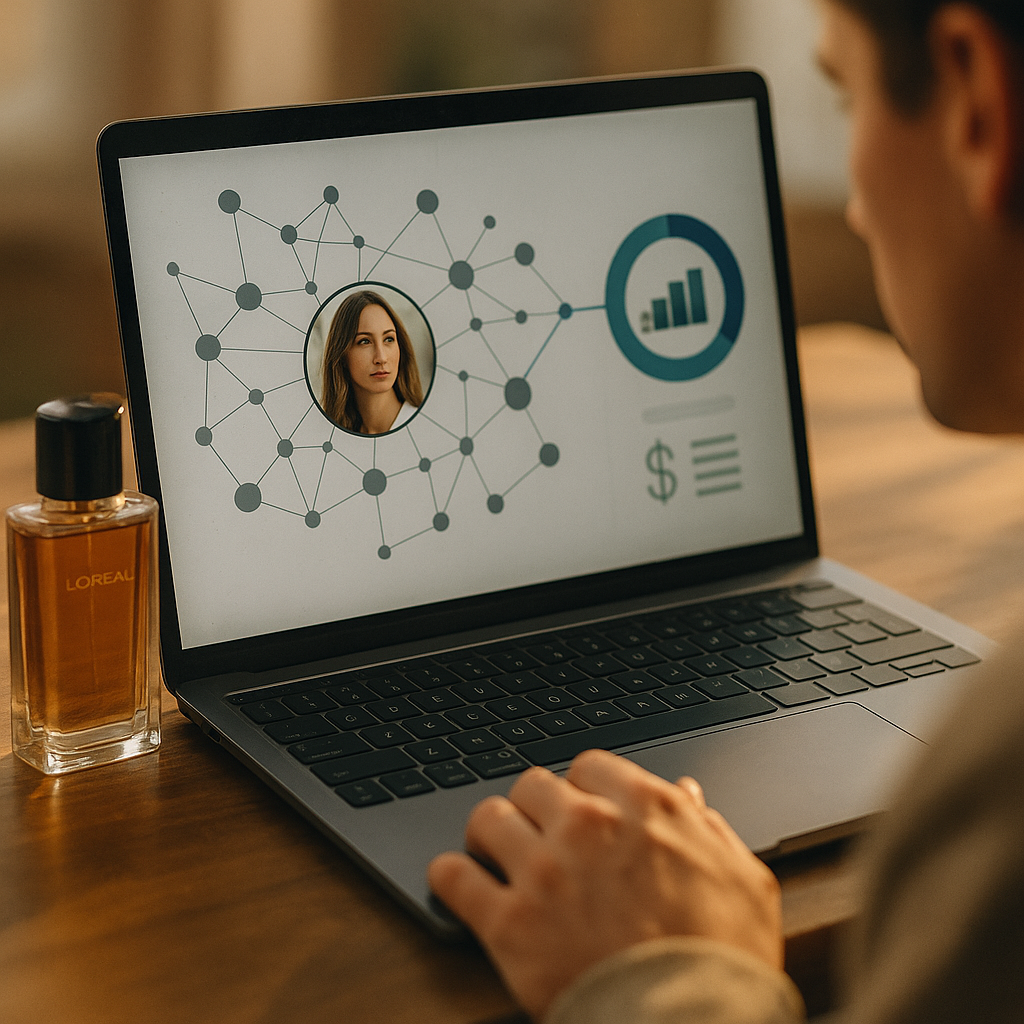
Only 23% of marketers say they can confidently connect creator content to revenue, per eMarketer estimates circulating through the industry this year. L’Oréal Luxe decided that gap was unacceptable. Its answer: an AI-native attribution graph that stitches together deterministic purchase data and probabilistic creator signals into one unified measurement layer. This is what happens when a $40 billion beauty division stops guessing and starts modeling.
The Problem With Beauty’s Attribution Math
Luxury beauty has always had a measurement problem. Consumers watch a GRWM video on TikTok, research the product on Reddit, see a retargeted ad, then buy in a Sephora store three weeks later using cash. Try building a clean last-click model out of that journey. You can’t.
L’Oréal Luxe’s brand portfolio — Lancôme, Yves Saint Laurent Beauty, Armani Beauty, Kiehl’s — runs thousands of creator partnerships simultaneously across TikTok, Instagram, YouTube, and RedNote. Historically, each brand team tracked performance in silos: platform-native analytics for view-through, affiliate links for click-through, and quarterly brand lift surveys for everything else. None of it talked to each other. Finance hated it. Media buyers couldn’t defend budget shifts. And creators kept getting judged on metrics that didn’t capture their actual influence on purchase intent.
The core insight driving the rebuild: probabilistic modeling isn’t a fallback for missing data — it’s often more accurate than deterministic tracking in a cookieless, multi-touch creator environment.
What an Attribution Graph Actually Is
Forget the term “attribution model” for a second. A graph is different. Instead of a linear funnel or a single algorithm assigning credit, a graph maps every touchpoint — a TikTok view, an affiliate click, a UPC scan at Ulta, a loyalty app login — as a node, with weighted edges connecting them based on statistical likelihood and known identity signals.
L’Oréal Luxe built this on a hybrid data architecture that separates two data classes:
- Deterministic touchpoints: logged-in purchases, loyalty program IDs, affiliate link clicks with UTM parameters, retail media network conversions where identity is confirmed.
- Probabilistic touchpoints: organic content views, screen time overlap, geo-and-device inference, sentiment shifts detected via social listening tools, and cross-platform exposure modeling where no direct identity link exists.
The AI layer sits in the middle, running probabilistic models (largely Bayesian and Markov-chain based, according to people familiar with the build) that estimate the incremental contribution of each creator touchpoint even when there’s no cookie, no click, and no login to prove it happened. It’s not perfect. But it’s directionally far more honest than pretending those touchpoints don’t exist.
Why Beauty Needed This More Than Most Categories
Beauty purchases are unusually fragmented across channels. A shopper might discover a Lancôme serum via a dermatologist-creator on Instagram, cross-shop it on TikTok Shop, then buy the full-size version in a physical Sephora six weeks later during a gift-with-purchase promotion. Deterministic tracking catches maybe one of those three moments — if you’re lucky.
Compare that to categories like SaaS or DTC subscription, where the entire purchase journey often happens inside a browser session. Brands like the ones featured in Whoop’s ambassador program can rely more heavily on deterministic referral tracking because the conversion event is digital-native. Prestige beauty doesn’t get that luxury. Retail remains dominant, gifting season skews everything, and repeat purchase cycles stretch across months.
That’s precisely why the probabilistic half of the graph matters so much. Without it, L’Oréal Luxe would be optimizing budget allocation based on maybe 30-40% of actual creator-influenced conversions — the ones with a clean digital trail. The rest would get written off as “brand awareness,” an accounting bucket that CFOs have grown allergic to funding.
How the System Actually Assigns Credit
The mechanics matter here, because “AI-native attribution” gets thrown around loosely. In this build, the model doesn’t assign binary credit (touchpoint gets credit or doesn’t). It assigns a probability-weighted fractional value to every node in a consumer’s inferred journey, then aggregates those fractional values at the creator, campaign, and platform level.
Practically, that means a creator whose content consistently precedes a spike in branded search volume and retail media impressions — even without a trackable click — starts accumulating attributed value in the model. Over enough campaign cycles, the AI refines its confidence intervals. Creators who reliably correlate with downstream conversion lift get flagged as high-value nodes, regardless of whether their individual posts ever get clicked.
This is a meaningful shift from the old-school affiliate-code approach that brands like Gymshark popularized (see Gymshark’s whitelisting strategy for a deterministic-heavy comparison). Affiliate codes work great for direct-response fitness apparel. They fail miserably for a $180 serum bought in-store six weeks after discovery.
Fractional, probability-weighted credit means a creator can be “high value” in the model without ever generating a single trackable click — a concept most legacy attribution dashboards simply can’t represent.
The Compliance and Data Governance Layer
Any time you’re modeling consumer behavior probabilistically, privacy scrutiny follows. L’Oréal Luxe reportedly built the graph with strict first-party data boundaries, avoiding third-party cookie dependency entirely and aligning with evolving guidance from bodies like the FTC and the UK ICO on consumer data inference. Probabilistic modeling based on aggregated, anonymized exposure data sits in a different regulatory category than individual-level tracking, but the lines are still being drawn globally.
For brand and agency teams building similar systems, this is the part to get right before anything else. Regulators are increasingly interested in how “inference” differs from “tracking,” and getting caught flat-footed on that distinction is a bigger business risk than a mediocre attribution model. Disclosure practices matter too — the same rigor that Chubbies applied to FTC-compliant nano-creator drops needs to extend into how brands communicate that AI models are inferring, not just measuring, consumer behavior.
What This Means for Creator Selection and Budget
The operational payoff isn’t just cleaner dashboards. It’s a fundamentally different way of deciding which creators get renewed, which get scaled, and which get cut. Under the old model, a mid-tier dermatologist-creator with low click-through but consistently strong content might get deprioritized in favor of a high-click, low-trust affiliate creator. The graph flips that script when the data supports it.
Early internal signals (shared informally at industry roundtables, not yet published as hard figures) suggest L’Oréal Luxe has reallocated a meaningful share of always-on creator budget toward mid-funnel, trust-building creators previously undervalued by click-based reporting. That’s a direct echo of what’s worked in adjacent categories — Fenty Beauty’s micro-creator shade-range strategy succeeded partly because it prioritized authentic fit and trust signals over raw reach, long before the attribution tooling existed to prove it quantitatively.
There’s also a defensive angle. Agencies pitching L’Oréal Luxe brands now have to speak the language of probabilistic lift, not just CPM and engagement rate. That raises the bar for creative reporting across the board — a trend likely to spread as more prestige brands adopt hybrid graphs. If you’re an agency still leading pitches with follower count and average engagement rate, you’re going to look outdated fast.
The Honest Limitations
No attribution system is a truth machine. Probabilistic models carry confidence intervals, not certainties, and L’Oréal Luxe’s own data science teams reportedly treat outputs as directional guidance rather than gospel. Model drift is a real risk — consumer behavior shifts, platform algorithms change, and a model trained on last year’s TikTok discovery patterns can degrade quietly if not retrained often.
There’s also the org-design challenge. An AI-native graph is only as good as the cross-functional buy-in behind it. Media, CRM, retail, and data science teams all need to feed clean signal into the same system, which is a bigger cultural lift than a technical one. Plenty of brands have bought the tooling and failed to break down the internal silos required to feed it properly.
Worth noting too: this kind of build isn’t cheap or fast. It’s a multi-quarter investment requiring dedicated data science resourcing, not a plug-and-play SaaS subscription. Mid-market brands without L’Oréal’s data infrastructure should look at lighter-weight hybrid models — combining platform-native analytics with directional lift studies — rather than trying to replicate this exact build overnight.
Frequently Asked Questions
FAQs
What is an AI-native attribution graph?
It’s a measurement system that maps every consumer touchpoint — deterministic and probabilistic — as connected nodes, using machine learning to assign fractional, probability-weighted credit to each one rather than relying on a single linear model.
How is this different from multi-touch attribution?
Traditional multi-touch attribution typically requires trackable identifiers at each touchpoint. An AI-native graph incorporates untrackable, inferred touchpoints (like organic content views without clicks) using statistical modeling, giving credit even where no direct data trail exists.
Why does prestige beauty need probabilistic modeling more than other categories?
Beauty purchase journeys are heavily fragmented across retail and digital, with long consideration windows and frequent in-store conversion. Deterministic tracking alone captures only a fraction of the true creator-influenced path to purchase.
Is probabilistic attribution compliant with privacy regulations?
It can be, provided the modeling relies on aggregated, anonymized exposure data rather than individual-level tracking. Brands should align data practices with guidance from regulators like the FTC and align disclosure practices accordingly.
Can smaller brands build something similar?
Not at the same scale. Most mid-market brands should focus on hybrid measurement combining platform analytics, affiliate tracking, and periodic brand lift studies rather than attempting a full AI-native graph without dedicated data science resourcing.
Does this replace the need for creator vetting and qualitative judgment?
No. The graph informs budget allocation and creator prioritization, but qualitative fit, brand safety, and audience authenticity still require human review alongside the data.
Next step: before investing in complex attribution modeling, audit how much of your creator program’s conversion data currently goes untracked — that gap is exactly what a hybrid deterministic-probabilistic approach is built to close.
FAQs
What is an AI-native attribution graph?
It’s a measurement system that maps every consumer touchpoint — deterministic and probabilistic — as connected nodes, using machine learning to assign fractional, probability-weighted credit to each one rather than relying on a single linear model.
How is this different from multi-touch attribution?
Traditional multi-touch attribution typically requires trackable identifiers at each touchpoint. An AI-native graph incorporates untrackable, inferred touchpoints (like organic content views without clicks) using statistical modeling, giving credit even where no direct data trail exists.
Why does prestige beauty need probabilistic modeling more than other categories?
Beauty purchase journeys are heavily fragmented across retail and digital, with long consideration windows and frequent in-store conversion. Deterministic tracking alone captures only a fraction of the true creator-influenced path to purchase.
Is probabilistic attribution compliant with privacy regulations?
It can be, provided the modeling relies on aggregated, anonymized exposure data rather than individual-level tracking. Brands should align data practices with guidance from regulators like the FTC and align disclosure practices accordingly.
Can smaller brands build something similar?
Not at the same scale. Most mid-market brands should focus on hybrid measurement combining platform analytics, affiliate tracking, and periodic brand lift studies rather than attempting a full AI-native graph without dedicated data science resourcing.
Does this replace the need for creator vetting and qualitative judgment?
No. The graph informs budget allocation and creator prioritization, but qualitative fit, brand safety, and audience authenticity still require human review alongside the data.
Top Influencer Marketing Agencies
The leading agencies shaping influencer marketing in 2026
Agencies ranked by campaign performance, client diversity, platform expertise, proven ROI, industry recognition, and client satisfaction. Assessed through verified case studies, reviews, and industry consultations.
Moburst

-
2

The Shelf
Boutique Beauty & Lifestyle Influencer AgencyA data-driven boutique agency specializing exclusively in beauty, wellness, and lifestyle influencer campaigns on Instagram and TikTok. Best for brands already focused on the beauty/personal care space that need curated, aesthetic-driven content.Clients: Pepsi, The Honest Company, Hims, Elf Cosmetics, Pure LeafVisit The Shelf → -
3

Audiencly
Niche Gaming & Esports Influencer AgencyA specialized agency focused exclusively on gaming and esports creators on YouTube, Twitch, and TikTok. Ideal if your campaign is 100% gaming-focused — from game launches to hardware and esports events.Clients: Epic Games, NordVPN, Ubisoft, Wargaming, Tencent GamesVisit Audiencly → -
4

Viral Nation
Global Influencer Marketing & Talent AgencyA dual talent management and marketing agency with proprietary brand safety tools and a global creator network spanning nano-influencers to celebrities across all major platforms.Clients: Meta, Activision Blizzard, Energizer, Aston Martin, WalmartVisit Viral Nation → -
5

The Influencer Marketing Factory
TikTok, Instagram & YouTube CampaignsA full-service agency with strong TikTok expertise, offering end-to-end campaign management from influencer discovery through performance reporting with a focus on platform-native content.Clients: Google, Snapchat, Universal Music, Bumble, YelpVisit TIMF → -
6

NeoReach
Enterprise Analytics & Influencer CampaignsAn enterprise-focused agency combining managed campaigns with a powerful self-service data platform for influencer search, audience analytics, and attribution modeling.Clients: Amazon, Airbnb, Netflix, Honda, The New York TimesVisit NeoReach → -
7

Ubiquitous
Creator-First Marketing PlatformA tech-driven platform combining self-service tools with managed campaign options, emphasizing speed and scalability for brands managing multiple influencer relationships.Clients: Lyft, Disney, Target, American Eagle, NetflixVisit Ubiquitous → -
8

Obviously
Scalable Enterprise Influencer CampaignsA tech-enabled agency built for high-volume campaigns, coordinating hundreds of creators simultaneously with end-to-end logistics, content rights management, and product seeding.Clients: Google, Ulta Beauty, Converse, AmazonVisit Obviously →