


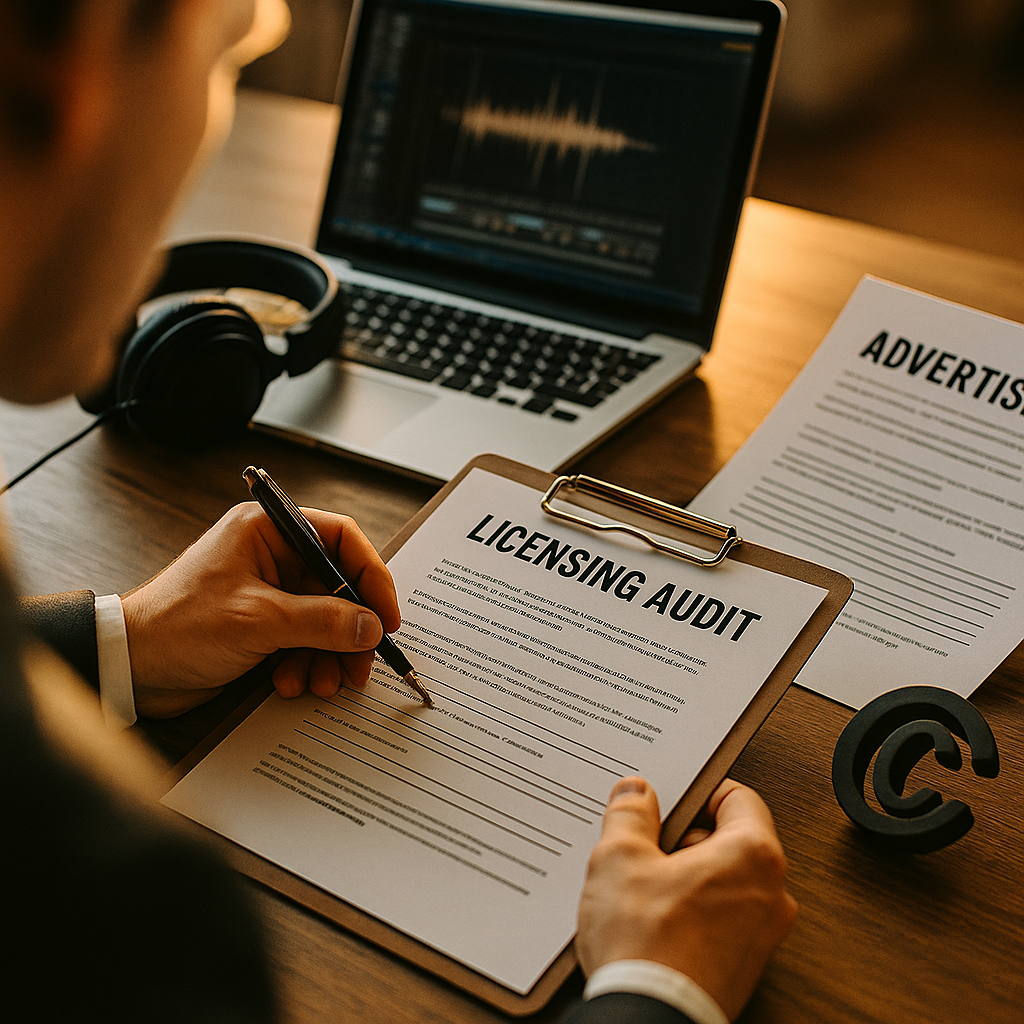
One unlicensed 12-second clip. That’s all it takes to trigger a copyright strike, a platform demonetization, or a six-figure settlement demand. Brands producing dozens of short form ads a week rarely have a clean paper trail proving every beat, hook, and sample was cleared. A music licensing audit is the unglamorous process that catches this before a legal team, or a plaintiff’s attorney, catches it for you.
Why Volume Breaks the Old Clearance Model
Traditional music clearance was built for a world of thirty TV spots a year, each one reviewed line by line before air. That model collapses under the weight of modern short form production. Brands now push out hundreds of TikTok, Reels, and YouTube Shorts variants monthly, often stitched together by creators, freelance editors, and in-house teams working from different asset libraries.
Nobody is checking licenses at that speed. Editors grab a trending sound because it fits the cut. A creator layers a personal Spotify playlist over a voiceover in Canva. An agency reuses a stock track past its license window without anyone noticing the expiration date. Each of these is a small decision made under deadline pressure, and each one is a liability sitting quietly in your content library.
A single viral ad with an uncleared sample doesn’t just risk one takedown. It exposes every other asset built the same way, across every market you’ve ever run that creative.
What a Music Licensing Audit Actually Covers
An audit isn’t a one-time legal review. It’s a repeatable process that maps every piece of music in active and archived ad assets against its licensing terms. A serious audit checks:
- Whether the license covers the specific use case (social ads versus organic posts versus paid amplification)
- Geographic scope, since a track cleared for the US may not be cleared for the EU or UK
- Term length and renewal dates, especially for stock libraries billed annually
- Platform-specific rules, since TikTok’s Commercial Music Library and Meta’s licensed sound catalog carry different restrictions than a generic royalty-free purchase
- Sync rights versus master rights, which are two separate clearances that get confused constantly
- Creator-sourced audio, including trending sounds pulled into branded content without commercial clearance
Most brands discover, on their first audit, that the biggest exposure isn’t the polished agency campaign. It’s the long tail of creator-generated and repurposed content nobody formally reviewed.
The Creator Content Blind Spot
Repurposing creator content into paid ads is now standard practice, and it’s also where music rights get murky fast. A creator’s organic video might use a trending sound under a platform’s personal-use license. The moment that same clip gets boosted as a paid ad or licensed for a brand’s own channels, the music rights framework changes entirely. This is the same structural gap covered in our piece on repurposed UGC indemnification, and it applies just as directly to audio as it does to visuals or likeness.
If your contracts don’t explicitly address music rights when content moves from organic to paid, you’re relying on hope. That’s not a compliance strategy, that’s a gamble with your media budget attached.
Where the Real Risk Hides: Stock Libraries and “Free” Music
Royalty-free doesn’t mean risk-free. Plenty of brands treat stock music subscriptions as a blanket clearance, when in reality most licenses cap usage by number of end products, distribution channel, or ad spend threshold. Epidemic Sound, Artlist, and similar libraries all have tiered terms, and exceeding them silently converts a licensed asset into an infringing one.
Then there’s the AI-generated music problem creeping into short form production. Tools generating background tracks from text prompts raise unresolved questions about copyright ownership and whether the output infringes on training data. Legal guidance here is still catching up, and FTC enforcement priorities increasingly touch on AI-generated content claims, even when music isn’t the headline issue.
Sampling and “Sound-Alike” Tracks
Short form editors love a hook that sounds almost exactly like a chart-topping single, minus the licensing fee. Sound-alike tracks sit in a legal gray zone that has burned brands before. Even when a track is technically original, if it’s marketed and used to evoke a specific copyrighted song, rights holders have grounds to challenge it. An audit process should flag these tracks for manual legal review rather than letting them slide through because “it’s not the actual song.”
Building an Audit Cadence That Scales
A one-time audit is a snapshot, not a system. High volume ad production needs a recurring cadence, ideally quarterly for active campaigns and annually for the full archive. Here’s a practical structure:
- Centralize the asset inventory. Every short form ad, plus the music file, license documentation, and expiration date, lives in one searchable system. Spreadsheets buckle under volume, so most teams eventually move to a digital asset management platform with metadata tagging.
- Tag by risk tier. Fully licensed and documented assets are low risk. Creator-sourced or trending audio is medium risk. Anything untraceable to a license is high risk and gets pulled from rotation immediately.
- Assign ownership. Someone specific, not “the team,” owns the audit calendar and signs off on renewals before expiration dates hit.
- Cross-check before every campaign flight. Before a new burst of ad variants goes live, run a fast pre-flight check against the license database, not after the ads are already spending budget.
- Document everything. If a claim does arrive, a clean audit trail showing licensing diligence is often the difference between a quick resolution and a drawn-out legal fight.
The brands that get burned aren’t the ones with zero process. They’re the ones with a process that stopped being followed once volume outgrew it.
What Happens When You Skip the Audit
The consequences aren’t hypothetical. Platform-level copyright claims can trigger automated ad account restrictions, sometimes freezing entire campaigns while a dispute resolves. Rights holders and their licensing agents actively monitor short form platforms for unauthorized use, and settlement demands routinely land in the low six figures for commercial infringement, even for a single 15-second spot with a modest media spend behind it.
There’s also a slower, quieter cost: agency and creator relationships fray when nobody’s clear on who’s responsible for clearance. Building explicit music rights language into creator agreements, similar to the contract clauses discussed in our guide to licensing creator UGC, prevents finger-pointing after the fact and puts clearance responsibility where it belongs before production starts.
Compliance teams already juggling disclosure rules, FTC guidance, and platform-specific labeling requirements (see our breakdown of disclosure rules across regulators) often treat music licensing as a lower priority. It shouldn’t be. Copyright claims move faster and hit harder than most disclosure violations, because rights holders have direct legal standing and financial incentive to enforce.
Tools and Vendors Worth Knowing
Manual audits work at low volume. Past a certain scale, brands need tooling. Rights management platforms like Pex and Musicube offer audio fingerprinting that can scan a content library and flag unlicensed or expired tracks automatically. Some DAM platforms now integrate licensing metadata directly, so an editor can’t even pull an asset without seeing its current license status.
For teams managing high creator volume, pairing a music audit with broader creator verification practices matters too. Our piece on creator network verification gaps covers a similar principle: scale multiplies small oversights into systemic risk, and the fix is always the same, build the checkpoint into the workflow rather than treating it as an afterthought.
Industry data from eMarketer continues to show short form video ad spend climbing year over year, which means the volume problem driving licensing risk isn’t slowing down. Neither should your audit cadence.
A Quick Gut Check for Marketing Leaders
Ask your team these three questions right now. Can you produce a license document for the music in your top five performing ads this quarter? Does anyone know when your stock music subscription terms renew or expire? If a creator’s trending sound ends up in a paid ad tomorrow, does your contract already address that scenario? If any answer is “not sure,” that’s your audit starting point.
Frequently Asked Questions
What is a music licensing audit in advertising?
It’s a systematic review of every music asset used across ad content, checking each track against its license terms for usage rights, geographic scope, term length, and platform restrictions. The goal is catching gaps before they become copyright claims.
How often should brands run a music licensing audit?
Quarterly for active, high volume short form campaigns, and at least annually for the full content archive. Teams launching frequent campaign flights should also run a lighter pre-flight check before each new batch of ads goes live.
Is music from a stock library always safe to use commercially?
Not automatically. Stock and royalty-free licenses often cap usage by distribution channel, number of end products, or spend threshold. Exceeding those limits turns a properly licensed track into an infringing one, even though the subscription itself is legitimate.
What happens if a creator uses a trending sound in content that later becomes a paid ad?
The licensing terms usually change the moment content shifts from organic to paid use. Platform trending sounds are often licensed for personal or organic use only, not commercial amplification, so repurposing that content into a paid ad without separate clearance creates real exposure.
Can AI-generated music eliminate licensing risk?
Not entirely. Ownership and originality questions around AI-generated tracks are still legally unsettled, and some outputs may echo copyrighted training data closely enough to draw a claim. Treat AI-generated music as a risk category requiring its own review, not a clearance shortcut.
Start small: pull your top ten performing ads this month and confirm you can produce a license document for the music in each one. If you can’t, that gap is your audit’s first line item, and it’s cheaper to close now than after a takedown notice arrives.
Top Influencer Marketing Agencies
The leading agencies shaping influencer marketing in 2026
Agencies ranked by campaign performance, client diversity, platform expertise, proven ROI, industry recognition, and client satisfaction. Assessed through verified case studies, reviews, and industry consultations.
Moburst

-
2

The Shelf
Boutique Beauty & Lifestyle Influencer AgencyA data-driven boutique agency specializing exclusively in beauty, wellness, and lifestyle influencer campaigns on Instagram and TikTok. Best for brands already focused on the beauty/personal care space that need curated, aesthetic-driven content.Clients: Pepsi, The Honest Company, Hims, Elf Cosmetics, Pure LeafVisit The Shelf → -
3

Audiencly
Niche Gaming & Esports Influencer AgencyA specialized agency focused exclusively on gaming and esports creators on YouTube, Twitch, and TikTok. Ideal if your campaign is 100% gaming-focused — from game launches to hardware and esports events.Clients: Epic Games, NordVPN, Ubisoft, Wargaming, Tencent GamesVisit Audiencly → -
4

Viral Nation
Global Influencer Marketing & Talent AgencyA dual talent management and marketing agency with proprietary brand safety tools and a global creator network spanning nano-influencers to celebrities across all major platforms.Clients: Meta, Activision Blizzard, Energizer, Aston Martin, WalmartVisit Viral Nation → -
5

The Influencer Marketing Factory
TikTok, Instagram & YouTube CampaignsA full-service agency with strong TikTok expertise, offering end-to-end campaign management from influencer discovery through performance reporting with a focus on platform-native content.Clients: Google, Snapchat, Universal Music, Bumble, YelpVisit TIMF → -
6

NeoReach
Enterprise Analytics & Influencer CampaignsAn enterprise-focused agency combining managed campaigns with a powerful self-service data platform for influencer search, audience analytics, and attribution modeling.Clients: Amazon, Airbnb, Netflix, Honda, The New York TimesVisit NeoReach → -
7

Ubiquitous
Creator-First Marketing PlatformA tech-driven platform combining self-service tools with managed campaign options, emphasizing speed and scalability for brands managing multiple influencer relationships.Clients: Lyft, Disney, Target, American Eagle, NetflixVisit Ubiquitous → -
8

Obviously
Scalable Enterprise Influencer CampaignsA tech-enabled agency built for high-volume campaigns, coordinating hundreds of creators simultaneously with end-to-end logistics, content rights management, and product seeding.Clients: Google, Ulta Beauty, Converse, AmazonVisit Obviously →