


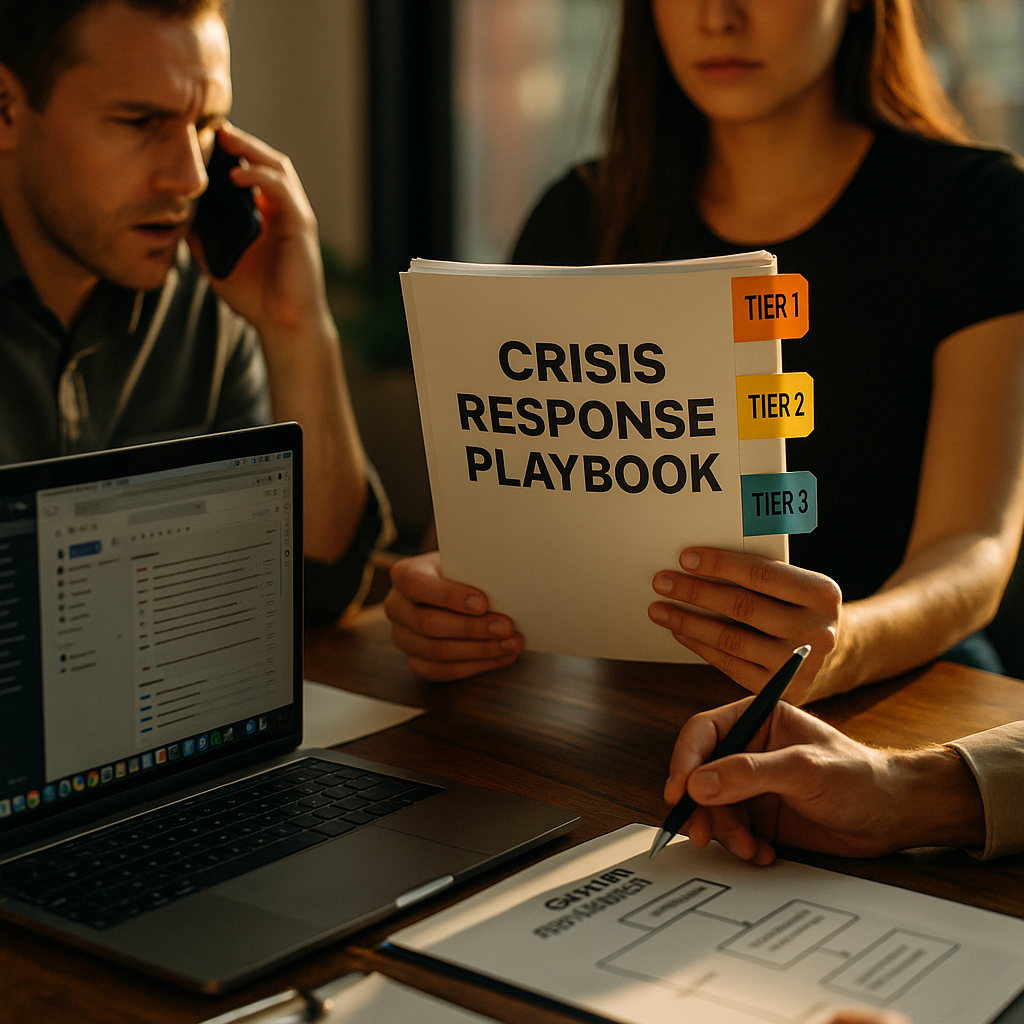
Sixty percent of a brand’s crisis window closes in the first six hours on social platforms, and most creator partnership teams don’t even have a documented response time target for hour one. That’s the gap this crisis response SLA playbook exists to close. If your influencer program still treats “crisis management” as a vague folder in a shared drive, you’re one bad tweet away from a very expensive lesson.
This isn’t about drafting apology templates. It’s about building measurable, enforceable service level agreements into how your creator partnership team detects, escalates, and resolves reputational threats, whether they originate from a creator’s own conduct, a brand misstep, or a viral pile-on that has nothing to do with either party.
Why “Have a Plan” Isn’t a Strategy Anymore
Most brands have a crisis communications deck somewhere. Few have turned it into an SLA with owners, timers, and consequences. The difference matters. A plan tells you what to do. An SLA tells you how fast, who’s accountable, and what happens if the clock runs out.
Creator partnerships add a layer of complexity that traditional PR crisis plans weren’t built for. You’re not just managing your own brand voice, you’re managing a third party’s platform, their audience relationship, and often a contractual gray zone about who controls the narrative once content goes sideways. A creator’s poorly timed joke, a resurfaced old post, or a partnership with someone who turns out to be embroiled in controversy can all detonate on your brand’s timeline within hours.
An SLA converts crisis response from a reactive scramble into a measurable operational function, the same way you’d measure creative turnaround or campaign approval speed.
Teams that have already built structured operating rhythms for other functions, like the trend production SLA model some brands use for content velocity, already understand this logic. Crisis response deserves the same rigor, arguably more.
Build a Four-Tier Severity Model First
Not every flare-up deserves a war room. Treating a minor comment-section complaint the same way you’d treat a creator facing legal allegations burns resources and desensitizes your team to real threats. Start by classifying incidents into tiers.
- Tier 1, Monitor: Isolated negative comments, minor factual pushback, no measurable spread. Response SLA: within 24 hours, handled by community management.
- Tier 2, Contain: Growing negative sentiment, screenshots circulating, press or niche media picking it up. Response SLA: within 4 hours, partnership manager plus comms lead.
- Tier 3, Escalate: Creator conduct issue, brand safety violation, or FTC disclosure complaint gaining traction. Response SLA: within 1 hour, cross-functional team including legal.
- Tier 4, Activate: Viral controversy, legal exposure, or safety concern. Response SLA: within 30 minutes, executive involvement required.
This mirrors the logic behind a good kill criteria framework for underperforming creators: clear thresholds remove emotion and debate from decisions made under pressure. You want your team arguing about strategy in a Tier 4 event, not arguing about whether it’s actually a Tier 4 event.
Set the Clock: Response Time Benchmarks That Actually Hold
Here’s where most playbooks get vague. “Respond quickly” isn’t an SLA. Numbers are. Based on patterns across brand safety incidents tracked by social listening vendors, sentiment typically peaks or plateaus within 6 to 12 hours of initial spread. That’s your real window, not the news cycle’s 24-hour framing.
A workable benchmark structure looks like this:
- Detection to acknowledgment (internal): 15 minutes for Tier 3 and 4, 2 hours for Tier 1 and 2.
- Acknowledgment to first external action (statement, content pause, creator contact): 1 hour for Tier 4, 6 hours for Tier 3.
- First action to resolution or holding pattern: 24 hours for Tier 3 and 4.
- Post-incident debrief: within 72 hours, no exceptions.
These numbers should live in your creator contracts and your internal ops documentation, not just a Slack channel description. If a creator’s team can’t hit a 1 hour response window during a Tier 4 event, that’s a contractual red flag you should have caught during vetting, which is exactly the kind of risk a procurement risk framework is designed to surface before you sign.
Who Owns What: A Lightweight RACI That Won’t Slow You Down
Crisis response fails most often not from lack of effort, but from confusion about who’s authorized to act. Build a RACI matrix specific to creator incidents, distinct from your general brand crisis plan.
At minimum, define four roles. The creator partnership manager is Responsible for direct creator communication and content decisions. Legal is Accountable for any public statement involving liability, disclosure compliance, or contract termination language. Comms or PR is Consulted on tone, timing, and channel strategy. Executive leadership is Informed at Tier 3 and above, with direct Accountability at Tier 4.
This is where organizational structure matters more than most teams admit. If your creator ops team structure already blends editorial and analytics functions, you likely have the cross-functional muscle memory to move fast. If your influencer function still sits in a silo separate from legal and comms, that’s the first structural gap to fix before you write a single SLA target.
The fastest crisis responses aren’t the ones with the best statement. They’re the ones where nobody had to ask “wait, who decides this?”
Contract Clauses That Make the SLA Enforceable
An SLA without contractual teeth is a suggestion. Bake crisis response obligations directly into creator agreements at the point of signing, not after the first incident forces a renegotiation.
Key clauses worth standardizing across your creator contracts:
- Response time obligation: Creator or their management must acknowledge brand outreach within a defined window (commonly 2 to 4 hours) during an active incident.
- Content pause authority: Brand’s right to request immediate removal or pausing of specific content pending review, with a defined compliance window.
- Disclosure compliance warranty: Explicit reference to FTC disclosure guidelines, with remediation timelines if violations occur.
- Termination triggers: Clearly defined conduct thresholds that permit immediate contract exit without prolonged negotiation.
- Joint statement protocol: Whether the creator can publish independent statements during an active brand crisis, and what approval is required.
If you’re already revisiting agreements because of shifting agency or network fees, this is a natural moment to layer in crisis clauses. The same conversations that come up during vendor contract renegotiation are a good opportunity to formalize SLA language without a separate legal cycle.
Don’t Forget the AI Layer
More brands are now using automated sentiment monitoring and even AI-driven response drafting to hit tighter SLA windows. That’s smart, but it introduces new risk. An AI agent that auto-flags or auto-responds to a brewing crisis without human review can make things worse, faster.
If your team is deploying any automated or agentic tools in the detection or response pipeline, run them through the same rigor you’d apply to campaign automation. The checklist approach outlined in agentic AI guardrails for campaign agents applies directly here: define what the tool can flag versus what it can act on, and never let automation own the final call at Tier 3 or above.
Social listening platforms like those tracked by Sprout Social can shave real minutes off detection time, and that matters. Every minute saved in detection is a minute added back to your response window.
The Post-Mortem Nobody Wants to Do
Here’s the part most teams skip. After the fire is out, the incident gets filed away and forgotten until the next one hits. That’s a wasted opportunity. Build the 72-hour debrief into the SLA itself, not as an optional nice-to-have.
A useful debrief covers three things: did we hit our response time targets, where did the RACI break down, and what contract gap allowed this to happen at all. Document it the same way you’d document a campaign performance review, tied to creator partnership OKRs where relevant, so leadership sees crisis readiness as a measurable operational metric rather than a fire drill that happened once and was forgotten.
According to data referenced by HubSpot on brand trust recovery, companies that publish a clear remediation timeline after an incident retain significantly more customer trust than those that go silent or delay. Speed and transparency compound. An SLA is how you guarantee both.
Where This Fits in Your Broader Ops Stack
Crisis response SLAs shouldn’t live in isolation. They should connect to how you structure your entire creator partnership function, from hiring to vendor selection to executive reporting. Brands building out dedicated leadership roles, as covered in executive influencer hires, are increasingly making crisis readiness a named KPI in that mandate, not an afterthought buried in a job description.
Consider benchmarking your incident volume and response times against industry data where available. Platforms like Statista and eMarketer periodically publish creator economy risk data that can help justify budget for dedicated crisis tooling or headcount to finance stakeholders who see this as a cost center until the first real incident proves otherwise.
FAQs
Frequently Asked Questions
What is a crisis response SLA for creator partnerships?
It’s a documented set of time-bound commitments, response windows, escalation paths, and ownership roles that a brand and its creator partners agree to follow when a reputational incident occurs, whether triggered by creator conduct, brand missteps, or external controversy.
How fast should a brand respond to a creator crisis?
It depends on severity. Low-level issues can wait 24 hours for a community management response, but high-severity incidents involving legal exposure or safety concerns typically require internal acknowledgment within 15 to 30 minutes and executive involvement within the hour.
Should crisis response SLAs be written into creator contracts?
Yes. Without contractual language covering response time obligations, content pause authority, and termination triggers, an SLA has no enforcement mechanism and relies entirely on goodwill during a moment when goodwill is often in short supply.
Who should own crisis response inside a creator partnership team?
A clear RACI matrix works best: the partnership manager handles direct creator communication, legal owns public statement liability and disclosure compliance, comms advises on messaging, and executives are looped in at higher severity tiers.
Can AI tools handle crisis detection and response?
AI is useful for detection and sentiment monitoring, shortening the time between an incident starting and your team knowing about it. It should not be given autonomous authority to publish responses or make judgment calls at higher severity tiers without human review.
Visible FAQ (HTML)
Next step: pull your last three creator-related incidents, whatever their size, and time-stamp your team’s actual response against the tiered benchmarks above. If you can’t reconstruct the timeline, that gap is your starting point for building the SLA before the next incident writes it for you.
Top Influencer Marketing Agencies
The leading agencies shaping influencer marketing in 2026
Agencies ranked by campaign performance, client diversity, platform expertise, proven ROI, industry recognition, and client satisfaction. Assessed through verified case studies, reviews, and industry consultations.
Moburst

-
2

The Shelf
Boutique Beauty & Lifestyle Influencer AgencyA data-driven boutique agency specializing exclusively in beauty, wellness, and lifestyle influencer campaigns on Instagram and TikTok. Best for brands already focused on the beauty/personal care space that need curated, aesthetic-driven content.Clients: Pepsi, The Honest Company, Hims, Elf Cosmetics, Pure LeafVisit The Shelf → -
3

Audiencly
Niche Gaming & Esports Influencer AgencyA specialized agency focused exclusively on gaming and esports creators on YouTube, Twitch, and TikTok. Ideal if your campaign is 100% gaming-focused — from game launches to hardware and esports events.Clients: Epic Games, NordVPN, Ubisoft, Wargaming, Tencent GamesVisit Audiencly → -
4

Viral Nation
Global Influencer Marketing & Talent AgencyA dual talent management and marketing agency with proprietary brand safety tools and a global creator network spanning nano-influencers to celebrities across all major platforms.Clients: Meta, Activision Blizzard, Energizer, Aston Martin, WalmartVisit Viral Nation → -
5

The Influencer Marketing Factory
TikTok, Instagram & YouTube CampaignsA full-service agency with strong TikTok expertise, offering end-to-end campaign management from influencer discovery through performance reporting with a focus on platform-native content.Clients: Google, Snapchat, Universal Music, Bumble, YelpVisit TIMF → -
6

NeoReach
Enterprise Analytics & Influencer CampaignsAn enterprise-focused agency combining managed campaigns with a powerful self-service data platform for influencer search, audience analytics, and attribution modeling.Clients: Amazon, Airbnb, Netflix, Honda, The New York TimesVisit NeoReach → -
7

Ubiquitous
Creator-First Marketing PlatformA tech-driven platform combining self-service tools with managed campaign options, emphasizing speed and scalability for brands managing multiple influencer relationships.Clients: Lyft, Disney, Target, American Eagle, NetflixVisit Ubiquitous → -
8

Obviously
Scalable Enterprise Influencer CampaignsA tech-enabled agency built for high-volume campaigns, coordinating hundreds of creators simultaneously with end-to-end logistics, content rights management, and product seeding.Clients: Google, Ulta Beauty, Converse, AmazonVisit Obviously →