


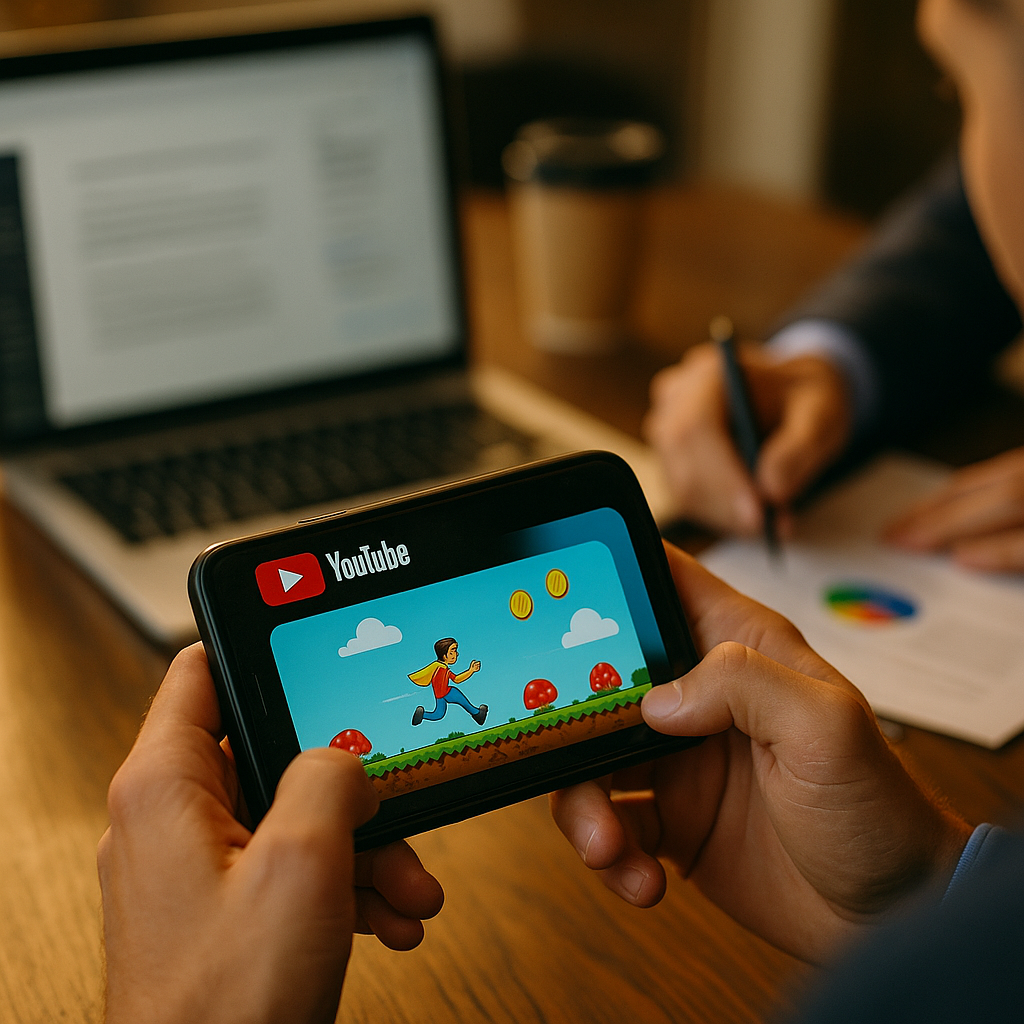
YouTube now hosts over 100 casual games directly on the watch page, and channels are already stitching sponsored branded mechanics into the mix. YouTube Playables just quietly became the newest ad format nobody briefed for. If your media plan still treats YouTube as a passive video feed, you’re already behind the creators experimenting with tap-to-play mechanics inside their content ecosystem.
This isn’t a gimmick. It’s a distribution shift. Playables sit in the same left rail as Shorts and subscriptions, meaning a viewer can go from watching a haul video to playing a branded puzzle without ever leaving the platform. For brands chasing attention in a scroll-fatigued market, that’s a rare thing: an ad experience people opt into voluntarily.
What Exactly Is a YouTube Playable, and Why Should Brand Teams Care?
Playables are lightweight HTML5 games that live natively inside YouTube, accessible from the homepage, a dedicated games shelf, and increasingly from creator channel pages. Google positioned the feature as a retention play, more time on platform, less reason to bounce to Roblox or a mobile app store. But the sponsorship angle is where it gets interesting for marketers.
Creators in the gaming, lifestyle, and even finance verticals have started building simple branded mini-games (think matching games, timed trivia, or physics-based tap challenges) and threading them into sponsored video content as a companion asset. The video drives awareness. The Playable drives dwell time and, in some cases, direct product interaction. That’s a two-surface sponsorship for the price of one integration.
Interactive formats consistently outperform static video on engagement metrics because they require a decision, not just attention. A tap is a stronger signal than a view.
Compare this to what happened when YouTube changed how it counts views for Shorts. Brands scrambled to figure out what a “view” actually meant for billing purposes, a story covered in depth in YouTube View Counting Change Forces Sponsors to Rebuild CPV. Playables introduce a similar measurement puzzle before most agencies have even built a rate card for it.
The ROI Case: Why Interactive Beats Passive for Certain Objectives
Let’s be blunt: not every campaign needs a game. If your KPI is pure reach, a Playable integration is overkill. But if you’re optimizing for time-on-brand, lead capture, or app pre-launch buzz, the math starts favoring interactivity.
- Dwell time multiplier: A 30-second video ad gets 30 seconds of attention, maybe. A playable session can run two to five minutes if the mechanic is sticky, and every second is spent with your branding visible.
- First-party signal capture: Game completion, score thresholds, and replay rates give you behavioral data that a view count never will.
- Novelty premium: Early adopters of new ad formats on YouTube have historically enjoyed lower CPMs before the format saturates. That window won’t stay open forever.
eMarketer has tracked rising engagement rates for interactive ad units across social platforms for several years running, and the pattern holds here too: friction that requires a tap, not just a scroll, correlates with better recall. You can check current benchmarks at eMarketer if you want to build a business case for budget reallocation.
Where Playables Fit in the Funnel
Top of funnel, Playables work as a discovery hook, especially for gaming, CPG, and entertainment brands with a mascot or visual identity that translates into a simple mechanic. Mid-funnel, they work as an engagement bridge between a sponsored video and a landing page or app download. Bottom of funnel, honestly, they’re weak. Nobody finishes a matching game and buys a mattress. Know your lane before you brief one.
Building the Brief: What Creative Teams Actually Need
Most brand teams don’t have an in-house game designer, and that’s fine. The creators building Playables today are largely working with lightweight game templates and third-party dev shops, not custom engines. Your job as the brand is to hand over a brief that constrains creative chaos without killing the fun.
A workable Playable brief should specify:
- The core mechanic (tap, swipe, timed challenge) and why it maps to your product story.
- Brand asset placement rules: logo visibility, color palette, mascot usage, and where disclosure language appears on-screen.
- A single measurable action inside the game (completion, share, or score threshold) that ties to your KPI.
- Disclosure requirements that meet FTC standards for interactive sponsored content, not just video disclosure norms.
That last point matters more than most teams realize. The FTC’s endorsement guidelines don’t carve out an exception for games. If a creator is paid to feature your brand inside a Playable, the same “clearly and conspicuously” disclosure standard applies, whether it’s spoken in a video or displayed as a banner inside a game loop. Review the current guidance directly at the FTC’s website before you greenlight anything. For a related sequencing problem on the video side, our piece on YouTube shoppable overlays and disclosure sequencing is a useful parallel for compliance teams building out interactive-format policy.
Measurement: The Metric Everyone Will Get Wrong First
Here’s the uncomfortable truth. YouTube hasn’t standardized a universal reporting dashboard for branded Playable performance the way it has for video views or Shorts plays. That means brands negotiating these deals right now are, in effect, writing their own measurement contracts creator by creator.
Ask for these numbers before you sign off on payment terms:
- Total game sessions started (not just impressions of the thumbnail)
- Average session length
- Completion rate and drop-off point
- Click-through to any linked destination, if applicable
-
2

The Shelf
Boutique Beauty & Lifestyle Influencer AgencyA data-driven boutique agency specializing exclusively in beauty, wellness, and lifestyle influencer campaigns on Instagram and TikTok. Best for brands already focused on the beauty/personal care space that need curated, aesthetic-driven content.Clients: Pepsi, The Honest Company, Hims, Elf Cosmetics, Pure LeafVisit The Shelf → -
3

Audiencly
Niche Gaming & Esports Influencer AgencyA specialized agency focused exclusively on gaming and esports creators on YouTube, Twitch, and TikTok. Ideal if your campaign is 100% gaming-focused — from game launches to hardware and esports events.Clients: Epic Games, NordVPN, Ubisoft, Wargaming, Tencent GamesVisit Audiencly → -
4

Viral Nation
Global Influencer Marketing & Talent AgencyA dual talent management and marketing agency with proprietary brand safety tools and a global creator network spanning nano-influencers to celebrities across all major platforms.Clients: Meta, Activision Blizzard, Energizer, Aston Martin, WalmartVisit Viral Nation → -
5

The Influencer Marketing Factory
TikTok, Instagram & YouTube CampaignsA full-service agency with strong TikTok expertise, offering end-to-end campaign management from influencer discovery through performance reporting with a focus on platform-native content.Clients: Google, Snapchat, Universal Music, Bumble, YelpVisit TIMF → -
6

NeoReach
Enterprise Analytics & Influencer CampaignsAn enterprise-focused agency combining managed campaigns with a powerful self-service data platform for influencer search, audience analytics, and attribution modeling.Clients: Amazon, Airbnb, Netflix, Honda, The New York TimesVisit NeoReach → -
7

Ubiquitous
Creator-First Marketing PlatformA tech-driven platform combining self-service tools with managed campaign options, emphasizing speed and scalability for brands managing multiple influencer relationships.Clients: Lyft, Disney, Target, American Eagle, NetflixVisit Ubiquitous → -
8

Obviously
Scalable Enterprise Influencer CampaignsA tech-enabled agency built for high-volume campaigns, coordinating hundreds of creators simultaneously with end-to-end logistics, content rights management, and product seeding.Clients: Google, Ulta Beauty, Converse, AmazonVisit Obviously →
Sound familiar? It should. This is the same conversation the industry had when YouTube introduced instant play counting for Shorts, forcing brands to renegotiate what actually counts as a valid engagement. That shift is dissected thoroughly in YouTube Instant Play Views Force Brands to Rethink Creator KPIs, and the lessons transfer almost directly to Playables measurement contracts.
Don’t pay a flat sponsorship fee for a Playable integration without a session-completion floor written into the contract. Otherwise you’re paying video-ad rates for a format with a completely different attention curve.
Risk Mitigation: Three Things Legal Will Ask About
Compliance teams move slower than creative teams, always. Get ahead of the questions.
Data collection inside the game. If your Playable integration captures any user data beyond gameplay analytics (email signups, age gates, location prompts), you need a privacy review before launch. Treat it like any other lead-gen surface, not a throwaway creative unit.
Age-appropriate design. YouTube’s push into casual gaming will pull in younger audiences, and platforms have already tightened rules around teen-targeted content and autoplay behavior. If your Playable could plausibly reach a teen audience, review the constraints outlined in Night Mode Blocks Squeeze Teen Ad Scheduling and Meta’s Teen Cap Ends Autoplay for how adjacent platforms are already restructuring around this exact issue.
Disclosure placement inside a game loop. A banner that appears for half a second during a fast-tap mechanic won’t satisfy regulators. Build disclosure into a natural pause point, like a loading screen or a “sponsored by” splash before gameplay starts.
Who Should Actually Run This Play Right Now?
Not every brand needs to rush into Playables this quarter. This format rewards brands with strong visual identity, a playful tone, and an audience that already spends time in casual gaming spaces. Think snack brands, mobile app developers, entertainment franchises, and youth-skewing CPG. B2B brands and anything in a heavily regulated category (finance, pharma, insurance) should watch from the sidelines for now and let the format mature.
If you do move forward, start small. One creator, one mechanic, a two-week test window. Measure session data against your existing YouTube benchmarks (check Google’s support documentation for the latest Playables partner requirements) and decide from real numbers, not from FOMO. HubSpot’s research on interactive content conversion, available at HubSpot, is a decent sanity check for setting realistic expectations before you scale spend.
Takeaway
Treat YouTube Playables as a mid-funnel engagement tool, not a video replacement, brief the mechanic before the aesthetics, and lock session-completion metrics into the contract before you pay a dime. Run one small test this quarter, measure dwell time against your standard video benchmark, and let the data decide whether it earns a bigger slice of next year’s budget.
Frequently Asked Questions
What is a YouTube Playable in the context of sponsored content?
A YouTube Playable is a lightweight, browser-based mini-game hosted natively on YouTube. Brands sponsor these games or pay creators to integrate branded mechanics, turning a passive viewing session into an interactive one.
Do FTC disclosure rules apply to branded Playables?
Yes. The FTC’s endorsement guidelines require clear and conspicuous disclosure of any paid partnership regardless of format. A sponsored Playable needs disclosure language visible before or during gameplay, not buried in a description box.
How should brands measure Playable performance?
Track sessions started, average session length, completion rate, and any downstream click-through, rather than relying on impression counts alone. Negotiate a completion-rate floor into the sponsorship contract before paying flat fees.
Are YouTube Playables worth the investment for every brand?
No. They work best for brands with strong visual identity and playful positioning, particularly in gaming, CPG, entertainment, and app marketing. Highly regulated categories like finance or pharma should wait for clearer platform guidelines.
How do Playables differ from Shorts or standard video sponsorships?
Shorts and standard video reward passive attention measured in views. Playables require an active decision from the viewer, which typically produces longer dwell time and stronger recall, but the format currently lacks the standardized reporting tools that video sponsorships already have.
Top Influencer Marketing Agencies
The leading agencies shaping influencer marketing in 2026
Agencies ranked by campaign performance, client diversity, platform expertise, proven ROI, industry recognition, and client satisfaction. Assessed through verified case studies, reviews, and industry consultations.
Moburst
