


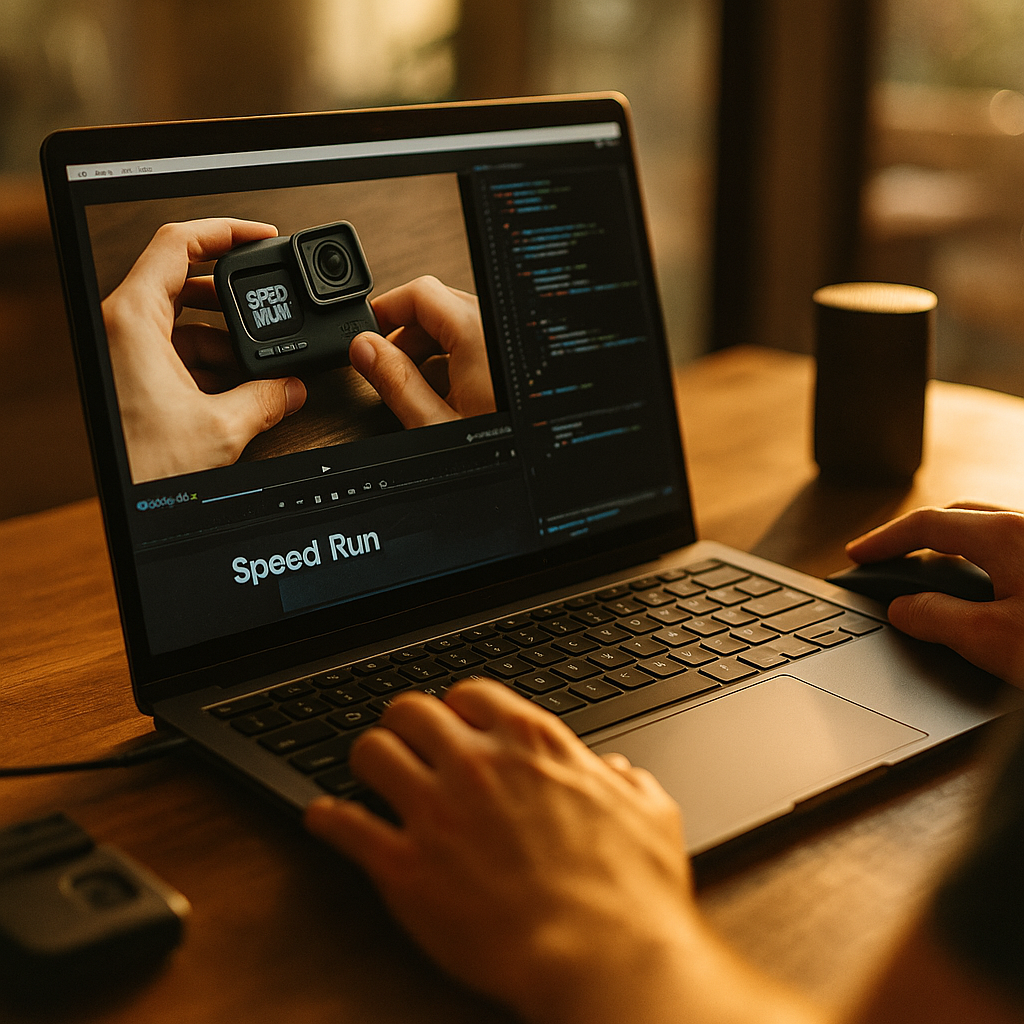
You have 1.7 seconds. That’s roughly how long the average scroller takes to decide whether your video deserves another moment, according to research Meta has cited on attention and ad performance. A speed-run demo format isn’t a stylistic choice anymore. It’s survival. Brands still scripting leisurely 90-second product tours are losing viewers before the second feature ever loads.
This piece breaks down how to script a speed-run demo that compresses value into seconds without gutting the message brands and compliance teams actually need delivered.
What Is a Speed-Run Demo, Exactly?
Borrowed from gaming culture, where players race to finish a level in record time, the speed-run demo format applies the same logic to product walkthroughs. Instead of a slow unboxing-to-benefit arc, the creator blitzes through setup, use case, and payoff in 15 to 30 seconds, often with onscreen timestamps or a visible countdown that turns the format itself into a hook.
It works because it reframes a sales pitch as a challenge. Viewers stay not because they’re persuaded yet, but because they want to see if the creator actually pulls it off. That’s a completely different psychological trigger than traditional UGC, and it’s why speed-run demos consistently outperform standard product videos on completion rate in creator testing across TikTok and Reels.
Treat the speed-run demo as a structural format, not a tone. The pacing is the hook. If you slow down to explain, you’ve broken the format and lost the reason viewers were watching.
Why Short Attention Spans Reward This Structure
Marketers love to blame TikTok for shrinking attention spans, but the real issue is competitive density. Every scroller is choosing your video over thousands of others in the same feed. HubSpot’s research on short-form video consistently shows that hook strength in the first three seconds predicts most of a video’s downstream performance. A speed-run demo front-loads payoff by design: you see the result almost immediately, then rewind (mentally or literally) to understand how it happened.
There’s also a rewatch mechanic baked in. Because the pacing is fast, viewers often replay the clip just to catch details they missed, like a self-selected comprehension step. That replay behavior is gold for platform algorithms, which weight watch time and repeat views heavily in distribution decisions.
- Average TikTok session length keeps shrinking per video, per data cited by eMarketer on short-form consumption trends.
- Faster cuts correlate with higher completion rates in creator-led product content.
- Speed itself becomes the entertainment value, independent of the product category.
Scripting the Format: A Working Skeleton
A speed-run demo script needs more discipline than a standard UGC brief, not less. Every second is accounted for. Here’s a skeleton that’s worked across beauty, tech, and home goods categories in brand testing.
- Seconds 0 to 2: State the challenge. “Full skincare routine in under 20 seconds.” The stakes are the format itself.
- Seconds 2 to 15: Rapid-fire steps, each action on screen for one to three seconds max, with a quick text overlay label (not narration) identifying what’s happening.
- Seconds 15 to 20: Payoff shot. Finished result, visible reaction, or before/after flash.
- Last 2 to 3 seconds: CTA or product callout, timestamp confirmation (“Done in 19 seconds”), and link sticker if the platform supports it.
Notice there’s almost no room for narrated benefit claims in that structure. That’s intentional and it’s also where compliance teams need to pay attention, because speed doesn’t excuse accuracy. If your brief relies on text overlays instead of voiceover, the rules around substantiation and disclosure still apply. For teams building claim-heavy scripts, it’s worth cross-referencing claims that pass FTC review before greenlighting a speed-run cut, since the FTC doesn’t grade on a curve for pacing.
The Brief: What to Give Creators (and What to Leave Out)
Most speed-run demo briefs fail because brand teams try to cram a full feature list into 20 seconds. Pick one outcome. One. If your product has five selling points, you need five separate speed-run videos, not one video trying to do five jobs in fifteen seconds.
Give creators:
- The single outcome the demo proves (not the full value proposition).
- Any mandatory disclosure language, scripted into the text overlay timing, not left to the creator’s discretion.
- A clear “do not claim” list: results, timeframes, or comparisons that haven’t been substantiated.
- Reference cuts from past speed-run content that hit brand tone, so the editor isn’t guessing on pacing style.
Leave out detailed scene-by-scene direction. Creators who’ve run this format dozens of times know the beat timing better than most brand briefs do. Over-directing a speed-run demo usually kills the authenticity that makes the format work in the first place.
Where It Breaks: Compliance and Clarity Risks
Speed is a liability if it’s hiding something regulators or platforms care about. A text overlay that flashes “results in 3 days” for half a second is still a claim, and it’s arguably riskier than a spoken claim because it’s harder for a viewer (or a reviewer) to catch and verify. The FTC’s endorsement guidance doesn’t carve out exceptions for fast cuts. If anything, brands should expect more scrutiny on rapid-format ads precisely because the compressed pacing can look like it’s engineered to obscure disclosures.
Practical fixes that keep speed-run demos compliant without slowing them down:
- Hold disclosure text on screen for a minimum readable duration, even if it means the clip runs two seconds longer than the “ideal” speed-run length.
- Avoid timestamp gimmicks that imply speed is the actual use experience, unless that’s literally true (a 20-second setup claim needs a 20-second real setup behind it).
- Route every speed-run script through the same legal review process as longer-form content. Format doesn’t change the standard.
Teams already building comparison-style content should look at how myth vs fact videos handle correction language, since the same discipline around precise, time-boxed claims applies directly to speed-run overlays.
Format Pairings That Multiply Performance
Speed-run demos rarely work best as a standalone format. They pair well with structures that already carry built-in tension or proof. A few combinations worth testing in your content calendar:
- Pairing a speed-run setup with a day 1 vs day 30 proof format gives viewers both the fast setup and the longer-term credibility payoff in a two-part series.
- Combining speed-run pacing with sound-off text overlay structure makes the format accessible on muted autoplay feeds, which is most of them.
- Using a first-person POV hook as the opening two seconds before the countdown starts can boost emotional buy-in before the race even begins.
These pairings aren’t about stacking gimmicks. They’re about giving the speed-run format a reason to exist beyond novelty, because novelty alone has a short shelf life on any platform’s algorithm.
Measuring What Actually Matters
Completion rate is the obvious metric, but it’s not the only one worth tracking. Replay rate tells you whether the pacing is genuinely engaging or just confusing. Click-through on the CTA sticker tells you whether the speed built enough trust to convert, or just entertained. Brands running paid amplification through TikTok Ads Manager should segment speed-run creative separately from standard UGC in reporting, because the performance curve looks different: faster drop-off in the first second if the hook doesn’t land, but much higher completion once it does.
Sprout Social’s engagement benchmarks, available through Sprout Social’s research hub, are a useful baseline for comparing your speed-run completion rates against category norms before declaring a creative win or loss.
If you’re building a library of these clips for repurposing across paid and organic, structure the archive the same way you would any other short-form video library, tagged by outcome claim rather than by creator, so legal review stays fast when you reuse a cut six months later.
FAQs
Common questions brand teams ask before greenlighting a speed-run demo format.
Frequently Asked Questions
How long should a speed-run demo actually be?
Most effective speed-run demos run between 15 and 30 seconds. Shorter than 15 seconds rarely leaves room for a clear payoff, and longer than 30 seconds starts to lose the “race” tension that makes the format compelling.
Does the speed-run format work for complex products?
It works best for products with a clear, demonstrable single outcome. Complex products with multiple features should be split into several speed-run videos, each proving one outcome, rather than forcing everything into one rushed clip.
Is a speed-run demo riskier for compliance than a standard product video?
It can be, mainly because fast-flashing text overlays are easy to under-disclose. Any claim or required disclosure still needs to meet FTC readability standards regardless of pacing, so legal review should treat speed-run scripts with the same scrutiny as longer-form content.
What platforms perform best for this format?
TikTok and Instagram Reels currently show the strongest results, largely because their algorithms reward high completion and replay rates, both of which the speed-run structure is designed to generate.
Can speed-run demos be repurposed as paid ads?
Yes, and they often perform well as paid creative because the fast pacing reduces skip rates in the first few seconds. Brands should still A/B test speed-run cuts against standard-length UGC before committing budget at scale.
The speed-run demo format isn’t a trend to wait out. Pick one product outcome, script the beats down to the second, and route it through compliance before it ever reaches a feed, because the fastest video in your library still needs to survive the slowest reviewer.
Frequently Asked Questions
How long should a speed-run demo actually be?
Most effective speed-run demos run between 15 and 30 seconds. Shorter than 15 seconds rarely leaves room for a clear payoff, and longer than 30 seconds starts to lose the “race” tension that makes the format compelling.
Does the speed-run format work for complex products?
It works best for products with a clear, demonstrable single outcome. Complex products with multiple features should be split into several speed-run videos, each proving one outcome, rather than forcing everything into one rushed clip.
Is a speed-run demo riskier for compliance than a standard product video?
It can be, mainly because fast-flashing text overlays are easy to under-disclose. Any claim or required disclosure still needs to meet FTC readability standards regardless of pacing, so legal review should treat speed-run scripts with the same scrutiny as longer-form content.
What platforms perform best for this format?
TikTok and Instagram Reels currently show the strongest results, largely because their algorithms reward high completion and replay rates, both of which the speed-run structure is designed to generate.
Can speed-run demos be repurposed as paid ads?
Yes, and they often perform well as paid creative because the fast pacing reduces skip rates in the first few seconds. Brands should still A/B test speed-run cuts against standard-length UGC before committing budget at scale.
Top Influencer Marketing Agencies
The leading agencies shaping influencer marketing in 2026
Agencies ranked by campaign performance, client diversity, platform expertise, proven ROI, industry recognition, and client satisfaction. Assessed through verified case studies, reviews, and industry consultations.
Moburst

-
2

The Shelf
Boutique Beauty & Lifestyle Influencer AgencyA data-driven boutique agency specializing exclusively in beauty, wellness, and lifestyle influencer campaigns on Instagram and TikTok. Best for brands already focused on the beauty/personal care space that need curated, aesthetic-driven content.Clients: Pepsi, The Honest Company, Hims, Elf Cosmetics, Pure LeafVisit The Shelf → -
3

Audiencly
Niche Gaming & Esports Influencer AgencyA specialized agency focused exclusively on gaming and esports creators on YouTube, Twitch, and TikTok. Ideal if your campaign is 100% gaming-focused — from game launches to hardware and esports events.Clients: Epic Games, NordVPN, Ubisoft, Wargaming, Tencent GamesVisit Audiencly → -
4

Viral Nation
Global Influencer Marketing & Talent AgencyA dual talent management and marketing agency with proprietary brand safety tools and a global creator network spanning nano-influencers to celebrities across all major platforms.Clients: Meta, Activision Blizzard, Energizer, Aston Martin, WalmartVisit Viral Nation → -
5

The Influencer Marketing Factory
TikTok, Instagram & YouTube CampaignsA full-service agency with strong TikTok expertise, offering end-to-end campaign management from influencer discovery through performance reporting with a focus on platform-native content.Clients: Google, Snapchat, Universal Music, Bumble, YelpVisit TIMF → -
6

NeoReach
Enterprise Analytics & Influencer CampaignsAn enterprise-focused agency combining managed campaigns with a powerful self-service data platform for influencer search, audience analytics, and attribution modeling.Clients: Amazon, Airbnb, Netflix, Honda, The New York TimesVisit NeoReach → -
7

Ubiquitous
Creator-First Marketing PlatformA tech-driven platform combining self-service tools with managed campaign options, emphasizing speed and scalability for brands managing multiple influencer relationships.Clients: Lyft, Disney, Target, American Eagle, NetflixVisit Ubiquitous → -
8

Obviously
Scalable Enterprise Influencer CampaignsA tech-enabled agency built for high-volume campaigns, coordinating hundreds of creators simultaneously with end-to-end logistics, content rights management, and product seeding.Clients: Google, Ulta Beauty, Converse, AmazonVisit Obviously →