


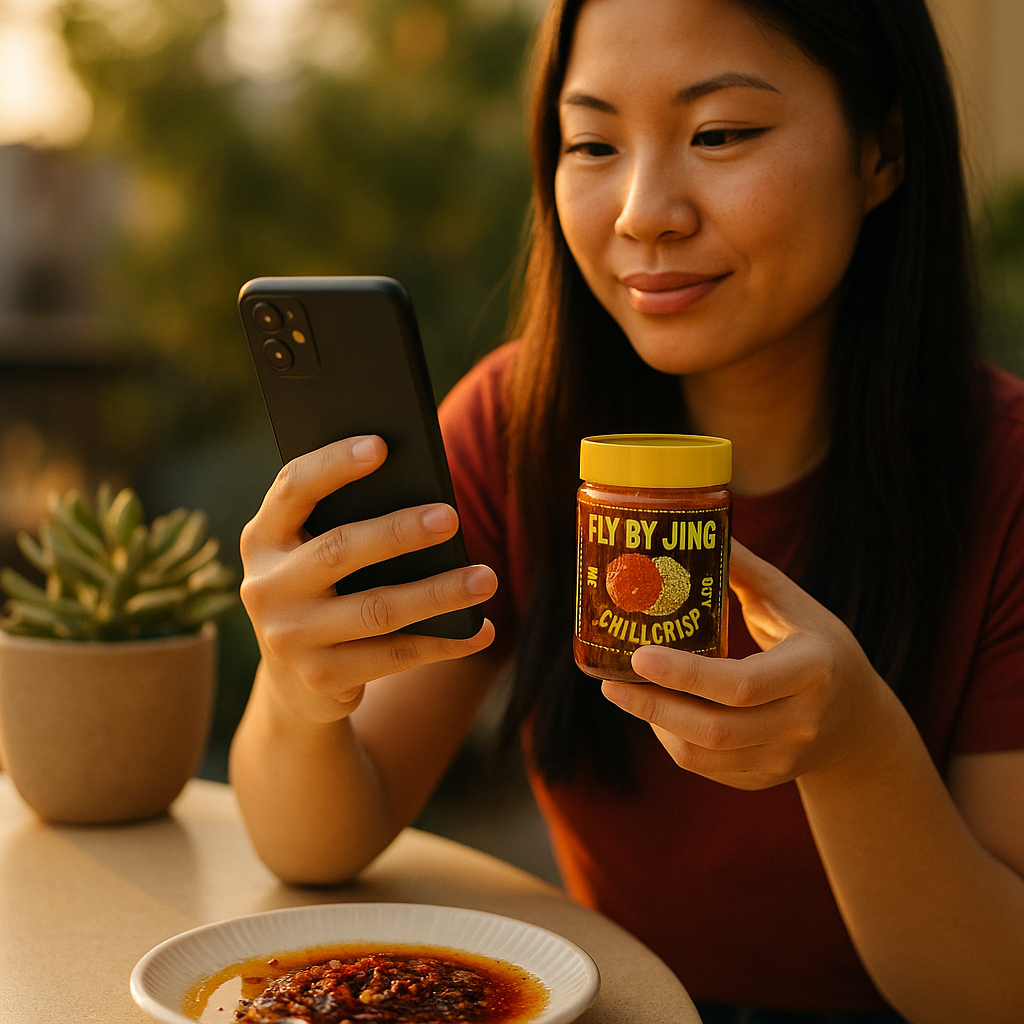
One SKU. Zero paid media at launch. A wait-list of 12,000 people before the first jar shipped. Fly By Jing didn’t buy its way into pantries across the country — it got tasted its way in. For any brand strategist tired of watching ad costs climb while engagement flatlines, the Fly By Jing chili crisp playbook is worth studying line by line.
This is a story about restraint. About picking the right hundred mouths before chasing the next million impressions.
The Problem With Launching a Condiment Nobody’s Heard Of
Condiments are a brutal category to break into. Shelf space is crowded, margins are thin, and consumer habits are sticky — people buy the hot sauce their mom bought. Jing Gao, founder of Fly By Jing, wasn’t trying to compete with Sriracha on price or distribution. She was trying to introduce an entirely new flavor category to American palates: mala, the numbing-spicy profile central to Sichuan cuisine.
You can’t advertise your way into explaining a taste. Words like “umami-forward” or “complex heat” mean nothing until someone’s tongue actually experiences it. That’s the core insight that shaped the entire go-to-market strategy: this product needed to be tasted, not told.
Fly By Jing didn’t market a condiment. It engineered thousands of first-taste reactions, then let the internet document the surprise for free.
Seeding the Taste, Not the Hashtag
Instead of running a traditional influencer campaign with scripted deliverables, Fly By Jing’s early growth team — reportedly working with a lean budget compared to VC-backed CPG competitors — built a seeding program around a simple mechanic: send the jar, film the reaction, let the spice do the talking.
The creators weren’t mega-influencers. Early seeding lists leaned heavily on food-focused nano and micro creators: home cooks, chefs’ assistants, food photographers with 3,000 to 40,000 followers who actually cooked at home and had audiences who trusted their palates. This mirrors a pattern seen across other breakout CPG brands — Chomps built an entire meat stick category the same way, prioritizing believable reactions over reach.
Why does this matter for brand strategists evaluating seeding budgets today? Because reaction authenticity is the actual product being distributed. A face genuinely reacting to unexpected heat, on camera, unscripted, does more conversion work than a paid ad ever could. It’s the taste-test equivalent of unboxing videos, except the “box” is someone’s tolerance for chili oil.
What the Content Actually Looked Like
Most seeded videos followed a loose, repeatable format:
- Close-up of the jar, often highlighting the crispy fried shallots and garlic suspended in oil
- A spoon-straight-from-the-jar taste test, no context, no recipe
- A visible reaction — eyes widening, a pause, a “wait, what is this?”
- A follow-up shot of it being poured over eggs, noodles, or dumplings
This format traveled well across TikTok and Instagram Reels because it required zero production budget and zero scripting. Creators didn’t need brand guidelines. They needed a spoon.
Why Nano-Creators Outperformed Celebrity Chefs Here
Fly By Jing did eventually get attention from bigger names and press features, but the foundational layer of trust was built bottom-up. Nano and micro creators weren’t chosen because they were cheap (though they were). They were chosen because their audiences believed them when they said something tasted incredible.
This is the same logic behind Olipop’s creator whitelisting strategy and Poppi’s micro-creator trust rebuild — both brands understood that in food and beverage, credibility scales faster through niche trust than broad reach. A celebrity chef endorsing a chili crisp reads as paid placement. A home cook discovering it in their own kitchen reads as real.
The data backs this instinct. According to eMarketer, smaller creators consistently post higher engagement rates than mega-influencers across most verticals, and food content in particular rewards specificity over polish. Nobody wants a studio-lit ad for chili crisp. They want to see if their favorite home cook actually likes it.
The Compounding Effect: One Jar Becomes a Platform
Here’s where the case study gets interesting for anyone building a long-term brand, not just a launch spike. Fly By Jing didn’t stop at Sichuan Chili Crisp. Once the flagship SKU built a loyal, vocal base, the brand expanded into a full pantry line: Zhong Sauce, Sichuan Gold, hot pot bases, and seasoning blends.
Each new SKU launch reused the same seeding infrastructure. Creators who’d built content around the original chili crisp were re-seeded with new products, creating a compounding content library that made Fly By Jing look — and feel — like a full lifestyle brand rather than a single-product novelty. This ladder approach echoes what Vuori did moving from niche to mainstream, expanding the creator tier as the product catalog widened.
The real ROI of taste-test seeding wasn’t the first spike in sales — it was owning a repeatable content engine that scaled with every new SKU.
Retail Momentum Followed the Content, Not the Other Way Around
By the time Fly By Jing pursued retail partnerships with Whole Foods, Target, and eventually broader grocery distribution, the brand had something most emerging CPG products don’t: pre-existing demand signals. Buyers could see search volume, sold-out drops, and a wall of organic user-generated content proving the product already had traction.
This sequencing — content first, retail second — is increasingly the norm for challenger brands. Feastables won shelf space the same way, and Chomps did too, using creator waves instead of retail media spend to prove demand before a single case hit a shelf. Retail buyers aren’t just betting on flavor anymore. They’re betting on whether a brand already has an audience willing to walk into a store looking for it.
Numbers That Matter to Marketing Leads
While Fly By Jing hasn’t published a granular breakdown of seeding spend versus revenue, the directional pattern is consistent with broader industry data. HubSpot’s marketing research has repeatedly shown that user-generated and creator-driven content outperforms branded content on trust metrics, and Statista data on the creator economy shows nano and micro creator partnerships remain the fastest-growing segment of influencer spend, precisely because of cost efficiency relative to output.
For a brand strategist building a business case internally, the takeaway isn’t “spend less.” It’s “spend earlier, on smaller, more trusted voices, before you spend on reach.” Seeding is cheap relative to paid media. The expensive mistake is skipping it and going straight to scaled advertising for a product nobody’s tried yet.
Where This Strategy Breaks Down (And What to Watch For)
Taste-test seeding isn’t a universal fix. It works exceptionally well for products with an immediate, visceral sensory hook — heat, crunch, surprise. It’s harder to replicate for products where the value proposition is slow-building or abstract, like a subscription service or a durability claim you can’t demonstrate in fifteen seconds.
There’s also a compliance dimension brand teams shouldn’t skip. Even unpaid product seeding can trigger disclosure obligations depending on the relationship and expectation of future content. The FTC’s endorsement guidelines apply regardless of whether a creator was paid in cash or product, and brands running seeding programs at scale need clear onboarding language so creators know when and how to disclose. This is the kind of operational detail that separates a defensible influencer program from a legal headache six months later.
Brands should also resist the urge to over-brief nano creators once the format proves itself. The temptation, once a brand sees what’s working, is to lock creators into scripts and brand guidelines. That’s usually the moment engagement drops. The entire value of this model is the unscripted reaction — protect that, even as the program scales.
What Other Brands Can Actually Copy
- Start small and sensory. If your product has an immediate physical reaction — taste, texture, sound — build your seeding program around capturing that moment, not explaining the brand story.
- Prioritize trust over reach. A creator with 8,000 followers who genuinely cooks at home will convert better than a celebrity reading a script.
- Reuse the infrastructure. Once you’ve built a seeding list and workflow, every new SKU launch gets cheaper and faster.
- Let retail follow content, not lead it. Walk into buyer meetings with proof of organic demand, not just a pitch deck.
- Build disclosure into onboarding. Don’t wait until a regulator or platform flags it — bake FTC-compliant language into your seeding kit from day one.
The Fly By Jing story isn’t really about chili crisp. It’s about understanding that some products sell themselves the moment someone tries them — the marketing job is just getting the spoon into the right hands first.
Frequently Asked Questions
What made Fly By Jing’s creator seeding strategy different from typical influencer marketing?
Instead of scripted brand deliverables, Fly By Jing prioritized unscripted taste-test reactions from nano and micro food creators, letting genuine surprise at the flavor drive organic sharing rather than paid promotion.
Why did Fly By Jing choose smaller creators over celebrity chefs or major influencers?
Smaller creators typically have higher engagement rates and more trusted relationships with their audiences, especially in food content where authenticity matters more than production polish or follower count.
Does unpaid product seeding still require FTC disclosure?
Yes. The FTC’s endorsement guidelines apply to any material connection between a brand and a creator, including free products, regardless of whether cash payment changed hands.
Can this taste-test seeding model work for non-food products?
It works best for products with an immediate sensory or visual hook. Products with slower or more abstract value propositions typically need a different content approach beyond a single reaction moment.
How does creator seeding help with retail distribution?
Organic content and demand signals give brands leverage in retail buyer conversations, proving consumer interest exists before committing shelf space, which reduces risk for both the brand and the retailer.
Frequently Asked Questions
What made Fly By Jing’s creator seeding strategy different from typical influencer marketing?
Instead of scripted brand deliverables, Fly By Jing prioritized unscripted taste-test reactions from nano and micro food creators, letting genuine surprise at the flavor drive organic sharing rather than paid promotion.
Why did Fly By Jing choose smaller creators over celebrity chefs or major influencers?
Smaller creators typically have higher engagement rates and more trusted relationships with their audiences, especially in food content where authenticity matters more than production polish or follower count.
Does unpaid product seeding still require FTC disclosure?
Yes. The FTC’s endorsement guidelines apply to any material connection between a brand and a creator, including free products, regardless of whether cash payment changed hands.
Can this taste-test seeding model work for non-food products?
It works best for products with an immediate sensory or visual hook. Products with slower or more abstract value propositions typically need a different content approach beyond a single reaction moment.
How does creator seeding help with retail distribution?
Organic content and demand signals give brands leverage in retail buyer conversations, proving consumer interest exists before committing shelf space, which reduces risk for both the brand and the retailer.
Top Influencer Marketing Agencies
The leading agencies shaping influencer marketing in 2026
Agencies ranked by campaign performance, client diversity, platform expertise, proven ROI, industry recognition, and client satisfaction. Assessed through verified case studies, reviews, and industry consultations.
Moburst

-
2

The Shelf
Boutique Beauty & Lifestyle Influencer AgencyA data-driven boutique agency specializing exclusively in beauty, wellness, and lifestyle influencer campaigns on Instagram and TikTok. Best for brands already focused on the beauty/personal care space that need curated, aesthetic-driven content.Clients: Pepsi, The Honest Company, Hims, Elf Cosmetics, Pure LeafVisit The Shelf → -
3

Audiencly
Niche Gaming & Esports Influencer AgencyA specialized agency focused exclusively on gaming and esports creators on YouTube, Twitch, and TikTok. Ideal if your campaign is 100% gaming-focused — from game launches to hardware and esports events.Clients: Epic Games, NordVPN, Ubisoft, Wargaming, Tencent GamesVisit Audiencly → -
4

Viral Nation
Global Influencer Marketing & Talent AgencyA dual talent management and marketing agency with proprietary brand safety tools and a global creator network spanning nano-influencers to celebrities across all major platforms.Clients: Meta, Activision Blizzard, Energizer, Aston Martin, WalmartVisit Viral Nation → -
5

The Influencer Marketing Factory
TikTok, Instagram & YouTube CampaignsA full-service agency with strong TikTok expertise, offering end-to-end campaign management from influencer discovery through performance reporting with a focus on platform-native content.Clients: Google, Snapchat, Universal Music, Bumble, YelpVisit TIMF → -
6

NeoReach
Enterprise Analytics & Influencer CampaignsAn enterprise-focused agency combining managed campaigns with a powerful self-service data platform for influencer search, audience analytics, and attribution modeling.Clients: Amazon, Airbnb, Netflix, Honda, The New York TimesVisit NeoReach → -
7

Ubiquitous
Creator-First Marketing PlatformA tech-driven platform combining self-service tools with managed campaign options, emphasizing speed and scalability for brands managing multiple influencer relationships.Clients: Lyft, Disney, Target, American Eagle, NetflixVisit Ubiquitous → -
8

Obviously
Scalable Enterprise Influencer CampaignsA tech-enabled agency built for high-volume campaigns, coordinating hundreds of creators simultaneously with end-to-end logistics, content rights management, and product seeding.Clients: Google, Ulta Beauty, Converse, AmazonVisit Obviously →