


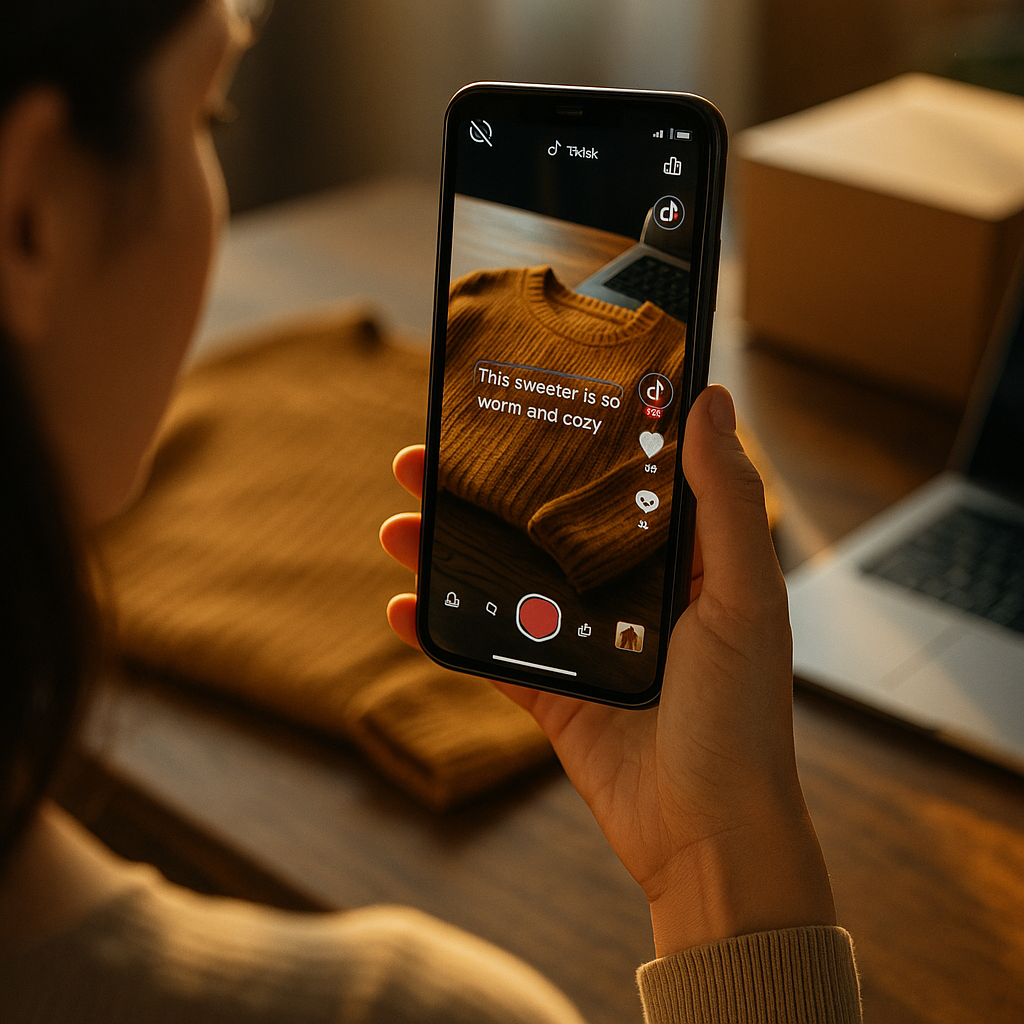
TikTok Shop videos with zero spoken dialogue are pulling completion rates that scripted talking-head content can’t touch. No hook line. No voiceover. Just footage, captions, and sound design doing the selling. The silent vlog format has quietly become one of the most reliable performance patterns on the platform, and most brands still haven’t noticed.
The Numbers Behind the Silence
TikTok’s own guidance has said for years that a huge share of video is watched with the sound off, particularly in feed environments where people scroll during commutes, meetings, or late-night bed rot sessions. That behavior hasn’t changed. What’s changed is that creators have stopped fighting it and started designing for it.
Silent vlogs strip out narration entirely. Think: a creator quietly making an iced matcha, applying a skincare routine, or unboxing a Shein haul with nothing but ambient sound, on-screen text, and maybe a trending audio bed underneath. No “hey guys” intro. No CTA read aloud. Just observation.
Creators running silent vlog formats on TikTok Shop are reporting completion rates 20 to 40 percent higher than matched talking-head videos in the same niche, largely because there’s no verbal hook to skip past.
That stat lines up with what platform researchers and marketers have been tracking for a while: attention spans on short-form video reward content that removes friction, and a spoken intro is friction. Every second before the product appears is a second closer to a swipe-away. Silence, paradoxically, gets people to stay.
Why This Works for Shoppable Content Specifically
TikTok Shop is a commerce environment first, entertainment second. Viewers browsing the Shop tab or shoppable For You feed are already primed to evaluate products, not chase personality. Silent vlogs fit that mindset better than a creator monologuing about their skincare journey for fifteen seconds before showing the bottle.
- Faster payoff: the product appears almost immediately because there’s no verbal setup to sit through.
- Lower production friction: no scripting, no retakes for flubbed lines, no voice direction. Just b-roll and captions.
- Higher rewatch value: ambient, ASMR-adjacent content gets replayed the way music does, which nudges the algorithm.
- Cross-market scalability: a video with no spoken language travels across regions without a dub or translation pass.
That last point matters more than most brands realize. A silent vlog shot for a US audience needs zero localization to run in the UK, Australia, or the Philippines. Compare that to a scripted voiceover ad, which needs full AI dubbing at scale to travel internationally without sounding robotic or off-brand.
What a Silent Vlog Brief Actually Looks Like
Briefing a creator for a no-talking video isn’t the absence of direction, it’s a different kind of direction. You’re not writing dialogue. You’re mapping moments.
A solid brief for this format usually covers:
- The sequence of visual beats (open package, hold product to light, apply/use, close on result).
- What text overlays need to appear and when, since captions now carry the narrative weight a script used to carry.
- Ambient sound direction: trending audio, ASMR-style foley, or genuinely silent room tone.
- Pacing cues, because silent content lives or dies on cut rhythm rather than vocal delivery.
This is where text overlay strategy becomes the real creative lever. If nobody’s talking, your captions are doing the persuasion work. Brands that treat overlay copy as an afterthought lose the format’s biggest advantage. For a deeper breakdown on caption timing and muted-feed subtitle rules, our piece on silent-first editing covers the mechanics brand teams need before briefing creators.
Not Just a TikTok Trend, a Behavior Shift
It’s tempting to file this under “TikTok quirk,” but the sound-off behavior isn’t unique to one platform. Meta has published similar guidance for years around designing for muted autoplay on Reels and Feed, and Meta’s business resources still recommend captioning every video as a baseline. YouTube Shorts audiences behave the same way. The silent vlog format is really just TikTok Shop’s commerce-native expression of a much bigger shift in how people consume video, which is: quietly, passively, and with the volume down by default.
That shift has implications beyond creative briefs. It changes measurement, too. Watch time and completion rate become more meaningful signals than they used to be, because they’re less contaminated by “I heard something interesting and looked up” behavior. Silence is a cleaner attention signal. eMarketer’s short-form video research has consistently flagged completion rate as one of the stronger predictors of downstream conversion on shoppable video platforms, which is exactly why this format deserves budget, not just curiosity.
Where It Fits Alongside Other Sound Off Formats
Silent vlogs sit in a broader family of no-dialogue content that’s been gaining traction across TikTok Shop and beyond. ASMR unboxings, static photo carousels, and text-to-speech voiceovers all solve the same underlying problem: how do you sell without asking someone to turn their volume up in public?
If you’re building a content calendar around this insight, it’s worth testing multiple formats against each other rather than betting everything on one. Our guide to ASMR unboxing briefs shows how sound cues without speech can extend watch time even further, and the static photo UGC approach proves you don’t even need motion to convert, just the right sequencing of stills and captions.
There’s also a trust dimension worth noting. Silent vlogs, done well, read as more authentic than scripted talking-head ads precisely because nobody’s performing enthusiasm. It’s closer in spirit to the low-pressure honesty behind founder video diaries, just without the founder on camera at all.
The Risk Nobody Talks About
Silence isn’t a shortcut around compliance. If a silent vlog implies a product benefit visually (a supplement making skin glow, a device curing a symptom), the FTC’s endorsement guidance still applies even without a spoken claim. Text overlays and visual implication count as claims. Brand and legal teams reviewing these assets should treat on-screen captions with the same scrutiny as a script, because regulators do. The FTC’s endorsement guidelines don’t carve out an exception for videos where nobody talks.
There’s also a discoverability trade-off. TikTok Shop’s search and recommendation systems still lean on spoken audio for some content categorization, alongside captions and hashtags. A completely silent video with no on-screen text is harder for the algorithm to understand and harder for search to surface. The format works best when “silent” means no dialogue, not no information. Captions still need to carry keywords, product names, and use-case context.
Getting Started Without Overhauling Your Whole Pipeline
You don’t need to abandon talking-head UGC to test this. Run a controlled comparison: same product, same creator if possible, one version scripted and one version silent with strong captions. Compare completion rate, watch time, and click-through over a two-week window. Most brands that run this test are surprised by how quickly the silent version pulls ahead, especially in categories like beauty, home, and food where visual demonstration already does most of the persuading.
Platforms like TikTok’s ad platform make it straightforward to split-test creative variants against the same audience segment, which is the cleanest way to validate this before committing a bigger production budget. For broader context on how muted consumption habits are reshaping paid creative more generally, HubSpot’s marketing research and Sprout Social’s platform data both track completion rate trends worth benchmarking against.
FAQs
Ready to test it? Brief one creator for a silent vlog version of your next TikTok Shop asset, keep the captions sharp, and run it head-to-head against your current talking-head content for two weeks before deciding where the next quarter’s budget goes.
Frequently Asked Questions
What exactly is a silent vlog on TikTok Shop?
A silent vlog is a video with no spoken dialogue or voiceover. Instead, it relies on ambient sound, trending audio, and on-screen text captions to communicate the product story, replacing the scripted talking-head format common in earlier UGC briefs.
Why does this format perform better than talking-head videos?
It removes the verbal hook that viewers often skip past, gets to the product faster, and aligns with the fact that a large share of TikTok viewing happens with the sound off. It also travels across markets without needing translation or dubbing.
Does a silent vlog still need captions?
Yes. Captions carry the narrative and persuasion work that dialogue used to handle. Skipping text overlays makes the video harder for viewers to follow and harder for TikTok’s discovery systems to categorize.
Is a silent vlog exempt from FTC endorsement rules?
No. Visual claims and on-screen text are still subject to the same endorsement and substantiation requirements as spoken claims. Brands should review captions and implied benefits with the same rigor as a scripted ad.
Which product categories benefit most from this format?
Beauty, food and beverage, home goods, and skincare tend to perform especially well, since these categories rely on visual demonstration anyway. Products that require verbal explanation of complex benefits may still need some spoken or captioned context.
How do I test whether silent vlogs will work for my brand?
Run a matched comparison: the same product with a scripted talking-head version and a silent captioned version, shown to a similar audience segment for two weeks. Compare completion rate, watch time, and click-through before shifting budget.
Top Influencer Marketing Agencies
The leading agencies shaping influencer marketing in 2026
Agencies ranked by campaign performance, client diversity, platform expertise, proven ROI, industry recognition, and client satisfaction. Assessed through verified case studies, reviews, and industry consultations.
Moburst

-
2

The Shelf
Boutique Beauty & Lifestyle Influencer AgencyA data-driven boutique agency specializing exclusively in beauty, wellness, and lifestyle influencer campaigns on Instagram and TikTok. Best for brands already focused on the beauty/personal care space that need curated, aesthetic-driven content.Clients: Pepsi, The Honest Company, Hims, Elf Cosmetics, Pure LeafVisit The Shelf → -
3

Audiencly
Niche Gaming & Esports Influencer AgencyA specialized agency focused exclusively on gaming and esports creators on YouTube, Twitch, and TikTok. Ideal if your campaign is 100% gaming-focused — from game launches to hardware and esports events.Clients: Epic Games, NordVPN, Ubisoft, Wargaming, Tencent GamesVisit Audiencly → -
4

Viral Nation
Global Influencer Marketing & Talent AgencyA dual talent management and marketing agency with proprietary brand safety tools and a global creator network spanning nano-influencers to celebrities across all major platforms.Clients: Meta, Activision Blizzard, Energizer, Aston Martin, WalmartVisit Viral Nation → -
5

The Influencer Marketing Factory
TikTok, Instagram & YouTube CampaignsA full-service agency with strong TikTok expertise, offering end-to-end campaign management from influencer discovery through performance reporting with a focus on platform-native content.Clients: Google, Snapchat, Universal Music, Bumble, YelpVisit TIMF → -
6

NeoReach
Enterprise Analytics & Influencer CampaignsAn enterprise-focused agency combining managed campaigns with a powerful self-service data platform for influencer search, audience analytics, and attribution modeling.Clients: Amazon, Airbnb, Netflix, Honda, The New York TimesVisit NeoReach → -
7

Ubiquitous
Creator-First Marketing PlatformA tech-driven platform combining self-service tools with managed campaign options, emphasizing speed and scalability for brands managing multiple influencer relationships.Clients: Lyft, Disney, Target, American Eagle, NetflixVisit Ubiquitous → -
8

Obviously
Scalable Enterprise Influencer CampaignsA tech-enabled agency built for high-volume campaigns, coordinating hundreds of creators simultaneously with end-to-end logistics, content rights management, and product seeding.Clients: Google, Ulta Beauty, Converse, AmazonVisit Obviously →