


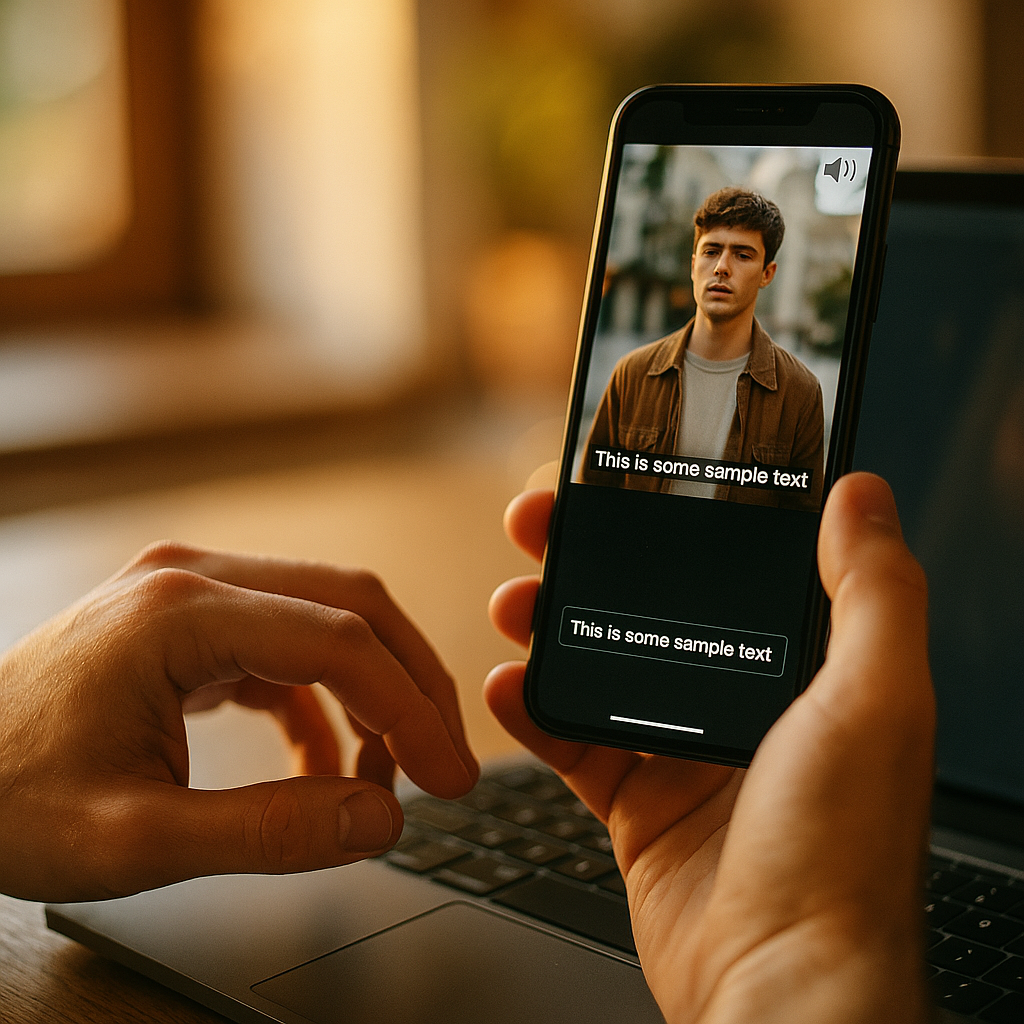
Eighty-five percent of Facebook video views happen with the sound off, and Meta’s own data has long shown similar muted-default behavior across Instagram and LinkedIn feeds. If your subtitles are an afterthought, bolted on after the edit is locked, you’re editing for a viewer who doesn’t exist. Silent first editing flips the process: captions aren’t decoration, they’re the primary storytelling layer, and the visual cut serves them.
This matters more in 2026 than it did even two years ago. Feed algorithms increasingly reward completion rate and dwell time before they reward sound-on engagement, which means the first two seconds of muted playback decide whether your creator content survives the scroll or dies in it.
Why Muted Autoplay Broke the Old Editing Playbook
Traditional video editing assumes an engaged, sound-on viewer. Pacing, music cues, voiceover timing, all of it was built around audio as the emotional driver. Autoplay feeds on TikTok, Instagram Reels, and LinkedIn video destroyed that assumption. Viewers now decide whether to unmute (or even keep watching) based purely on visual and text signals in the first beat of the clip.
That’s a fundamentally different creative brief. You’re not editing a video with captions added. You’re designing a silent film with an optional audio track. The subtitle isn’t support material, it’s the script.
If your hook only works with sound on, you don’t have a hook. You have a dependency.
The Core Subtitle Design Rules
Here’s where most brand teams get tripped up: they treat captions as a compliance checkbox rather than a design discipline. Silent first editing requires rules, not vibes.
- Front-load meaning in the first three words. Feed users scan, they don’t read. If the sentence’s payoff lands at word twelve, you’ve already lost the muted scroller.
- One idea per caption card, never two. Cramming a full sentence with a subordinate clause onto one screen forces the eye to work. Split it.
- Sync text to the cut, not the sentence. Captions should land on the beat of a visual change, a product reveal, a facial reaction. This is the single biggest difference between amateur auto-caption exports and a genuinely edited silent-first cut.
- Keep line count to two, max three. Anything longer and you’ve built a slide deck, not a video.
- Use contrast, not just size. A white caption on a bright product shot disappears. Bold outlines or a semi-opaque background bar solve this without shrinking the text.
- Reserve color and motion for emphasis, not decoration. If every word pops and bounces, nothing does.
Platforms differ here too. TikTok’s native caption sticker behaves differently from an Instagram Reels burned-in caption, and LinkedIn video players crop safe zones tighter than either. Test your subtitle placement against each platform’s actual player chrome, not a blank export canvas, or you’ll ship captions that get clipped by the UI.
Placement Zones Nobody Checks Until It’s Too Late
Every major feed reserves screen real estate for its own interface: like buttons, usernames, sound icons, the “follow” prompt. Subtitles placed in the lower third routinely collide with this chrome on mobile. The fix is boring but effective: build a safe zone template for each platform and lock your subtitle position inside it before you touch color grading or motion graphics. Agencies running high volume creator programs increasingly bake this into their production brief so editors aren’t guessing per asset.
Pacing: The Silent Edit Runs on a Different Clock
Sound-on video can breathe. A three-second beat of ambient audio still feels intentional. Silent video has no such luxury. Every static caption card that lingers too long reads as dead air, and dead air is exactly when a muted scroller swipes away.
Practical benchmark: most high-performing silent-first cuts change either the caption or the visual (ideally both) every 1.2 to 1.8 seconds during the hook window. That’s tighter than typical talking-head pacing, and it’s why editors trained on long-form or sound-driven formats often struggle with the transition. This is the same tension we’ve covered in silent vlogging formats, where creators who master the sound-off pace consistently post higher completion rates than peers relying on voiceover-driven storytelling.
Compare that to Connected TV creative, where the opposite problem shows up: mobile-paced cuts feel frantic on a living room screen. If your team is repurposing across both environments, it’s worth reviewing why mobile edits flop in the living room before assuming one master edit can serve every surface.
Auto-Captions Are a Starting Point, Not a Finished Product
Platform auto-caption tools have gotten genuinely good. TikTok’s and YouTube’s speech-to-text accuracy is high enough that brand teams often treat the output as “done.” That’s a mistake, and it’s costing engagement.
Auto-captions sync to speech timing, not to editorial intent. They break lines wherever the algorithm decides, ignore emphasis, and rarely account for brand terminology, product names, or the visual cut underneath them. A subtitle that breaks mid-brand-name or splits a call to action across two cards undermines exactly the clarity muted viewers need.
Auto-generated captions optimize for accuracy. Edited captions optimize for attention. Those are not the same job.
Brand compliance teams should also treat caption accuracy as a legal safeguard, not just a UX nicety. Misleading or garbled auto-captions on claims-heavy content (health, finance, performance claims) create real regulatory exposure. The FTC’s endorsement guidance applies to what’s on screen in text form just as much as spoken disclosure, and a mangled auto-caption isn’t a defense if a claim reads differently than intended.
Localization Adds Another Layer of Risk
Multi-market brands running the same creative across regions face a compounding problem: subtitle timing that works in English often breaks in languages with longer word counts or different reading directions. German and Finnish captions routinely run 20 to 30 percent longer than their English source, which blows through your two-line limit and forces awkward mid-word breaks.
Teams already working through this at scale have found success building subtitle timing flexibility into the source script itself, rather than retrofitting after translation. It’s the same lesson covered in script-once, publish-global workflows and in same day global rollout planning: design the caption cadence for your longest-word-count language, not your shortest.
Measuring Whether Your Captions Actually Work
Most brands measure video performance in aggregate: views, completion rate, engagement. Silent first editing demands a more granular diagnostic. Pull your retention curve and look specifically at the drop-off points in the first three seconds. A steep cliff at the exact moment your first caption card appears is a strong signal that the text failed to land the hook, independent of the visual.
A/B testing caption phrasing, not just visuals, is still underused by brand teams. Platforms like Sprout Social and native platform analytics dashboards make it straightforward to isolate creative variants; the discipline is in actually running the test rather than assuming the visual cut did the work. Recent industry benchmarking from eMarketer continues to show short-form video completion rates as one of the most volatile, format-sensitive metrics brands track, which makes this kind of granular testing worth the operational overhead.
If you’re running influencer content through a broader production system, subtitle QA should sit alongside brand safety review, not after it. The same rigor teams apply when reviewing AI avatar output at scale for trust risk applies to caption accuracy: it’s a quality gate, not an afterthought.
A Practical Checklist Before You Ship
- Watch the edit fully muted, on a phone, at arm’s length. If the story doesn’t land, the cut isn’t done.
- Confirm no caption sits behind platform UI chrome on at least two device sizes.
- Check that every caption card changes with, or just ahead of, a visual beat.
- Verify localized versions haven’t blown past your line-length rule.
- Run one A/B variant on caption phrasing before scaling budget behind the winner.
None of this replaces good storytelling. It just recognizes that, for most of your audience, the story arrives as text first and sound second, if at all.
Next step: audit your last five published assets muted, on mobile, with no sound. If you can’t follow the story without turning audio on, your editing process still isn’t built for the feed you’re actually publishing to.
FAQs
What is silent first editing?
Silent first editing is a video production approach where captions and visual pacing are designed as the primary storytelling layer, treating audio as optional rather than assumed, since most feed views happen muted.
How long should a subtitle stay on screen in a muted autoplay feed?
Most high-performing hooks change captions or visuals every 1.2 to 1.8 seconds during the opening beats. Beyond that, muted viewers read the pause as dead air and scroll away.
Are platform auto-captions good enough for brand content?
Auto-captions are accurate for transcription but not optimized for attention or brand clarity. They ignore emphasis, break lines poorly, and can mangle brand names or claims, which creates both engagement and compliance risk.
Where should subtitles be placed to avoid platform UI overlap?
Build a safe zone template for each platform (TikTok, Instagram Reels, LinkedIn video) before finalizing placement, since like buttons, usernames, and sound icons commonly sit in the lower third where captions default.
Does subtitle design change for localized or multi-market content?
Yes. Languages with longer average word counts can run 20 to 30 percent longer than English captions, so timing and line-length rules should be built around your longest-word-count market, not your source language.
Top Influencer Marketing Agencies
The leading agencies shaping influencer marketing in 2026
Agencies ranked by campaign performance, client diversity, platform expertise, proven ROI, industry recognition, and client satisfaction. Assessed through verified case studies, reviews, and industry consultations.
Moburst

-
2

The Shelf
Boutique Beauty & Lifestyle Influencer AgencyA data-driven boutique agency specializing exclusively in beauty, wellness, and lifestyle influencer campaigns on Instagram and TikTok. Best for brands already focused on the beauty/personal care space that need curated, aesthetic-driven content.Clients: Pepsi, The Honest Company, Hims, Elf Cosmetics, Pure LeafVisit The Shelf → -
3

Audiencly
Niche Gaming & Esports Influencer AgencyA specialized agency focused exclusively on gaming and esports creators on YouTube, Twitch, and TikTok. Ideal if your campaign is 100% gaming-focused — from game launches to hardware and esports events.Clients: Epic Games, NordVPN, Ubisoft, Wargaming, Tencent GamesVisit Audiencly → -
4

Viral Nation
Global Influencer Marketing & Talent AgencyA dual talent management and marketing agency with proprietary brand safety tools and a global creator network spanning nano-influencers to celebrities across all major platforms.Clients: Meta, Activision Blizzard, Energizer, Aston Martin, WalmartVisit Viral Nation → -
5

The Influencer Marketing Factory
TikTok, Instagram & YouTube CampaignsA full-service agency with strong TikTok expertise, offering end-to-end campaign management from influencer discovery through performance reporting with a focus on platform-native content.Clients: Google, Snapchat, Universal Music, Bumble, YelpVisit TIMF → -
6

NeoReach
Enterprise Analytics & Influencer CampaignsAn enterprise-focused agency combining managed campaigns with a powerful self-service data platform for influencer search, audience analytics, and attribution modeling.Clients: Amazon, Airbnb, Netflix, Honda, The New York TimesVisit NeoReach → -
7

Ubiquitous
Creator-First Marketing PlatformA tech-driven platform combining self-service tools with managed campaign options, emphasizing speed and scalability for brands managing multiple influencer relationships.Clients: Lyft, Disney, Target, American Eagle, NetflixVisit Ubiquitous → -
8

Obviously
Scalable Enterprise Influencer CampaignsA tech-enabled agency built for high-volume campaigns, coordinating hundreds of creators simultaneously with end-to-end logistics, content rights management, and product seeding.Clients: Google, Ulta Beauty, Converse, AmazonVisit Obviously →