


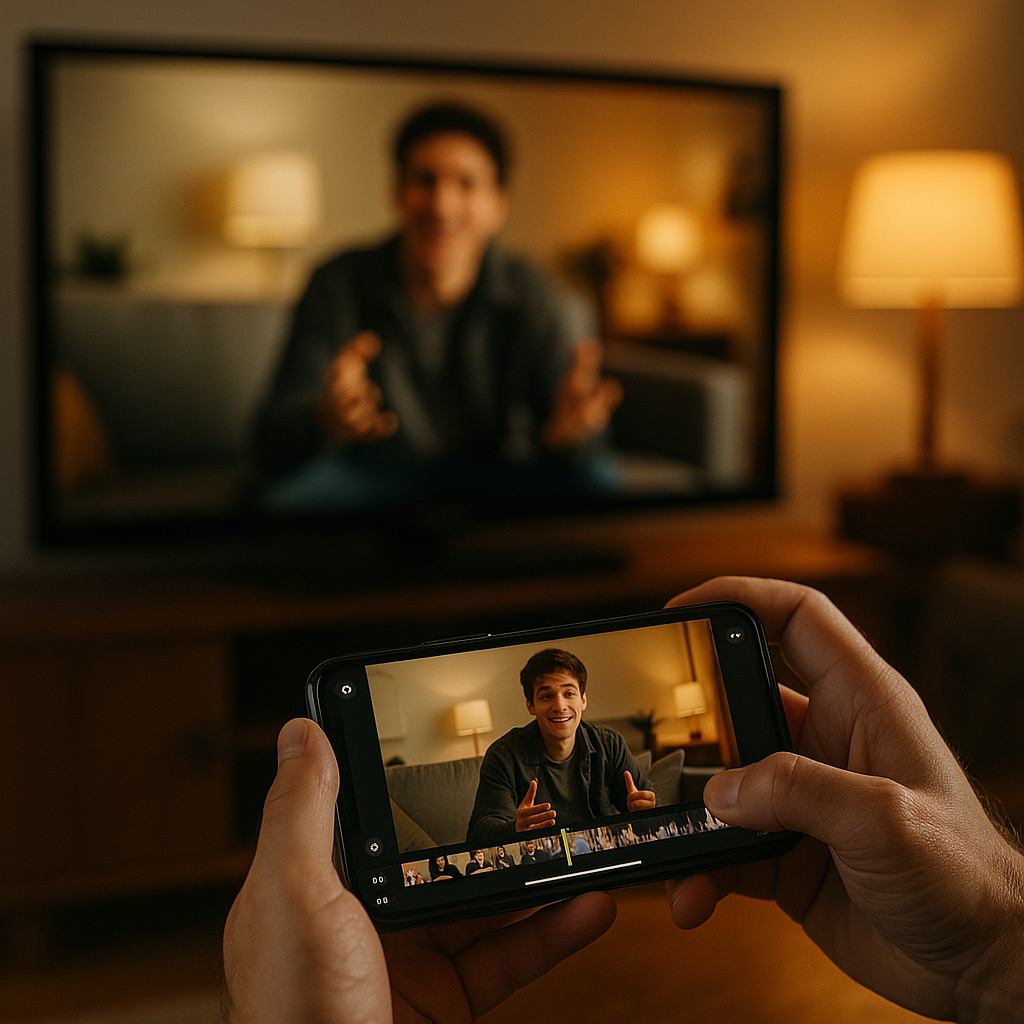
Ninety-six percent completion rate. That’s what connected TV ads routinely pull compared to the 15 to 30 percent scroll-away rate on mobile feeds. So why do so many brands still air a shrunk-down TikTok cut on the living room screen and wonder why it flops? Connected TV creator formats demand a different creative logic than the phone, and treating CTV like “mobile but bigger” is quietly wasting a growing share of video budgets.
The Living Room Is Not a Bigger Phone Screen
Vertical video was engineered for thumbs. CTV is engineered for a remote, a couch, and often a shared room full of distractions. That single shift changes everything: aspect ratio, pacing, sound design, and even the call to action. A nine-second hook that stops a scroll on Instagram feels frantic and jarring on a 65-inch television. Viewers aren’t fleeing after two seconds on CTV. They’re already committed to sitting through it, which means the old “hook or die” opening isn’t just unnecessary, it can actively undercut trust.
Brands that repurpose creator content without rethinking structure tend to see decent completion but weak recall. The ad plays, nobody skips, and nobody remembers it either. That’s the trap of format laziness.
CTV rewards patience in the opening seconds and urgency in the closing ones, which is nearly the inverse of what works in a mobile feed.
Where Short-Form Habits Actively Hurt You
- Text-heavy overlays: Captions built for sound-off scrolling become clutter on a screen viewers are already watching with full attention, often from ten feet away where small text is unreadable.
- Rapid jump cuts: Editing rhythms borrowed from Reels can feel chaotic and cheap when blown up to a living room display.
- QR-only CTAs: A code that works when someone’s phone is already in hand doesn’t work the same when the phone is across the room. Pairing it with a second-screen prompt matters more than the code itself, a nuance covered well in our breakdown of shoppable CTV spots.
Rebuilding the Creator Cut: A Practical Reformatting Checklist
You don’t need to reshoot everything. Most brands can salvage 60 to 80 percent of existing creator footage if they rebuild the edit around three variables: framing, pacing, and audio.
- Reframe for 16:9, not 9:16. Center the subject, widen the background, and stop treating negative space as wasted real estate. It’s breathing room, not a mistake.
- Slow the cut rate by roughly 30 to 40 percent. What feels sluggish on mobile often feels natural on a television, where viewers expect a slightly more cinematic tempo.
- Move the CTA earlier and repeat it. CTV audiences frequently pick up a second device mid-ad. If your offer only appears once at the end, you’ve lost anyone who glanced away, which is most of your audience at some point.
- Design for glanceable, not scrollable, text. Larger type, fewer words, more white space. Think billboard, not caption.
- Localize thoughtfully. CTV inventory increasingly spans regions and languages inside a single buy, and the same reformatting discipline applies to translated cuts, a challenge our guide to instant localization micro assets tackles directly.
Sound Design for a Room, Not Earbuds
Here’s a detail brands underestimate constantly: CTV audio plays through speakers shared by whoever’s in the room, not earbuds tuned to one listener. A whispery ASMR hook that performs beautifully on mobile can get lost entirely, or worse, get muted by someone reaching for the remote out of irritation. Dialogue needs to be mixed louder relative to music than you’d expect. Sound effects that felt subtle on a phone need more presence on a soundbar.
That said, don’t assume every CTV viewer has full audio attention either. Plenty of households run the TV as background noise while scrolling their own phones. That’s part of why formats built around visual clarity without dependence on sound, similar to the principles in silent vlogging, translate surprisingly well to the living room even though the original use case was mobile. The lesson carries: never let your core message live entirely in either audio or text alone. Build redundancy into both.
Pacing Is the Real Differentiator, Not Length
A common misconception is that CTV demands longer creative because completion rates are higher. Not exactly. Length matters less than structure. A 30-second creator spot with a clear three-act arc (context, proof, offer) will consistently outperform a 15-second spot that feels like a Reel with the crop removed. If you’re already producing longer-form YouTube content, the pacing discipline from chaptered YouTube series maps closely onto CTV, since both formats assume an audience that has chosen to keep watching rather than one you need to trick into staying.
According to eMarketer, CTV ad spend continues climbing faster than linear TV budgets year over year, which means more brands are entering this format without a native creative playbook. That gap is exactly where the reformatting opportunity sits. Agencies that build a repeatable CTV adaptation process now will have a structural advantage as budgets keep shifting.
Measurement Still Lags the Creative Shift
Attribution on CTV remains messier than mobile, and pretending otherwise sets false expectations with clients or leadership. Household-level targeting is improving, but individual-level click attribution simply doesn’t exist the way it does on a phone. Brands need to lean on incrementality testing, matched market comparisons, and second-screen conversion tracking rather than expecting a clean last-click path.
This is also where multi-format strategies earn their keep. Running the same creator concept across CTV, feed, and search in a coordinated stack, the approach outlined in our three layer video stack piece, gives you multiple attribution signals instead of relying on one shaky channel to prove the whole campaign worked. Platforms like Meta and connected TV inventory providers are both investing in cross-device measurement, but until that matures, triangulation beats blind faith in any single dashboard.
What About Personalization at Scale?
One underused lever: dynamic creative variants for CTV, where the same creator footage gets swapped headlines, offers, or localized details per household segment. It sounds ambitious, but the production model already exists in adjacent formats. The workflow described in AI personalized video variants is directly portable to CTV buys that support addressable insertion, and it’s one of the few genuine efficiency gains left in a channel that’s otherwise expensive to produce for.
Compliance Doesn’t Disappear on the Big Screen
Disclosure rules don’t relax because the ad runs on a television instead of a phone. FTC guidance on clear and conspicuous endorsement disclosure applies regardless of screen size, and given how briefly text can appear before feeling cluttered on CTV, brands need to be deliberate about where disclosure language sits in the frame. Review the FTC’s endorsement guidelines before finalizing any creator based CTV buy, and build disclosure into the script rather than bolting it on as an afterthought during final edit.
A disclosure that’s legible on a phone screen at arm’s length can become invisible on a television viewed from across the room. Test on the actual device, not just the export preview.
Platforms selling CTV inventory, including major players connected to TikTok’s ad ecosystem and other social-native buyers, are increasingly building CTV placements directly into their planning tools, which means the same creator relationships fueling your mobile campaigns can extend into living room inventory without starting from scratch. The relationship stays the same. The edit does not.
Next Step
Don’t port your best-performing mobile cut straight to CTV and call it done. Pull one high-performing creator asset, rebuild it around the reframing, pacing, and sound checklist above, and run it against the original in a matched market test before committing the full budget.
FAQs
What makes connected TV creator formats different from mobile short-form video?
CTV assumes a committed viewer rather than a scrolling one, which changes pacing, aspect ratio, sound mixing, and where the call to action needs to sit in the edit.
Can I just resize a vertical TikTok video for CTV?
You can, but it usually underperforms. Reframing for 16:9, slowing the cut rate, and rebalancing audio typically improves recall and completion far more than a simple crop or letterbox.
How is CTV ad performance measured if there’s no click attribution?
Most brands rely on incrementality testing, matched market comparisons, and second-screen conversion tracking instead of last-click attribution, since individual-level tracking on television remains limited.
Do FTC disclosure rules apply differently to CTV ads?
No. The same clear and conspicuous disclosure standards apply regardless of screen size, but legibility from a normal television viewing distance needs to be tested separately from mobile.
Is CTV worth the investment for brands still building out influencer programs?
It depends on scale and existing creator assets. Brands with strong creator content already in production can often adapt existing footage for CTV at a fraction of the cost of a native shoot, making it a reasonable next channel once mobile programs are established.
Frequently Asked Questions
Top Influencer Marketing Agencies
The leading agencies shaping influencer marketing in 2026
Agencies ranked by campaign performance, client diversity, platform expertise, proven ROI, industry recognition, and client satisfaction. Assessed through verified case studies, reviews, and industry consultations.
Moburst

-
2

The Shelf
Boutique Beauty & Lifestyle Influencer AgencyA data-driven boutique agency specializing exclusively in beauty, wellness, and lifestyle influencer campaigns on Instagram and TikTok. Best for brands already focused on the beauty/personal care space that need curated, aesthetic-driven content.Clients: Pepsi, The Honest Company, Hims, Elf Cosmetics, Pure LeafVisit The Shelf → -
3

Audiencly
Niche Gaming & Esports Influencer AgencyA specialized agency focused exclusively on gaming and esports creators on YouTube, Twitch, and TikTok. Ideal if your campaign is 100% gaming-focused — from game launches to hardware and esports events.Clients: Epic Games, NordVPN, Ubisoft, Wargaming, Tencent GamesVisit Audiencly → -
4

Viral Nation
Global Influencer Marketing & Talent AgencyA dual talent management and marketing agency with proprietary brand safety tools and a global creator network spanning nano-influencers to celebrities across all major platforms.Clients: Meta, Activision Blizzard, Energizer, Aston Martin, WalmartVisit Viral Nation → -
5

The Influencer Marketing Factory
TikTok, Instagram & YouTube CampaignsA full-service agency with strong TikTok expertise, offering end-to-end campaign management from influencer discovery through performance reporting with a focus on platform-native content.Clients: Google, Snapchat, Universal Music, Bumble, YelpVisit TIMF → -
6

NeoReach
Enterprise Analytics & Influencer CampaignsAn enterprise-focused agency combining managed campaigns with a powerful self-service data platform for influencer search, audience analytics, and attribution modeling.Clients: Amazon, Airbnb, Netflix, Honda, The New York TimesVisit NeoReach → -
7

Ubiquitous
Creator-First Marketing PlatformA tech-driven platform combining self-service tools with managed campaign options, emphasizing speed and scalability for brands managing multiple influencer relationships.Clients: Lyft, Disney, Target, American Eagle, NetflixVisit Ubiquitous → -
8

Obviously
Scalable Enterprise Influencer CampaignsA tech-enabled agency built for high-volume campaigns, coordinating hundreds of creators simultaneously with end-to-end logistics, content rights management, and product seeding.Clients: Google, Ulta Beauty, Converse, AmazonVisit Obviously →