


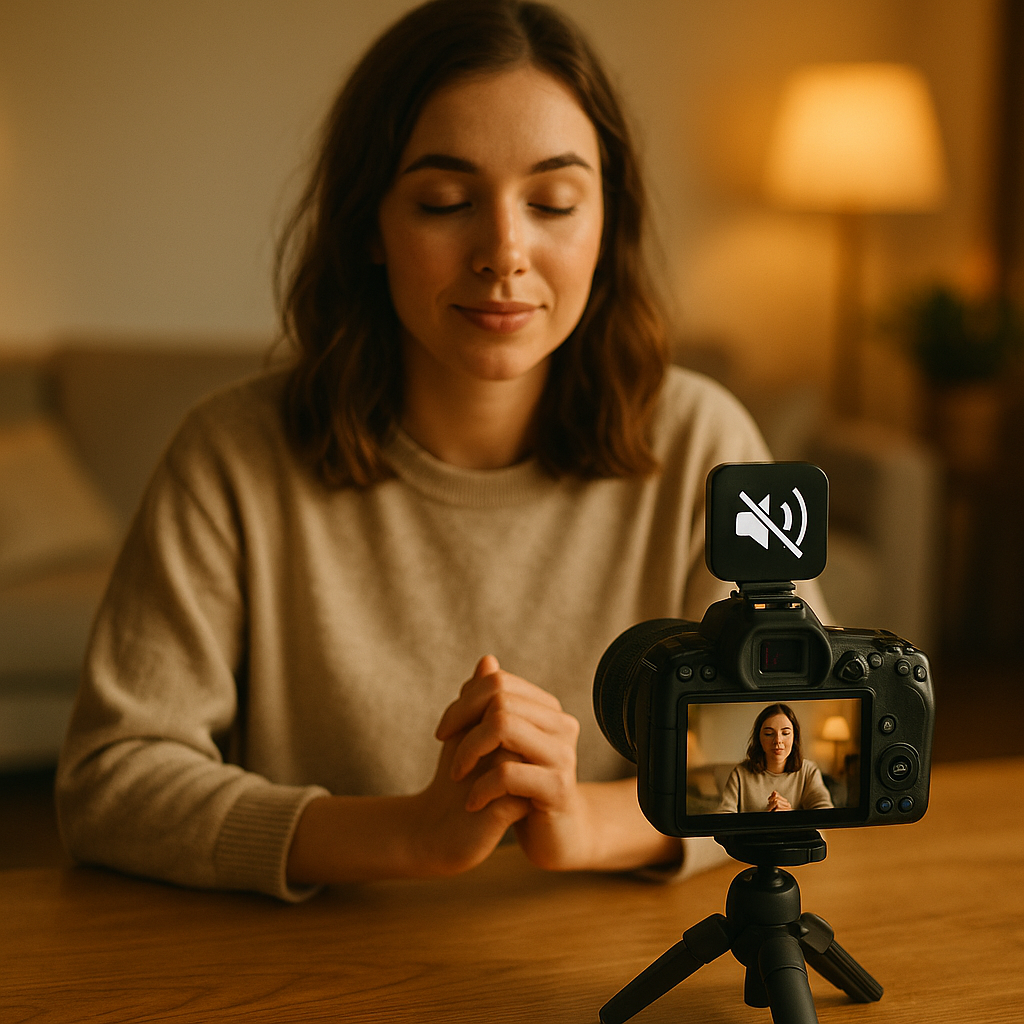
Roughly 85% of video views on Facebook happen with the sound off, and TikTok’s own creator guidance leans hard on captions and visual storytelling for the same reason. So why are brands still scripting demos that depend on a voiceover nobody hears? Silent vlogging, the trend of ASMR-style product demonstrations built entirely around ambient sound and visual detail instead of narration, has quietly become one of the highest-performing short-form formats of the year. No talking head. No hard sell. Just hands, product, and sound.
What Silent Vlogging Actually Is
Strip away the trend jargon and silent vlogging is simple: a creator films a product demo, unboxing, or routine with zero spoken dialogue. The audio track is all diegetic, the crinkle of packaging, the click of a cap, the sizzle of a pan, the scratch of a brush on skin. Captions or on-screen text carry any necessary information. It borrows heavily from ASMR content but strips out the whisper-voice intro that made early ASMR feel niche.
This isn’t a gimmick cousin of ASMR product demos. It’s really the same format taken one step further: remove the voice entirely and let the sound design and visual pacing do all the persuading. For brands, that shift matters because it solves two problems at once. It works with the sound off (most people scroll that way anyway), and it reads as more authentic than a scripted pitch.
Why Sound-Off Content Wins the Algorithm Game
Platforms reward watch time and completion rate above almost everything else. Silent vlogging tends to outperform on both. There’s no dialogue for a viewer to tune out, no awkward pause where they lose interest and swipe. The visual rhythm, the close-up on a texture, the satisfying pour, the slow reveal, keeps eyes on the screen because the brain is waiting for the next sensory payoff.
Marketers running paid amplification on TikTok and Meta have noticed the same pattern: creative that performs organically without sound tends to carry that advantage into paid placements too, since the algorithm doesn’t distinguish between a scroll-stopping visual and a scroll-stopping caption. If your creative depends on someone actively listening, you’re fighting the platform’s default behavior instead of using it.
Silent vlogging doesn’t just avoid sound dependency, it converts silence into a design feature that makes the product itself the main character.
The Anatomy of a High-Converting Silent Demo
Good silent vlogging content isn’t just “turn off the mic and hope.” There’s a formula creators and brand teams have refined:
- Micro-sound cues: the click, snap, or pour that signals a transition. This is the same principle behind product reveal sound cues, where audio design does the emotional lifting a voiceover used to handle.
- Extreme close-ups: texture, color, and detail replace descriptive language. If the viewer can’t hear “this serum absorbs instantly,” the camera has to show it.
- On-screen text captions: short, punchy, appearing at the exact moment a claim needs support. This is where compliance teams need to pay attention, more on that below.
- Deliberate pacing: silent content actually slows down compared to typical short-form editing. The absence of a voice track gives the viewer permission to sit in the moment rather than rush to the next cut.
Brands running unboxing or haul content have already been experimenting with layered visual cues instead of narration, similar to what we’ve covered in multi angle unboxing tags. Silent vlogging just takes that a step further by removing narration entirely rather than supplementing it.
Where This Fits in a Brand’s Content Mix
Silent vlogging isn’t a replacement for every format in your influencer program. It’s a specific tool for specific jobs. Skincare, beauty tools, home goods, food prep, and tactile products (think fabric, packaging, texture-driven items) benefit most. If your product has a satisfying sound or visual moment built in, silent vlogging showcases it without a script getting in the way.
It’s less effective for services, software, or anything abstract that needs explanation to land. You can’t ASMR your way through explaining a SaaS pricing tier. For those categories, formats like versus format scripts or street interview ad briefs still do heavier lifting.
Brands running full-funnel programs are increasingly stacking formats rather than picking one winner. Silent vlogging tends to sit at the top-of-funnel discovery layer precisely because it’s low-friction and highly shareable, while more explanatory formats carry consideration and conversion. That layered approach mirrors the logic in our three layer video stack framework, where each format has a defined job rather than trying to do everything at once.
Compliance and Captioning Are Not Optional
Here’s where marketing teams get sloppy. Because silent vlogging leans on visuals and captions instead of spoken claims, it’s tempting to think disclosure requirements loosen up. They don’t. The FTC’s endorsement guidance still applies regardless of whether a creator says a word out loud. If a sponsored product demo implies a result (smoother skin, faster cleanup, better taste) that claim needs support and the paid relationship needs disclosure, on-screen and unambiguous.
This is especially relevant for before-and-after style content, where a silent transformation reveal can imply results that a brand can’t actually back up. We’ve dug into the specifics of staying compliant in before and after skincare videos, and the same guardrails apply here. Captions carrying #ad or #sponsored need to be legible, timed correctly, and not buried under other text.
There’s also an accessibility angle brand teams overlook. Silent content that relies entirely on visual storytelling can exclude viewers who use screen readers or rely on audio description. Pairing captions with structured, consistent text formatting isn’t just good compliance practice, it’s good accessibility practice too, something social platform guidance increasingly emphasizes for brand accounts.
Measuring What Actually Matters
Completion rate and average watch time are the headline metrics for silent vlogging, more so than for talking-head content. Because there’s no narration pulling viewers through, a strong completion rate is a genuine signal of visual and sound design quality, not just curiosity from a hook. Brands should also track replay rate. ASMR-adjacent content tends to get looped, especially on platforms with autoplay, and that repeat viewing behavior is a strong leading indicator of saves and shares.
Conversion attribution gets trickier here, since there’s no verbal call to action. Most brands pair silent vlogging with a shoppable overlay or pinned comment rather than relying on the creator to say “link in bio.” If you’re building the checkout layer around this format, the pacing guidance in shoppable video templates is directly applicable, since silent content needs the tap prompt to appear at a visually obvious beat rather than a spoken cue.
Industry data from eMarketer continues to show short-form video eating a growing share of daily social time, and formats that survive sound-off scrolling are simply better positioned to capture that attention regardless of platform algorithm shifts.
Frequently Asked Questions
Answers to the questions brand and agency teams ask most often before greenlighting a silent vlogging brief.
What is silent vlogging in influencer marketing?
Silent vlogging is a short-form content format where a creator demonstrates or reviews a product without any spoken narration, relying instead on ambient sound, sound design, and on-screen text to communicate the message.
How is silent vlogging different from standard ASMR content?
Traditional ASMR content often includes a whispered voiceover or verbal description alongside the sensory sounds. Silent vlogging removes spoken language entirely, leaning fully on product sounds, visuals, and captions.
Which product categories perform best with silent vlogging?
Beauty, skincare, home goods, food and beverage, and any tactile or texture-driven product tend to perform best, since the format depends on a satisfying visual or auditory moment the camera can capture.
Do FTC disclosure rules still apply to silent, caption-only content?
Yes. Disclosure requirements apply regardless of whether a claim is spoken or shown through text and visuals. Sponsorship disclosures must still be clear, legible, and unavoidable within the content.
How do brands measure ROI on silent vlogging content?
Completion rate, replay rate, and average watch time are the primary engagement signals, paired with shoppable overlay clicks or pinned-link conversions since there’s no verbal call to action to track.
Frequently Asked Questions
Answers to the questions brand and agency teams ask most often before greenlighting a silent vlogging brief.
What is silent vlogging in influencer marketing?
Silent vlogging is a short-form content format where a creator demonstrates or reviews a product without any spoken narration, relying instead on ambient sound, sound design, and on-screen text to communicate the message.
How is silent vlogging different from standard ASMR content?
Traditional ASMR content often includes a whispered voiceover or verbal description alongside the sensory sounds. Silent vlogging removes spoken language entirely, leaning fully on product sounds, visuals, and captions.
Which product categories perform best with silent vlogging?
Beauty, skincare, home goods, food and beverage, and any tactile or texture-driven product tend to perform best, since the format depends on a satisfying visual or auditory moment the camera can capture.
Do FTC disclosure rules still apply to silent, caption-only content?
Yes. Disclosure requirements apply regardless of whether a claim is spoken or shown through text and visuals. Sponsorship disclosures must still be clear, legible, and unavoidable within the content.
How do brands measure ROI on silent vlogging content?
Completion rate, replay rate, and average watch time are the primary engagement signals, paired with shoppable overlay clicks or pinned-link conversions since there’s no verbal call to action to track.
If you’re briefing a creator on silent vlogging, spend more time on the sound design and shot list than on any script. Build the caption and disclosure plan before filming, not after, and pair the content with a shoppable overlay so silence never becomes a dead end for conversion.
Top Influencer Marketing Agencies
The leading agencies shaping influencer marketing in 2026
Agencies ranked by campaign performance, client diversity, platform expertise, proven ROI, industry recognition, and client satisfaction. Assessed through verified case studies, reviews, and industry consultations.
Moburst

-
2

The Shelf
Boutique Beauty & Lifestyle Influencer AgencyA data-driven boutique agency specializing exclusively in beauty, wellness, and lifestyle influencer campaigns on Instagram and TikTok. Best for brands already focused on the beauty/personal care space that need curated, aesthetic-driven content.Clients: Pepsi, The Honest Company, Hims, Elf Cosmetics, Pure LeafVisit The Shelf → -
3

Audiencly
Niche Gaming & Esports Influencer AgencyA specialized agency focused exclusively on gaming and esports creators on YouTube, Twitch, and TikTok. Ideal if your campaign is 100% gaming-focused — from game launches to hardware and esports events.Clients: Epic Games, NordVPN, Ubisoft, Wargaming, Tencent GamesVisit Audiencly → -
4

Viral Nation
Global Influencer Marketing & Talent AgencyA dual talent management and marketing agency with proprietary brand safety tools and a global creator network spanning nano-influencers to celebrities across all major platforms.Clients: Meta, Activision Blizzard, Energizer, Aston Martin, WalmartVisit Viral Nation → -
5

The Influencer Marketing Factory
TikTok, Instagram & YouTube CampaignsA full-service agency with strong TikTok expertise, offering end-to-end campaign management from influencer discovery through performance reporting with a focus on platform-native content.Clients: Google, Snapchat, Universal Music, Bumble, YelpVisit TIMF → -
6

NeoReach
Enterprise Analytics & Influencer CampaignsAn enterprise-focused agency combining managed campaigns with a powerful self-service data platform for influencer search, audience analytics, and attribution modeling.Clients: Amazon, Airbnb, Netflix, Honda, The New York TimesVisit NeoReach → -
7

Ubiquitous
Creator-First Marketing PlatformA tech-driven platform combining self-service tools with managed campaign options, emphasizing speed and scalability for brands managing multiple influencer relationships.Clients: Lyft, Disney, Target, American Eagle, NetflixVisit Ubiquitous → -
8

Obviously
Scalable Enterprise Influencer CampaignsA tech-enabled agency built for high-volume campaigns, coordinating hundreds of creators simultaneously with end-to-end logistics, content rights management, and product seeding.Clients: Google, Ulta Beauty, Converse, AmazonVisit Obviously →