


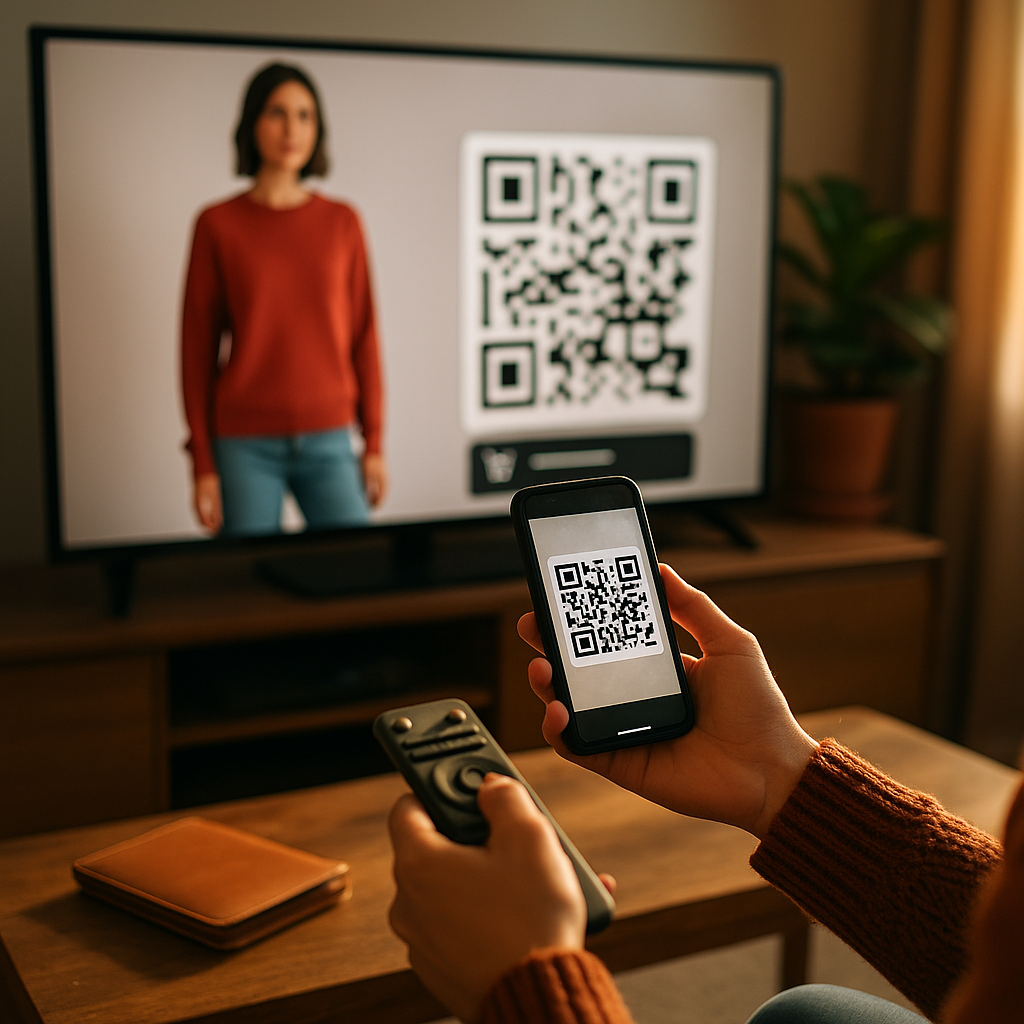
Nielsen puts daily connected TV streaming time north of four hours in the average US household. That is a captive, lean-back audience holding a phone in their lap, ready to scan something. Shoppable CTV is the format built for exactly that moment, and creators are turning out to be the missing link between a static QR code and an actual sale.
Most brands treat CTV as a brand-awareness channel and QR codes as an afterthought bolted onto the last frame. That is a mistake. When you design a shoppable CTV spot around a creator’s credibility and a QR code built for the physical distance of a living room, you get something closer to direct response TV than traditional broadcast advertising. Let’s get into how to build it right.
Why the Living Room Is Suddenly a Performance Channel
For years, CTV was a reach play. Advertisers bought impressions on Hulu or Roku the same way they bought linear spots, betting on brand lift and hoping attribution would sort itself out later. That math has changed. Streaming platforms now carry shoppable ad units natively, retail media networks are plugging into CTV inventory, and QR scan rates have climbed as consumers got comfortable scanning codes during the pandemic and never really stopped.
eMarketer has tracked steady growth in CTV ad spend as budgets shift away from linear, and a meaningful chunk of that new spend is earmarked for interactive and shoppable formats. Brands are not just buying attention anymore. They are buying a path to purchase that lives inside the same fifteen or thirty seconds as the ad itself.
A QR code on a CTV spot is not a nice-to-have anymore. It is the bridge between a ten-foot screen experience and a two-inch checkout flow, and if that bridge is badly built, the whole campaign collapses at the last mile.
What Makes a CTV QR Code Actually Work
Here is the part most media buyers get wrong: they treat the CTV QR code like a print ad code, shrink it into a corner, and call it done. Living rooms are not magazine racks. Viewers sit six to twelve feet from the screen, often with dim lighting and a phone camera that has to refocus across the room.
- Size matters more than branding. The code needs to occupy a meaningful portion of the frame, ideally displayed for at least five to seven seconds with no competing motion around it.
- Contrast beats aesthetics. High-contrast black-on-white or brand-color-on-white codes scan faster than codes matched to a moody color palette.
- Static placement wins. Codes that appear during a slow-paced or paused moment in the creator’s read scan at dramatically higher rates than codes crammed into a fast cut.
- Verbal cueing helps. A creator saying “grab your phone and scan this” while pointing at the code does more for conversion than any visual design trick.
Test your code from across an actual room, on an actual TV, before it ever goes to air. It sounds obvious. Plenty of teams skip it and find out during a client review that the code does not scan from a couch.
Casting Creators for a Screen They Don’t Usually Live On
Most creators build their instincts for a phone screen: vertical framing, fast cuts, text overlays that read in a second. CTV asks for something different. The read needs to feel authentic at a slower pace, in a horizontal frame, often intercut with more traditional footage.
That does not mean you strip the creator’s personality out of it. It means you brief for the format’s pacing while keeping their voice intact. A creator who is good at direct-to-camera trust building, the same skill set behind strong ingredient deep dive videos or comparison content, tends to translate well to CTV because the format still rewards a believable human explaining why something is worth buying.
Casting for CTV also means thinking about repeat exposure. A viewer might see the same spot four or five times across a binge session. A creator whose energy holds up on a fifth viewing, rather than grating, is worth more than one who peaks on the first watch. Test this in focus groups if your budget allows it. If not, lean on creators who already have proven audience retention data from long-form content, since that is a decent proxy for wear-out resistance.
Structuring the Spot: A Beat-by-Beat Framework
A shoppable CTV spot generally needs to do more in less time than a typical social ad, because you only get one shot at the scan window before the viewer’s attention moves elsewhere. A workable structure looks like this:
- Hook (0 to 3 seconds): Creator states the problem or the surprising claim, no logo, no code yet.
- Proof (3 to 12 seconds): Quick demonstration or comparison, similar in spirit to the pacing used in versus format scripts, which are built to persuade fast without overselling.
- Offer (12 to 20 seconds): Creator states the specific deal or reason to act now, and the QR code appears, held on screen.
- Reinforcement (20 to 30 seconds): Verbal repeat of the offer, code stays visible, brand tag appears small and clean.
Notice the code is not an afterthought tacked onto the final frame. It gets real screen time, layered under a verbal cue, which is the single biggest lever for scan rate improvement based on what agencies are reporting from early shoppable CTV tests.
Where the QR Code Should Actually Send People
This is where a lot of otherwise well-produced spots fall apart. A generic homepage link kills momentum instantly. If someone scans a code mid-ad, they are in a hot, impulsive moment, and every extra click between scan and purchase bleeds conversion.
Best practice is a dedicated mobile landing page, built specifically for that spot, that mirrors the offer stated on screen and lets the viewer complete a purchase or claim a code in two taps or fewer. Some brands are pairing this with the same shoppable logic used in shoppable video overlays on social, essentially recreating the tap-to-buy experience on a page instead of an in-app overlay, since CTV platforms cannot yet embed native checkout the way TikTok or Instagram can.
If you are running the campaign across multiple markets, do not reuse one static landing page for every region. Localization matters here too. The same discipline used in instant localization micro assets, adapting currency, language, and regional promo codes without reshooting, applies directly to the post-scan experience for CTV.
Attribution: The Question Every CFO Will Ask
Shoppable CTV solves a real measurement problem that has haunted television advertising for decades. Instead of guessing at lift through brand surveys or matched market tests, you get a scan, a landing page visit, and ideally a transaction, all timestamped and traceable to a specific creative variant and airing window.
That said, do not oversell QR attribution as perfect. Not everyone scans. Some viewers see the ad, remember the offer, and buy later through search or a different device entirely, a behavior sometimes called the “screen jump.” Google’s own guidance on cross-device attribution acknowledges this gap, and smart CTV teams pair QR data with incrementality testing and unique promo codes rather than relying on scans as the sole measure of success.
Set expectations with finance stakeholders before launch. Scan rate is a useful proxy, not a complete picture, and the gap between impressions and scans will always look large next to a platform like TikTok or Instagram, where the entire funnel lives inside one app.
Compliance Is Not Optional Here
Because CTV spots often air alongside broadcast-style content and can be repurposed from or into social cuts, brands need to be careful about disclosure. If a creator’s face is on screen making a claim, FTC endorsement guidance applies exactly as it would on any other platform. That means clear, legible disclosure of the paid relationship, ideally spoken or shown prominently rather than buried in a fast text card. The same rigor used in FTC-compliant before and after content should carry over to CTV, especially for regulated categories like beauty, supplements, and financial products.
Review the FTC’s endorsement guidelines directly if you are running claims-heavy creative, and loop in legal before the spot locks, not after it airs on a national streaming buy where a pulled ad costs real money.
Budget Reality: What This Actually Costs
Shoppable CTV is not cheap to produce well. You are essentially shooting a hybrid: broadcast-quality footage with a creator’s authentic delivery, plus a QR overlay that needs its own design and testing pass, plus a dedicated landing page build. Expect production costs to run higher than a standard social creator deal, though media costs on CTV inventory have been trending more accessible as programmatic buying opens up smaller placements.
A practical way to control cost is reusing the creator’s existing content architecture. If they already have a strong product comparison duet or demo format that performs on social, adapt that same structure for the CTV cut instead of starting from a blank script. It keeps the read authentic and cuts production time significantly.
Getting Started Without Overbuilding
You do not need a national streaming buy to test this. Start with a regional CTV placement, one creator, one offer, and a single landing page. Measure scan rate, landing page conversion, and time-on-page before scaling spend. Treat the first flight as a diagnostic, not a victory lap, and adjust code placement, verbal cueing, and offer clarity based on what the data actually shows rather than what the storyboard promised.
Frequently Asked Questions
FAQs
What makes a QR code scannable on a CTV screen versus print?
Distance and contrast are the main factors. CTV viewers sit several feet from the screen, so the code needs to be larger, higher contrast, and held on screen longer than a typical print or social placement, ideally five to seven seconds with a verbal prompt.
Do shoppable CTV ads actually convert, or is this mostly a brand awareness play?
Early data from retail media networks and streaming platforms shows measurable scan-to-purchase conversion, particularly when the QR code links to a dedicated, offer-matched landing page rather than a generic homepage. It will not match in-app social checkout rates, but it outperforms passive CTV impressions by a wide margin.
How do I choose a creator for a CTV spot specifically?
Prioritize creators with strong direct-to-camera trust building and proven retention on longer content, since CTV rewards a slower, more believable pace than short-form social. Repeat-viewing wear-out resistance matters more here than it does on platforms with high content turnover.
Is FTC disclosure required on shoppable CTV creator ads?
Yes. If a creator is making claims or endorsing a product on screen, the paid relationship needs clear disclosure, consistent with FTC endorsement guidelines regardless of the platform it airs on.
What is the biggest reason shoppable CTV campaigns underperform?
Poor QR code execution is the most common failure point, whether that is a code too small to scan from a couch, a code shown for less than a second, or a landing page that does not match the on-screen offer.
Run one regional flight before committing to a national buy: test code placement, verbal cueing, and landing page speed with a single creator and offer, then scale only what the scan data proves works.
Top Influencer Marketing Agencies
The leading agencies shaping influencer marketing in 2026
Agencies ranked by campaign performance, client diversity, platform expertise, proven ROI, industry recognition, and client satisfaction. Assessed through verified case studies, reviews, and industry consultations.
Moburst

-
2

The Shelf
Boutique Beauty & Lifestyle Influencer AgencyA data-driven boutique agency specializing exclusively in beauty, wellness, and lifestyle influencer campaigns on Instagram and TikTok. Best for brands already focused on the beauty/personal care space that need curated, aesthetic-driven content.Clients: Pepsi, The Honest Company, Hims, Elf Cosmetics, Pure LeafVisit The Shelf → -
3

Audiencly
Niche Gaming & Esports Influencer AgencyA specialized agency focused exclusively on gaming and esports creators on YouTube, Twitch, and TikTok. Ideal if your campaign is 100% gaming-focused — from game launches to hardware and esports events.Clients: Epic Games, NordVPN, Ubisoft, Wargaming, Tencent GamesVisit Audiencly → -
4

Viral Nation
Global Influencer Marketing & Talent AgencyA dual talent management and marketing agency with proprietary brand safety tools and a global creator network spanning nano-influencers to celebrities across all major platforms.Clients: Meta, Activision Blizzard, Energizer, Aston Martin, WalmartVisit Viral Nation → -
5

The Influencer Marketing Factory
TikTok, Instagram & YouTube CampaignsA full-service agency with strong TikTok expertise, offering end-to-end campaign management from influencer discovery through performance reporting with a focus on platform-native content.Clients: Google, Snapchat, Universal Music, Bumble, YelpVisit TIMF → -
6

NeoReach
Enterprise Analytics & Influencer CampaignsAn enterprise-focused agency combining managed campaigns with a powerful self-service data platform for influencer search, audience analytics, and attribution modeling.Clients: Amazon, Airbnb, Netflix, Honda, The New York TimesVisit NeoReach → -
7

Ubiquitous
Creator-First Marketing PlatformA tech-driven platform combining self-service tools with managed campaign options, emphasizing speed and scalability for brands managing multiple influencer relationships.Clients: Lyft, Disney, Target, American Eagle, NetflixVisit Ubiquitous → -
8

Obviously
Scalable Enterprise Influencer CampaignsA tech-enabled agency built for high-volume campaigns, coordinating hundreds of creators simultaneously with end-to-end logistics, content rights management, and product seeding.Clients: Google, Ulta Beauty, Converse, AmazonVisit Obviously →