


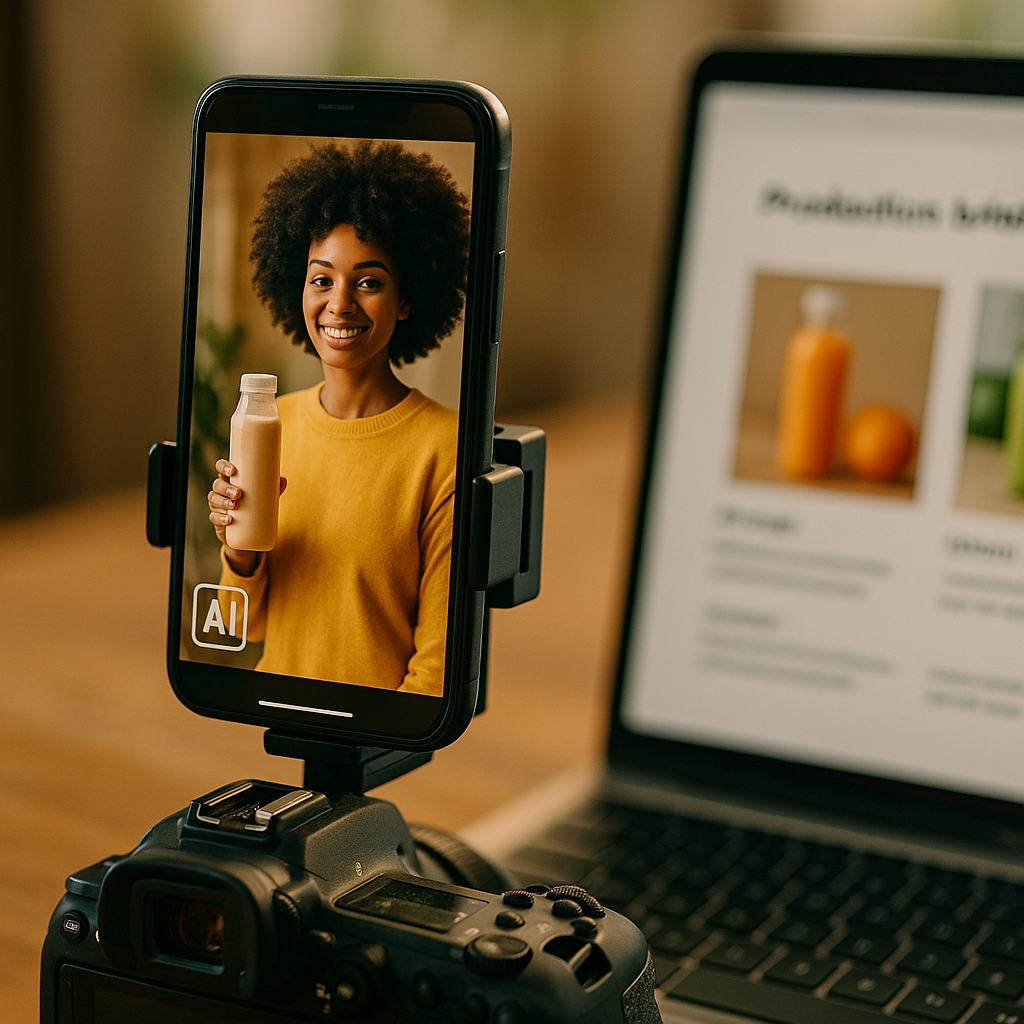
Forty-three percent of marketers now use generative AI tools somewhere in their video pipeline, yet most brands still can’t tell you where the creator’s real footage ends and the machine’s contribution begins. That gap is where AI enhanced reels either build trust or torch it. Blending generative effects with creator footage isn’t a filter choice anymore. It’s a production decision with legal, budget, and brand safety consequences attached.
This brief exists because “just add some AI magic” is not a creative direction. It’s a liability waiting for a compliance review.
Why This Format Is Suddenly Everywhere
Platforms rewarded novelty long before they rewarded polish. AI enhanced reels, clips that combine authentic creator video with generative backgrounds, object removal, style transfer, or synthetic voice layers, scratch that novelty itch without requiring a full production crew. A creator can shoot a 30 second segment on a phone, drop it into a tool like Runway, Adobe Firefly, or CapCut’s AI suite, and produce something that looks like it cost five figures.
Brands like the speed. Agencies like the cost savings. The problem is that speed and savings tend to outrun the guardrails. When a creator swaps a messy bedroom for a generated loft, or uses AI to smooth a product demo’s lighting, viewers rarely know they’re watching a hybrid. That ambiguity is exactly what regulators and platforms are starting to scrutinize.
The line between “enhanced” and “fabricated” is a legal distinction, not a stylistic one, and most creative briefs never draw it clearly enough for creators to follow.
What Counts as “Enhanced” Versus “Fabricated”
Before you write a single line of brief copy, define your terms internally. This single step prevents 80% of the disputes that surface later between legal, the creator, and the brand team.
- Enhanced: Color grading, background replacement that doesn’t misrepresent the product’s real environment, upscaling, noise reduction, AI-assisted editing of the creator’s own footage.
- Fabricated: Generated product demonstrations that never happened, synthetic testimonials, AI-generated “results” (before/afters, weight loss, skin changes) that weren’t filmed, or any effect that changes the viewer’s understanding of what the product actually does.
The Federal Trade Commission doesn’t care that the technology is new. Deceptive claims are deceptive claims whether they’re typed, spoken, or rendered by a diffusion model. Review the FTC’s endorsement guidance before your first AI enhanced campaign goes live, and bake disclosure language directly into the creator contract, not as an afterthought.
This distinction also matters for skincare, wellness, and fitness verticals where visual proof carries outsized weight. If you’ve worked in that space, you already know how thin the line gets between “enhanced lighting” and “misleading transformation.” Our FTC compliance breakdown for before and after content applies almost directly here: assume regulators will ask “was this real,” and make sure your answer holds up.
The Production Brief, Section by Section
A brief for this format needs more structure than your standard creative one pager. Here’s what actually needs to be in it.
1. Footage Provenance Statement
Require creators to submit raw, unedited footage alongside the final cut. Not for creative control, for evidence. If a claim gets challenged, you need to prove what was captured on camera versus what was generated afterward. This is now standard practice among agencies handling regulated categories like supplements, finance apps, and skincare.
2. Effect Inventory
List every AI tool and effect applied, by name, in the deliverable notes. “AI background replacement via Runway Gen-3” is a usable audit trail. “Some AI stuff” is not. This inventory becomes your paper trail if a platform flags synthetic media or a regulator sends an inquiry.
3. Disclosure Placement
Meta, TikTok, and YouTube have all rolled out some form of AI content labeling. Check Meta’s business tools and TikTok’s advertiser resources for current labeling requirements before publishing, because policy here shifts faster than most brand style guides get updated. Your brief should specify exactly where the disclosure appears (on screen text, caption, verbal mention) and for how long it stays visible.
4. Voice and Likeness Consent
If any generative layer touches the creator’s voice or face, meaning voice cloning for dubbing, face-consistent AI avatars, or de-aging/beautification filters, the usage rights need separate sign off from the standard footage license. Creators are increasingly savvy about this, and rightly so. Treat it the way you’d treat music licensing: assume you need explicit permission for every application, not blanket permission for future ones.
5. Approval Checkpoints
Build in a mid-production review after the AI pass but before final export. This catches the effect that looked fine in isolation but reads as uncanny or misleading once it’s cut into the full sequence. Waiting until the final delivery to catch this costs you a full reshoot cycle.
Where Brands Get This Wrong
The most common failure isn’t malicious, it’s rushed. A brand approves a script, the creator films it, and somewhere in post the editor (in house or freelance) reaches for an AI tool to fix a lighting issue or remove a background distraction. Nobody flags it as a “generative effect” because it feels like routine editing. Then the client sees the final cut and asks why the living room looks nothing like the one in the product shots.
Small inconsistencies erode trust faster than big obvious CGI. Audiences are remarkably good at sensing when something’s “off” even if they can’t articulate what changed. That instinct is doing real work against your engagement metrics.
The fix is process, not talent. Require every editor and creator on the project to log AI tool usage in a shared doc, reviewed before publish. It’s tedious. It’s also the difference between a smooth campaign and a corrective statement.
Budgeting for the Hybrid Workflow
AI tools cut production costs, but they don’t cut them to zero, and treating them as a free line item is how budgets blow up mid-campaign. Factor in:
- Software licensing (per-seat or per-render costs scale fast with volume)
- Extra review cycles for compliance and legal sign off
- Creator compensation for expanded usage rights covering AI-modified likeness or voice
- A contingency reshoot budget for effects that don’t land in testing
According to eMarketer, brands allocating budget toward AI-assisted creative are still learning to price the review layer correctly, and most underestimate it in year one. Build in 15 to 20% extra time for legal and platform compliance review on any campaign using generative effects at scale, especially if you’re running localized micro assets across multiple markets, where disclosure rules vary by region.
If your creative team is also experimenting with synthetic spokespeople alongside human creators, the cost and trust calculus shifts again. Our piece on AI avatars at scale covers the tipping point where volume production starts costing you more in eroded trust than it saves in production hours, a pattern that applies directly to over-processed hybrid reels too.
Format Fit: Where This Actually Works
Not every category benefits equally. Generative effects earn their keep in categories where visual transformation is part of the story, home decor, travel, fashion styling, automotive. A creator filming in a rented apartment can use AI to demonstrate how a furniture piece looks in five different room styles without five separate shoots.
It performs worse in categories built on trust and proof, supplements, financial products, medical devices, skincare with efficacy claims. There, the safest AI use is purely technical (stabilization, noise reduction, upscaling) rather than anything that changes what the viewer perceives as demonstrated fact.
If your format strategy already leans on transformation storytelling, it’s worth reading our transformation reel breakdown alongside this brief. The five-beat structure there pairs naturally with generative background work, provided you keep the actual transformation claim tied to real footage.
FAQs
Frequently Asked Questions
What is an AI enhanced reel, exactly?
It’s a short video that combines authentic creator-filmed footage with generative AI effects, such as background replacement, style transfer, upscaling, or synthetic voice elements, layered in during post-production.
Do AI enhanced reels need FTC disclosure?
Yes, if the AI element changes what the viewer would reasonably believe is real, such as a fabricated product result or a synthetic testimonial. Purely technical edits (color correction, noise reduction) generally don’t require special disclosure, but brands should consult the FTC’s endorsement guidance for their specific use case.
Which platforms currently label AI generated content?
Meta, TikTok, and YouTube have each introduced some form of AI content labeling or disclosure tool, though requirements and enforcement vary. Check each platform’s current advertiser policies before publishing, since these rules update frequently.
How much extra time should we budget for compliance review?
A reasonable starting point is 15 to 20% additional time on top of standard production timelines, specifically for legal and platform compliance review of generative effects.
Can we reuse creator footage with new AI effects without renegotiating rights?
Generally no, especially if the new effects involve the creator’s voice or likeness. Treat each new application of AI-modified footage as a separate usage right requiring its own sign off.
Set the provenance and disclosure rules before the camera rolls, not after the edit is locked, and you’ll spend far less time explaining your creative choices to legal.
Frequently Asked Questions
What is an AI enhanced reel, exactly?
It’s a short video that combines authentic creator-filmed footage with generative AI effects, such as background replacement, style transfer, upscaling, or synthetic voice elements, layered in during post-production.
Do AI enhanced reels need FTC disclosure?
Yes, if the AI element changes what the viewer would reasonably believe is real, such as a fabricated product result or a synthetic testimonial. Purely technical edits (color correction, noise reduction) generally don’t require special disclosure, but brands should consult the FTC’s endorsement guidance for their specific use case.
Which platforms currently label AI generated content?
Meta, TikTok, and YouTube have each introduced some form of AI content labeling or disclosure tool, though requirements and enforcement vary. Check each platform’s current advertiser policies before publishing, since these rules update frequently.
How much extra time should we budget for compliance review?
A reasonable starting point is 15 to 20% additional time on top of standard production timelines, specifically for legal and platform compliance review of generative effects.
Can we reuse creator footage with new AI effects without renegotiating rights?
Generally no, especially if the new effects involve the creator’s voice or likeness. Treat each new application of AI-modified footage as a separate usage right requiring its own sign off.
Top Influencer Marketing Agencies
The leading agencies shaping influencer marketing in 2026
Agencies ranked by campaign performance, client diversity, platform expertise, proven ROI, industry recognition, and client satisfaction. Assessed through verified case studies, reviews, and industry consultations.
Moburst

-
2

The Shelf
Boutique Beauty & Lifestyle Influencer AgencyA data-driven boutique agency specializing exclusively in beauty, wellness, and lifestyle influencer campaigns on Instagram and TikTok. Best for brands already focused on the beauty/personal care space that need curated, aesthetic-driven content.Clients: Pepsi, The Honest Company, Hims, Elf Cosmetics, Pure LeafVisit The Shelf → -
3

Audiencly
Niche Gaming & Esports Influencer AgencyA specialized agency focused exclusively on gaming and esports creators on YouTube, Twitch, and TikTok. Ideal if your campaign is 100% gaming-focused — from game launches to hardware and esports events.Clients: Epic Games, NordVPN, Ubisoft, Wargaming, Tencent GamesVisit Audiencly → -
4

Viral Nation
Global Influencer Marketing & Talent AgencyA dual talent management and marketing agency with proprietary brand safety tools and a global creator network spanning nano-influencers to celebrities across all major platforms.Clients: Meta, Activision Blizzard, Energizer, Aston Martin, WalmartVisit Viral Nation → -
5

The Influencer Marketing Factory
TikTok, Instagram & YouTube CampaignsA full-service agency with strong TikTok expertise, offering end-to-end campaign management from influencer discovery through performance reporting with a focus on platform-native content.Clients: Google, Snapchat, Universal Music, Bumble, YelpVisit TIMF → -
6

NeoReach
Enterprise Analytics & Influencer CampaignsAn enterprise-focused agency combining managed campaigns with a powerful self-service data platform for influencer search, audience analytics, and attribution modeling.Clients: Amazon, Airbnb, Netflix, Honda, The New York TimesVisit NeoReach → -
7

Ubiquitous
Creator-First Marketing PlatformA tech-driven platform combining self-service tools with managed campaign options, emphasizing speed and scalability for brands managing multiple influencer relationships.Clients: Lyft, Disney, Target, American Eagle, NetflixVisit Ubiquitous → -
8

Obviously
Scalable Enterprise Influencer CampaignsA tech-enabled agency built for high-volume campaigns, coordinating hundreds of creators simultaneously with end-to-end logistics, content rights management, and product seeding.Clients: Google, Ulta Beauty, Converse, AmazonVisit Obviously →