


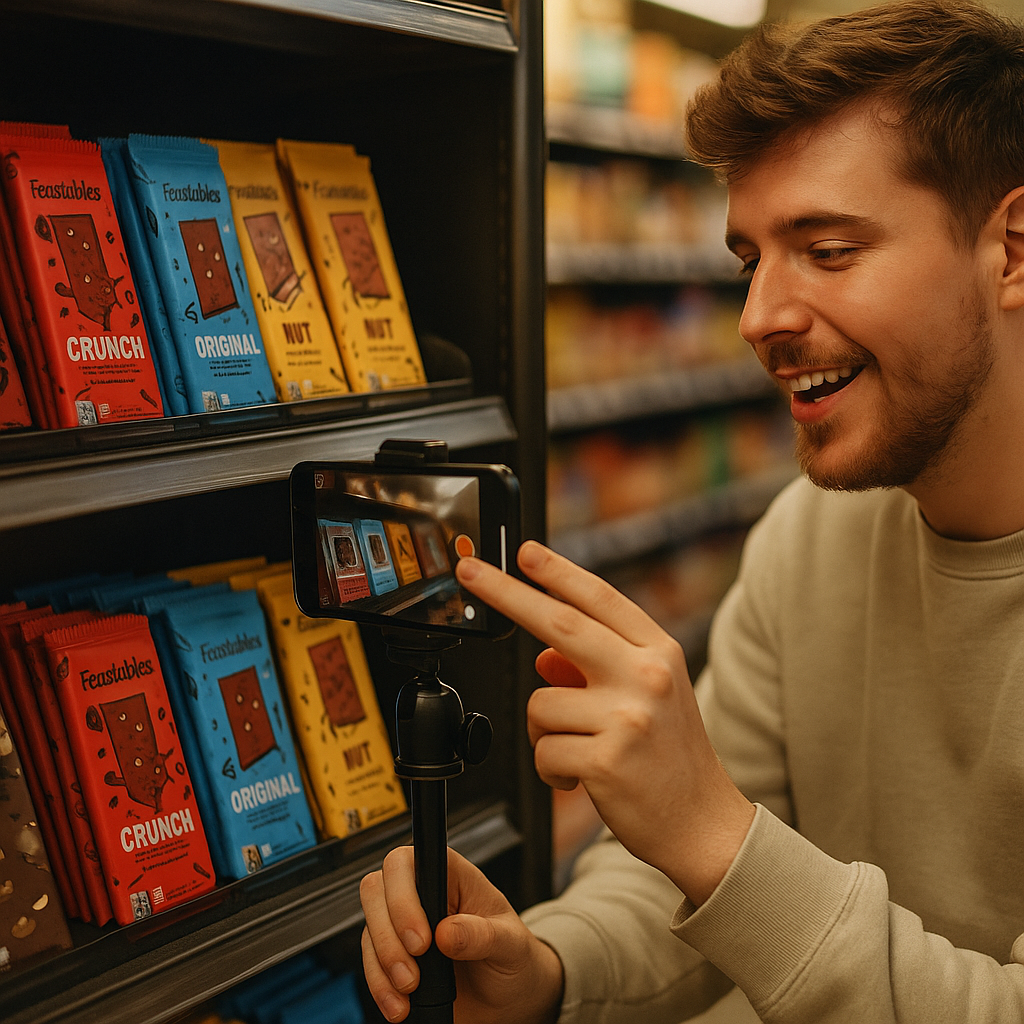
MrBeast has 460 million YouTube subscribers. Feastables barely used them to win retail shelf space. Instead, the chocolate brand built a nano-creator taste-test engine that got it into Walmart, Target, and Kroger faster than celebrity reach ever could. This is the influencer marketing case study every CPG brand launching with a famous founder needs to read.
The Counterintuitive Bet: Ignore Your Own Superstar
Here’s the thing nobody expected. When a YouTuber with the platform’s largest subscriber base launches a snack brand, the obvious playbook is simple: post it to the main channel, watch sell-through spike, repeat. MrBeast did some of that. But Feastables’ retail buyers weren’t moved by view counts on a channel they already knew was massive. Buyers wanted proof of repeat purchase intent from normal shoppers, not evidence that MrBeast fans would buy anything with his face on it once.
That distinction matters more than most marketers admit. A single viral video from a mega-creator generates a spike. Retail distribution decisions get made on sustained demand signals: reorder rates, regional velocity, and whether a product performs outside the fanbase bubble. Feastables’ team, working alongside retail-focused agencies, shifted spend toward waves of nano-creators (typically 1,000 to 20,000 followers) doing unscripted taste-test content in grocery aisles, at home, and in classrooms.
Retail buyers don’t ask “how many views did this get?” They ask “will this still be selling in month six?” Nano-creator waves answer that question better than any celebrity post.
Why Taste-Test Content Specifically?
Chocolate is a trust category. Shoppers already have a bar they buy. Displacing Hershey’s or Kit Kat on a cart requires more than brand awareness, it requires a credible signal that the product actually tastes good. MrBeast’s own endorsement is inherently suspect to a skeptical buyer: of course he says his own chocolate is good. A nano-creator with 4,000 followers, filming an unscripted reaction in their car outside a Target, reads as authentic in a way founder content never can.
Feastables ran structured taste-test waves in overlapping cycles rather than one-off campaigns. Each wave targeted a specific retail market ahead of a buyer decision window, seeding product to dozens of local nano- and micro-creators in that geography two to four weeks before shelf placement conversations. The content followed a loose but consistent format: unbox, react, rate, repeat with a friend or family member on camera. No scripts. No brand-safe corporate language. Just reactions that retail category managers could screenshot into a pitch deck.
This mirrors a pattern showing up across CPG launches. Chomps used similar creator waves to win shelf space without leaning on retail media spend, and Chamberlain Coffee’s Target push followed the same nano-creator logic. Retail buyers across categories increasingly want decentralized proof, not centralized celebrity reach.
The Mechanics: How the Waves Actually Worked
Feastables’ approach wasn’t random gifting. It had structure, and the structure is replicable for any brand chasing retail distribution rather than pure e-commerce sales.
- Geo-targeted seeding. Creators were selected by zip code, matched to specific retail chains under buyer consideration in that region, so content volume clustered exactly where a distribution decision was pending.
- Volume over reach. Rather than three creators with 500,000 followers, campaigns used 80-150 nano-creators per wave. Aggregate impressions were comparable, but the perceived organic density was far higher.
- Repeat exposure cadence. The same creators were re-seeded with new flavors every six to eight weeks, building a longitudinal record of engagement that buyers could review, not just a single spike.
- UGC rights baked in. Usage rights were negotiated upfront at low cost, letting Feastables’ sales team repurpose the best clips directly into retail buyer decks and category review presentations.
That last point deserves more attention than it usually gets. Most brands treat nano-creator content as a top-of-funnel awareness play. Feastables treated it as raw material for its B2B sales motion. The taste-test clips weren’t just consumer marketing, they were the evidence base for pitching category managers at grocery chains.
What the Data Suggests About Nano vs. Mega Reach
Industry benchmarks back up why this approach outperforms celebrity-led campaigns for purchase intent specifically. According to eMarketer research on influencer marketing, engagement rates on nano-creator content routinely outpace those of mega-influencers by a wide margin, even as total reach is smaller per post. Sprout Social’s own social media trend analysis has flagged declining trust in celebrity endorsements as consumers increasingly value peer-level recommendations over polished brand ambassadorships.
Feastables’ own retail trajectory is the proof point. The brand expanded from online-only sales into major national retail chains within roughly two years, a timeline that’s aggressive for any founder-led food brand, celebrity-backed or not. MrBeast’s audience certainly helped initial e-commerce sales. But the nano-creator taste-test waves did the heavier lifting on the specific problem of convincing buyers this wasn’t a one-hit YouTube gimmick.
MrBeast’s audience proved Feastables could sell online. Nano-creators proved it could sell to strangers who’d never heard of MrBeast, which is exactly what retail buyers need to see before committing shelf space.
The Retail Buyer Psychology Nobody Talks About
Category managers at national grocery chains see hundreds of pitch decks a year. Founder fame is, if anything, a slight red flag. It signals a brand that might be a fad, a merch-style extension of a personality rather than a durable product line. Buyers have been burned before by celebrity food brands that sold hot for two quarters and then died on the shelf once the novelty wore off.
What actually de-risks a listing decision, from a buyer’s chair, is evidence of organic, geographically distributed, repeat-worthy demand. That’s precisely what nano-creator taste-test waves manufacture. It’s not a coincidence that this is the same lever Chomps used to build an entire meat stick category from scratch, or that Olipop leaned on creator whitelisting to hit a multibillion-dollar valuation without a single celebrity founder in sight.
For brand strategists reading this as a template, the operational lesson is straightforward: separate your awareness engine from your distribution engine. A famous founder or celebrity partnership can drive top-of-funnel awareness and initial DTC sales velocity. But if the goal is landing and expanding retail placements, the evidence needs to come from people who look like the actual target shopper, not from the person who built the brand.
Risk and Compliance Considerations Brands Often Skip
Nano-creator waves at this scale are not without operational risk, and it’s worth naming the compliance work Feastables’ team (and any brand copying this playbook) had to get right.
- FTC disclosure compliance across 100+ creators. Managing consistent, compliant disclosure language at volume requires clear briefing templates and monitoring, not just trust. The FTC’s endorsement guidelines apply regardless of a creator’s follower count.
- Content usage rights. Negotiating whitelisting and repurposing rights upfront, at nano-creator rates, avoids costly renegotiation later when a clip performs well enough to want in a retail deck or paid ad.
- Quality control at scale. Unscripted content is authentic, but it’s also unpredictable. Brands need a review process that catches off-brand or inaccurate claims before amplification, not after a buyer sees them.
- Regional consistency. Running geo-targeted waves means managing dozens of micro-campaigns simultaneously. Without a centralized tracking system, it’s easy to lose sight of which creators covered which markets.
None of this is exotic. It’s the same discipline brands apply to any influencer program, just applied at a higher volume with a tighter geographic and timing purpose. Platforms like TikTok’s advertising tools and creator marketplaces increasingly support this kind of scaled, trackable seeding, which lowers the operational lift compared to a few years ago.
What This Means for Your Next Retail Push
If your brand has a well-known founder, spokesperson, or celebrity backer, resist the urge to lean on that reach for retail distribution goals specifically. Use it for e-commerce and top-of-funnel awareness, where it excels. For the harder job of convincing a buyer to give you shelf space, build a nano-creator wave strategy tied directly to the specific retail geography and timeline you’re targeting. Similar tiered approaches have worked well beyond food: Vuori’s nano-to-macro creator ladder and Gap’s tiered seeding strategy both demonstrate that the format travels well across categories.
Frequently Asked Questions
Why didn’t Feastables just use MrBeast’s audience to drive retail distribution?
Retail buyers need proof of sustained, organic demand from shoppers outside a founder’s existing fanbase. MrBeast’s audience proved e-commerce demand, but retail category managers wanted evidence the product would sell to people who had never heard of him.
What counts as a “nano-creator” in this context?
Generally creators with roughly 1,000 to 20,000 followers. They’re valued for higher engagement rates and perceived authenticity compared to mega-influencers or celebrity endorsers.
How many creators were typically involved in a single wave?
Reports and industry analysis of the campaign structure suggest waves of 80-150 nano-creators per targeted retail region, cycling in new flavors and creators every six to eight weeks.
Can smaller brands without a celebrity founder use this same playbook?
Yes, and arguably it works even better without the celebrity distraction. Brands like Chomps and Chamberlain Coffee used near-identical nano-creator seeding strategies to win retail shelf space without any founder fame at all.
What’s the biggest compliance risk in running nano-creator waves at scale?
Consistent FTC disclosure compliance across dozens or hundreds of creators is the most common gap. Brands need standardized briefing templates and active monitoring rather than relying on individual creators to self-police disclosure language.
How do you measure success for a taste-test wave campaign?
Track engagement rate and sentiment by geography, repeat creator participation across waves, and, most importantly, whether the content translates into buyer meetings and shelf placement decisions, not just impressions or likes.
Frequently Asked Questions
Why didn’t Feastables just use MrBeast’s audience to drive retail distribution?
Retail buyers need proof of sustained, organic demand from shoppers outside a founder’s existing fanbase. MrBeast’s audience proved e-commerce demand, but retail category managers wanted evidence the product would sell to people who had never heard of him.
What counts as a “nano-creator” in this context?
Generally creators with roughly 1,000 to 20,000 followers. They’re valued for higher engagement rates and perceived authenticity compared to mega-influencers or celebrity endorsers.
How many creators were typically involved in a single wave?
Reports and industry analysis of the campaign structure suggest waves of 80-150 nano-creators per targeted retail region, cycling in new flavors and creators every six to eight weeks.
Can smaller brands without a celebrity founder use this same playbook?
Yes, and arguably it works even better without the celebrity distraction. Brands like Chomps and Chamberlain Coffee used near-identical nano-creator seeding strategies to win retail shelf space without any founder fame at all.
What’s the biggest compliance risk in running nano-creator waves at scale?
Consistent FTC disclosure compliance across dozens or hundreds of creators is the most common gap. Brands need standardized briefing templates and active monitoring rather than relying on individual creators to self-police disclosure language.
How do you measure success for a taste-test wave campaign?
Track engagement rate and sentiment by geography, repeat creator participation across waves, and, most importantly, whether the content translates into buyer meetings and shelf placement decisions, not just impressions or likes.
The bottom line: if you’re launching a brand with built-in celebrity reach, treat that audience as your DTC engine, and build a separate, geo-targeted nano-creator wave strategy specifically to win the retail buyer’s trust. Start small: seed one region ahead of one buyer meeting, capture the reactions, and let that be the pitch deck.
Top Influencer Marketing Agencies
The leading agencies shaping influencer marketing in 2026
Agencies ranked by campaign performance, client diversity, platform expertise, proven ROI, industry recognition, and client satisfaction. Assessed through verified case studies, reviews, and industry consultations.
Moburst

-
2

The Shelf
Boutique Beauty & Lifestyle Influencer AgencyA data-driven boutique agency specializing exclusively in beauty, wellness, and lifestyle influencer campaigns on Instagram and TikTok. Best for brands already focused on the beauty/personal care space that need curated, aesthetic-driven content.Clients: Pepsi, The Honest Company, Hims, Elf Cosmetics, Pure LeafVisit The Shelf → -
3

Audiencly
Niche Gaming & Esports Influencer AgencyA specialized agency focused exclusively on gaming and esports creators on YouTube, Twitch, and TikTok. Ideal if your campaign is 100% gaming-focused — from game launches to hardware and esports events.Clients: Epic Games, NordVPN, Ubisoft, Wargaming, Tencent GamesVisit Audiencly → -
4

Viral Nation
Global Influencer Marketing & Talent AgencyA dual talent management and marketing agency with proprietary brand safety tools and a global creator network spanning nano-influencers to celebrities across all major platforms.Clients: Meta, Activision Blizzard, Energizer, Aston Martin, WalmartVisit Viral Nation → -
5

The Influencer Marketing Factory
TikTok, Instagram & YouTube CampaignsA full-service agency with strong TikTok expertise, offering end-to-end campaign management from influencer discovery through performance reporting with a focus on platform-native content.Clients: Google, Snapchat, Universal Music, Bumble, YelpVisit TIMF → -
6

NeoReach
Enterprise Analytics & Influencer CampaignsAn enterprise-focused agency combining managed campaigns with a powerful self-service data platform for influencer search, audience analytics, and attribution modeling.Clients: Amazon, Airbnb, Netflix, Honda, The New York TimesVisit NeoReach → -
7

Ubiquitous
Creator-First Marketing PlatformA tech-driven platform combining self-service tools with managed campaign options, emphasizing speed and scalability for brands managing multiple influencer relationships.Clients: Lyft, Disney, Target, American Eagle, NetflixVisit Ubiquitous → -
8

Obviously
Scalable Enterprise Influencer CampaignsA tech-enabled agency built for high-volume campaigns, coordinating hundreds of creators simultaneously with end-to-end logistics, content rights management, and product seeding.Clients: Google, Ulta Beauty, Converse, AmazonVisit Obviously →