


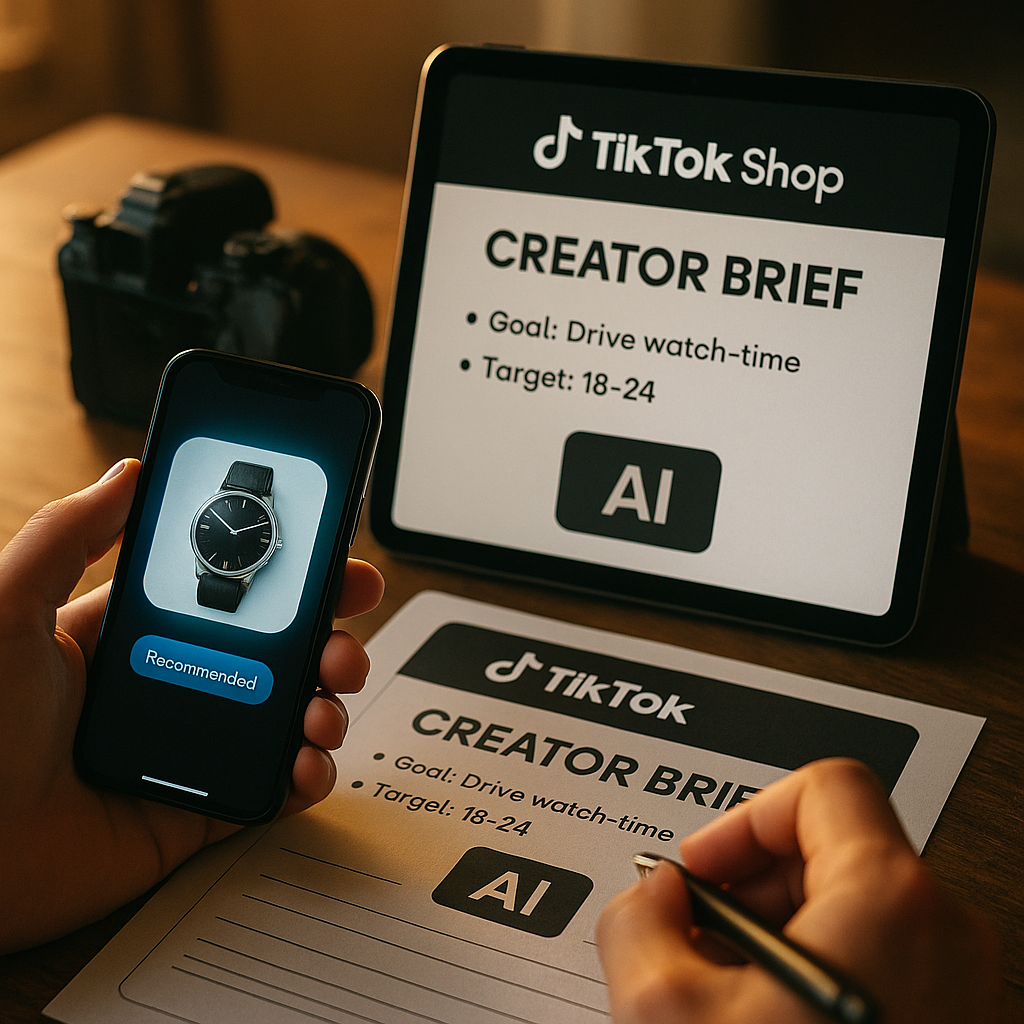
TikTok Shop’s AI discovery layer now influences which products surface in over 60% of in-app purchase journeys, yet most creator briefs are still written as if the only audience is human. That’s a costly blind spot. Social commerce creator brief design for TikTok Shop requires satisfying two distinct evaluation systems at once, and the brands winning right now have cracked that dual optimization.
Two Audiences, One Video: Understanding the Stack
TikTok’s product discovery architecture operates on layered signals. The human viewer responds to narrative tension, relatability, and visual payoff. The AI shopping retrieval layer, powered by TikTok’s proprietary product graph and semantic indexing, responds to something different: product name density, attribute specificity, structured verbal cues, and metadata alignment between what the creator says, what appears on screen, and what’s tagged in the Shop listing.
Most briefs optimize for one or the other. Briefs that over-index on entertainment sacrifice retrieval. Briefs stuffed with product specs kill watch time and tank the algorithm’s distribution signal. The brief is the document where you resolve that tension before the camera ever rolls.
TikTok’s internal research indicates that videos where spoken product attributes match Shop listing metadata within the first 15 seconds generate significantly higher add-to-cart rates than those where that alignment is absent. Your brief controls whether that alignment happens.
What TikTok’s AI Discovery Layer Actually Needs
Before writing a single brief line, your team needs to understand what the retrieval layer indexes. It pulls from three main sources: the video’s auto-generated transcript, on-screen text overlays, and the Shop product tile metadata attached to the post. When all three contain consistent product terminology, the AI treats the content as high-confidence retrieval material and surfaces it more aggressively in personalized shopping feeds and the TikTok Shop discovery carousel.
The practical implication: your brief must specify exact language. Not “talk about the moisturizer,” but “say ‘SPF 50 daily moisturizer with niacinamide’ within the first ten seconds.” The creator’s natural delivery handles the human trust signal; the specific terminology handles the retrieval signal. These are not in conflict if the brief separates them clearly.
Product density requirements are another spec most briefs ignore. The AI layer rewards content where the product appears visually and verbally at regular intervals, not just at the open and close. A rough operational benchmark: for a 60-second Shop video, the product should appear on screen or be named at least four times. Your brief should state this explicitly, with suggested moments rather than leaving it to creator instinct.
The Brief Architecture That Solves Both Problems
Structure your TikTok Shop creator brief with five named sections, in this order.
1. Watch-Time Engineering Section. Specify the hook format (question, bold claim, visual surprise) and the narrative arc. State the target average watch percentage. For Shop content, aim for 65%+ based on Sprout Social benchmarks for commerce-optimized short-form video. Tell creators where to create a “pattern interrupt” (typically seconds 8-12) to prevent early scroll-off. This section is written entirely for the human audience.
2. AI Retrieval Compliance Section. List the exact product name as it appears in the Shop listing. Include the two to three primary attributes the AI needs to match: size, key ingredient, use case, finish, or whatever differentiates the SKU. Specify the required number of verbal mentions and their placement. Require that on-screen text overlays mirror at least one spoken phrase. This section is written for the machine audience and should be visually separated in the brief document so creators understand they’re working with two different briefs in one.
3. Scene Density Map. Provide a rough timeline: what should be happening visually at seconds 0-5, 6-15, 16-30, 31-45, and 45-60. Include product presence markers at each stage. This is where watch-time and retrieval overlap. A scene density map forces creators to plan shots where the product is both dramatically integrated and consistently visible. For more on how this kind of structured direction plays across platforms, see our guidance on shop stream scroll journeys.
4. Compliance and Disclosure Anchor. Specify where the #ad or paid partnership disclosure appears. For Shop affiliate content, FTC guidance (see ftc.gov) requires clear and conspicuous disclosure, and placement affects both trust signals and algorithmic treatment. There’s substantial evidence that transparent disclosure, placed correctly, improves rather than hurts performance. Our analysis of disclosure as a performance driver goes deeper on this dynamic.
5. Metadata Alignment Checklist. List the exact caption language, including product name, category hashtags (not trend hashtags), and Shop tag placement. Many brands lose retrieval points because the caption diverges from the spoken content. This checklist closes that gap before post.
Watch-Time Signals: What the Brief Must Protect
Retrieval optimization is worthless if the video doesn’t get watched. TikTok’s content distribution algorithm still heavily weights completion rate, shares, and save rate. Product-heavy content that feels like a manual gets penalized on distribution before the shopping AI ever sees it.
Your brief’s watch-time engineering must give creators genuine narrative freedom within the retrieval constraints. The difference between a restrictive brief and an effective one is whether you’re telling creators what to say or when and how often to say it. Specify the slots; let the creator fill them with their voice.
Hooks are where most Shop content loses. The brief should prohibit product-first openers for most categories. “This moisturizer is amazing” is a weaker hook than “I’ve been getting asked what changed about my skin for three weeks.” The product appears in second place; the human tension appears first. Creators know this instinctively, but a brief that doesn’t protect the hook will get overridden by brand teams who want the logo in frame at second one.
For reference on how hook architecture and retrieval requirements interact in multi-platform executions, our piece on unified TikTok and AI search briefs covers adjacent ground.
Common Brief Failures and What They Cost You
The most expensive brief failure in TikTok Shop is attribute mismatch. The creator calls it “the vitamin C serum” in the video. The Shop listing title says “Brightening Serum with 15% Ascorbic Acid.” Those are not the same retrieval signal. The AI does not automatically reconcile synonyms at the same confidence level. Your brief should include a terminology lock: one canonical product name, one canonical attribute phrase, used consistently across transcript, overlays, caption, and listing.
Second most common: insufficient product recurrence. Brands brief “feature the product naturally” and get a video where the product appears at second 3 and second 55. For a 60-second video, that’s two appearances. The retrieval layer interprets this as low product relevance. Specify the minimum appearances in the brief. Four to five for a 60-second format is a reasonable floor.
Third: over-scripting the human-facing narrative. When creators follow a word-for-word script, delivery quality drops and watch time follows. The AI retrieval section of the brief should be scripted. The narrative section should be directional. That’s the line.
The brands scaling TikTok Shop revenue fastest are the ones who’ve separated their briefs into two voices: one for the algorithm, one for the audience. Most are still writing one brief trying to serve both, and serving neither well.
Scaling This Approach Across a Creator Roster
One creator executing a dual-signal brief is a test. Twenty creators executing it consistently is a system. When scaling, the AI Retrieval Compliance Section should be standardized and locked across all creators in a campaign. The Watch-Time Engineering Section should have guardrails but allow creator-specific customization. This is exactly the tension addressed in our framework for brand consistency across multiple creators.
Use a brief review checkpoint specifically for retrieval compliance before approving any creator content. Build a one-page checklist: Does the spoken product name match the listing exactly? Does the product appear on-screen at least four times? Do the caption hashtags include the category tag? Is there at least one on-screen text overlay mirroring a spoken product attribute? That checkpoint takes two minutes and eliminates the most common retrieval failures.
For teams managing high-volume Shop campaigns, tools like EMARKETER’s commerce tracking data can help benchmark whether your retrieval optimization is actually moving discovery metrics, not just creative quality scores. Pair that with TikTok Shop Seller Center analytics to track which creator content is driving organic discovery versus paid placement.
Also worth reviewing: our analysis of briefs structured for AI campaign optimizers covers how brief architecture affects downstream automated distribution decisions, which compounds retrieval optimization significantly.
Your immediate next step: Pull your last three TikTok Shop creator briefs and audit them against the five-section structure above. Identify whether you have a retrieval compliance section at all. Most brands don’t, which means the AI discovery layer is working against you on every piece of content you’ve already paid to produce.
Frequently Asked Questions
What is TikTok Shop’s AI discovery layer and why does it matter for creator briefs?
TikTok Shop’s AI discovery layer is the recommendation and retrieval system that determines which products and creator videos surface in personalized shopping feeds, the Shop tab, and in-video product carousels. It indexes spoken transcripts, on-screen text, and Shop listing metadata. Creator briefs that don’t align these three data sources lose retrieval placement, meaning the content gets produced but doesn’t drive discovery-led purchases.
How many times should a product be mentioned or shown in a 60-second TikTok Shop video?
A practical minimum is four to five times across verbal mentions and on-screen appearances combined in a 60-second format. The AI retrieval layer uses product recurrence as a relevance signal. Sparse appearances (once at the start, once at the end) underperform in discovery placement compared to content with regular, distributed product presence throughout the video.
How do you write a TikTok Shop creator brief that doesn’t kill watch time with product density requirements?
Separate the brief into two distinct sections: one for watch-time engineering (hook, narrative arc, pattern interrupt) and one for AI retrieval compliance (exact product name, attribute phrases, placement timing). Script the retrieval requirements; keep the narrative section directional rather than word-for-word. This gives creators freedom to deliver authentically while ensuring the machine-readable signals are present.
Does the product name in the video need to match the Shop listing exactly?
Yes, as closely as possible. TikTok’s retrieval AI uses semantic matching, but exact terminology in the transcript and on-screen text that mirrors the Shop listing title and key attributes produces higher-confidence retrieval signals than paraphrased descriptions. Build a terminology lock into your brief: one canonical product name and one to two key attribute phrases used consistently across all content touchpoints.
Where should sponsorship disclosure go in TikTok Shop creator content?
FTC guidelines require clear and conspicuous disclosure. For TikTok Shop affiliate and paid content, this typically means a verbal disclosure in the first 30 seconds and a visible text overlay or caption label. Disclosure placement should be specified in the brief. Research indicates that transparent disclosure placed early in the video does not significantly reduce watch time and can improve trust-based engagement metrics, particularly for commerce-focused content.
Top Influencer Marketing Agencies
The leading agencies shaping influencer marketing in 2026
Agencies ranked by campaign performance, client diversity, platform expertise, proven ROI, industry recognition, and client satisfaction. Assessed through verified case studies, reviews, and industry consultations.
Moburst

-
2

The Shelf
Boutique Beauty & Lifestyle Influencer AgencyA data-driven boutique agency specializing exclusively in beauty, wellness, and lifestyle influencer campaigns on Instagram and TikTok. Best for brands already focused on the beauty/personal care space that need curated, aesthetic-driven content.Clients: Pepsi, The Honest Company, Hims, Elf Cosmetics, Pure LeafVisit The Shelf → -
3

Audiencly
Niche Gaming & Esports Influencer AgencyA specialized agency focused exclusively on gaming and esports creators on YouTube, Twitch, and TikTok. Ideal if your campaign is 100% gaming-focused — from game launches to hardware and esports events.Clients: Epic Games, NordVPN, Ubisoft, Wargaming, Tencent GamesVisit Audiencly → -
4

Viral Nation
Global Influencer Marketing & Talent AgencyA dual talent management and marketing agency with proprietary brand safety tools and a global creator network spanning nano-influencers to celebrities across all major platforms.Clients: Meta, Activision Blizzard, Energizer, Aston Martin, WalmartVisit Viral Nation → -
5

The Influencer Marketing Factory
TikTok, Instagram & YouTube CampaignsA full-service agency with strong TikTok expertise, offering end-to-end campaign management from influencer discovery through performance reporting with a focus on platform-native content.Clients: Google, Snapchat, Universal Music, Bumble, YelpVisit TIMF → -
6

NeoReach
Enterprise Analytics & Influencer CampaignsAn enterprise-focused agency combining managed campaigns with a powerful self-service data platform for influencer search, audience analytics, and attribution modeling.Clients: Amazon, Airbnb, Netflix, Honda, The New York TimesVisit NeoReach → -
7

Ubiquitous
Creator-First Marketing PlatformA tech-driven platform combining self-service tools with managed campaign options, emphasizing speed and scalability for brands managing multiple influencer relationships.Clients: Lyft, Disney, Target, American Eagle, NetflixVisit Ubiquitous → -
8

Obviously
Scalable Enterprise Influencer CampaignsA tech-enabled agency built for high-volume campaigns, coordinating hundreds of creators simultaneously with end-to-end logistics, content rights management, and product seeding.Clients: Google, Ulta Beauty, Converse, AmazonVisit Obviously →