


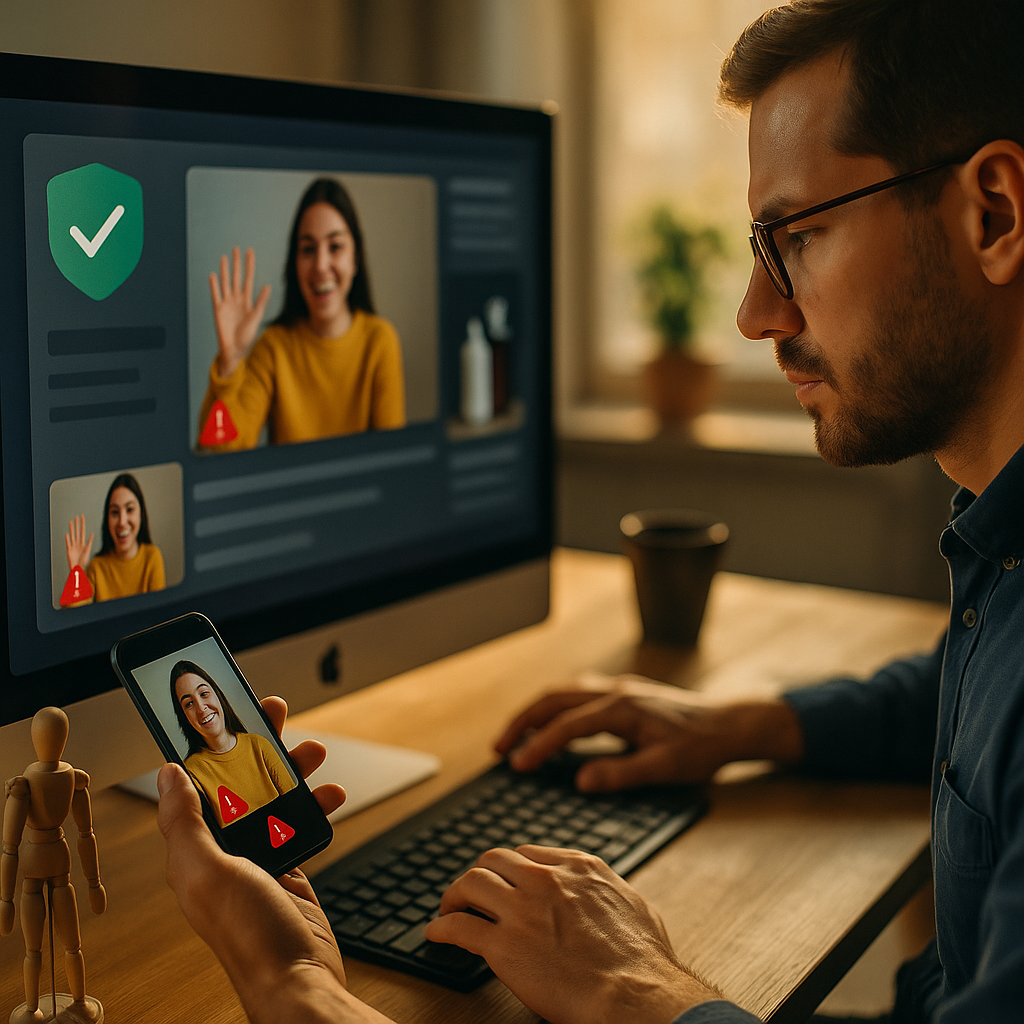
Automation Scales Everything—Including Your Mistakes
Brands running AI-driven UGC clipping and distribution workflows are pushing hundreds of content variations live per week. That velocity is the point. But a 2024 Sprout Social report found that 68% of consumers say they would stop buying from a brand after a single trust-related content incident. Automated UGC operations without structured human review checkpoints don’t just risk one bad clip—they risk systematically amplifying it across every channel before anyone notices.
This isn’t a theoretical problem. It’s an operational design flaw that compounds at scale.
Why AI Alone Cannot Own Brand Safety
AI clipping tools—Opus Clip, Vidyo.ai, and similar platforms—are genuinely impressive at identifying high-engagement moments, generating captions, and formatting content for TikTok, Reels, YouTube Shorts, and CTV placements. They are not impressive at understanding context. An AI will clip a creator saying “this literally saved my life” and flag it as high-performing testimonial content without recognizing that the product is a regulated supplement, or that the claim violates FTC guidelines on health endorsements.
Context failures are the most expensive brand safety failures. They’re also the category least visible to automated systems.
Beyond claims, AI tools routinely miss: music licensing issues in background audio, competitor logos appearing in frame, creator disclosures that were removed during trimming, and off-brand emotional tone that technically passes keyword filters but lands wrong for the audience segment being targeted. The AI vs. human judgment distinction isn’t philosophical here—it’s a practical gap with a dollar value attached to it.
Designing the Human Review Layer: Four Checkpoints That Actually Matter
The goal isn’t to add human review everywhere—that defeats the purpose of automation. The goal is to place review checkpoints at the specific moments in the workflow where AI error rates are highest and where the cost of a miss is greatest. Four checkpoints cover the majority of real-world brand safety risk.
Checkpoint 1: Pre-Ingestion Creator Vetting. Before any creator content enters an automated clipping pipeline, the creator’s account should already have passed a baseline vetting process. This is upstream work, but it dramatically reduces the quality-control burden downstream. If a creator with a history of controversial content never enters the pipeline, the AI never generates a dangerous clip. A structured creator vetting framework at onboarding is the cheapest brand safety investment a team can make.
Checkpoint 2: Post-Clip, Pre-Caption Generation. After the AI selects and trims clips, a human reviewer should scan flagged items before captions and CTAs are auto-generated. This is the fastest and highest-leverage checkpoint. Reviewing a 30-second clip takes 90 seconds. Reversing a brand safety incident after captions, hashtags, and paid placements have already been attached takes weeks and legal fees. Flag criteria should include: regulated product claims, competitor brand visibility, incomplete disclosures, and emotional tone mismatches for the target segment.
Checkpoint 3: Rights and Attribution Verification. AI distribution tools do not independently verify whether a brand holds the rights to repurpose a specific clip for paid media. That verification step is a human task, and it belongs in the workflow before any clip is queued for paid amplification. This is especially critical when UGC is being used for paid media attribution, where the legal and financial exposure of a rights dispute is meaningfully higher than organic posts.
Checkpoint 4: Channel-Specific Compliance Review. A clip cleared for Instagram Reels is not automatically cleared for CTV, DOOH, or a retail media network placement. Each channel carries different compliance standards, audience age profiles, and platform policies. A human reviewer—or a clearly documented rules engine with human sign-off—should confirm channel-specific clearance before programmatic distribution queues the content. Teams moving content across CTV and DOOH channels face particularly high stakes here, because those placements carry broadcast-adjacent standards that social-native AI tools aren’t calibrated for.
The four checkpoints above are not about slowing down your pipeline. They are about concentrating human attention at the four moments where automation is statistically most likely to produce a miss that costs real money.
Structuring the Review Team Without Breaking Velocity
A common objection from ops teams: “We publish 200 clips a week. We can’t review all of them.” Correct. You shouldn’t try to. The answer is tiered review, not universal review.
Tier 1 content (UGC from pre-vetted creators, within established brand categories, going to owned social channels) can run through automated approval with a 24-hour audit window rather than pre-flight review. Tier 2 content (new creators, regulated categories, paid media placements, new markets) requires human pre-flight review at checkpoints 2 and 4. Tier 3 content (sensitive topics, international distribution, broadcast or retail media placements) requires a full four-checkpoint review and, in many cases, legal or compliance sign-off.
This structure also maps cleanly to how lean teams managing large creator rosters already think about prioritization. You’re not inventing a new system—you’re applying the same risk-tiering logic to the content pipeline.
The Metrics That Tell You Your Review Layer Is Working
If you can’t measure the effectiveness of your human review checkpoints, you’ll lose budget for them in the next planning cycle. Three metrics are worth tracking explicitly.
- Pre-flight catch rate: The percentage of clips flagged at human review checkpoints versus clips flagged post-publication. A healthy program catches 90%+ of issues before they go live.
- False positive rate: The percentage of clips flagged by reviewers that are cleared on secondary review. High false positive rates signal that your flagging criteria are too broad and are creating unnecessary friction without improving safety.
- Time-to-flag on live incidents: For any brand safety issue that does make it to publication, how quickly does your team identify and remove it? This metric is your fallback—not a sign of failure, but a necessary backstop when pre-flight review doesn’t catch everything.
Tying these metrics to your broader campaign measurement infrastructure gives the review function a clear performance profile that justifies its operational cost.
Tools and Governance: What Needs to Exist Before You Scale
Automation without governance documentation is just risk without accountability. Before scaling an AI-driven UGC clipping operation, the following should be in writing and reviewed by both marketing and legal.
- A brand safety policy that defines explicit trigger criteria for each review tier
- A documented escalation path for content that reviewers cannot independently clear
- A rights management log that tracks creator permissions, usage terms, and channel clearances
- A takedown protocol with defined response time SLAs by content tier
FTC compliance requirements for endorsements and testimonials, ICO guidance on data use in AI-generated content workflows (relevant for UK and EU markets), and platform-specific policies from Meta and TikTok all need to be reflected in these documents. The tools change. The governance principles stay stable.
Platforms like Sprinklr and Percolate offer workflow automation with built-in approval routing. But the approval logic those tools execute is only as good as the criteria your team writes into them. The technology is not a substitute for the governance layer—it’s an executor of it.
AI creative policy for marketing teams isn’t about restricting automation. It’s about defining exactly where human judgment is non-negotiable—and embedding that definition into the workflow architecture before it’s needed. Teams that have invested in an AI creative policy are operationally better positioned to scale UGC without brand safety exposure.
The Sprout Social data point at the top of this article frames the stakes simply: one trust-related incident can break a purchasing relationship. At scale, “one incident” becomes a statistical certainty if the review layer isn’t built correctly.
Audit your current UGC automation workflow against the four checkpoints above. If any of them are missing or informally handled, fix that before the next campaign cycle, not after a brand safety incident forces the conversation.
FAQs
What is a human review checkpoint in an automated UGC workflow?
A human review checkpoint is a defined point in the content automation pipeline where a qualified team member manually evaluates content before it advances to the next stage—typically before caption generation, paid media placement, or cross-channel distribution. These checkpoints exist because AI tools can identify high-performing content moments but cannot reliably assess regulatory compliance, rights clearance, or contextual brand safety risks.
How many human reviewers does a brand need for AI-driven UGC operations?
The number depends on content volume, channel mix, and risk tier. A tiered review structure—where pre-vetted, low-risk content runs on a post-publication audit model and high-risk content (paid media, regulated categories, new markets) gets pre-flight review—allows most brands to operate with one to three dedicated reviewers at the 100-200 weekly clips scale, rather than requiring a full QA team for every asset.
What types of content should always require human review before publication?
At minimum: any UGC involving health or financial claims, content from newly onboarded creators, any clip being queued for paid media amplification, content destined for CTV or DOOH placements, and any content involving partial or potentially missing FTC-required disclosures. These categories carry the highest combination of compliance risk and public visibility.
Can AI tools be configured to reduce the human review burden over time?
Yes, but with caveats. AI flagging models can be trained on your brand’s historical review decisions to improve pre-screening accuracy. Over time, a well-trained classifier can reduce the volume of content requiring manual review by surfacing only the highest-risk clips. However, the governance framework—the documented criteria for what triggers review—must still be written and maintained by humans. The AI executes the logic; it doesn’t own the policy.
What is the biggest brand safety risk specific to AI clipping tools?
Contextual claim extraction is the highest-risk failure mode. AI clipping tools optimize for engagement signals, not compliance context. A clip of a creator making an unsubstantiated product claim may score highly on predicted performance precisely because strong claims drive engagement—making it more likely to be selected and distributed without review. This is why a human checkpoint between clip selection and caption/CTA generation is the single most high-leverage intervention in the workflow.
Top Influencer Marketing Agencies
The leading agencies shaping influencer marketing in 2026
Agencies ranked by campaign performance, client diversity, platform expertise, proven ROI, industry recognition, and client satisfaction. Assessed through verified case studies, reviews, and industry consultations.
Moburst

-
2

The Shelf
Boutique Beauty & Lifestyle Influencer AgencyA data-driven boutique agency specializing exclusively in beauty, wellness, and lifestyle influencer campaigns on Instagram and TikTok. Best for brands already focused on the beauty/personal care space that need curated, aesthetic-driven content.Clients: Pepsi, The Honest Company, Hims, Elf Cosmetics, Pure LeafVisit The Shelf → -
3

Audiencly
Niche Gaming & Esports Influencer AgencyA specialized agency focused exclusively on gaming and esports creators on YouTube, Twitch, and TikTok. Ideal if your campaign is 100% gaming-focused — from game launches to hardware and esports events.Clients: Epic Games, NordVPN, Ubisoft, Wargaming, Tencent GamesVisit Audiencly → -
4

Viral Nation
Global Influencer Marketing & Talent AgencyA dual talent management and marketing agency with proprietary brand safety tools and a global creator network spanning nano-influencers to celebrities across all major platforms.Clients: Meta, Activision Blizzard, Energizer, Aston Martin, WalmartVisit Viral Nation → -
5

The Influencer Marketing Factory
TikTok, Instagram & YouTube CampaignsA full-service agency with strong TikTok expertise, offering end-to-end campaign management from influencer discovery through performance reporting with a focus on platform-native content.Clients: Google, Snapchat, Universal Music, Bumble, YelpVisit TIMF → -
6

NeoReach
Enterprise Analytics & Influencer CampaignsAn enterprise-focused agency combining managed campaigns with a powerful self-service data platform for influencer search, audience analytics, and attribution modeling.Clients: Amazon, Airbnb, Netflix, Honda, The New York TimesVisit NeoReach → -
7

Ubiquitous
Creator-First Marketing PlatformA tech-driven platform combining self-service tools with managed campaign options, emphasizing speed and scalability for brands managing multiple influencer relationships.Clients: Lyft, Disney, Target, American Eagle, NetflixVisit Ubiquitous → -
8

Obviously
Scalable Enterprise Influencer CampaignsA tech-enabled agency built for high-volume campaigns, coordinating hundreds of creators simultaneously with end-to-end logistics, content rights management, and product seeding.Clients: Google, Ulta Beauty, Converse, AmazonVisit Obviously →