


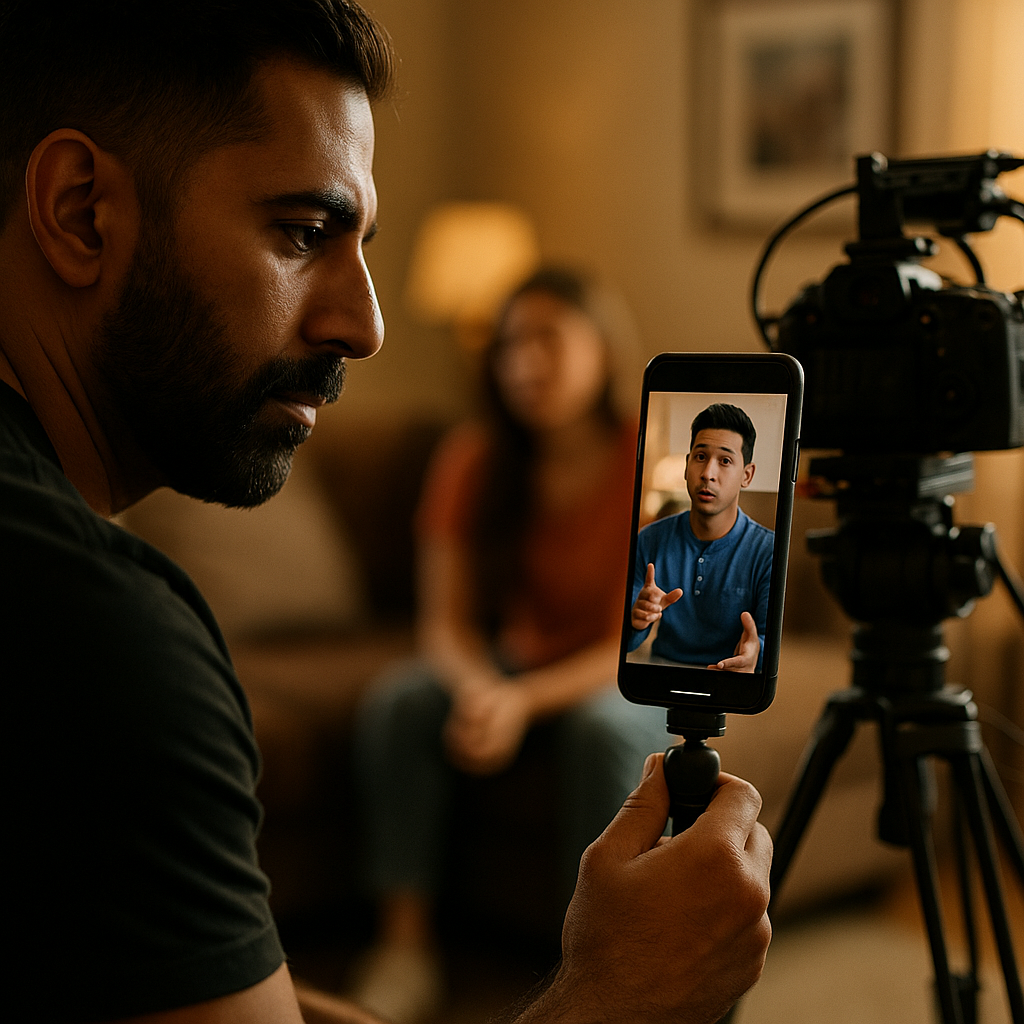
Vertical Scripted Drama Is Now a Legitimate Media Buy
Dhar Mann Studios generates over 20 billion views annually across YouTube, Facebook, and TikTok. That number deserves to sit in your media plan next to linear TV, not in a footnote under “experimental creator spend.” Vertical scripted drama as a brand integration category has quietly matured, and most brand strategists are still evaluating it with the wrong framework.
What “Vertical Scripted Drama” Actually Means for Brand Buyers
This is not traditional influencer content. Vertical scripted drama refers to short-form, narrative-driven video produced with recurring characters, moral arcs, and serialized storylines — formatted natively for mobile viewing. Studios like Dhar Mann, TOGETHXR, and emerging players on platforms like TikTok and YouTube produce these at volume, with consistent brand-safe premises built into the creative DNA of the studio itself.
The distinction matters operationally. When you buy into this format, you are not negotiating a one-off post with a creator. You are entering a recurring content ecosystem with an established audience contract — viewers return because they trust the emotional cadence of the storytelling. That’s a fundamentally different attention environment than a product mention dropped into a vlog.
Think of it the way a media planner thinks about a network: Dhar Mann has a defined genre (moral redemption), a consistent tone, a loyal subscriber base averaging 20+ minutes of weekly watch time per viewer, and a production infrastructure capable of delivering integration specs across dozens of episodes per quarter. That is a media property, not a creator.
Why the Comparison to Traditional TV Sponsorships Holds Up
Brand strategists have historically used three benchmarks to justify TV sponsorship investment: audience scale, contextual brand alignment, and repeatability of exposure. Vertical scripted drama checks all three, with some measurable advantages.
Scale: Dhar Mann’s YouTube channel alone consistently ranks in the top 1% of global channels by views. Across all platforms, the studio reaches a predominantly 18-34 demographic that has been measurably difficult to hold on linear TV since the mid-2010s.
Contextual alignment: Because the narratives are morally driven — honesty, hard work, empathy, consequence — the brand integration surface is inherently values-forward. A financial services brand, a healthcare company, or a family-oriented retailer sits naturally within a story about someone learning a life lesson, in a way that a banner ad or a pre-roll never could.
Repeatability: Unlike a single sponsored post, a studio deal can be structured around episode-level integrations across a full content calendar. This is how traditional TV upfronts work. YouTube’s Brandcast model has been pushing exactly this framing for several years, normalizing the idea that creator content deserves upfront-style investment commitments.
When an audience returns weekly to the same studio’s content, your brand integration isn’t an interruption. It’s part of the viewing ritual. That’s a trust asset traditional CPM models completely fail to price.
The CPM math also works. Depending on the integration type, pre-negotiated studio deals with Dhar Mann-scale properties can deliver effective CPMs in the $8-$18 range for highly engaged 18-34 audiences — competitive with cable, superior to most programmatic alternatives in the same demo, and with zero ad-skipping.
Evaluating a Content Studio as a Media Partner: The Right Criteria
Most brands approach studio partnerships the way they approach influencer deals: engagement rate, follower count, past brand work. That framework undersells the opportunity and misses the real risk variables. Here’s what actually matters.
Content cadence and production reliability. A studio that publishes two episodes per month can’t support an annual sponsorship program the way a studio publishing 8-12 pieces per month can. Audit their publishing history across platforms before committing budget. Consistency is a proxy for operational maturity.
Cross-platform distribution architecture. Studios like Dhar Mann don’t just post to YouTube. They operate coordinated distribution across Facebook, Instagram, TikTok, and often their own owned channels. For brands, this multiplies impression volume per integration without proportionally increasing cost. Understanding how to evaluate platform distribution strategy is essential before signing any studio deal.
Audience ownership vs. platform dependency. Does the studio have an email list, app, or owned channel beyond platform algorithms? Studios with diversified distribution are more durable partners. A studio that lives entirely on one platform’s algorithm is a counterparty risk.
Integration format flexibility. The best studio deals allow for multiple integration types: in-narrative product placement, pre-roll exclusivity within the studio’s ad stack, end-card sponsorship, and even co-produced episodes where the brand brief shapes the storyline itself. Evaluate whether the studio’s creative team can execute across these formats without compromising editorial integrity, which is what sustains audience trust.
Brand safety track record. This is non-negotiable. Review the studio’s full content library, comment sentiment, and any controversy history. The contractual brand safety standards you’d apply to any creator program apply here with higher stakes, because the studio’s entire library lives alongside your integration.
Contract Structure and Revenue Comparability
This is where most brand teams leave money on the table. Vertical scripted studio deals can be structured with the same financial instruments as traditional media buys: guaranteed impression floors, exclusivity windows by category, rights to use integration footage in paid social, and performance bonuses tied to completion rates or downstream conversion events.
A properly negotiated studio deal should include category exclusivity (your competitor can’t appear in the same studio’s content during your contract window), defined creative approval workflows, platform-specific reporting cadences, and clear IP terms for any co-produced content. Creator contracts increasingly mirror entertainment industry norms — brand teams should be negotiating accordingly, not treating these as glorified influencer agreements.
For planning purposes: studio-level integrations with Dhar Mann-tier properties typically start at $250K-$500K for quarterly commitments and scale to seven figures for annual exclusivity packages. That positions them squarely alongside mid-market cable buys — and delivers far better demographic precision.
The Metrics That Should Drive Your Evaluation
Standard influencer metrics — EMV, reach, follower count — don’t capture the value of scripted narrative integration accurately. Brand lift, aided recall, and sentiment shift are more relevant, but they require commissioning dedicated measurement, which most studio partners can support through third-party brand lift studies via Statista-validated panels or platform-native tools.
Completion rate per episode is your baseline attention metric. Studios like Dhar Mann regularly see 60-80% average view duration on long-form content — a metric that most pre-roll and display inventory can’t approach. Moving beyond standard CPM metrics is essential to making the internal case for this budget category.
Completion rate on scripted studio content is a stronger proxy for brand message retention than any engagement rate figure. If viewers are watching 70% of a 12-minute episode that features your product, that’s not an impression. That’s a considered exposure.
Also track: comment sentiment polarity (are viewers talking positively about the brand integration or calling it out negatively?), subscriber growth rate during your campaign window (a proxy for audience expansion velocity), and cross-platform content syndication performance to understand total distribution reach per episode.
For teams building the internal business case, creator budget accountability frameworks designed for CMOs can be directly adapted for studio-level deals — the logic is the same, the investment threshold is higher.
The Strategic Window Is Still Open — But Not Indefinitely
Vertical scripted drama is at the same inflection point that podcast advertising was around 2019: measurably effective, under-priced relative to comparable traditional media, and not yet crowded with competitive brand spend. Studios with Dhar Mann’s scale and content velocity are actively seeking brand partners who understand the format. The first movers in a studio’s category exclusivity will set the pricing baseline for everyone who follows.
The brands that evaluate content studios through a proper media partnership lens now — assessing distribution architecture, production reliability, contract structure, and audience retention data — will have category exclusivity locked in before the format becomes a line item in every competitor’s upfront budget.
Start by requesting a full content audit and audience analytics package from any studio you’re considering, exactly as you would from a media property — because that’s what it is. Pull their social analytics benchmarks, commission a brand lift baseline study, and negotiate the contract with an entertainment attorney familiar with both creator deals and traditional broadcast sponsorship structures. The opportunity is real. The framework for capturing it is already in your media buying toolkit.
Frequently Asked Questions
What is vertical scripted drama in the context of brand integration?
Vertical scripted drama refers to short-to-mid-form narrative video content produced by dedicated content studios, formatted for mobile-first platforms like YouTube, TikTok, and Facebook. Studios like Dhar Mann produce serialized, character-driven stories with consistent moral themes. For brands, these studios function as media properties where integration can be structured across recurring episodes, offering sustained audience exposure rather than one-off placements.
How does Dhar Mann compare to traditional TV as a brand media partner?
Dhar Mann Studios generates over 20 billion views annually and reaches a predominantly 18-34 demographic across YouTube, Facebook, and TikTok. Average view duration on long-form episodes regularly exceeds 60-70%, which rivals or outperforms premium cable in terms of sustained audience attention. Category exclusivity, guaranteed impression floors, and rights to use integration footage in paid social can all be negotiated — making the deal structure comparable to traditional TV sponsorship packages.
What budget range should brands expect for a studio integration deal?
Studio-level integrations with properties at the scale of Dhar Mann typically begin at $250,000-$500,000 for quarterly commitments, scaling to seven-figure annual packages with category exclusivity. These figures are comparable to mid-market cable buys but offer significantly better demographic targeting precision and measurable completion-rate data per episode.
What contract terms should brand teams negotiate with content studios?
Key contract elements include: category exclusivity (preventing competitors from appearing in the studio’s content during your window), creative approval workflows with defined turnaround timelines, platform-specific performance reporting cadences, guaranteed minimum impression floors, IP rights for any co-produced content, and clear brand safety provisions covering both new and existing library content. Treat the negotiation like a broadcast sponsorship agreement, not a standard influencer deal.
Which metrics matter most for evaluating a scripted studio integration?
Prioritize completion rate (average view duration per episode), comment sentiment analysis, brand lift measured through third-party studies, and cross-platform distribution reach per piece of content. Standard influencer metrics like follower count and EMV are insufficient for assessing the value of narrative integration. Brands should also track aided recall and purchase intent shifts among viewers exposed to the integration versus a control group.
How is vertical scripted drama different from standard influencer marketing?
Standard influencer marketing involves a creator inserting a brand mention or product demo into their organic content format. Vertical scripted drama involves a studio producing scripted narratives where brand integration is embedded into the story itself — or where the brand helps shape the episode brief through co-production. The audience relationship is with the studio’s content universe, not with a single creator’s personality, which makes the integration more durable and less dependent on any individual talent’s reputation.
Top Influencer Marketing Agencies
The leading agencies shaping influencer marketing in 2026
Agencies ranked by campaign performance, client diversity, platform expertise, proven ROI, industry recognition, and client satisfaction. Assessed through verified case studies, reviews, and industry consultations.
Moburst

-
2

The Shelf
Boutique Beauty & Lifestyle Influencer AgencyA data-driven boutique agency specializing exclusively in beauty, wellness, and lifestyle influencer campaigns on Instagram and TikTok. Best for brands already focused on the beauty/personal care space that need curated, aesthetic-driven content.Clients: Pepsi, The Honest Company, Hims, Elf Cosmetics, Pure LeafVisit The Shelf → -
3

Audiencly
Niche Gaming & Esports Influencer AgencyA specialized agency focused exclusively on gaming and esports creators on YouTube, Twitch, and TikTok. Ideal if your campaign is 100% gaming-focused — from game launches to hardware and esports events.Clients: Epic Games, NordVPN, Ubisoft, Wargaming, Tencent GamesVisit Audiencly → -
4

Viral Nation
Global Influencer Marketing & Talent AgencyA dual talent management and marketing agency with proprietary brand safety tools and a global creator network spanning nano-influencers to celebrities across all major platforms.Clients: Meta, Activision Blizzard, Energizer, Aston Martin, WalmartVisit Viral Nation → -
5

The Influencer Marketing Factory
TikTok, Instagram & YouTube CampaignsA full-service agency with strong TikTok expertise, offering end-to-end campaign management from influencer discovery through performance reporting with a focus on platform-native content.Clients: Google, Snapchat, Universal Music, Bumble, YelpVisit TIMF → -
6

NeoReach
Enterprise Analytics & Influencer CampaignsAn enterprise-focused agency combining managed campaigns with a powerful self-service data platform for influencer search, audience analytics, and attribution modeling.Clients: Amazon, Airbnb, Netflix, Honda, The New York TimesVisit NeoReach → -
7

Ubiquitous
Creator-First Marketing PlatformA tech-driven platform combining self-service tools with managed campaign options, emphasizing speed and scalability for brands managing multiple influencer relationships.Clients: Lyft, Disney, Target, American Eagle, NetflixVisit Ubiquitous → -
8

Obviously
Scalable Enterprise Influencer CampaignsA tech-enabled agency built for high-volume campaigns, coordinating hundreds of creators simultaneously with end-to-end logistics, content rights management, and product seeding.Clients: Google, Ulta Beauty, Converse, AmazonVisit Obviously →