


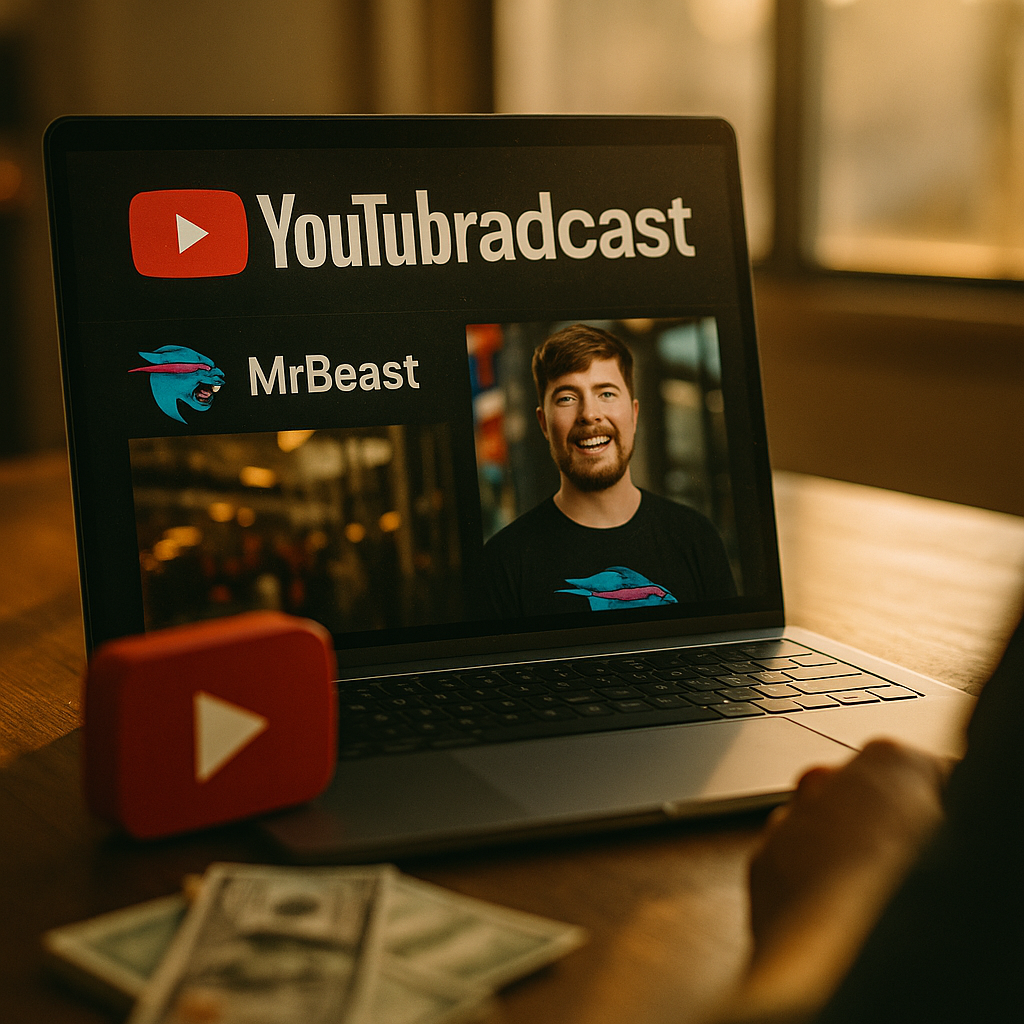
MrBeast at Upfronts Changes Everything
When was the last time a creator headlined a TV upfront? YouTube Brandcast put MrBeast on stage alongside legacy network talent, and that signal alone should force every media buyer with a linear TV budget to ask a hard question: what exactly are you still buying on broadcast?
YouTube’s upfront presentation made a structural argument, not just a sales pitch. Creator inventory, video podcasts, and music-video ad formats are now positioned as premium buys, not supplemental placements. If your annual budget still defaults to linear TV as the anchor and creator spend as a rounding error, Brandcast is telling you that logic is inverted.
YouTube now reaches more adults 18–49 on connected TV than any single linear network — a statistic the platform has leaned on for three consecutive upfront cycles. At Brandcast, that claim came backed by co-viewing data showing household watch sessions on TV screens now rival primetime broadcast numbers.
What the New Ad Formats Actually Mean for Creative Operations
Two formats dominated the Brandcast reveal: creator-integrated video podcast sponsorships and music-video adjacent ad units. Both require brands to rethink more than just placement. They require a creative operations overhaul.
Video podcast inventory on YouTube works differently from pre-roll. Sponsors integrate into long-form conversational content where skip behavior is lower and contextual relevance drives recall. The production expectation is closer to what you’d negotiate for a podcast host read, except you’re now also managing visual brand safety across a 60-plus-minute video frame. Your existing 30-second TV spot will not perform here. It may not even be accepted.
Music-video adjacency units sit in a different behavioral moment entirely. Viewers in music content are passive, lean-back, high-frequency users. The format rewards reach over engagement depth. For brand awareness objectives, that’s compelling. For conversion-focused campaigns, it’s a poor fit unless paired with retargeting layers through Google’s ad ecosystem. The key operational mistake brands will make is applying one creative brief across both formats. They serve different psychological states.
If your team is still working from a brief template designed for broadcast, you need to address that before upfront commitments land. The shift in how brands write creative direction for creators is already accelerating, and the gap between brief vs. script thinking is where most campaign underperformance originates.
The Creator Inventory Pricing Reality Nobody Wants to Say Out Loud
MrBeast appearing at Brandcast is not just cultural validation. It’s a pricing signal. When YouTube positions top-tier creator inventory at the upfront level, it normalizes premium CPMs for creator placements that many media buyers have historically pushed back on.
Creator earnings have surged significantly, and the brands that locked in long-term rates before the upfront positioning shift are in a structurally better negotiating position than those entering the market now. For context on where creator rate strategy is heading, the leverage has shifted decisively toward talent.
Upfront commitments for creator inventory are becoming a real consideration. YouTube’s Brandcast explicitly invited brands to treat creator buys with the same advance planning discipline they apply to network upfronts. That means annual deal structures, guaranteed impressions, and content calendars negotiated months out. If your procurement team isn’t building that muscle, a competitor’s is.
The contract complexity is also escalating. Creator contracts increasingly mirror entertainment industry standards — exclusivity windows, IP ownership clauses, usage rights for paid amplification. Media buyers who treat creator agreements as simple influencer deliverable sheets are creating legal and financial exposure for their brands.
Restructuring Annual Budget: A Framework That Actually Works
Let’s be specific about what reallocation looks like in practice. The Brandcast signals point to three shifts that should inform how you build your video budget for the next planning cycle.
First, anchor audience data to connected TV behavior, not linear ratings. YouTube’s co-viewing data shows that a substantial portion of its watch time now happens on TV screens in household settings. That means your traditional linear TV reach argument weakens further every quarter. The audience is moving; the budget should follow.
Second, build a creator tier that functions like a media plan. Not every creator placement serves the same objective. Mega-creators like MrBeast operate as brand awareness vehicles at scale, comparable to a primetime buy. Mid-tier creators (500K to 5M subscribers) drive consideration and affinity. Nano and micro-tier creators, when deployed strategically through interest-graph targeting, often outperform on conversion efficiency. For a deeper breakdown of how nano-creator ROI works against algorithmic distribution, the math is more favorable than most planning teams assume.
Third, treat video podcast sponsorships as a separate line item, not a social media catchall. The audience behavior, CPM structure, and creative requirements are distinct. Brands that lump podcast video into a generic “influencer” budget category will consistently under-resource it and see proportionally weaker results.
- Shift 10–15% of linear TV budget to creator-native YouTube inventory in Q3 planning
- Reserve separate creative production budget for video podcast integration formats
- Negotiate music-video adjacency units as reach plays, not conversion plays
- Lock upfront creator commitments 90 days earlier than your current timeline
- Align legal review timelines with entertainment-tier contract complexity
Risk Factors Media Buyers Are Underweighting
Brandcast makes creator inventory look clean and scalable. The pitch is polished. But media buyers need to stress-test a few operational risks before reallocating significant budget.
Brand safety in long-form video podcast content is harder to audit than a 30-second pre-roll. A 90-minute podcast episode with a mid-roll sponsor read can drift into off-message territory in ways your brand safety vendor’s keyword blocklist won’t catch. You need creator-specific vetting protocols, not just platform-level controls. The IAB vetting frameworks offer a starting structure, though most sophisticated buyers will need to build internal overlay criteria specific to their category.
Measurement is the other gap. Linear TV has imperfect measurement, but it’s consistent and comparable across buys. Creator inventory measurement remains fragmented. YouTube’s native analytics are strong within the platform but don’t integrate cleanly with cross-channel attribution models most enterprise brands rely on. Until you solve that attribution problem, your CFO will have legitimate questions about the reallocation case you’re making. Reference external benchmarks from eMarketer’s video ad data and build a parallel measurement framework before the first campaign launches.
Disclosure compliance is also non-negotiable and increasingly scrutinized. The FTC’s endorsement guidelines apply fully to creator-integrated formats, including video podcast sponsorships. Any brand moving serious budget into creator inventory without a disclosure audit process is accumulating regulatory risk at scale.
The brands that will extract the most value from YouTube’s creator upfront positioning aren’t the ones moving the most money — they’re the ones who build the internal infrastructure to buy, measure, and govern creator inventory at the same operational rigor they apply to linear TV.
The Broadcast Budget Question Is No Longer Hypothetical
For years, the “shift budget from linear TV to digital” argument was framed as a gradual evolution. Brandcast signals it’s now a structural decision with a deadline. Statista’s streaming penetration data consistently shows linear TV’s share of viewing time contracting across every demographic under 55. YouTube’s connected TV growth compounds that pressure.
The planning question for your next annual cycle isn’t whether to reallocate. It’s how quickly you can build the operational capability to deploy creator inventory at scale without sacrificing the rigor your current linear buys deliver. Distribution strategy matters enormously here. Understanding how algorithmic reach works for creator content is foundational to making that case internally.
Start your next planning cycle with a zero-based view of your video budget. Rebuild it from audience behavior up, not from historical channel allocation down. MrBeast on the Brandcast stage isn’t a novelty. It’s a benchmark.
Frequently Asked Questions
What is YouTube Brandcast and why does it matter for media buyers?
YouTube Brandcast is YouTube’s annual upfront presentation targeting media buyers and brand advertisers. It functions similarly to television network upfronts, where platforms showcase content, creators, and ad formats to encourage advance budget commitments. It matters for media buyers because it signals where YouTube is investing platform support, which ad formats will receive algorithmic priority, and which creator partnerships will be positioned as premium buys for the coming year.
How should brands think about video podcast sponsorships on YouTube versus traditional podcast audio ads?
YouTube video podcast sponsorships introduce a visual dimension that audio podcast ads lack. Brands must account for on-screen brand presentation, visual brand safety across long-form content, and the expectation that creative will feel native to the host’s visual format. CPMs are generally higher than audio podcast equivalents, but skip rates tend to be lower in engaged podcast audiences. Treat them as a distinct line item with separate creative production budgets and specific measurement KPIs.
What does MrBeast’s appearance at YouTube Brandcast mean for creator pricing?
It signals that YouTube is positioning top-tier creator inventory at the same prestige level as broadcast network placements. When mega-creators appear at upfronts, it normalizes premium CPM expectations and encourages brands to negotiate creator deals with the same advance planning discipline as network buys. Expect rate pressure to increase for top-tier YouTube creators, particularly those with strong connected TV viewership and cross-format content libraries.
How should media buyers approach brand safety for long-form YouTube creator content?
Platform-level keyword blocklists are insufficient for long-form video podcast content. Media buyers should implement creator-specific pre-approval protocols, review recent episode content before committing to sponsorships, and establish contractual content guardrails covering topics the creator agrees not to address during sponsored segments. IAB vetting frameworks provide a baseline, but category-specific overlay criteria are necessary for most brand categories.
What percentage of linear TV budget should brands consider reallocating to YouTube creator inventory?
There is no universal figure, but a defensible starting point for most mid-to-large brands is reallocating 10–15% of existing linear TV budget toward YouTube creator and video podcast inventory in the next annual planning cycle. The right percentage depends on your target demographic’s streaming vs. linear viewing split, your campaign objectives (awareness vs. conversion), and your team’s operational readiness to manage creator inventory at scale. Brands targeting adults under 45 should weight the reallocation more aggressively given linear TV’s declining reach in that cohort.
How do music-video ad formats on YouTube differ from standard pre-roll placements?
Music-video adjacency units reach audiences in a passive, lean-back consumption mode with high repeat-viewing frequency. Unlike standard pre-roll, which interrupts active content seeking, music-video formats work best for brand awareness and recall objectives. Conversion-focused campaigns generally underperform in this context unless supported by retargeting layers. Creative should prioritize visual impact and brand recognition over call-to-action messaging.
Top Influencer Marketing Agencies
The leading agencies shaping influencer marketing in 2026
Agencies ranked by campaign performance, client diversity, platform expertise, proven ROI, industry recognition, and client satisfaction. Assessed through verified case studies, reviews, and industry consultations.
Moburst

-
2

The Shelf
Boutique Beauty & Lifestyle Influencer AgencyA data-driven boutique agency specializing exclusively in beauty, wellness, and lifestyle influencer campaigns on Instagram and TikTok. Best for brands already focused on the beauty/personal care space that need curated, aesthetic-driven content.Clients: Pepsi, The Honest Company, Hims, Elf Cosmetics, Pure LeafVisit The Shelf → -
3

Audiencly
Niche Gaming & Esports Influencer AgencyA specialized agency focused exclusively on gaming and esports creators on YouTube, Twitch, and TikTok. Ideal if your campaign is 100% gaming-focused — from game launches to hardware and esports events.Clients: Epic Games, NordVPN, Ubisoft, Wargaming, Tencent GamesVisit Audiencly → -
4

Viral Nation
Global Influencer Marketing & Talent AgencyA dual talent management and marketing agency with proprietary brand safety tools and a global creator network spanning nano-influencers to celebrities across all major platforms.Clients: Meta, Activision Blizzard, Energizer, Aston Martin, WalmartVisit Viral Nation → -
5

The Influencer Marketing Factory
TikTok, Instagram & YouTube CampaignsA full-service agency with strong TikTok expertise, offering end-to-end campaign management from influencer discovery through performance reporting with a focus on platform-native content.Clients: Google, Snapchat, Universal Music, Bumble, YelpVisit TIMF → -
6

NeoReach
Enterprise Analytics & Influencer CampaignsAn enterprise-focused agency combining managed campaigns with a powerful self-service data platform for influencer search, audience analytics, and attribution modeling.Clients: Amazon, Airbnb, Netflix, Honda, The New York TimesVisit NeoReach → -
7

Ubiquitous
Creator-First Marketing PlatformA tech-driven platform combining self-service tools with managed campaign options, emphasizing speed and scalability for brands managing multiple influencer relationships.Clients: Lyft, Disney, Target, American Eagle, NetflixVisit Ubiquitous → -
8

Obviously
Scalable Enterprise Influencer CampaignsA tech-enabled agency built for high-volume campaigns, coordinating hundreds of creators simultaneously with end-to-end logistics, content rights management, and product seeding.Clients: Google, Ulta Beauty, Converse, AmazonVisit Obviously →