


Most Brands Are Automating the Wrong Thing
Sixty-three percent of marketing teams using generative AI report at least one brand voice inconsistency per campaign cycle. The problem is not the AI. The problem is the absence of a human-override policy built into the workflow before the first asset goes live. Adobe’s production philosophy, which separates asset generation from brand stewardship, gives creative directors a concrete operating model to fix this.
The Taste-and-Storytelling Model, Explained
Adobe’s internal creative teams operate on a principle that most agencies are still learning: AI is a production engine, not a creative authority. The model splits creative work into two distinct lanes. In the first lane, AI handles volume: image variants, copy iterations, format adaptations, localized asset resizes, A/B test permutations. In the second lane, human creative directors exercise taste, judgment, and narrative coherence. They decide whether an asset actually sounds like the brand, whether the emotional register is right, and whether the story arc across a campaign holds together.
This is not a philosophical position. It is an operational one. And it has direct implications for how you structure approval gates, set automation thresholds, and define the exact moments a human must step in before content ships.
AI generates at scale. Humans protect the signal. The brands that confuse these two functions will produce more content and mean less with every piece they publish.
Why Creative Directors Are the Last Line of Brand Defense
Consider what happens inside a typical automated campaign workflow on a platform like Meta’s ad system or Google’s Performance Max. The system dynamically assembles headlines, images, and calls to action based on performance signals. It optimizes for clicks, conversions, and cost-per-acquisition. It does not optimize for whether your brand sounds like itself. It does not know that your brand never uses urgency language, or that your tone is warm and advisory rather than promotional and pressured.
Left unchecked, automated assembly will gradually erode the stylistic and tonal distinctiveness that makes a brand recognizable. The assets perform. The brand degrades. This is the risk creative directors are specifically positioned to counter, and it requires more than a style guide PDF that lives in a shared folder no AI system ever reads.
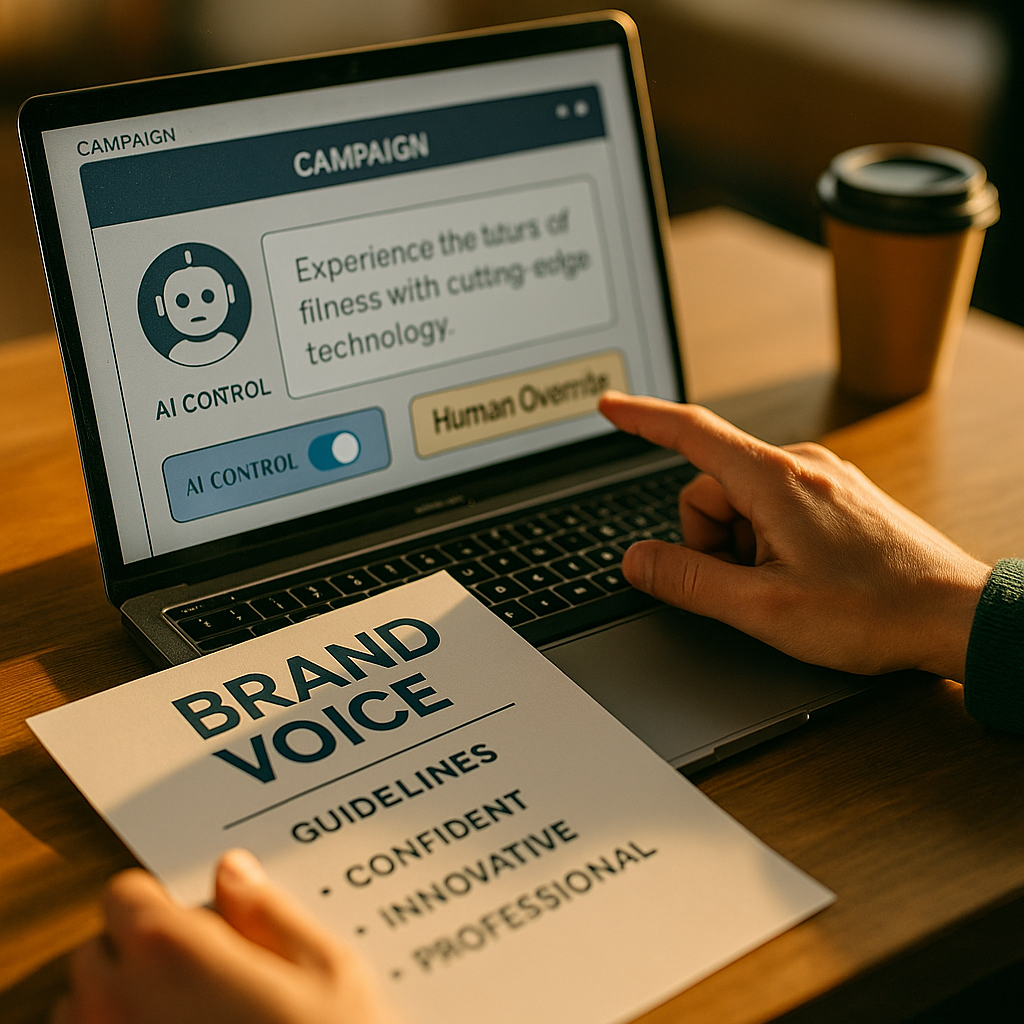
The solution is a structured human-override policy: a documented, enforceable set of rules specifying which creative decisions require human review before automation can execute. Think of it as the constitution for your AI production environment. The generative AI governance frameworks most CMOs are building right now need this layer baked in, not bolted on afterward.
Building Your Human-Override Policy: Four Operational Layers
A workable override policy is not a checklist. It is a tiered decision architecture. Here is how to build it across four layers:
- Mandatory human approval gates. Identify the creative decisions where no AI output ships without a human sign-off. These typically include: campaign-level tone direction, any content touching sensitive brand categories (crisis response, social commentary, new product positioning), and any asset that will run in a format the brand has not previously used at scale.
- Supervised automation zones. Define where AI can generate and queue assets for human spot-check rather than full review. Volume creative for retargeting, size adaptations of already-approved hero assets, and localized copy variations based on approved source copy all qualify here. A human reviews samples, not every unit.
- Fully autonomous zones with guardrails. Establish where AI operates without human review per asset, but within tightly defined parameters your team has already approved. This includes things like dynamic pricing callouts within a confirmed range, personalized subject lines drawn from a pre-approved vocabulary set, or image cropping within brand-safe compositions. The guardrails are the policy. AI executes inside them.
- Override triggers. Specify the conditions under which automation must pause and escalate to a human regardless of where the asset falls in the above tiers. Examples: a sentiment shift in the campaign environment, a breaking news event in your category, performance anomalies that suggest the AI is optimizing toward an unintended audience segment.
This architecture lets you capture AI’s speed advantage without surrendering creative control. And it gives your operations team something they can actually enforce, audit, and iterate.
What Adobe Gets Right That Most Brands Miss
Adobe’s creative philosophy makes a distinction that most brand teams paper over: the difference between aesthetic judgment and production execution. Aesthetic judgment requires cultural context, emotional intelligence, and knowledge of what a brand has stood for across years of consumer relationships. Production execution requires speed, consistency, and computational scale. These are genuinely different capabilities.
When brands assign both to AI, they typically get efficient production and degraded judgment. When they assign both to humans, they get sound judgment and throttled production. Adobe’s model assigns each function to the party actually capable of doing it well.
For creative directors, this means redefining your role. Your job is not to make every asset. Your job is to set the taste parameters that constrain how every asset gets made, to review the outputs that fall outside those parameters, and to continuously refine the system based on what you see. This is closer to an editorial director role than a traditional art director role. And it requires a different kind of presence in the workflow: earlier in the process and more systematic in how you encode your standards.
Tools like Adobe GenStudio are built around exactly this model, allowing creative directors to establish brand kits, tone profiles, and approved asset libraries that constrain generative outputs before the AI ever starts producing. The constraint is the creative leadership, not the review at the end.
Connecting Override Policies to Campaign Automation in Practice
When you are running AI-driven asset production alongside sentiment-based distribution logic, the override policy needs to integrate with both systems. A campaign that auto-adapts creative based on real-time sentiment signals, for example, needs a defined escalation path for when those signals move outside the range your policy covers.
Practically, this means your override policy document should be a living artifact that your creative ops team updates as new automation capabilities come online. It should be reviewed every time you add a new platform, a new AI tool, or a new campaign type. And it should include explicit naming of who holds override authority at each tier, because ambiguity about decision ownership in automated workflows is where brand voice incidents originate.
For brands running influencer and creator programs, the same logic applies at the content brief level. When AI tools are generating creator briefs or flagging content for compliance, human creative directors should be defining the brand voice standards that the AI is checking against. See how leading programs are approaching influencer campaign activation with risk controls built into the workflow from the start.
There is also a governance infrastructure question worth addressing. Your override policy is only as durable as the data and tooling that supports it. If your AI systems are operating on stale brand guidelines or undocumented tone standards, no policy will close the gap. Before you formalize override tiers, run a hard audit of what brand voice documentation actually exists in a format your AI systems can use. The AI ad governance work most brands need to do precedes the automation, not follows it.
A human-override policy is only as strong as the brand standards it enforces. If your AI is working from a vague style guide, your override policy is just a speed bump, not a brand safeguard.
Risk Framing for Budget and Compliance Stakeholders
Creative directors often need to justify override policies to stakeholders who see human review as a bottleneck. The frame that works: brand voice degradation has measurable downstream costs. Research from Edelman’s trust research consistently shows that brand inconsistency correlates with reduced consumer trust scores over time. Rebuilding trust after a visible brand voice failure costs more than the human review hours you saved by removing the override gate.
The compliance angle is equally important. As the FTC continues to expand its scrutiny of AI-generated content and automated advertising claims, having documented human review points in your workflow is not just good creative practice. It is a risk mitigation record. If a claim in an auto-generated ad is challenged, your override policy documentation is the evidence that a human had an opportunity to catch it.
For performance-focused CMOs, the integration of override policies with attribution models matters too. When AI is simultaneously generating assets and optimizing distribution, understanding which human-approved versus fully automated assets are driving conversion requires clean tagging at the source. This connects directly to how multi-touch attribution models need to account for creative provenance, not just channel touchpoints. And if your team wants to pressure-test whether your AI marketing stack is actually performing, Sprout Social’s benchmarking tools can surface engagement pattern anomalies that signal creative drift before it becomes a brand problem.
Start this week: map every active automated workflow against the four-tier framework above, identify which tier each one currently falls into, and flag any workflow operating in a tier with no documented override authority. That gap list is your override policy roadmap.
FAQs
What is the taste-and-storytelling model in AI creative production?
It is a production framework, associated with Adobe’s internal creative approach, that assigns AI systems the task of generating assets at volume while reserving aesthetic judgment, brand voice decisions, and narrative coherence for human creative directors. The model treats AI as a production engine and humans as editorial authorities.
What should a human-override policy include in an automated campaign workflow?
A robust override policy should define at minimum: which creative decisions require mandatory human approval before any AI output ships, which zones allow supervised automation with spot-check review, which zones allow fully autonomous AI execution within pre-approved guardrails, and what triggers require the automation to pause and escalate to a human regardless of tier.
How do creative directors encode brand voice for AI systems?
The most effective approach is to build structured brand kits, tone profiles, and approved vocabulary sets within the AI production tools you are using, such as Adobe GenStudio or similar platforms. These constraints operate at the input stage, limiting what the AI generates rather than relying solely on review at the output stage.
Why is a human-override policy relevant for compliance and legal risk?
Regulators including the FTC are increasing scrutiny of AI-generated advertising content and automated claims. Having documented human review points in your campaign workflow creates an audit trail showing that responsible human oversight was built into the process. This is meaningful evidence if an automated asset generates a compliance challenge.
How often should a human-override policy be updated?
The policy should be treated as a living document reviewed every time you add a new AI tool, a new platform, or a new campaign type to your workflow. At minimum, a formal review should occur quarterly or any time a brand voice incident occurs in an automated campaign, using the incident as diagnostic input for policy refinement.
Top Influencer Marketing Agencies
The leading agencies shaping influencer marketing in 2026
Agencies ranked by campaign performance, client diversity, platform expertise, proven ROI, industry recognition, and client satisfaction. Assessed through verified case studies, reviews, and industry consultations.
Moburst

-
2

The Shelf
Boutique Beauty & Lifestyle Influencer AgencyA data-driven boutique agency specializing exclusively in beauty, wellness, and lifestyle influencer campaigns on Instagram and TikTok. Best for brands already focused on the beauty/personal care space that need curated, aesthetic-driven content.Clients: Pepsi, The Honest Company, Hims, Elf Cosmetics, Pure LeafVisit The Shelf → -
3

Audiencly
Niche Gaming & Esports Influencer AgencyA specialized agency focused exclusively on gaming and esports creators on YouTube, Twitch, and TikTok. Ideal if your campaign is 100% gaming-focused — from game launches to hardware and esports events.Clients: Epic Games, NordVPN, Ubisoft, Wargaming, Tencent GamesVisit Audiencly → -
4

Viral Nation
Global Influencer Marketing & Talent AgencyA dual talent management and marketing agency with proprietary brand safety tools and a global creator network spanning nano-influencers to celebrities across all major platforms.Clients: Meta, Activision Blizzard, Energizer, Aston Martin, WalmartVisit Viral Nation → -
5

The Influencer Marketing Factory
TikTok, Instagram & YouTube CampaignsA full-service agency with strong TikTok expertise, offering end-to-end campaign management from influencer discovery through performance reporting with a focus on platform-native content.Clients: Google, Snapchat, Universal Music, Bumble, YelpVisit TIMF → -
6

NeoReach
Enterprise Analytics & Influencer CampaignsAn enterprise-focused agency combining managed campaigns with a powerful self-service data platform for influencer search, audience analytics, and attribution modeling.Clients: Amazon, Airbnb, Netflix, Honda, The New York TimesVisit NeoReach → -
7

Ubiquitous
Creator-First Marketing PlatformA tech-driven platform combining self-service tools with managed campaign options, emphasizing speed and scalability for brands managing multiple influencer relationships.Clients: Lyft, Disney, Target, American Eagle, NetflixVisit Ubiquitous → -
8

Obviously
Scalable Enterprise Influencer CampaignsA tech-enabled agency built for high-volume campaigns, coordinating hundreds of creators simultaneously with end-to-end logistics, content rights management, and product seeding.Clients: Google, Ulta Beauty, Converse, AmazonVisit Obviously →