


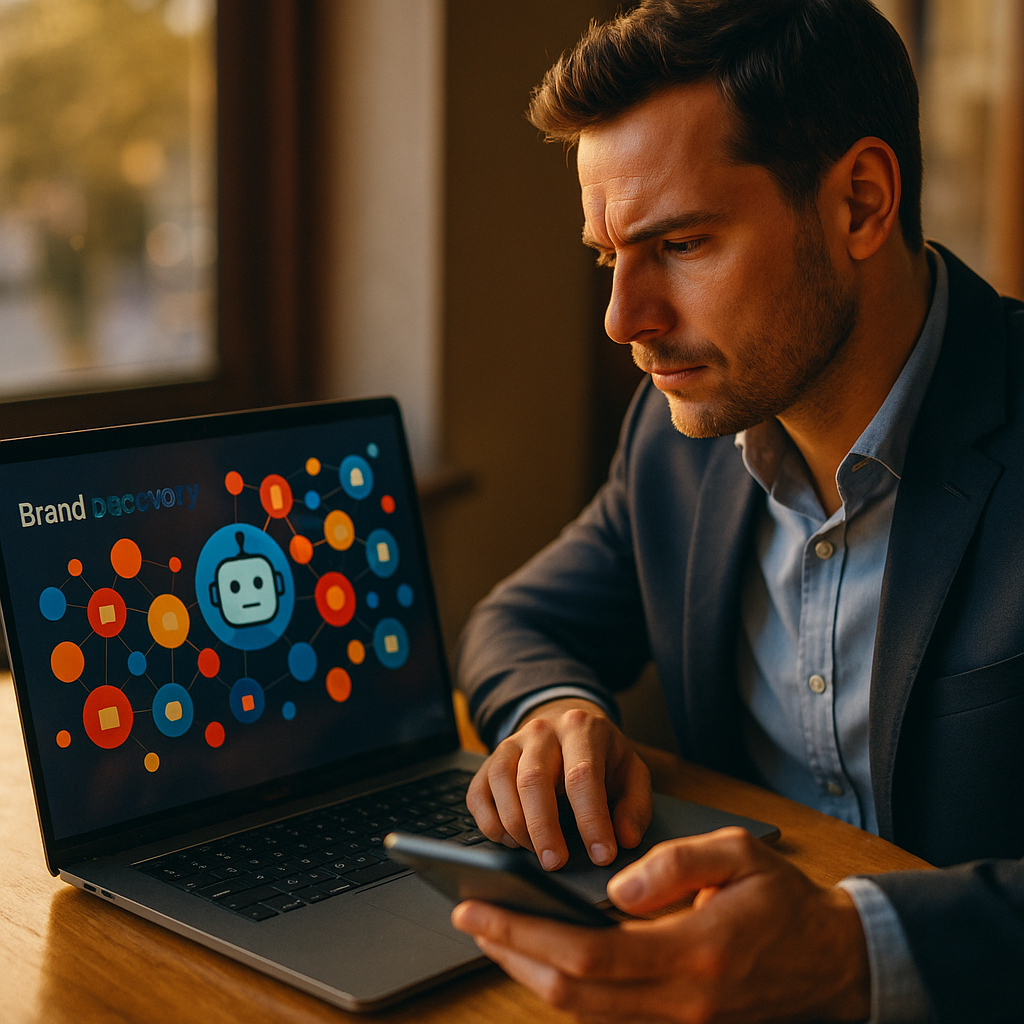
Your Brand May Already Be Invisible to the Next Generation of Buyers
When an AI agent recommends products on behalf of a consumer, your SEO strategy, your paid search budget, and your influencer content may not even be in the room. AI-driven product discovery is no longer a future concern — it is the operating reality CMOs need to build against right now. The brands that protect visibility in this environment will not be the ones with the biggest ad spend. They will be the ones with the strongest signals.
How AI Agents Are Changing the First Step of Discovery
Historically, discovery happened through search engine results pages, social feeds, or word-of-mouth. A consumer had a need, typed a query, and encountered your brand somewhere in the results. You could buy your way into that moment. You could optimize for it. You had levers.
AI agents — think Perplexity, Google’s AI Overviews, ChatGPT’s shopping capabilities, and the emerging wave of autonomous shopping agents from Amazon and Apple — are collapsing that funnel. The agent interprets the need, evaluates options from its training data and real-time retrieval sources, and delivers a recommendation. The consumer may never see your product page. They may never encounter your creative. The agent decides.
According to eMarketer research, AI-powered search and recommendation tools are already influencing purchase consideration across retail categories at a rate that would have seemed implausible three years ago. The shift is not incremental. It is structural.
Brands that cannot demonstrate trustworthiness through community signals, structured data, and authentic customer relationships will be systematically deprioritized by AI recommendation engines — not penalized, just absent.
Three Pillars CMOs Need to Prioritize Now
The playbook for AI-era discovery rests on three interdependent pillars: customer relationship depth, community engagement signals, and structured product data. None of these is new as a concept. What is new is how directly they feed the systems making recommendations on your behalf or against you.
Pillar 1: Customer Relationships as Signal Infrastructure
First-party data has been the industry’s rallying cry for several years. But in the AI discovery context, the value is not just in targeting. It is in demonstrating the legitimacy and longevity of a brand’s customer base to external systems that learn from user behavior, review ecosystems, and engagement patterns.
Brands with deep loyalty program data, verified purchase histories, and high volumes of authentic review content are more likely to be surfaced by AI agents trained on retrieval-augmented generation (RAG) models. These models pull from sources they deem authoritative and credible. A brand with 50,000 verified reviews on multiple platforms has a fundamentally different data profile than a brand with 200 generic testimonials buried in a website footer.
The operational implication: review generation programs, customer re-engagement cadences, and post-purchase feedback loops are no longer just CRM hygiene. They are AI discoverability infrastructure. Your CRM team and your AI strategy team need to be in the same conversation.
Pillar 2: Community Engagement as a Discoverability Signal
AI systems learn from the web. Community forums, Reddit threads, YouTube comment sections, and niche Facebook Groups all contribute to the corpus from which large language models draw their understanding of brand reputation and category relevance. This is not a peripheral factor. It is a primary one.
As we have covered in our analysis of community engagement signals that drive LLM discoverability, authentic discussion volume, sentiment consistency, and the presence of expert voices in brand-adjacent communities measurably affect how often a brand surfaces in AI-generated recommendations.
The practical implication for CMOs: organic community investment needs a budget line, not just a hashtag. Supporting forums, sponsoring communities, engaging with user-generated content systematically, and deploying creators who actually participate in category conversations (not just post and leave) all build the kind of signal density that AI systems recognize.
Critically, this is also where influencer strategy intersects with AI discoverability in ways most brands have not fully mapped. Creators who generate persistent, community-embedded conversations about your product category are contributing to your LLM footprint. As noted in the creator content investment for the AI answer layer framework, the distinction between a creator post and a creator-driven community thread is becoming one of the most important distinctions in media planning.
Pillar 3: Structured Product Data — The Unsexy Priority
Schema markup, product feeds, and structured data standards are the least glamorous item on this list. They are also, increasingly, the most operationally critical.
AI agents that perform product discovery often rely on machine-readable data to understand what a product is, what it costs, who manufactures it, what its specifications are, and what reviewers have said about it. If your product data is incomplete, inconsistently formatted across platforms, or absent from key data aggregators, AI agents simply cannot confidently recommend you. Confidence, for a language model, is derived partly from data completeness.
Schema.org product markup, Google Merchant Center feeds, and platforms like Salsify for product content management are not optional infrastructure for brands competing in AI-mediated discovery. They are table stakes. If your e-commerce team has deprioritized structured data audits, that decision now carries significant brand visibility risk.
The CMO’s Coordination Problem
Here is the uncomfortable truth most playbooks skip: the three pillars above are owned by different teams in almost every organization. Customer relationships live with CRM or loyalty. Community engagement sits with social or brand. Structured data is an e-commerce or IT problem. AI discovery falls on no one’s desk consistently.
The brands that will win this transition are the ones where a CMO explicitly owns the coordination layer. This is not about creating a new AI team. It is about recognizing that the signals feeding AI recommendation systems are generated across your entire marketing and product operation, and someone needs to be accountable for their cumulative quality.
As the Bain AI maturity model for CMOs framework makes clear, organizational readiness is often the actual constraint, not technology. The tools exist. The cross-functional alignment frequently does not.
Consider also how this coordination failure shows up in influencer strategy. Creators are briefed to generate awareness content but are rarely given structured direction on the kinds of community conversations, review prompts, or search-optimized content that actually contribute to LLM discoverability. Tightening creator brief architecture to include AI discoverability objectives is a low-cost, high-leverage fix that most brands have not made yet.
The gap between brands that understand AI discovery and brands that are still optimizing for 2021-era search behavior is compounding every quarter. The cost of catching up grows as LLMs update their training data and reinforce existing brand associations.
Risk Mitigation: What Happens When You Get It Wrong
The downside scenario deserves explicit attention. If a brand has low review volume, poor sentiment in community forums, incomplete product data, and no systematic creator strategy oriented toward LLM signals, the risk is not just suboptimal discovery. It is active displacement by competitors who have invested in these pillars.
AI agents optimizing for consumer satisfaction will surface the brand with better signal quality. This creates a compounding disadvantage: lower AI visibility leads to fewer purchases, which leads to fewer reviews, which leads to even lower AI visibility. Brands that recognize this loop early enough to interrupt it will build a durable advantage. Brands that recognize it late will face a structural recovery problem.
The AI marketing performance stall many brands are already experiencing often traces back to exactly this dynamic, even when teams attribute it to algorithm changes or creative fatigue.
For additional context on how AI systems evaluate brand authority and content credibility, Google’s own Search Central documentation and HubSpot’s research on content authority signals both provide relevant frameworks that translate to AI recommendation contexts.
Platform-Specific Considerations
Not all AI agents weigh signals equally. Perplexity leans heavily on cited sources and community discussion depth. Google’s AI Overviews favor schema-enriched content with strong E-E-A-T signals. ChatGPT’s shopping integrations increasingly pull from verified merchant data and review aggregators. Amazon’s Rufus assistant draws on product listing quality, review volume, and purchase velocity data.
The implication: a single AI discoverability strategy will not serve every surface. CMOs need a platform-aware approach that maps each agent’s known data sources against the brand’s current signal strength per channel, then prioritizes investments accordingly. This is portfolio-level thinking applied to a new media layer.
The Concrete Next Step
Run a discovery signal audit before your next planning cycle: map your review volume and sentiment across the top five platforms where AI agents retrieve data, assess your Schema.org product markup completeness against your top 20 SKUs, and identify which creator partnerships are generating persistent community conversations versus ephemeral posts. Those three diagnostics will surface your biggest vulnerability and your fastest fix.
Frequently Asked Questions
What is AI-driven brand discovery and why does it matter for CMOs?
AI-driven brand discovery refers to the process by which AI agents — such as ChatGPT, Perplexity, Google’s AI Overviews, and autonomous shopping assistants — evaluate and recommend products or brands on behalf of consumers, often before the consumer visits any brand-owned channel. It matters for CMOs because these agents increasingly control the first step of the purchase journey, and brands with weak community signals, incomplete product data, or shallow customer relationships risk being systematically excluded from AI-generated recommendations regardless of their ad spend.
How does community engagement influence LLM-based product recommendations?
Large language models are trained on and retrieve from public web content including forums, review platforms, social media, and community discussions. Brands with high volumes of authentic, positive community engagement — real conversations in Reddit threads, YouTube comments, niche forums, and social groups — create a denser, more credible data footprint. This footprint influences how confidently an LLM associates a brand with a product category and whether it surfaces that brand in a recommendation.
What structured data elements are most important for AI discoverability?
The most impactful structured data elements for AI product discovery include Schema.org product markup (covering name, description, price, availability, and aggregate ratings), Google Merchant Center feed completeness, product data syndication across major retail platforms, and verified review schema. Brands should also ensure their product data is consistent across all surfaces where AI agents retrieve information, including third-party retailers and data aggregators.
How should CMOs adjust influencer briefs to support AI discoverability?
Influencer briefs should explicitly include AI discoverability objectives alongside traditional awareness and engagement goals. This means directing creators to participate in ongoing community conversations rather than just posting and exiting, encouraging creators to generate long-form content that can be indexed and retrieved by search-integrated AI tools, and requesting that creators prompt their audiences to leave verified reviews on key platforms. These are measurable brief additions that compound over time into a stronger LLM signal profile for the brand.
Is AI discovery a threat primarily to smaller brands or does it affect major brands too?
AI discovery dynamics affect brands at every scale, but the nature of the risk differs. Smaller brands are more likely to be absent from AI recommendations due to low data volume. Larger brands face the risk of being displaced within their category if a well-structured competitor builds a stronger community and data signal profile. For major brands, the additional risk is brand misrepresentation — AI agents surfacing outdated, inaccurate, or context-free information if structured data is not actively maintained.
Top Influencer Marketing Agencies
The leading agencies shaping influencer marketing in 2026
Agencies ranked by campaign performance, client diversity, platform expertise, proven ROI, industry recognition, and client satisfaction. Assessed through verified case studies, reviews, and industry consultations.
Moburst

-
2

The Shelf
Boutique Beauty & Lifestyle Influencer AgencyA data-driven boutique agency specializing exclusively in beauty, wellness, and lifestyle influencer campaigns on Instagram and TikTok. Best for brands already focused on the beauty/personal care space that need curated, aesthetic-driven content.Clients: Pepsi, The Honest Company, Hims, Elf Cosmetics, Pure LeafVisit The Shelf → -
3

Audiencly
Niche Gaming & Esports Influencer AgencyA specialized agency focused exclusively on gaming and esports creators on YouTube, Twitch, and TikTok. Ideal if your campaign is 100% gaming-focused — from game launches to hardware and esports events.Clients: Epic Games, NordVPN, Ubisoft, Wargaming, Tencent GamesVisit Audiencly → -
4

Viral Nation
Global Influencer Marketing & Talent AgencyA dual talent management and marketing agency with proprietary brand safety tools and a global creator network spanning nano-influencers to celebrities across all major platforms.Clients: Meta, Activision Blizzard, Energizer, Aston Martin, WalmartVisit Viral Nation → -
5

The Influencer Marketing Factory
TikTok, Instagram & YouTube CampaignsA full-service agency with strong TikTok expertise, offering end-to-end campaign management from influencer discovery through performance reporting with a focus on platform-native content.Clients: Google, Snapchat, Universal Music, Bumble, YelpVisit TIMF → -
6

NeoReach
Enterprise Analytics & Influencer CampaignsAn enterprise-focused agency combining managed campaigns with a powerful self-service data platform for influencer search, audience analytics, and attribution modeling.Clients: Amazon, Airbnb, Netflix, Honda, The New York TimesVisit NeoReach → -
7

Ubiquitous
Creator-First Marketing PlatformA tech-driven platform combining self-service tools with managed campaign options, emphasizing speed and scalability for brands managing multiple influencer relationships.Clients: Lyft, Disney, Target, American Eagle, NetflixVisit Ubiquitous → -
8

Obviously
Scalable Enterprise Influencer CampaignsA tech-enabled agency built for high-volume campaigns, coordinating hundreds of creators simultaneously with end-to-end logistics, content rights management, and product seeding.Clients: Google, Ulta Beauty, Converse, AmazonVisit Obviously →