


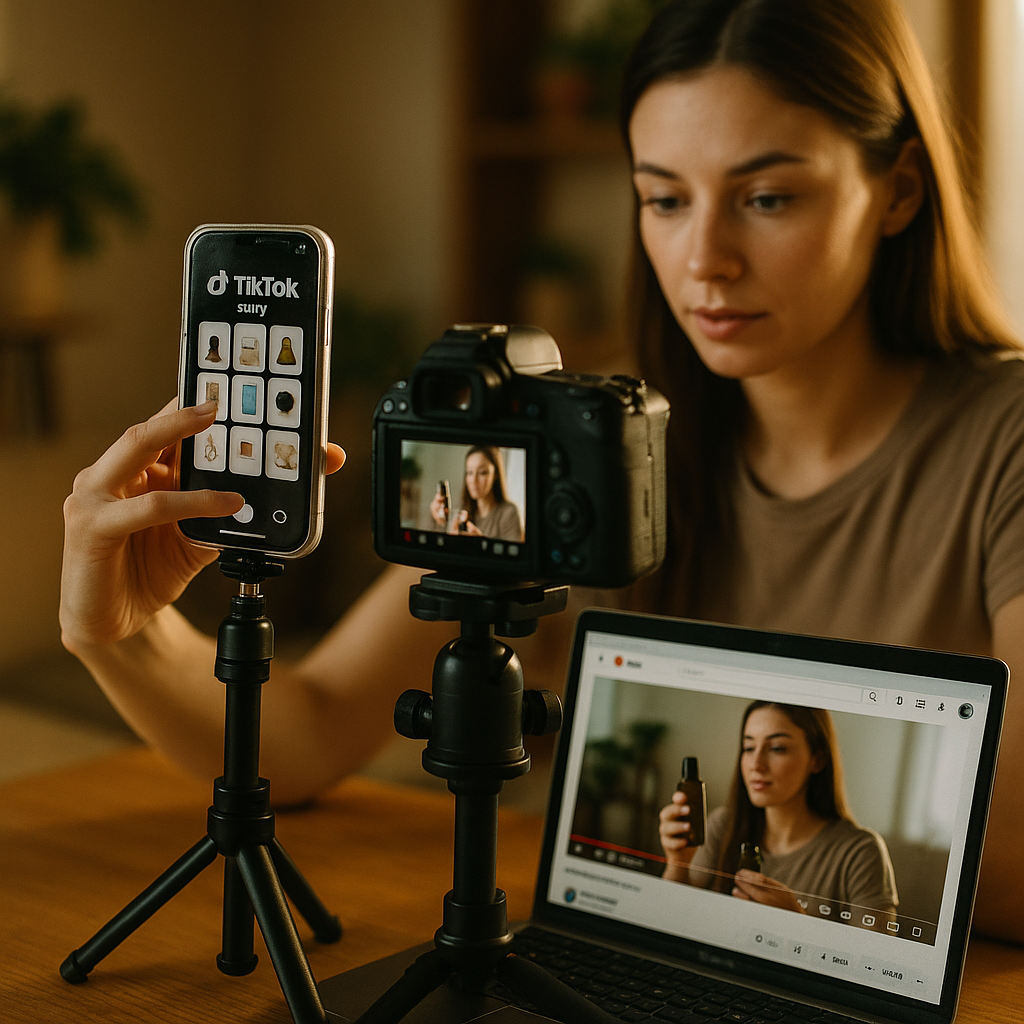
The average consumer touches five screens before making a purchase decision. They scroll TikTok while a YouTube video autoplays on the TV behind them, then pivot to Google — or increasingly, ChatGPT — to confirm a product claim before hitting buy. If your creator brief was written for a single platform, you are already losing that consumer at step two.
Why Single-Platform Briefs Are a Production Tax
Most brand teams still operate in silos: a TikTok brief, a YouTube brief, a product description brief, each written separately, each triggering a separate production session. The result is fractured messaging, inconsistent product claims, and a creator who makes three trips to the same set for three slightly different deliverables.
The operational cost is real. A mid-size brand running six influencer campaigns per year could easily burn 40+ production days on content that could have been consolidated. But the strategic cost is worse: siloed briefs produce siloed content that cannot reinforce itself across surfaces. The TikTok video does not feed the YouTube search result. The YouTube clip does not inform the AI answer engine response. Nothing compounds.
Brands that consolidate multi-surface deliverables into a single creator production session report up to 60% reduction in per-asset production cost while increasing content volume threefold, according to early adopter data from social commerce agencies managing TikTok Shop programs.
The fix is not a bigger budget. It is a smarter brief architecture.
Understanding the Multi-Surface Consumer Journey
Before building the template, you need to accept an uncomfortable truth: the consumer journey is not a funnel anymore. It is a web. eMarketer research consistently shows that social commerce purchases are preceded by three or more touchpoints across different platforms, with search (including AI-powered search) playing a confirmation role rather than a discovery role for younger demographics.
That means your creator content needs to do three distinct jobs simultaneously:
- Interrupt and entertain (TikTok Shop, Instagram Reels, short-form feed)
- Educate and convert (YouTube commerce clips, long-form product demos)
- Answer and confirm (AI search citations, featured snippet fodder, product Q&A content)
Each job has different content requirements. But they share a common raw material: a creator, a product, and a well-structured production session. The brief is what determines whether that session produces one asset or nine.
For context on how AI search is changing content requirements, the work being done on AI answer engine citations is essential reading before you finalize any brief structure.
The Multi-Surface Creator Brief: Core Architecture
The template has five layers. Each layer produces specific outputs. The creator executes once; the brand extracts multiple deliverables.
Layer 1: The Anchor Narrative (60-90 seconds, vertical)
This is the creative spine of the session. The creator tells a real, specific story about the product: a problem they had, the moment they discovered the product, the outcome. No scripts. Give them three to five talking points and let them find their own language. This raw footage becomes the source for TikTok Shop clips, Reels, and the YouTube hook. It also contains the natural-language product claims that feed AI search optimization.
Layer 2: The Product Close-Up Sequence (15 structured shots)
Brief the creator to capture 15 specific visual moments: unboxing, texture or material detail, scale comparison, usage in context, before/after if applicable, and the packaging call-out. These shots are the raw material for TikTok Shop product carousels, YouTube B-roll, and e-commerce image assets. Give them a shot list, not a script. Specificity here is non-negotiable — see how specificity in creator briefs drives performance compared to vague direction.
Layer 3: The FAQ Response Clips (90 seconds total, 6 x 15-second answers)
Pull the six most common questions from your product reviews, Reddit threads, and TikTok comment sections. Brief the creator to answer each one directly to camera, in plain conversational language. These become standalone TikTok Shop Q&A pins, YouTube Shorts, and — critically — the verbatim content that AI answer engines pull when someone asks a product question. This layer is where your search intent optimization lives.
Layer 4: The Comparison and Credibility Segment (45-60 seconds)
The creator articulates why they chose this product over an alternative. Not a takedown, but a specific, honest comparison. This content is high-converting for YouTube mid-roll placement and performs well in AI search results where consumers are asking “X vs Y” questions. Train creators to use exact product names and categories in their language — vague language gets you nothing in AI retrieval.
Layer 5: The Sound-Off Cut-Down (30 seconds, captions mandatory)
Brief the creator to deliver the core product claim once, cleanly, with no filler. This becomes the silent-scroll asset for feed placement. It requires a separate pass during the session, not an edit-room miracle. For the complete brief methodology on this asset type, the guide on sound-off social video briefs covers caption and overlay strategy in detail.
Building the TikTok Shop Layer
TikTok Shop requires specific asset types that most creator briefs ignore entirely. Product showcase clips need a verbal product mention within the first three seconds. The creator must show the product in use, not just hold it. Affiliate link placement requires a verbal CTA that mirrors the on-screen Shop tab prompt.
From your single production session, TikTok Shop extracts: the anchor narrative (clipped to 45 seconds), two to three FAQ response clips as Shop Q&A content, the sound-off cut-down for paid Shop amplification, and the product close-up sequence as the Shop image carousel. That is five asset types from one session.
Optimizing the YouTube Commerce Layer
YouTube’s shopping integrations, particularly product tagging in Shorts and the affiliate commerce features rolling out across the platform, reward depth and watch time. The anchor narrative becomes a YouTube video with chapters. The comparison segment becomes a standalone Short. The FAQ clips become a playlist. Google’s guidelines for shoppable content reward videos that contain specific product attributes in spoken audio, not just descriptions — another reason why the FAQ layer, spoken in natural language, is so valuable.
Brief your creator to state the product’s full name, category, and primary use case aloud at least twice during the anchor narrative. Not in a robotic way. In the way a friend would describe something they actually use. That spoken specificity is what YouTube’s search algorithm and Google’s AI Overviews are indexing.
The AI Search Optimization Layer Most Brands Miss
This is where the brief template earns its most underappreciated ROI. When a consumer asks ChatGPT, Perplexity, or Google’s AI Overviews “what is the best [product category] for [use case],” the responses are increasingly sourced from creator content, product reviews, and video transcripts. Your creator’s FAQ response clips, transcribed and indexed, compete directly with editorial review sites for that AI citation slot.
AI answer engines are increasingly pulling product claim language directly from video transcripts and creator-generated content. Brands that brief creators to use exact search query language in spoken content are seeing measurably higher citation rates in AI-powered search results.
The brief needs to include a list of target phrases — not keywords in the traditional SEO sense, but full-sentence question-and-answer constructions. “Is [product] worth it for [specific use case]?” gets answered by the creator, on camera, in their own words, with that exact framing. For a deeper dive into AI-first brief construction, the AI-first creator brief framework addresses algorithm, commerce, and citation requirements together.
The transcript from your creator’s session is then reformatted by your brand team into a product FAQ page, a structured data-enriched product description, and a Q&A block on the PDP. One session. Multiple citation surfaces.
Session Logistics That Make This Work
The brief needs to specify session length (minimum three hours), shot list format (not a mood board), and a mandatory 15-minute “roaming” block where the creator films themselves using the product without any direction. That unscripted footage is often the most authentic and the most algorithmically rewarded.
Send the creator the FAQ list and the comparison framing 48 hours before the session, not on the day. They need time to develop genuine opinions, not read from a prep sheet.
For production quality guidance relevant to multi-platform distribution, ensure all footage is captured in 4K vertical (9:16) and horizontal (16:9) simultaneously if the session allows. Most modern smartphones handle this with third-party camera apps. Budget for it.
Finally, build FTC compliance into the brief at the session level, not in post. The creator needs to disclose the partnership in each asset type, using platform-appropriate language. One disclosure recorded on TikTok does not satisfy FTC guidelines for a YouTube upload of the same content.
Run a single well-architected production session this quarter. Map each output to its destination surface before the creator shows up. The brief is the blueprint; the session is the build.
FAQs
What is a multi-surface creator brief?
A multi-surface creator brief is a structured document that guides a single creator production session to produce deliverables for multiple platforms simultaneously. Instead of separate briefs for TikTok, YouTube, and product content, it consolidates all surface-specific requirements into one session plan, with distinct layers for each output type.
How do you optimize creator content for AI search?
Brief creators to answer specific product questions aloud, using the exact language consumers use when searching. These spoken FAQ responses, once transcribed, are indexed by AI answer engines like ChatGPT, Perplexity, and Google’s AI Overviews. Structuring the brief to include six to eight natural-language Q&A segments gives the brand multiple citation opportunities across AI-powered search results.
What assets does a single production session realistically produce?
A well-structured three-to-four hour production session can yield: one anchor narrative video (for YouTube and long-form), five to eight short-form clips (for TikTok Shop, Reels, YouTube Shorts), a product close-up image sequence, six FAQ response clips, one sound-off optimized cut-down, and raw transcript content for product pages and AI search optimization. That is typically 12-15 distinct assets from one session.
Does TikTok Shop require different content than organic TikTok?
Yes. TikTok Shop assets require a product mention within the first three seconds, visible product use, and a verbal call-to-action aligned with the in-app Shop tab prompt. Organic TikTok prioritizes entertainment and hook strength. The brief needs to specify TikTok Shop requirements as a separate layer with its own compliance checklist, distinct from organic content guidelines.
How far in advance should creators receive the multi-surface brief?
At minimum, 72 hours before the production session. The FAQ list and comparison framing should be sent 48 hours in advance to give the creator time to develop genuine opinions and natural language. Shot lists and platform-specific requirements should accompany the brief at delivery, not be shared on the day of the session.
Top Influencer Marketing Agencies
The leading agencies shaping influencer marketing in 2026
Agencies ranked by campaign performance, client diversity, platform expertise, proven ROI, industry recognition, and client satisfaction. Assessed through verified case studies, reviews, and industry consultations.
Moburst

-
2

The Shelf
Boutique Beauty & Lifestyle Influencer AgencyA data-driven boutique agency specializing exclusively in beauty, wellness, and lifestyle influencer campaigns on Instagram and TikTok. Best for brands already focused on the beauty/personal care space that need curated, aesthetic-driven content.Clients: Pepsi, The Honest Company, Hims, Elf Cosmetics, Pure LeafVisit The Shelf → -
3

Audiencly
Niche Gaming & Esports Influencer AgencyA specialized agency focused exclusively on gaming and esports creators on YouTube, Twitch, and TikTok. Ideal if your campaign is 100% gaming-focused — from game launches to hardware and esports events.Clients: Epic Games, NordVPN, Ubisoft, Wargaming, Tencent GamesVisit Audiencly → -
4

Viral Nation
Global Influencer Marketing & Talent AgencyA dual talent management and marketing agency with proprietary brand safety tools and a global creator network spanning nano-influencers to celebrities across all major platforms.Clients: Meta, Activision Blizzard, Energizer, Aston Martin, WalmartVisit Viral Nation → -
5

The Influencer Marketing Factory
TikTok, Instagram & YouTube CampaignsA full-service agency with strong TikTok expertise, offering end-to-end campaign management from influencer discovery through performance reporting with a focus on platform-native content.Clients: Google, Snapchat, Universal Music, Bumble, YelpVisit TIMF → -
6

NeoReach
Enterprise Analytics & Influencer CampaignsAn enterprise-focused agency combining managed campaigns with a powerful self-service data platform for influencer search, audience analytics, and attribution modeling.Clients: Amazon, Airbnb, Netflix, Honda, The New York TimesVisit NeoReach → -
7

Ubiquitous
Creator-First Marketing PlatformA tech-driven platform combining self-service tools with managed campaign options, emphasizing speed and scalability for brands managing multiple influencer relationships.Clients: Lyft, Disney, Target, American Eagle, NetflixVisit Ubiquitous → -
8

Obviously
Scalable Enterprise Influencer CampaignsA tech-enabled agency built for high-volume campaigns, coordinating hundreds of creators simultaneously with end-to-end logistics, content rights management, and product seeding.Clients: Google, Ulta Beauty, Converse, AmazonVisit Obviously →