


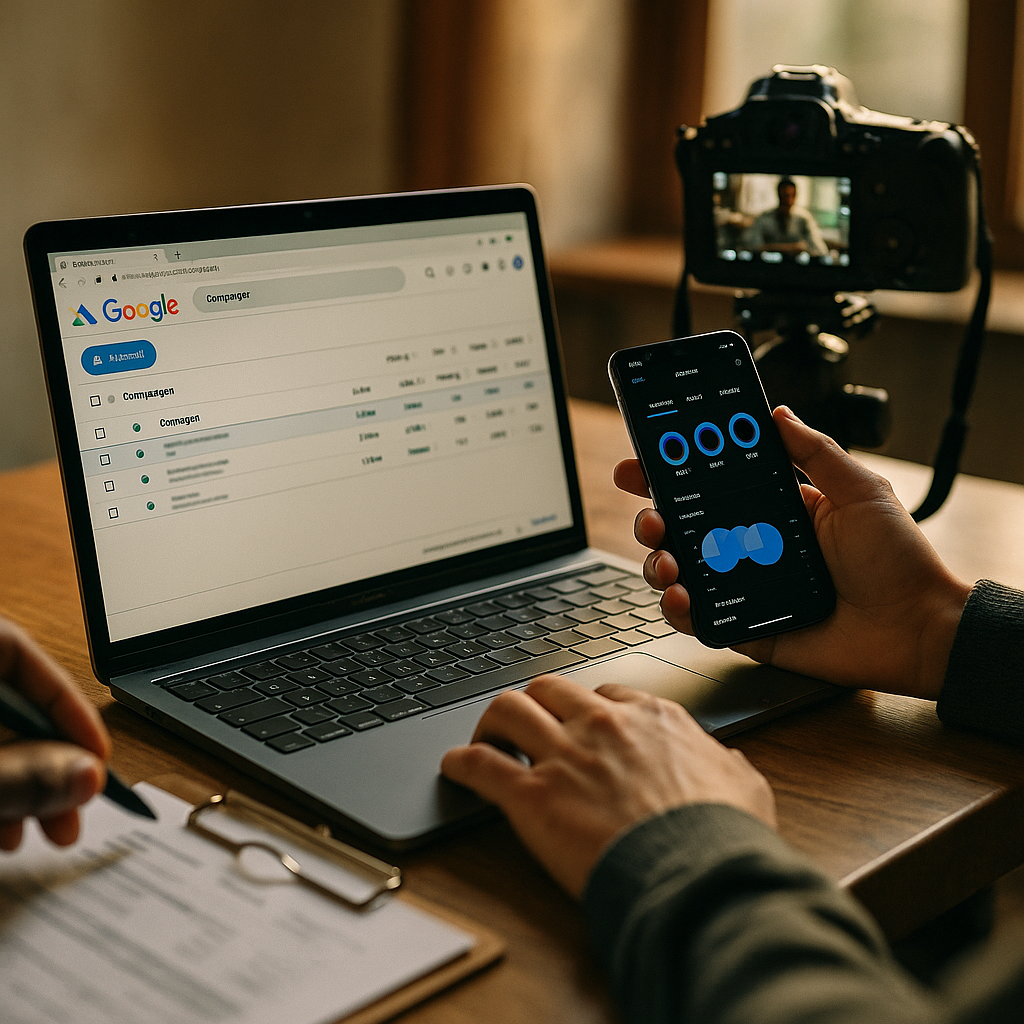
What happens when a machine selects your creator partners, writes the brief, and deploys spend across YouTube, Search, and Display before your campaign manager finishes their morning coffee? That is not a hypothetical. Google’s agentic media buying tools, unveiled at NewFronts, are making agentic media buying for creator campaigns operational right now, and most brand teams are nowhere near ready.
What Google’s Agentic Tools Actually Do
Google’s NewFront announcements introduced a suite of AI-native capabilities within Google Ads and DV360 that operationalize the full campaign lifecycle: a brand inputs a creative brief, the system interprets campaign objectives, recommends creator matches from the YouTube Partner ecosystem, and autonomously deploys cross-platform spend. Think of it as a closed-loop system where the brief is the only human input required.
The creator match layer is particularly significant. Google’s AI pulls from performance data, audience overlap signals, content categorization, and brand safety scoring to surface YouTube creators whose audiences statistically align with campaign objectives. The system can prioritize by CPM efficiency, audience demographics, past conversion rates, or brand affinity scores, depending on how the brief is structured.
Cross-platform deployment then pushes approved creative across YouTube (pre-roll, mid-roll, Shorts), Google Display Network, and Search in formats calibrated to each placement. Budget pacing is dynamic, not static. The system reallocates in near real-time based on performance signals, without waiting for a human to pull a report and make a manual adjustment.
Agentic campaign systems don’t eliminate decisions — they accelerate them to a speed where human review becomes the bottleneck. That’s a governance problem, not a technology feature.
The Role Shift Nobody Is Talking About Honestly
Here is where the conversation gets uncomfortable for agencies and in-house teams alike.
Campaign managers have historically owned three core functions: creator selection judgment, budget allocation strategy, and performance optimization. Google’s agentic stack automates all three. That does not make campaign managers irrelevant, but it fundamentally reassigns their value. The new role is less executor and more auditor, policy architect, and exception handler.
Practically, this means the skills that differentiated a strong campaign manager — knowing which mid-tier creator’s audience converts better for a CPG launch, understanding how to pace spend around cultural moments, building relationships with creator reps — become secondary to the ability to write precise brief inputs, configure governance guardrails, and interpret model behavior when outputs deviate from expectations.
Agencies facing this transition should read it as a workforce restructuring signal, not a productivity upgrade. The headcount math changes. So does the talent profile. For an honest look at how AI-to-human control dynamics are reshaping vendor relationships, the analysis on AI vs human control in MarTech is directly applicable to this shift.
What “Creative Brief Input” Really Means in an Agentic System
The brief is now the primary governance document. Full stop.
In a traditional workflow, the brief guides humans who exercise judgment at every subsequent step. In an agentic workflow, the brief is parsed by a model that executes literally. Ambiguous brand safety language, vague audience definitions, or incomplete exclusion lists do not get caught by a junior strategist asking a clarifying question. They get operationalized at scale.
A brief that says “target health-conscious consumers aged 25-44” will produce creator matches and placements that meet that criterion by Google’s signal interpretation, which may or may not match your brand’s actual intent. If your brand has specific category exclusions (say, no creators who also promote competing supplements, or no placements adjacent to political content), those must be written explicitly into the brief or configured as hard constraints in the campaign settings, not assumed.
This is a structural change in how brand teams should think about brief development. It moves brief-writing from a creative function to a technical compliance function. Teams that treat it otherwise will discover the gap the hard way, mid-flight.
For teams building out their MarTech stack for AI campaigns, brief architecture needs to be a documented component of the stack, not an informal process.
Governance Policies That Must Precede Adoption
The governance question is not optional. Running an agentic campaign without a governance framework is equivalent to giving a new hire unrestricted access to the media budget on day one.
Here are the specific policies that need to exist before a single agentic campaign goes live:
- Creator Eligibility Standards: Define which creator categories, content types, and audience compositions are approved. This should mirror or extend your existing creator vetting standards, translated into machine-readable criteria where possible.
- Budget Authorization Thresholds: Establish the maximum spend the system can commit autonomously before triggering human review. Tiered thresholds by campaign size are reasonable. A $50K campaign has different risk tolerance than a $2M one. The autonomous bidding override guide framework applies directly here.
- Brand Safety Configuration: Do not rely on platform defaults. Configure exclusion lists, content category blocks, and sensitive topic restrictions at the account level. FTC disclosure requirements still apply regardless of whether a human or an AI selected the creator placement, and the brand is liable.
- Audit Trail Requirements: Every agentic decision — creator selection, budget allocation, placement choice — must be logged in a format your team can audit. This is a compliance requirement, not a nice-to-have. Data protection regulators in multiple markets are increasingly scrutinizing automated decision-making, and campaign decisions that involve personal data (audience targeting) are in scope.
- Override and Pause Protocols: Define who has authority to pause an agentic campaign, under what conditions, and within what response time. This should be a documented escalation path, not an ad hoc decision made when something goes wrong at 11 PM on a Friday.
- Performance Guardrails: Set minimum performance thresholds below which the system pauses spend and flags for human review. Relying entirely on the platform’s optimization objectives creates misalignment if your business KPIs diverge from the platform’s proxy metrics.
For organizations running high-volume programs, the AI governance framework for creator programs provides a scalable policy structure worth adapting before deploying any agentic toolset.
The Vendor Lock-In Risk Is Real
Adopting Google’s agentic stack creates dependency that is worth pricing into the decision. When creator selection, budget optimization, and cross-platform deployment all run through a single vendor’s AI, your campaign muscle memory migrates to that vendor’s infrastructure. Switching costs compound over time.
This mirrors the broader concern around AI marketing OS vendor lock-in risks that brand teams are already navigating with other platforms. With Google specifically, the conflict of interest between creator recommendation and Google’s own inventory monetization goals is a question worth asking explicitly: is the AI optimizing for your campaign outcomes, or for Google’s yield?
That is not an accusation. It is a due diligence question that should be in every evaluation. eMarketer’s programmatic coverage has documented how walled-garden agentic tools inherit the inventory biases of their parent platforms. Request transparency on optimization logic, and if it isn’t forthcoming, treat that as a data point.
Brief quality is now a competitive advantage. Brands that build precise, machine-readable brief standards will outperform those that treat brief-writing as an informal creative exercise — because the AI executes exactly what it’s told.
Attribution in an Agentic World
Cross-platform agentic deployment creates a new attribution challenge. When Google’s system allocates spend dynamically across YouTube, Display, and Search for the same campaign, understanding which touchpoint drove conversion requires a measurement setup that most brand teams do not yet have configured.
Google’s default attribution will favor Google-owned touchpoints, which is expected behavior for any walled garden. Independent measurement matters more, not less, in an agentic environment precisely because the system is making allocation decisions that should be informed by accurate conversion data, not platform-favorable proxy metrics. Building out an AI-augmented attribution dashboard is a prerequisite, not a post-launch optimization.
Consider also that HubSpot’s marketing benchmarks and similar third-party measurement frameworks become more valuable, not less, when your primary campaign system is also your primary reporting environment. Separation of execution and measurement is a governance principle, not a technical preference.
What to Do Before Your Next Campaign Cycle
Before piloting Google’s agentic tools on a live campaign, conduct a structured readiness audit across three areas: brief architecture (can your team write machine-precise briefs with explicit constraints?), governance documentation (do the six policy categories above exist in writing?), and measurement independence (is your attribution setup capable of validating platform-reported outcomes against first-party data?). Run a single mid-scale campaign with manual monitoring before expanding agentic autonomy. The learning from that controlled pilot is worth more than any vendor onboarding deck.
Frequently Asked Questions
What is agentic media buying in the context of creator campaigns?
Agentic media buying refers to AI systems that autonomously execute campaign tasks — including creator selection, budget allocation, and cross-platform deployment — based on a structured input like a creative brief, without requiring human intervention at each decision step. Google’s NewFront tools apply this model to YouTube and broader Google inventory for creator-led campaigns.
How does Google’s AI select creators for campaigns?
Google’s system draws on YouTube Partner program data, audience demographic signals, content category classification, brand safety scores, and historical performance metrics to match creators to campaign briefs. The selection reflects how the brief is written, meaning vague or incomplete briefs produce less precise matches.
What governance policies should brands implement before adopting agentic campaign tools?
Brands should establish creator eligibility standards, tiered budget authorization thresholds, explicit brand safety configurations, audit trail requirements for all AI decisions, documented override and pause protocols, and minimum performance guardrails before running any agentic campaign. These policies must be written and operationalized, not assumed.
Does the brand still carry FTC compliance liability when an AI selects creators?
Yes. FTC disclosure requirements apply to the brand regardless of whether a human or an AI system selected the creator or placement. The brand is the advertiser of record and carries compliance responsibility for all paid partnerships, including those facilitated through agentic tools.
How does agentic campaign deployment affect the campaign manager’s role?
The campaign manager’s role shifts from executor to governance architect and performance auditor. Core tasks such as creator selection and budget pacing become automated, while higher-value responsibilities like writing precise brief inputs, configuring system constraints, monitoring for model drift, and managing exception cases become the primary focus.
What is the vendor lock-in risk with Google’s agentic tools?
When creator discovery, budget optimization, and deployment all run through a single platform, institutional knowledge and campaign infrastructure become dependent on that vendor. Switching costs increase over time, and the platform’s AI may have optimization objectives that favor its own inventory yield. Brands should build independent measurement systems and evaluate transparency in the platform’s decision logic before committing significant spend.
Top Influencer Marketing Agencies
The leading agencies shaping influencer marketing in 2026
Agencies ranked by campaign performance, client diversity, platform expertise, proven ROI, industry recognition, and client satisfaction. Assessed through verified case studies, reviews, and industry consultations.
Moburst

-
2

The Shelf
Boutique Beauty & Lifestyle Influencer AgencyA data-driven boutique agency specializing exclusively in beauty, wellness, and lifestyle influencer campaigns on Instagram and TikTok. Best for brands already focused on the beauty/personal care space that need curated, aesthetic-driven content.Clients: Pepsi, The Honest Company, Hims, Elf Cosmetics, Pure LeafVisit The Shelf → -
3

Audiencly
Niche Gaming & Esports Influencer AgencyA specialized agency focused exclusively on gaming and esports creators on YouTube, Twitch, and TikTok. Ideal if your campaign is 100% gaming-focused — from game launches to hardware and esports events.Clients: Epic Games, NordVPN, Ubisoft, Wargaming, Tencent GamesVisit Audiencly → -
4

Viral Nation
Global Influencer Marketing & Talent AgencyA dual talent management and marketing agency with proprietary brand safety tools and a global creator network spanning nano-influencers to celebrities across all major platforms.Clients: Meta, Activision Blizzard, Energizer, Aston Martin, WalmartVisit Viral Nation → -
5

The Influencer Marketing Factory
TikTok, Instagram & YouTube CampaignsA full-service agency with strong TikTok expertise, offering end-to-end campaign management from influencer discovery through performance reporting with a focus on platform-native content.Clients: Google, Snapchat, Universal Music, Bumble, YelpVisit TIMF → -
6

NeoReach
Enterprise Analytics & Influencer CampaignsAn enterprise-focused agency combining managed campaigns with a powerful self-service data platform for influencer search, audience analytics, and attribution modeling.Clients: Amazon, Airbnb, Netflix, Honda, The New York TimesVisit NeoReach → -
7

Ubiquitous
Creator-First Marketing PlatformA tech-driven platform combining self-service tools with managed campaign options, emphasizing speed and scalability for brands managing multiple influencer relationships.Clients: Lyft, Disney, Target, American Eagle, NetflixVisit Ubiquitous → -
8

Obviously
Scalable Enterprise Influencer CampaignsA tech-enabled agency built for high-volume campaigns, coordinating hundreds of creators simultaneously with end-to-end logistics, content rights management, and product seeding.Clients: Google, Ulta Beauty, Converse, AmazonVisit Obviously →