


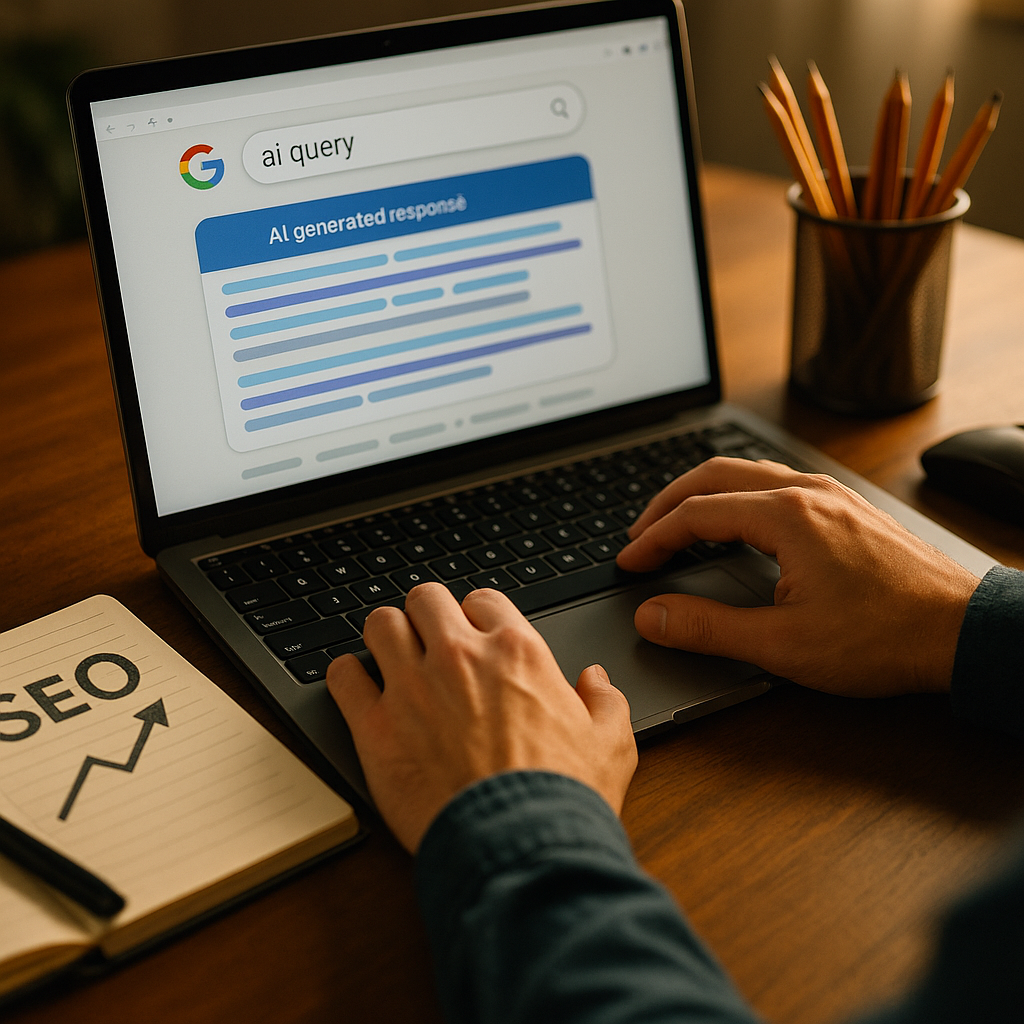
Nearly 60% of Google searches now end without a click, according to a widely cited SimilarWeb analysis of zero-click behavior, and that number keeps climbing as AI Overviews and chatbot answers absorb what used to be organic traffic. So here’s the uncomfortable question: if your content strategy is still built for blue links, who’s optimizing for the answer engines actually reading your pages? Generative search marketing is the discipline that fills that gap.
It’s not a replacement for SEO. It’s SEO’s more demanding sibling — one that cares less about keyword density and more about whether an AI model trusts your content enough to cite it.
What Generative Search Marketing Actually Means
Generative search marketing (GSM) is the practice of optimizing content so it gets surfaced, summarized, and cited by AI-driven search experiences — Google’s AI Overviews, ChatGPT, Perplexity, Copilot, and increasingly, agentic shopping assistants. Some call it GEO (generative engine optimization). The label matters less than the mechanics.
Traditional SEO optimizes for rankings on a results page. GSM optimizes for inclusion in a synthesized answer, where there’s no guaranteed page one, no ten blue links, and often no click at all. Your brand either gets mentioned in the answer or it doesn’t exist for that query.
The shift isn’t from keywords to no keywords. It’s from ranking for a query to being trustworthy enough that a language model chooses to reference you when constructing an answer.
This distinction matters for budget conversations. If your CMO is asking why organic traffic is flat despite rankings holding steady, the answer is probably sitting in AI Overviews, not a Google penalty. We covered this shift in detail in our breakdown of GEO infrastructure versus classic SEO, and the CTR data there is worth revisiting before you present budget shifts internally.
Classic SEO Isn’t Dead — It’s the Foundation
Here’s the part a lot of “SEO is dead” hot takes get wrong: large language models still rely heavily on crawled, indexed, structured web content to ground their answers. Google’s AI Overviews pull from the same index that ranks organic results. Perplexity cites live web sources. Even ChatGPT’s browsing mode leans on search infrastructure that rewards the same fundamentals SEOs have used for two decades.
That means technical SEO — crawlability, site speed, clean information architecture, schema markup — is still table stakes. What’s changed is what happens after the crawl.
- Structured data still matters, arguably more. Schema.org markup helps AI systems parse entities, relationships, and facts faster than prose alone.
- Authoritative backlinks still signal trust. LLMs trained on web-scale data absorb the same trust signals that PageRank was built on.
- Content depth still wins. Thin, keyword-stuffed pages get skipped by both crawlers and citation algorithms.
Where GSM diverges is in how content gets structured for extraction. AI systems don’t read a page the way a human scans it top to bottom. They chunk it, extract entities, and pull the most self-contained, answer-shaped passages. If your key insight is buried in paragraph four of a 2,000-word post with no clear heading above it, a generative engine may never find it. Machine readability isn’t optional anymore — it’s a growing share of your actual traffic, bot or otherwise.
Query Understanding Changes the Keyword Game
Classic keyword research asked: what phrase does someone type into a search box? AI query understanding asks something broader: what’s the underlying intent, and what related questions will the model need to answer to satisfy it fully?
This is why long-tail, conversational content is outperforming keyword-stuffed landing pages in AI citation tests. Perplexity and ChatGPT don’t match strings, they interpret semantic intent. A page optimized for “best influencer platform 2026” as an exact phrase will lose to a page that thoroughly answers “how do I choose an influencer platform for a mid-size DTC brand,” even if that phrase never appears verbatim.
Google itself has been signaling this shift in its own guidance to publishers. Their recent documentation on AI-generated search experiences pushes creators toward answering complete questions rather than chasing fragments. We unpacked what that means operationally in Google’s new AI guidance for brand blogs, and it’s a useful checklist if your content team is still writing for 2020-era keyword targets.
How Do You Actually Optimize for AI Query Understanding?
Five tactics separate brands getting cited from brands getting ignored.
- Answer the question in the first two sentences. LLMs favor extractable, self-contained answers near the top of a section. Bury your thesis and you lose the citation.
- Use descriptive, question-based subheadings. Headings phrased as real questions (“How much does influencer whitelisting cost?”) map directly to how users query chatbots.
- Build topical depth, not just page volume. A cluster of ten thin pages loses to one comprehensive resource that covers a topic’s full scope, including edge cases and objections.
- Cite your own data. Original research, proprietary benchmarks, and named case studies give models something unique to attribute — generic rehashed content gets deprioritized because it adds no new information to the corpus.
- Mark up entities explicitly. Schema for organizations, products, and FAQs helps disambiguate who you are and what you sell, reducing the model’s uncertainty about citing you correctly.
If you’re rebuilding a content playbook around this, start with this generative AI search optimization playbook — it walks through prioritization when you can’t fix everything at once, which, let’s be honest, is every marketing team’s actual constraint.
The Attribution Problem Nobody Wants to Talk About
Here’s the part that makes CFOs nervous: when a chatbot answers a question using your content and the user never clicks through, how do you prove ROI? You can’t run last-click attribution on a conversation that happened entirely inside ChatGPT.
This is where GSM stops being a content exercise and becomes a measurement exercise. Brands are starting to track citation frequency in LLM outputs the way they used to track keyword rankings — a proxy metric, imperfect but directional.
If you can’t measure whether AI systems are citing your brand, you’re optimizing blind. Citation tracking is becoming as fundamental as rank tracking was a decade ago.
Tools for this are maturing fast, and it’s worth building the muscle now rather than after a board member asks why your AI Overview presence looks worse than a competitor’s. Our guide on LLM brand tracking and citation monitoring covers the current tooling landscape, and this piece on zero-click attribution is essential reading if your reporting dashboard still assumes every conversion needs a session.
For a broader operational view, this deep dive on AI search workflows connects the content and measurement pieces into a single process rather than treating them as separate initiatives.
Where Influencer Content Fits Into This
This is where it gets interesting for anyone running influencer programs. AI models increasingly treat creator content — reviews, comparison videos, unboxings — as trusted third-party validation, similar to how they weight independent editorial. A creator’s honest comparison of two skincare products, published on a blog or YouTube description with clear structure, can become a citation source for “what’s the best retinol serum for sensitive skin” queries.
That means influencer briefs now need a content-structure component, not just messaging guidelines. Creators publishing structured, question-answering content (in captions, blog partnerships, or video descriptions) are more likely to get pulled into AI-generated answers than creators posting purely visual content with no extractable text.
If you’re briefing creators for the AI-search era, this framework for agentic AI campaign briefs is a solid starting point for building that structure into deliverables without turning every creator into a copywriter.
It also raises stakes for retail and product-feed accuracy. If an AI shopping agent is comparing your product against competitors using structured data, clean SKU schema and product feeds aren’t a technical nice-to-have anymore, they’re the difference between being recommended and being invisible in an agentic purchase flow. The same logic extends to marketplace listings — brands are already auditing AI-referred purchases on Amazon to see how much of their traffic is now agent-driven rather than human-browsed.
The Compliance Angle Brand Teams Can’t Skip
One risk that doesn’t get enough airtime: AI models can misattribute claims, hallucinate product specs, or cite outdated pricing pulled from stale cached pages. If your product page hasn’t been updated in eight months and an LLM cites it confidently to a shopper, that’s a compliance and trust problem, not just an SEO one.
Regulatory bodies including the FTC have signaled growing scrutiny of AI-generated commercial claims, and brands relying on AI-surfaced content for high-consideration purchases (health, finance, beauty efficacy claims) should treat content freshness as a governance issue, not just an SEO best practice. Build a review cadence. Audit what’s actually being cited. Don’t assume silence means accuracy.
Building the Actual Workflow
Practically, merging classic SEO with generative query understanding looks like this inside a content team:
- Keep technical SEO audits (crawl health, Core Web Vitals, indexation) as a recurring baseline — nothing above this works without it.
- Add a monthly citation audit: query your top 20 target topics in ChatGPT, Perplexity, and Google’s AI Overview, and log whether your brand appears.
- Restructure cornerstone content around question-based subheadings with front-loaded answers, not buried conclusions.
- Expand schema coverage beyond basic Organization and Product markup into FAQPage, HowTo, and Review schema where applicable.
- Brief influencer and UGC partners on structured, extractable content formats alongside traditional messaging guidelines.
None of this requires abandoning your existing SEO team or tooling stack. It requires expanding their mandate and giving them a new success metric that isn’t “position one” — it’s “did the model mention us at all.”
Start small: pick your five highest-value content pages, run them through ChatGPT and Perplexity queries this week, and see who gets cited instead of you. That gap is your generative search marketing roadmap.
FAQs
What’s the difference between GEO and generative search marketing?
They’re largely the same discipline described with different terms. GEO (generative engine optimization) tends to emphasize technical content structuring for AI extraction, while generative search marketing is the broader strategic umbrella covering content, measurement, and brand strategy across AI search surfaces.
Does classic SEO still matter if I’m optimizing for AI search?
Yes, and arguably more than before. AI Overviews and chatbot browsing modes still rely on crawled, indexed web content. Technical SEO fundamentals like crawlability, site speed, and structured data remain the foundation that generative optimization builds on top of.
How do I measure ROI from generative search marketing?
Track citation frequency across AI platforms as a proxy metric, similar to how rank tracking worked for traditional SEO. Combine this with proxy conversion signals, branded search lift, and direct traffic increases, since zero-click AI answers won’t show up in last-click attribution models.
Should influencer content be optimized for AI search too?
Yes. AI models increasingly cite creator content as third-party validation for product and comparison queries. Structuring creator deliverables (captions, blog partnerships, video descriptions) with clear, question-answering text improves the odds of AI citation.
What’s the biggest mistake brands make in generative search marketing?
Treating it purely as a content rewrite exercise while ignoring measurement and governance. Brands need citation tracking, content freshness audits, and compliance review for AI-surfaced claims, not just restructured blog posts.
Top Influencer Marketing Agencies
The leading agencies shaping influencer marketing in 2026
Agencies ranked by campaign performance, client diversity, platform expertise, proven ROI, industry recognition, and client satisfaction. Assessed through verified case studies, reviews, and industry consultations.
Moburst

-
2

The Shelf
Boutique Beauty & Lifestyle Influencer AgencyA data-driven boutique agency specializing exclusively in beauty, wellness, and lifestyle influencer campaigns on Instagram and TikTok. Best for brands already focused on the beauty/personal care space that need curated, aesthetic-driven content.Clients: Pepsi, The Honest Company, Hims, Elf Cosmetics, Pure LeafVisit The Shelf → -
3

Audiencly
Niche Gaming & Esports Influencer AgencyA specialized agency focused exclusively on gaming and esports creators on YouTube, Twitch, and TikTok. Ideal if your campaign is 100% gaming-focused — from game launches to hardware and esports events.Clients: Epic Games, NordVPN, Ubisoft, Wargaming, Tencent GamesVisit Audiencly → -
4

Viral Nation
Global Influencer Marketing & Talent AgencyA dual talent management and marketing agency with proprietary brand safety tools and a global creator network spanning nano-influencers to celebrities across all major platforms.Clients: Meta, Activision Blizzard, Energizer, Aston Martin, WalmartVisit Viral Nation → -
5

The Influencer Marketing Factory
TikTok, Instagram & YouTube CampaignsA full-service agency with strong TikTok expertise, offering end-to-end campaign management from influencer discovery through performance reporting with a focus on platform-native content.Clients: Google, Snapchat, Universal Music, Bumble, YelpVisit TIMF → -
6

NeoReach
Enterprise Analytics & Influencer CampaignsAn enterprise-focused agency combining managed campaigns with a powerful self-service data platform for influencer search, audience analytics, and attribution modeling.Clients: Amazon, Airbnb, Netflix, Honda, The New York TimesVisit NeoReach → -
7

Ubiquitous
Creator-First Marketing PlatformA tech-driven platform combining self-service tools with managed campaign options, emphasizing speed and scalability for brands managing multiple influencer relationships.Clients: Lyft, Disney, Target, American Eagle, NetflixVisit Ubiquitous → -
8

Obviously
Scalable Enterprise Influencer CampaignsA tech-enabled agency built for high-volume campaigns, coordinating hundreds of creators simultaneously with end-to-end logistics, content rights management, and product seeding.Clients: Google, Ulta Beauty, Converse, AmazonVisit Obviously →