


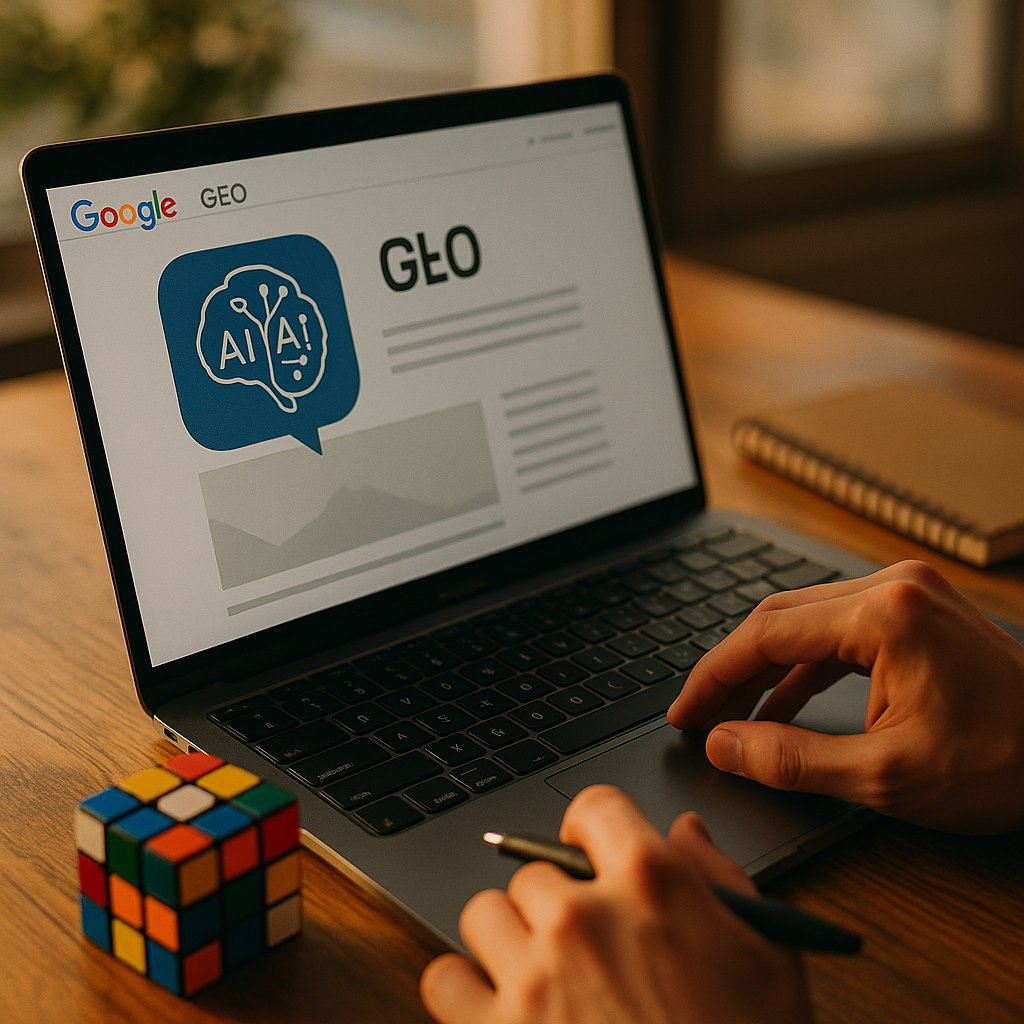
Roughly six in ten searches now end without a click, according to eMarketer estimates on zero-click behavior. If your brand blog was built for the old rules, it’s already invisible to a growing share of your buyers. Optimizing content for generative AI in search isn’t a future problem anymore — Google’s latest guidance makes it a right-now problem, and most content teams haven’t caught up.
What Actually Changed
Google’s newest guidance update refines how its AI systems evaluate content for inclusion in AI Overviews and the broader AI Mode experience. The core shift: less emphasis on keyword density and traditional on-page signals, more emphasis on what Google calls “verifiable contribution” — does a page add something a synthesized answer can’t get elsewhere?
That’s a meaningfully different bar than classic SEO. A page can rank well in traditional blue links and still get skipped entirely by the AI layer if it reads like a rehash of five competitor articles. Google’s Search Central documentation now explicitly calls out original data, named expert sourcing, and clear structural hierarchy as factors influencing generative inclusion. None of that is shocking on its own. What’s new is Google saying it out loud, in writing, as guidance rather than inference from leaked ranking factors.
For brand blogs specifically, this matters because most corporate content teams have spent years optimizing for a click. Now the win condition, for a huge share of queries, is getting cited without a click at all. That requires a different production model, not just a tweaked style guide.
The bar isn’t “rank on page one” anymore. It’s “be the source an AI model trusts enough to summarize without hedging.”
Why Brand Blogs Are Especially Vulnerable
Brand blogs tend to have a structural problem: they’re written to sound authoritative and safe, which often means they’re written to say very little. Legal review softens claims. Marketing softens claims further. By the time a post publishes, it’s frequently indistinguishable from ten other brand posts on the same topic.
That’s exactly the content generative systems are learning to deprioritize.
Google’s guidance rewards specificity — named case studies, proprietary numbers, dated benchmarks, quoted practitioners. It penalizes, in effect, the genre of content that exists mainly to check an SEO box. If your blog’s “Ultimate Guide to X” reads like every other Ultimate Guide to X, an AI Overview has no reason to cite you over a competitor. It’ll cite whichever version has the clearest structure and the least filler.
This connects directly to a trend we’ve tracked before: 57% of web traffic is bots, and a growing share of that traffic is AI crawlers assessing your content for machine readability, not human engagement. If you’re still writing exclusively for a human scanning a SERP, you’re optimizing for a shrinking slice of your actual audience.
The Data Point That Should Worry You
Search visibility studies increasingly show that pages earning AI Overview citations skew toward content published or substantially updated within the last several months, with clear author bylines and structured data markup. Freshness and provenance are doing more work than they used to. A blog post that hasn’t been touched since its original publish date, however well it once ranked, is increasingly treated as stale evidence rather than authoritative source material.
Applying the Guidance to Your Blog Strategy
So what does this mean operationally, for a brand content team running quarterly editorial calendars and quarterly budgets? A few concrete shifts:
- Lead with proprietary data. If your team runs surveys, has internal benchmark data, or can aggregate anonymized campaign results, that’s now your most valuable content asset. Generic advice content is commoditized; your data isn’t.
- Name real experts, not “our team of experts.” Bylines with credentials, LinkedIn links, and quoted subject-matter experts satisfy both EEAT signals and the specificity generative models reward.
- Structure for extraction. Clear headers, direct-answer paragraphs near the top of sections, and scannable lists make it easier for an AI system to lift a clean summary that credits you accurately.
- Update instead of republish. Refreshing a high-performing post with new data and a visible “last updated” date often outperforms publishing a new, thinner post on the same topic.
- Mark up everything. Schema markup, FAQ blocks, and clean semantic HTML aren’t cosmetic anymore — they’re part of how machine readers parse your credibility.
This isn’t a wholesale rejection of prior SEO practice. It’s an evolution, and it builds on ground we covered in our earlier playbook on generative AI search optimization. What’s different in the May guidance is the explicit framing around verifiability and the elevated weight given to structural clarity over keyword coverage.
GEO Isn’t Replacing SEO. It’s Sitting On Top of It.
Marketers keep asking whether generative engine optimization (GEO) makes traditional SEO obsolete. It doesn’t. Technical SEO fundamentals — crawlability, site speed, indexation — remain the floor. GEO is the layer above
Top Influencer Marketing Agencies
The leading agencies shaping influencer marketing in 2026
Agencies ranked by campaign performance, client diversity, platform expertise, proven ROI, industry recognition, and client satisfaction. Assessed through verified case studies, reviews, and industry consultations.
Moburst

-
2

The Shelf
Boutique Beauty & Lifestyle Influencer AgencyA data-driven boutique agency specializing exclusively in beauty, wellness, and lifestyle influencer campaigns on Instagram and TikTok. Best for brands already focused on the beauty/personal care space that need curated, aesthetic-driven content.Clients: Pepsi, The Honest Company, Hims, Elf Cosmetics, Pure LeafVisit The Shelf → -
3

Audiencly
Niche Gaming & Esports Influencer AgencyA specialized agency focused exclusively on gaming and esports creators on YouTube, Twitch, and TikTok. Ideal if your campaign is 100% gaming-focused — from game launches to hardware and esports events.Clients: Epic Games, NordVPN, Ubisoft, Wargaming, Tencent GamesVisit Audiencly → -
4

Viral Nation
Global Influencer Marketing & Talent AgencyA dual talent management and marketing agency with proprietary brand safety tools and a global creator network spanning nano-influencers to celebrities across all major platforms.Clients: Meta, Activision Blizzard, Energizer, Aston Martin, WalmartVisit Viral Nation → -
5

The Influencer Marketing Factory
TikTok, Instagram & YouTube CampaignsA full-service agency with strong TikTok expertise, offering end-to-end campaign management from influencer discovery through performance reporting with a focus on platform-native content.Clients: Google, Snapchat, Universal Music, Bumble, YelpVisit TIMF → -
6

NeoReach
Enterprise Analytics & Influencer CampaignsAn enterprise-focused agency combining managed campaigns with a powerful self-service data platform for influencer search, audience analytics, and attribution modeling.Clients: Amazon, Airbnb, Netflix, Honda, The New York TimesVisit NeoReach → -
7

Ubiquitous
Creator-First Marketing PlatformA tech-driven platform combining self-service tools with managed campaign options, emphasizing speed and scalability for brands managing multiple influencer relationships.Clients: Lyft, Disney, Target, American Eagle, NetflixVisit Ubiquitous → -
8

Obviously
Scalable Enterprise Influencer CampaignsA tech-enabled agency built for high-volume campaigns, coordinating hundreds of creators simultaneously with end-to-end logistics, content rights management, and product seeding.Clients: Google, Ulta Beauty, Converse, AmazonVisit Obviously →