


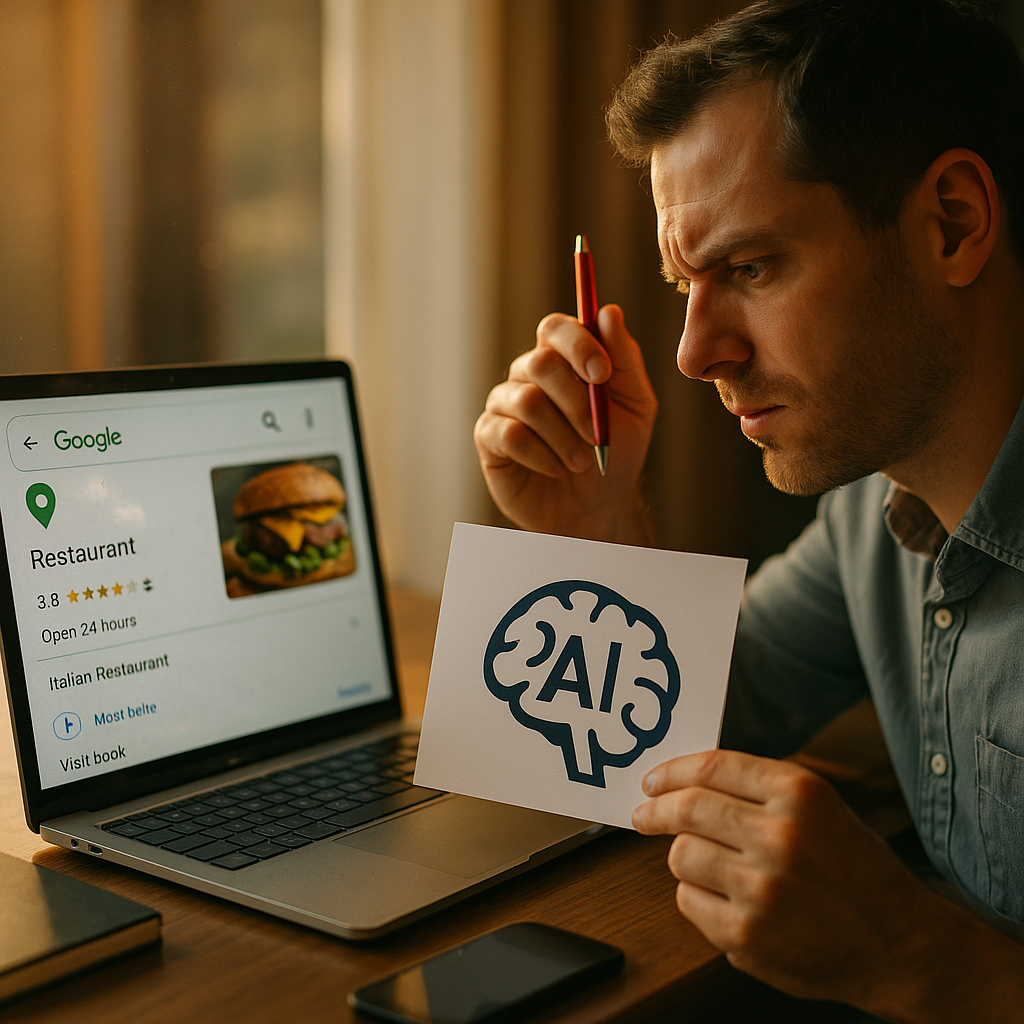
63% of consumers now say they’ve encountered inaccurate business information through an AI assistant, and most brands have no idea which of their storefronts are the culprit. If ChatGPT tells a customer your Chicago location closes at 6pm when it actually closes at 9pm, that’s not a Google problem. That’s a revenue problem, and it starts with sloppy Google Business listings feeding bad data into every AI surface that scrapes them.
Auditing for AI-referred traffic accuracy isn’t a nice-to-have anymore. It’s the operational hygiene layer sitting underneath every generative search strategy you’re running.
Why Google Business Profiles Became AI Training Wheels
Here’s the uncomfortable truth: Gemini, ChatGPT with browsing, Perplexity, and even Amazon’s Rufus all lean on structured local business data, and Google Business Profile (GBP) is often the cleanest, most authoritative source available. When a user asks “is [brand] open near me right now,” the AI isn’t calling your store. It’s pulling from cached GBP data, sometimes hours or days old, and presenting it as fact with total confidence.
That confidence is the problem. Unlike a search results page, where a user sees ten blue links and can cross-check, an AI answer is often singular and final. There’s no second source shown. If your hours, address, or phone number are stale, the AI doesn’t hedge. It just tells the customer something wrong, and the customer believes it.
An AI chatbot doesn’t say “I think” — it says “yes, they’re open.” That certainty is exactly why listing accuracy now carries more downstream risk than it did in the pure-search era.
This mirrors what we’ve seen play out on retail platforms too. Our earlier look at AI-referred purchases on Amazon found the same pattern: assistants treat product listing fields as ground truth, errors and all, with zero friction for the shopper to verify.
The Audit: What to Actually Check
Most brand teams treat GBP as a set-and-forget asset. Wrong move. Here’s a working checklist for a quarterly audit, built specifically around what AI models tend to misfire on:
- Hours of operation, including holiday hours. AI models frequently default to “regular hours” even when a location has posted a temporary closure. Check every location individually — don’t assume franchise consistency.
- Primary and secondary category accuracy. Miscategorized listings (a “cafe” tagged as “restaurant”) confuse intent-matching in AI answers, leading to wrong recommendations entirely.
- Phone number and website URL freshness. Old numbers get cited by voice assistants and chat interfaces long after they’ve been disconnected.
- Attributes and services fields. “Wheelchair accessible,” “curbside pickup,” “accepts reservations” — these get pulled directly into AI-generated comparisons between your brand and competitors.
- Duplicate or unclaimed listings. Multiple listings for one location split review signal and confuse which address is canonical, and AI models sometimes cite the wrong one.
- Review sentiment recency. Some AI summarization tools weight recent reviews heavily. A stale profile with old reviews can misrepresent current service quality.
Run this across every location, not just flagship stores. Multi-location brands are especially exposed because franchise-level data entry is inconsistent by nature.
Building a Traffic Attribution Layer for AI Referrals
Auditing accuracy is half the job. The other half is knowing whether inaccurate listings are actually costing you traffic and conversions. This is trickier than standard analytics because AI referral traffic often shows up as direct traffic or isn’t tagged at all.
A few practical moves:
- Set up UTM parameters on your GBP website field and monitor referral strings from AI browsing tools where visible in server logs.
- Cross-reference spikes in “direct” traffic with periods when you know a listing had errors, then compare against corrected-period performance.
- Use call tracking numbers specifically on GBP listings so you can isolate calls originating from profile clicks versus organic search.
- Monitor branded query volume in Google Search Console alongside AI Overviews impressions, where available, to spot mismatches between what’s being asked and what’s being shown.
This connects directly to the broader measurement challenge brands are wrestling with in zero-click AI attribution. If you can’t see the click, you need proxy signals, and listing accuracy is one of the cleanest levers you can actually control while everything else stays murky.
What Happens When You Don’t Audit
Let’s talk real consequences, not hypotheticals. A regional restaurant chain reported last year that a wrong closing time on one high-traffic location, propagated through Google’s AI Overviews, correlated with a measurable dip in evening foot traffic over several weeks before anyone caught it. Nobody flagged it internally because nobody owned the review cadence. The listing had been “fine” for two years, so it fell off the maintenance checklist entirely.
That’s the trap. GBP accuracy isn’t a launch task, it’s ongoing maintenance, and it needs an owner the same way your paid media budget has an owner.
Treat your Google Business Profile like a live product feed, not a static directory entry. Product feeds get audited weekly. Your listings should too, at minimum monthly for high-traffic locations.
Compliance and Risk Angle Brands Keep Missing
There’s also a regulatory dimension marketing teams tend to overlook. If your listing shows inaccurate pricing, promotional claims, or accessibility information and an AI assistant repeats that inaccuracy to a consumer who then makes a purchase decision based on it, that’s a potential deceptive advertising exposure, even if your brand never directly said it. The FTC has been increasingly vocal about advertiser responsibility extending to how third-party platforms represent your business, and AI-generated summaries arguably sit in that gray zone.
This isn’t dissimilar to the governance thinking brands are applying to agentic ad buying. Our governance checklist for agentic media buying makes the case that any automated system representing your brand needs a human review layer. Google Business Profile, feeding AI answers at scale, deserves the same scrutiny.
Operationalizing the Audit Without Adding Headcount
Nobody’s hiring a full-time GBP auditor. Realistically, this needs to slot into existing workflows:
- Assign ownership to local SEO or store ops, not just corporate marketing. Store managers know when hours change; corporate often doesn’t hear until weeks later.
- Use Google’s bulk location management tools inside Business Profile Manager to catch inconsistencies across large location sets faster than manual review.
- Set calendar triggers tied to seasonal changes — holiday hours, daylight saving shifts, and promotional periods are the highest-risk windows for stale data.
- Pull a quarterly export and diff it against the previous quarter’s data to spot silent changes nobody approved.
For brands running broader generative-engine-optimization programs, this listing hygiene should sit alongside the content workstreams described in optimizing content for generative AI in search. It’s the same discipline, applied to structured data instead of prose.
Worth checking your monitoring stack too. If you’re already running AI citation monitoring for brand mentions, extend that same tracking to location-specific queries. “Is [brand] open near me” and “[brand] hours today” are exactly the query types worth watching weekly, not quarterly.
Third-party data providers matter here too. Services like Sprout Social and listing management platforms increasingly offer AI-visibility reporting alongside standard social analytics, worth evaluating if you’re managing more than a handful of locations. And keep an eye on aggregate consumer behavior data from sources like eMarketer, which regularly tracks how AI assistant usage for local discovery is shifting year over year.
The Bigger Pattern: AI Doesn’t Forgive Bad Data
Traditional SEO had a forgiving quality. A wrong phone number on page three of your website rarely got clicked. AI search removes that buffer entirely. Every field in your GBP is now a potential single source of truth for a customer who will never see your website at all.
That’s a structural shift in how much operational precision marketing needs to maintain. It’s less about crafting the perfect meta description now and more about making sure the boring, unglamorous fields — hours, categories, phone numbers — are correct everywhere, all the time.
FAQs
Frequently Asked Questions
How often should brands audit Google Business listings for AI accuracy?
Monthly for high-traffic or multi-location brands, quarterly at minimum for smaller operations. Seasonal transition periods, like holidays and daylight saving changes, warrant an extra check outside the regular cadence.
Can I tell if traffic came from an AI assistant rather than organic search?
Not always directly. Most AI-referred sessions currently show up as direct traffic. Using dedicated UTM parameters, call tracking numbers on GBP fields, and monitoring branded query patterns in Search Console are the closest proxy signals available today.
What’s the biggest listing error that affects AI-generated answers?
Stale hours of operation, particularly holiday or temporary closures. AI models tend to default to standard listed hours unless a recent update overrides them, and that gap causes the most consumer-facing inaccuracy.
Is inaccurate AI-repeated listing information a legal liability for brands?
It can carry advertising compliance risk, particularly around pricing or promotional claims, even when the brand didn’t directly generate the AI’s response. Regulatory bodies including the FTC have signaled growing interest in how third-party platform data reflects on advertiser responsibility.
Who should own Google Business Profile accuracy inside a marketing org?
Ideally a shared responsibility between local SEO or digital marketing and store/location operations. Corporate marketing alone often lacks real-time visibility into hour changes or closures happening at the store level.
Next step: pull your GBP locations into a single spreadsheet this week, flag anything not updated in the last 90 days, and assign an owner before your next AI Overviews spike catches you off guard.
FAQs
How often should brands audit Google Business listings for AI accuracy?
Monthly for high-traffic or multi-location brands, quarterly at minimum for smaller operations. Seasonal transition periods, like holidays and daylight saving changes, warrant an extra check outside the regular cadence.
Can I tell if traffic came from an AI assistant rather than organic search?
Not always directly. Most AI-referred sessions currently show up as direct traffic. Using dedicated UTM parameters, call tracking numbers on GBP fields, and monitoring branded query patterns in Search Console are the closest proxy signals available today.
What’s the biggest listing error that affects AI-generated answers?
Stale hours of operation, particularly holiday or temporary closures. AI models tend to default to standard listed hours unless a recent update overrides them, and that gap causes the most consumer-facing inaccuracy.
Is inaccurate AI-repeated listing information a legal liability for brands?
It can carry advertising compliance risk, particularly around pricing or promotional claims, even when the brand didn’t directly generate the AI’s response. Regulatory bodies including the FTC have signaled growing interest in how third-party platform data reflects on advertiser responsibility.
Who should own Google Business Profile accuracy inside a marketing org?
Ideally a shared responsibility between local SEO or digital marketing and store/location operations. Corporate marketing alone often lacks real-time visibility into hour changes or closures happening at the store level.
Top Influencer Marketing Agencies
The leading agencies shaping influencer marketing in 2026
Agencies ranked by campaign performance, client diversity, platform expertise, proven ROI, industry recognition, and client satisfaction. Assessed through verified case studies, reviews, and industry consultations.
Moburst

-
2

The Shelf
Boutique Beauty & Lifestyle Influencer AgencyA data-driven boutique agency specializing exclusively in beauty, wellness, and lifestyle influencer campaigns on Instagram and TikTok. Best for brands already focused on the beauty/personal care space that need curated, aesthetic-driven content.Clients: Pepsi, The Honest Company, Hims, Elf Cosmetics, Pure LeafVisit The Shelf → -
3

Audiencly
Niche Gaming & Esports Influencer AgencyA specialized agency focused exclusively on gaming and esports creators on YouTube, Twitch, and TikTok. Ideal if your campaign is 100% gaming-focused — from game launches to hardware and esports events.Clients: Epic Games, NordVPN, Ubisoft, Wargaming, Tencent GamesVisit Audiencly → -
4

Viral Nation
Global Influencer Marketing & Talent AgencyA dual talent management and marketing agency with proprietary brand safety tools and a global creator network spanning nano-influencers to celebrities across all major platforms.Clients: Meta, Activision Blizzard, Energizer, Aston Martin, WalmartVisit Viral Nation → -
5

The Influencer Marketing Factory
TikTok, Instagram & YouTube CampaignsA full-service agency with strong TikTok expertise, offering end-to-end campaign management from influencer discovery through performance reporting with a focus on platform-native content.Clients: Google, Snapchat, Universal Music, Bumble, YelpVisit TIMF → -
6

NeoReach
Enterprise Analytics & Influencer CampaignsAn enterprise-focused agency combining managed campaigns with a powerful self-service data platform for influencer search, audience analytics, and attribution modeling.Clients: Amazon, Airbnb, Netflix, Honda, The New York TimesVisit NeoReach → -
7

Ubiquitous
Creator-First Marketing PlatformA tech-driven platform combining self-service tools with managed campaign options, emphasizing speed and scalability for brands managing multiple influencer relationships.Clients: Lyft, Disney, Target, American Eagle, NetflixVisit Ubiquitous → -
8

Obviously
Scalable Enterprise Influencer CampaignsA tech-enabled agency built for high-volume campaigns, coordinating hundreds of creators simultaneously with end-to-end logistics, content rights management, and product seeding.Clients: Google, Ulta Beauty, Converse, AmazonVisit Obviously →