


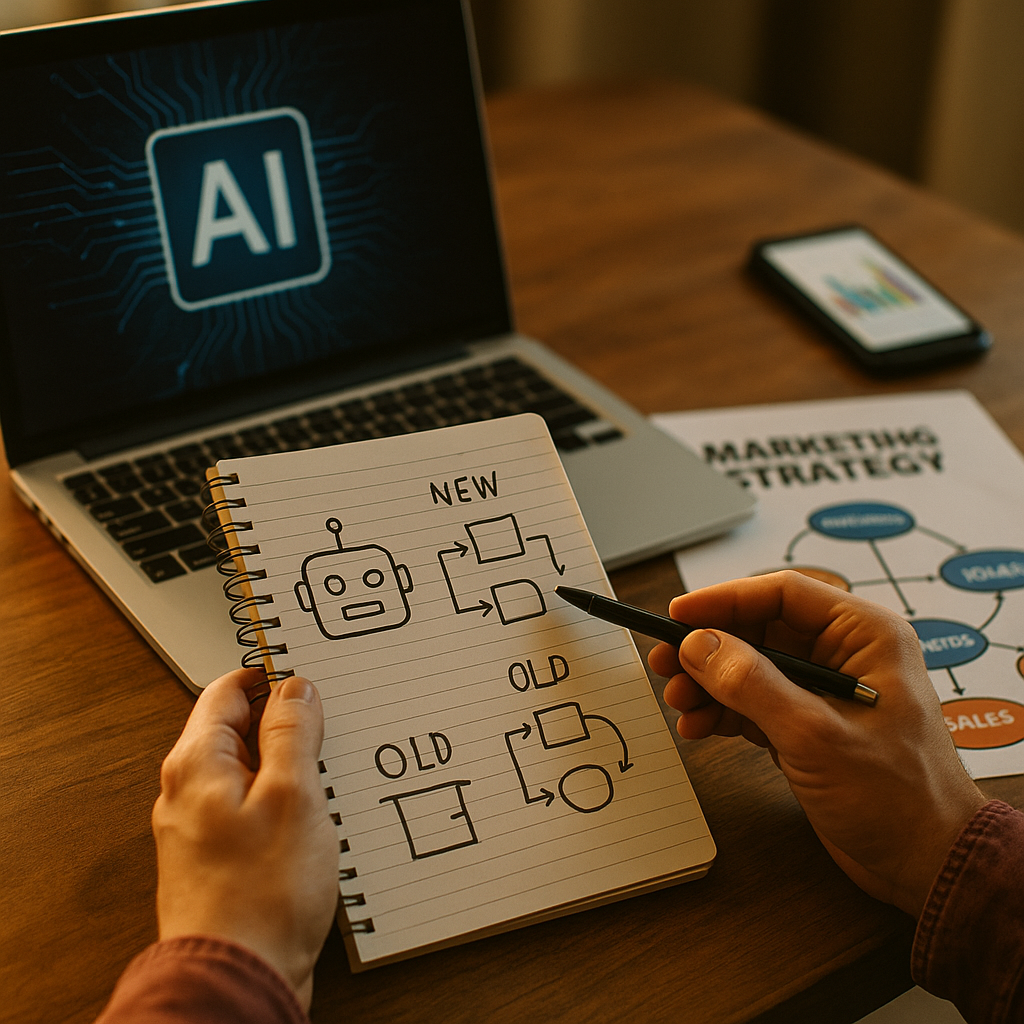
Search “AI marketing playbook” and you’ll find dozens of guides promising to reinvent your strategy. Here’s the uncomfortable truth: most of them recycle segmentation and email automation tips from a decade ago, just with “AI” bolted on. Practical Ecommerce’s recent playbook is better than most, but even it blends genuinely new capabilities with warmed-over tactics. Brand teams need to know which is which before they reallocate budget.
That distinction matters more than it sounds. Get it wrong and you either underinvest in something that could compound your ROI, or you spend six figures rebuilding a “predictive personalization engine” that’s functionally the same rules-based email trigger you had running in 2018.
What’s Actually New: Agentic Execution, Not Just Prediction
The genuine shift in AI marketing right now isn’t prediction. Marketers have had predictive lead scoring and churn models for years. What’s new is agentic execution: systems that don’t just recommend an action, they take it, monitor the result, and adjust without a human clicking “approve” at every step.
Google’s agentic media buying tools are the clearest example. Campaigns can now shift budget across channels in real time based on performance signals, not just at the end of a weekly review. That’s a structural change in how media teams operate, not a rebrand of existing automation. If you’re evaluating this shift, our governance checklist for agentic media buying is a useful starting point before you hand over budget controls.
The real dividing line in 2026 isn’t “uses AI” versus “doesn’t.” It’s whether the system executes decisions autonomously and self-corrects, or whether it just hands a human a smarter recommendation.
Self-correction is the piece most playbooks gloss over. A model that flags an underperforming ad set is useful. A system that reallocates spend, tests a new creative variant, and reports back on why it made that call is a different order of capability. We’ve covered what to actually monitor when campaigns start making their own decisions in this breakdown of agentic campaign monitoring, and it’s worth reading before you greenlight any “set it and forget it” pitch from a vendor.
Repackaged: “AI-Powered” Segmentation and Content Calendars
Here’s where a lot of the Practical Ecommerce-style advice starts to feel like filler. Audience segmentation using behavioral data? That’s been standard in email platforms like Klaviyo and Mailchimp for years. Slapping “AI-driven” on top of a lookalike audience model doesn’t make it new — it’s the same statistical clustering marketers have used since programmatic display took off in the 2010s.
Same goes for “AI content calendars.” Scheduling tools that suggest posting times based on historical engagement have existed since Buffer and Hootsuite were the only tools in the category. Running that logic through a large language model doesn’t change the underlying mechanic. It’s still a rules engine dressed in a new interface.
Ask any vendor pitching an “AI segmentation breakthrough” one question: what decision does this make that a marketer couldn’t make with a well-built dashboard and three years of first-party data? If the answer is vague, you’re looking at a relabeled tactic, not an upgrade.
Content Generation: Genuinely Faster, Not Genuinely Smarter
Generative AI’s speed gains for content production are real and measurable. Teams report cutting first-draft time on blog posts, ad copy variants, and social captions by 60-80% depending on the workflow. That’s not hype. According to HubSpot’s ongoing marketing research, a majority of marketers now use generative AI tools in some part of their content workflow.
But speed isn’t strategy. The playbook mistake brands keep making is treating volume as the win condition. Publishing ten times more content doesn’t help if none of it gets surfaced in AI search results or cited by an LLM when a prospect asks a question. That’s a distribution and structure problem, not a generation problem. If your content isn’t built for how AI models actually parse and cite sources, more of it just means more noise. Our guide on optimizing content for generative AI in search covers the structural changes that actually move the needle, and it’s a better use of your time than another “10 AI prompts for blog ideas” listicle.
Where Practical Ecommerce Gets It Right: Infrastructure Over Tactics
To their credit, the stronger sections of most current AI marketing guides push toward infrastructure thinking, not tactic-hopping. That’s the right instinct. Repurposing a single brand asset across ten formats and five channels used to require a production team. Now it’s a workflow question: do you build the pipeline in-house, license a platform, or stitch together point solutions?
This is genuinely underexplored territory in most playbooks, and it’s where the ROI conversation gets real. We broke down the tradeoffs in brand asset repurposing infrastructure for scale, and the build-vs-buy decision echoes a broader question every marketing org is facing right now. Do you build your own AI marketing OS, license an enterprise suite, or bolt together specialized tools? We’ve mapped out the cost and control tradeoffs of each path in our AI marketing OS comparison.
None of this is flashy. But it’s the difference between a scalable content operation and a team burning hours re-uploading the same video to six platforms with six sets of manual edits.
The Attribution Blind Spot Nobody’s Playbook Fixes
Here’s what almost every generic AI marketing guide skips entirely: attribution is breaking down, and no amount of clever segmentation fixes it. When a consumer asks ChatGPT or Perplexity for a product recommendation and buys based on that answer, there’s no click to track. eMarketer and other research firms have flagged zero-click AI-driven purchases as one of the fastest-growing blind spots in ecommerce measurement.
This isn’t a hypothetical future problem. It’s happening now, on Amazon, on Google’s AI Overviews, inside chat interfaces. If your reporting stack still assumes every conversion has a traceable click path, you’re already missing revenue in your attribution model. We’ve covered the proxy metrics smart CMOs are using to fill that gap in zero-click AI attribution reporting, and how creator-driven purchases specifically get lost in the shuffle in creator attribution in AI purchase journeys.
If your dashboard can’t explain how AI-referred traffic is converting, you’re not measuring your funnel anymore. You’re measuring a fraction of it.
Brands selling on Amazon specifically should be auditing their listings for AI-readiness right now, not next quarter. Our piece on auditing Amazon listings for AI-referred purchases walks through exactly what to check.
Governance: The Section Every Playbook Underwrites
Most AI marketing playbooks treat governance as a footnote — a paragraph about “responsible AI use” tucked at the end. That’s backwards. Governance should be the second thing you build, right after you decide what the tool actually does.
Creative approval tiers, rights management for UGC in paid placements, and clear decision boundaries for agentic systems aren’t compliance overhead. They’re what keeps a campaign from generating a brand safety incident at 2am while nobody’s watching the dashboard. The FTC’s endorsement guidelines already apply to AI-generated influencer content the same way they apply to human-created posts, and regulators are not going to grant a pass because “the model did it.”
If you haven’t set creative governance tiers for your organization, start with our AI creative governance framework. And if your UGC program touches paid social or retail media, the rights-clearance workflow needs to be automated, not manual — we cover that in AI UGC rights routing for paid social.
A Quick Gut-Check for Any “New” AI Tactic
- Does it make a decision autonomously, or just surface a recommendation a human still has to act on?
- Would this have worked with 2019-era rules-based automation, just slower?
- Does it change your attribution model, or just your content production speed?
- Is there a governance layer built in, or is that being left for “later”?
- Can you point to a measurable ROI change, or is the value purely qualitative (“feels more efficient”)?
Run any pitched tactic through those five questions. If it fails three or more, you’re looking at a repackaged tactic, not a strategic shift worth reorganizing your team around.
Frequently Asked Questions
FAQs
What’s the biggest genuinely new AI marketing capability right now?
Agentic execution — AI systems that autonomously adjust campaigns, reallocate budget, and self-correct based on performance signals without requiring human approval at each step. This differs from predictive analytics, which has existed for years and only recommends actions rather than taking them.
Is AI-powered audience segmentation actually different from traditional segmentation?
In most cases, no. Behavioral clustering and lookalike modeling have been standard practice in email and ad platforms for over a decade. Running the same logic through a large language model changes the interface, not the underlying statistical mechanic, unless the system is making autonomous targeting decisions in real time.
How should brands handle attribution for AI-driven, zero-click purchases?
Traditional click-based attribution models miss purchases that originate from AI chat interfaces, search overviews, or assistant recommendations. Brands need proxy metrics, such as branded search lift and AI citation tracking, alongside traditional analytics to estimate the true impact of AI-referred traffic.
Does generative AI content actually improve marketing performance?
It improves production speed significantly, often cutting first-draft time by more than half. But speed alone doesn’t guarantee performance. Content still needs to be structured for AI search visibility and citation, or the volume gains won’t translate into pipeline or revenue.
What governance should be in place before launching an agentic AI campaign?
At minimum: defined decision boundaries for what the AI can execute without approval, creative governance tiers, rights clearance workflows for any UGC or creator content, and a monitoring process for self-correcting campaign behavior. Skipping this step is the most common and costly mistake brands make.
Next step: before adopting any tactic from an AI marketing playbook, run it through the five-question gut-check above. If it doesn’t change decision-making autonomy, attribution, or governance, it’s not a new strategy, it’s a rebrand of something you already do.
Top Influencer Marketing Agencies
The leading agencies shaping influencer marketing in 2026
Agencies ranked by campaign performance, client diversity, platform expertise, proven ROI, industry recognition, and client satisfaction. Assessed through verified case studies, reviews, and industry consultations.
Moburst

-
2

The Shelf
Boutique Beauty & Lifestyle Influencer AgencyA data-driven boutique agency specializing exclusively in beauty, wellness, and lifestyle influencer campaigns on Instagram and TikTok. Best for brands already focused on the beauty/personal care space that need curated, aesthetic-driven content.Clients: Pepsi, The Honest Company, Hims, Elf Cosmetics, Pure LeafVisit The Shelf → -
3

Audiencly
Niche Gaming & Esports Influencer AgencyA specialized agency focused exclusively on gaming and esports creators on YouTube, Twitch, and TikTok. Ideal if your campaign is 100% gaming-focused — from game launches to hardware and esports events.Clients: Epic Games, NordVPN, Ubisoft, Wargaming, Tencent GamesVisit Audiencly → -
4

Viral Nation
Global Influencer Marketing & Talent AgencyA dual talent management and marketing agency with proprietary brand safety tools and a global creator network spanning nano-influencers to celebrities across all major platforms.Clients: Meta, Activision Blizzard, Energizer, Aston Martin, WalmartVisit Viral Nation → -
5

The Influencer Marketing Factory
TikTok, Instagram & YouTube CampaignsA full-service agency with strong TikTok expertise, offering end-to-end campaign management from influencer discovery through performance reporting with a focus on platform-native content.Clients: Google, Snapchat, Universal Music, Bumble, YelpVisit TIMF → -
6

NeoReach
Enterprise Analytics & Influencer CampaignsAn enterprise-focused agency combining managed campaigns with a powerful self-service data platform for influencer search, audience analytics, and attribution modeling.Clients: Amazon, Airbnb, Netflix, Honda, The New York TimesVisit NeoReach → -
7

Ubiquitous
Creator-First Marketing PlatformA tech-driven platform combining self-service tools with managed campaign options, emphasizing speed and scalability for brands managing multiple influencer relationships.Clients: Lyft, Disney, Target, American Eagle, NetflixVisit Ubiquitous → -
8

Obviously
Scalable Enterprise Influencer CampaignsA tech-enabled agency built for high-volume campaigns, coordinating hundreds of creators simultaneously with end-to-end logistics, content rights management, and product seeding.Clients: Google, Ulta Beauty, Converse, AmazonVisit Obviously →