


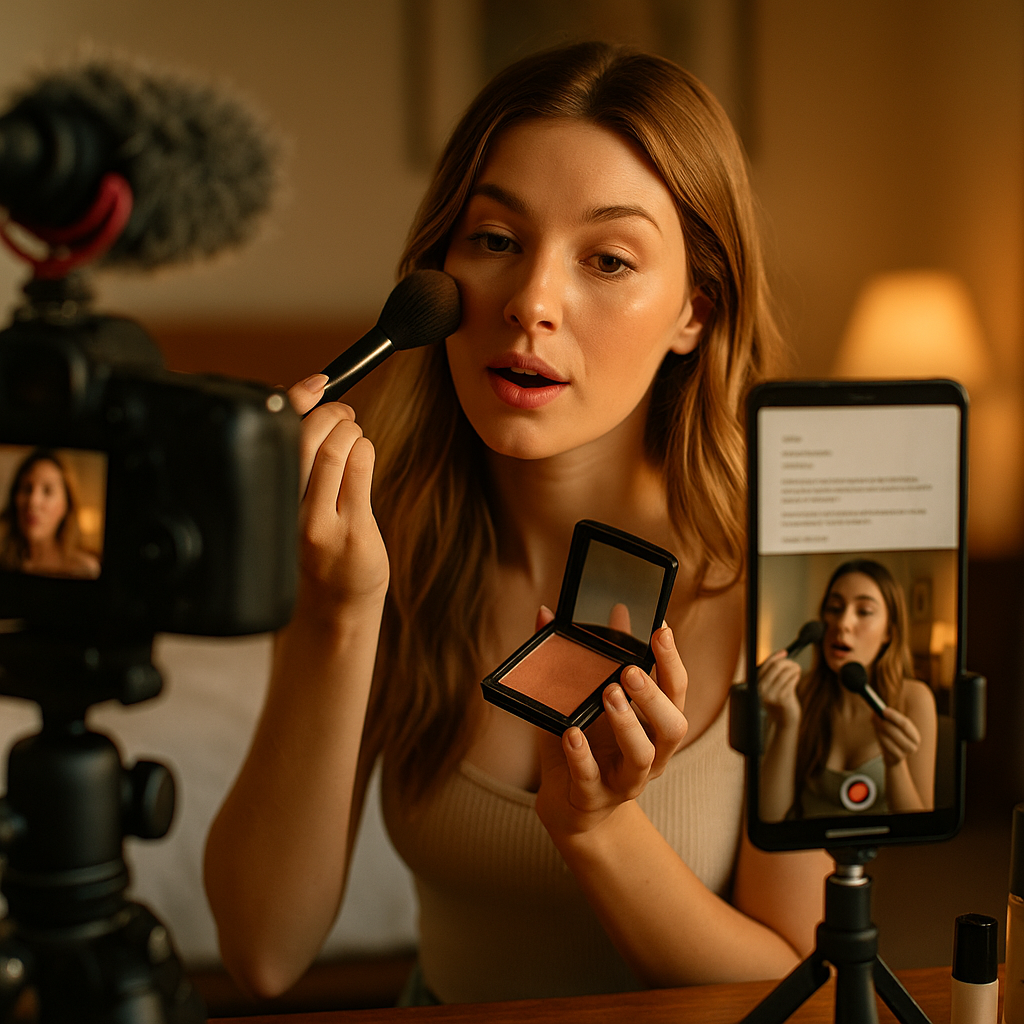
Skip rate on branded GRWM content jumped past 60% on some platforms last year, according to internal creator agency benchmarks — and audiences can now spot a scripted “get ready with me” video within the first three seconds. The GRWM format made creators millions by feeling unscripted. Brands broke that trust by scripting it anyway. Here’s how to fix the creative direction before your next brief kills another campaign.
Why the Format Broke in the First Place
GRWM worked because it mimicked a FaceTime call with a friend who happens to be doing her makeup. The camera angle, the ring light glow, the half-finished sentence about her ex — all of it signaled intimacy. Brands noticed the engagement numbers and did what brands do: they templated it. Suddenly every GRWM had the same beats. Product reveal at second eight. Benefit statement at second fifteen. Discount code read verbatim at the end.
Audiences aren’t stupid. They know when a “spontaneous” mention of a serum was actually clause four in a contract. The format’s power came from its looseness, and tight briefs strangled that looseness out of it. This is the same trap brands fell into with haul videos and unboxings — a format goes viral organically, brands try to industrialize it, and the industrialization is exactly what audiences reject. We’ve covered this pattern before in how to brief creators for haul and tutorial formats, and GRWM is following the same arc, just faster.
The moment a GRWM video feels like it was approved by legal before it was approved by the creator’s own judgment, the audience checks out — and the algorithm notices the drop-off before your brand team does.
What “Reinvented” Actually Means Here
Reinventing GRWM doesn’t mean inventing a new format. It means restoring the structural randomness that made the original version watchable. That requires brands to direct for texture, not for message delivery. Three shifts matter most:
- Direct the environment, not the script. Tell the creator where they are (car, dorm bathroom, backstage) and what they’re getting ready for (a first date, a client pitch, a flight). Let the product enter the frame the way it would in real life — mid-sentence, slightly late, sometimes fumbled.
- Build in narrative stakes. The best-performing GRWM content right now has a “why” attached — she’s getting ready for something that matters to her, and the product is incidental to that story, not the point of it.
- Allow visible imperfection. A dropped brush, a re-take joke, an aside about being late — these are trust signals. Scripts that eliminate all friction eliminate the believability along with it.
The Brief Structure That Doesn’t Kill the Vibe
Most GRWM briefs fail because they’re written like ad scripts with a beauty filter. A better brief separates non-negotiables from creative latitude explicitly, so the creator knows exactly where the compliance line is and where they’re free to improvise.
Here’s a structure that’s worked across beauty, wellness, and even fintech clients experimenting with the format:
- Context anchor: One sentence describing the real-life scenario the GRWM is built around. Not “morning routine” — “getting ready for a job interview she’s nervous about.”
- Product integration window: A range, not a timestamp. “Somewhere between 20-40 seconds” beats “at 0:22.”
- Required claims: Exact language for any functional or efficacy claim, pulled straight from legal. This is non-negotiable and should be flagged as such — see our FTC compliance guide for creator briefs if your product makes any performance claims.
- Tone guardrails: Three adjectives max. “Rushed, honest, a little self-deprecating” tells a creator more than two paragraphs of brand voice guidelines.
- Explicit permission to improvise: State outright that filler words, tangents, and off-script moments are welcome. Creators default to over-compliance unless told otherwise.
This mirrors the specificity principle we’ve argued for elsewhere — briefs that win aren’t longer, they’re sharper. Our piece on scoring creator briefs that perform goes deeper on how to build that scoring rubric internally.
Sound-Off Viewing Changes the Calculus
A growing share of GRWM views happen without sound, especially on commute-heavy platforms like Instagram Reels and YouTube Shorts. If your entire product mention lives in spoken dialogue, you’re losing a meaningful chunk of comprehension. Captions and on-screen text need to carry the functional claim independently of the voiceover, which means creative direction has to plan for two parallel information layers: what’s said, and what’s shown. We broke this down in detail in our guide to sound-off social video briefs — it’s essential reading before you finalize any GRWM shot list.
Casting Matters More Than the Script Does
Here’s an uncomfortable truth for brand teams used to controlling every variable: the single biggest predictor of GRWM performance isn’t the brief, it’s the creator’s baseline talk-to-camera style. Creators who already have a rambling, unfiltered format in their normal content will make your product feel native. Creators who are polished and presentational will make it feel like an ad no matter how loose the brief is.
Vet for this specifically. Pull three to five recent non-sponsored GRWMs from a shortlisted creator and watch for: Do they talk over themselves? Do they go on tangents unrelated to beauty or the getting-ready process itself? Do they address the camera like a friend or like an audience? That last distinction is the whole game.
Measurement: What to Actually Track
Standard view-through and engagement metrics undersell what makes a GRWM succeed or fail. Add these to your reporting template:
- Retention curve shape at the product mention timestamp. A dip here means the integration read as an ad break. A flat line means it blended in.
- Comment sentiment specifically around the product, not just overall comment volume. “Wait what is she using” is the signal you want.
- Save rate versus share rate. GRWM content that gets saved (for the routine) but not shared (because it feels branded) is a half-win at best.
- Duet and stitch volume. Genuinely resonant GRWM content spawns response videos. Ad-flavored content rarely does.
According to eMarketer, creator-led video continues to outpace traditional social ad formats on time-spent metrics, but that gap narrows fast when audiences detect scripted intent — which is exactly why retention-curve analysis at the integration point matters more than top-line view counts.
Where Brands Get the Legal Line Wrong
Disclosure doesn’t have to kill authenticity, but plenty of brand teams treat #ad placement like an afterthought bolted onto the caption, which makes the whole video feel like a bait-and-switch. Better practice: have the creator acknowledge the partnership naturally within the video itself, early, in their own words. “Full transparency, this month’s routine has some [Brand] stuff in it because they sent me some things I actually like” does more disclosure work than a buried hashtag, and it satisfies FTC disclosure requirements more robustly too. Regulators in the UK apply similar scrutiny — see ICO guidance if you’re running campaigns across both markets.
This upfront honesty, paradoxically, buys creators more room to be unscripted later in the video. Audiences forgive sponsorship. They don’t forgive being fooled about it.
A Quick Format Comparison Worth Knowing
GRWM isn’t the only lifestyle-adjacent format brands are trying to de-ad-ify right now. If you’re building out a broader content taxonomy across formats and budgets, our social-first format taxonomy and ROI guide maps GRWM against hauls, day-in-the-life, and tutorial content, with rough budget ranges for each. Worth a read before you allocate next quarter’s creator spend across formats rather than defaulting to whatever performed last quarter.
Platforms are also investing directly in creator-native ad tooling that assumes this kind of loose integration — TikTok’s ad platform and Meta’s business tools both now surface organic-style creator content formats as first-class ad units, which tells you where the industry consensus is heading.
The takeaway: stop briefing GRWM like a commercial script and start briefing it like a documentary with a product placement. Give creators a real scenario, a claims checklist, and permission to be messy — then measure the retention curve at the product mention, not just the view count.
FAQs
What makes a GRWM video feel like an ad instead of authentic content?
Rigid scripting, exact-timestamp product placement, and verbatim discount code reads are the three biggest tells. Audiences pick up on unnatural pacing almost instantly, especially when the product mention interrupts rather than integrates into the routine.
How much creative freedom should brands give creators in a GRWM brief?
As much as possible outside of legally required claims language and disclosure. Lock down exact wording only where compliance demands it, and leave tone, pacing, and environment fully to the creator’s judgment.
Does GRWM content need FTC disclosure even if it feels casual?
Yes. Any material connection between a brand and creator requires clear disclosure under FTC guidelines, regardless of how unscripted the content appears. Naturalized, early, in-video disclosure tends to outperform buried hashtag disclosures on both compliance and engagement.
What metrics best indicate a GRWM integration succeeded?
Retention rate at the product mention timestamp, product-specific comment sentiment, and duet/stitch volume are stronger signals than raw view count or overall engagement rate.
Should brands prioritize follower count or content style when casting GRWM creators?
Content style. A creator whose normal, non-sponsored content already has a rambling, off-script talk-to-camera style will integrate a product far more believably than a highly polished creator with a larger following.
Top Influencer Marketing Agencies
The leading agencies shaping influencer marketing in 2026
Agencies ranked by campaign performance, client diversity, platform expertise, proven ROI, industry recognition, and client satisfaction. Assessed through verified case studies, reviews, and industry consultations.
Moburst

-
2

The Shelf
Boutique Beauty & Lifestyle Influencer AgencyA data-driven boutique agency specializing exclusively in beauty, wellness, and lifestyle influencer campaigns on Instagram and TikTok. Best for brands already focused on the beauty/personal care space that need curated, aesthetic-driven content.Clients: Pepsi, The Honest Company, Hims, Elf Cosmetics, Pure LeafVisit The Shelf → -
3

Audiencly
Niche Gaming & Esports Influencer AgencyA specialized agency focused exclusively on gaming and esports creators on YouTube, Twitch, and TikTok. Ideal if your campaign is 100% gaming-focused — from game launches to hardware and esports events.Clients: Epic Games, NordVPN, Ubisoft, Wargaming, Tencent GamesVisit Audiencly → -
4

Viral Nation
Global Influencer Marketing & Talent AgencyA dual talent management and marketing agency with proprietary brand safety tools and a global creator network spanning nano-influencers to celebrities across all major platforms.Clients: Meta, Activision Blizzard, Energizer, Aston Martin, WalmartVisit Viral Nation → -
5

The Influencer Marketing Factory
TikTok, Instagram & YouTube CampaignsA full-service agency with strong TikTok expertise, offering end-to-end campaign management from influencer discovery through performance reporting with a focus on platform-native content.Clients: Google, Snapchat, Universal Music, Bumble, YelpVisit TIMF → -
6

NeoReach
Enterprise Analytics & Influencer CampaignsAn enterprise-focused agency combining managed campaigns with a powerful self-service data platform for influencer search, audience analytics, and attribution modeling.Clients: Amazon, Airbnb, Netflix, Honda, The New York TimesVisit NeoReach → -
7

Ubiquitous
Creator-First Marketing PlatformA tech-driven platform combining self-service tools with managed campaign options, emphasizing speed and scalability for brands managing multiple influencer relationships.Clients: Lyft, Disney, Target, American Eagle, NetflixVisit Ubiquitous → -
8

Obviously
Scalable Enterprise Influencer CampaignsA tech-enabled agency built for high-volume campaigns, coordinating hundreds of creators simultaneously with end-to-end logistics, content rights management, and product seeding.Clients: Google, Ulta Beauty, Converse, AmazonVisit Obviously →