


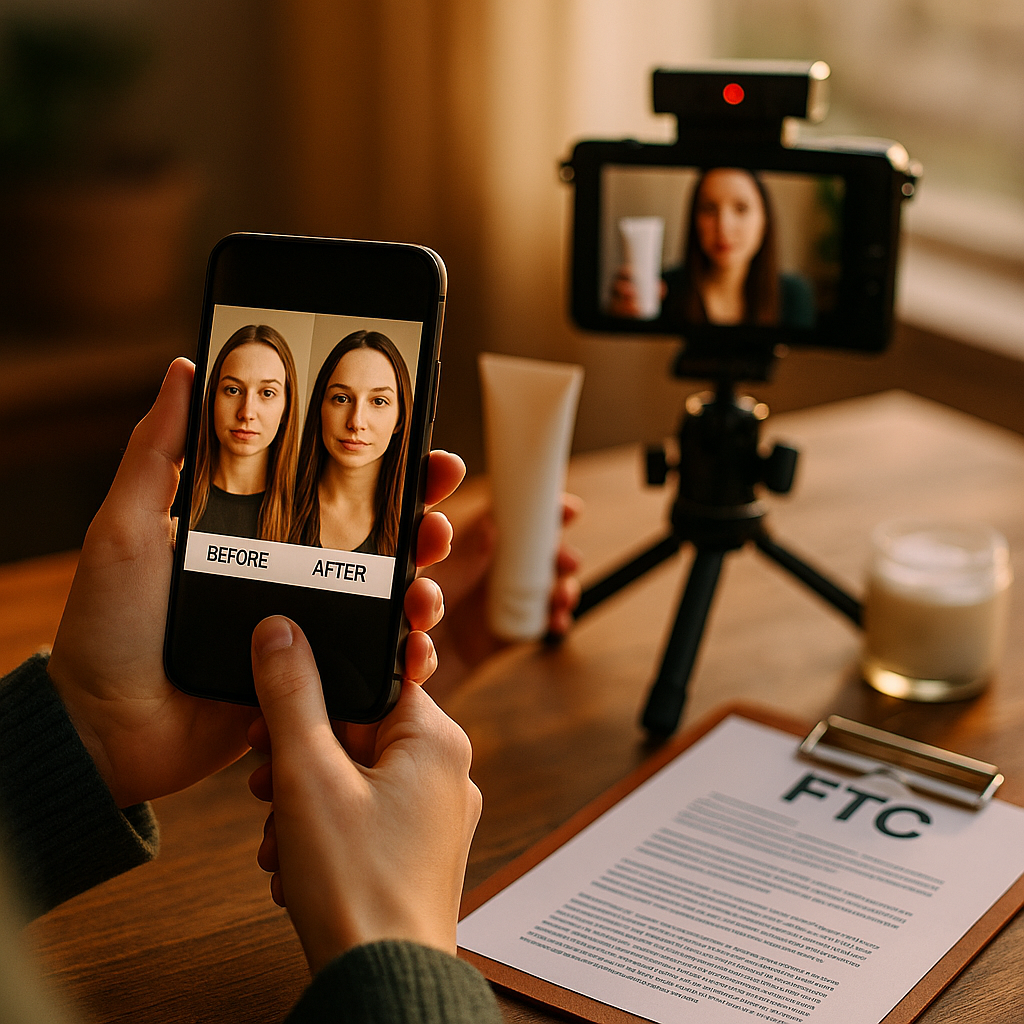
Transformation videos get 2-3x the engagement of standard product demos on platforms like TikTok and Instagram, according to internal creator benchmarks widely cited across the industry. Why does a shaky before-and-after clip beat a $50,000 production shoot? Because it answers the only question that matters to a skeptical buyer: did this actually work? The transformation format has become the backbone of performance creative for home, beauty, and fitness brands. Done wrong, it’s also a fast track to a regulatory headache.
Why Before-and-After Still Wins Attention
Humans are wired for contrast. A cluttered garage next to an organized one. A dull complexion next to a glowing one. A body at week one next to a body at week twelve. The format works because it compresses a story arc into seconds — setup, tension, payoff — without needing a script. Viewers fill in the emotional gap themselves.
This is also why the format travels so well across categories. Home organizers, skincare brands, and fitness apps are all selling the same underlying promise: transformation with minimal effort on the viewer’s part. The creative device is identical; only the props change.
The transformation format isn’t a beauty trend or a fitness trend — it’s a persuasion mechanism that happens to work across every category selling a better version of “after.”
Brands that treat it as a template rather than a gimmick tend to see it hold up as a reliable performance format quarter after quarter, not just a one-off viral moment.
The Compliance Trap Hiding Inside a Great Hook
Here’s the uncomfortable part. The same drama that makes transformation content shareable is exactly what makes it risky. The FTC has been explicit about testimonials and results claims: if a result isn’t typical, you need to say so, and “results not typical” disclaimers buried in tiny text won’t cut it anymore. The FTC’s endorsement guidance applies to influencer content exactly the same way it applies to a national TV ad.
For fitness and beauty brands specifically, this gets tangled up with functional claims. A creator saying “this serum erased my wrinkles in a week” isn’t just an engaging hook — it’s a claim your legal team needs to substantiate or a claim you need to strike from the brief entirely. Our FTC compliance guide for functional claims breaks down exactly where brands get exposed, and it’s required reading before you greenlight any transformation campaign.
Lighting changes, filters, angles, even just better posture in the “after” shot — all of it can tip a transformation video from persuasive to deceptive in the eyes of a regulator. The line isn’t always obvious, which is precisely why it needs to be defined in the brief, not left to the creator’s judgment on set.
What Actually Trips Brands Up
- Undisclosed editing or filters that exaggerate the “after” result beyond what the product delivers.
- Cherry-picked timelines that imply a typical result when the creator’s outcome was an outlier.
- Vague causation — implying the product caused a result that also involved diet changes, professional treatments, or unrelated lifestyle shifts.
- Missing or buried disclosures about paid partnerships, which the FTC treats as a separate violation from the results claim itself.
None of this means brands should avoid the format. It means the brief has to do more work than “show a before and after, make it feel real.”
Briefing the Format by Category
Home, beauty, and fitness each carry different risk profiles and different audience expectations. Treating them identically in a brief is a missed opportunity — and sometimes a compliance gap.
Home: The Lowest-Risk, Highest-Volume Category
Organization, cleaning, and renovation transformations are relatively low-risk from a claims perspective — nobody’s suing over a closet that “still looks a little messy.” But they carry a different problem: authenticity fatigue. Audiences have seen thousands of pantry makeovers. The format needs a fresh constraint to stand out, whether that’s a tight time limit, an unconventional space, or an unexpected before state.
Home brands also benefit from stacking transformation content with other high-performing formats. A satisfying declutter sequence pairs naturally with the sensory hooks used in ASMR-style product demos, since the “after” reveal often carries its own oddly satisfying sound design — zippers, snaps, the click of a labeled bin sliding into place.
Beauty: Where Disclosure Has to Be Load-Bearing
Beauty is the category where regulators pay closest attention, and for good reason — skin, hair, and body claims are among the most litigated in advertising. Every beauty transformation brief should specify: no professional retouching, consistent lighting conditions disclosed on camera, and a stated timeline that matches the product’s actual claimed results window.
Split-screen formats are particularly popular here, showing simultaneous “before” and “after” rather than a sequential reveal. If you’re using that structure, our guide on briefing split-screen content that stays compliant covers the disclosure placement rules that keep this exact setup out of regulatory crosshairs.
Fitness: The Category With the Longest Tail of Risk
Fitness transformations carry the longest exposure window because results compound over months, and audiences know it. A single-video “12-week transformation” almost always implies a program, a diet, or professional guidance the brand didn’t provide. Briefs need explicit language requiring creators to disclose what else changed — training frequency, nutrition, sleep — alongside product use.
This is also where GRWM-adjacent formats intersect with transformation storytelling. Fitness creators increasingly blend “get ready with me” routines with progress documentation. If your brand is testing that hybrid, the framework in reinventing GRWM briefs applies directly, particularly around keeping the tone unscripted while still hitting disclosure requirements.
Building a Brief That Protects the Story and the Brand
A strong transformation brief isn’t longer than a standard creator brief — it’s more precise. Vague instructions like “show your journey” invite creators to fill gaps with whatever performs, which is exactly how brands end up with a viral video and a legal problem in the same week.
- Define the timeline in writing. If the product’s claimed results window is eight weeks, the content can’t imply results at week two.
- Require disclosure of confounding variables. Diet, other products, professional services — all named on camera or in caption, not just in fine print.
- Lock down editing standards. Specify lighting consistency and prohibit filters or retouching on the “after” segment specifically.
- Place the paid partnership disclosure early. Not buried after the reveal, where viewers have already formed a conclusion.
- Pre-approve the results claim language. Legal should sign off on the specific phrase a creator uses, not just the general concept.
Brands running this format at scale across dozens of creators should also look at how briefs hold up under volume. Our piece on how to scale creator briefs without killing authenticity is directly relevant here — transformation content is exactly the kind of format that gets flattened into a formula when brands stop reviewing individual creator context.
Measuring What the Format Actually Delivers
Engagement rate tells you the hook worked. It doesn’t tell you whether the transformation narrative drove purchase intent or just scroll-stopping curiosity. Brands serious about ROI on this format should be tracking:
- Save and share rate relative to like rate — transformation content that gets saved is being used as reference material, a strong purchase-intent signal.
- Comment sentiment specifically around authenticity (“is this real?” comments spiking is a warning sign, not a vanity metric).
- Post-view conversion lag — transformation content, especially fitness, tends to convert over days or weeks, not minutes, because viewers research before buying.
- Repeat exposure effect — does a viewer who sees three transformation videos from different creators convert at a higher rate than one exposure?
Platforms like Sprout Social and category benchmarks from eMarketer are useful for contextualizing whether your engagement numbers are actually above category norms or just feel impressive in isolation. Don’t grade the format against your own historical average alone — grade it against what competitors in home, beauty, and fitness are actually pulling.
Where This Format Is Headed
Expect scrutiny to increase, not decrease. Regulators in the UK and EU have been tightening influencer disclosure enforcement, and the ICO’s guidance on data and consumer protection increasingly intersects with how “results” content gets targeted via ad platforms. Brands operating across markets need briefs that meet the strictest applicable standard, not the loosest.
At the same time, AI-generated “after” imagery is starting to blur into organic transformation content, and audiences are getting sharper at spotting it. The brands that win here won’t be the ones with the most dramatic reveal. They’ll be the ones whose reveals audiences actually trust — which, in a crowded feed, is the rarer and more valuable asset.
Next step: Audit your last five transformation briefs against the FTC’s endorsement standards before your next campaign ships — not after a creator’s comment section starts asking if it’s real.
FAQs
What makes a before-and-after video legally risky for brands?
The risk comes from implying a typical result without disclosure, using undisclosed editing or filters on the “after” shot, or failing to mention other factors (diet, professional treatment, additional products) that contributed to the result.
How long should a transformation timeline be to stay credible?
It should match the product’s actual substantiated results window. If a brand’s testing shows results at eight weeks, content implying faster results misrepresents the product, regardless of whether it’s technically possible for an outlier user.
Does the transformation format work outside beauty and fitness?
Yes. Home organization, renovation, and even B2B software demos use the same before-and-after structure. The core mechanic — contrast plus payoff — isn’t category-specific, though the compliance stakes vary significantly by category.
Should brands require creators to disclose editing tools used?
For any content making a results claim, yes. If lighting, filters, or retouching were used on the “after” segment, that needs disclosure, since it directly affects whether the claim is accurate.
What metric best indicates a transformation video is driving real ROI?
Save and share rate relative to likes, combined with delayed conversion tracking, tends to be more reliable than immediate engagement rate, since transformation content often influences purchase decisions over days rather than in the moment.
Top Influencer Marketing Agencies
The leading agencies shaping influencer marketing in 2026
Agencies ranked by campaign performance, client diversity, platform expertise, proven ROI, industry recognition, and client satisfaction. Assessed through verified case studies, reviews, and industry consultations.
Moburst

-
2

The Shelf
Boutique Beauty & Lifestyle Influencer AgencyA data-driven boutique agency specializing exclusively in beauty, wellness, and lifestyle influencer campaigns on Instagram and TikTok. Best for brands already focused on the beauty/personal care space that need curated, aesthetic-driven content.Clients: Pepsi, The Honest Company, Hims, Elf Cosmetics, Pure LeafVisit The Shelf → -
3

Audiencly
Niche Gaming & Esports Influencer AgencyA specialized agency focused exclusively on gaming and esports creators on YouTube, Twitch, and TikTok. Ideal if your campaign is 100% gaming-focused — from game launches to hardware and esports events.Clients: Epic Games, NordVPN, Ubisoft, Wargaming, Tencent GamesVisit Audiencly → -
4

Viral Nation
Global Influencer Marketing & Talent AgencyA dual talent management and marketing agency with proprietary brand safety tools and a global creator network spanning nano-influencers to celebrities across all major platforms.Clients: Meta, Activision Blizzard, Energizer, Aston Martin, WalmartVisit Viral Nation → -
5

The Influencer Marketing Factory
TikTok, Instagram & YouTube CampaignsA full-service agency with strong TikTok expertise, offering end-to-end campaign management from influencer discovery through performance reporting with a focus on platform-native content.Clients: Google, Snapchat, Universal Music, Bumble, YelpVisit TIMF → -
6

NeoReach
Enterprise Analytics & Influencer CampaignsAn enterprise-focused agency combining managed campaigns with a powerful self-service data platform for influencer search, audience analytics, and attribution modeling.Clients: Amazon, Airbnb, Netflix, Honda, The New York TimesVisit NeoReach → -
7

Ubiquitous
Creator-First Marketing PlatformA tech-driven platform combining self-service tools with managed campaign options, emphasizing speed and scalability for brands managing multiple influencer relationships.Clients: Lyft, Disney, Target, American Eagle, NetflixVisit Ubiquitous → -
8

Obviously
Scalable Enterprise Influencer CampaignsA tech-enabled agency built for high-volume campaigns, coordinating hundreds of creators simultaneously with end-to-end logistics, content rights management, and product seeding.Clients: Google, Ulta Beauty, Converse, AmazonVisit Obviously →