


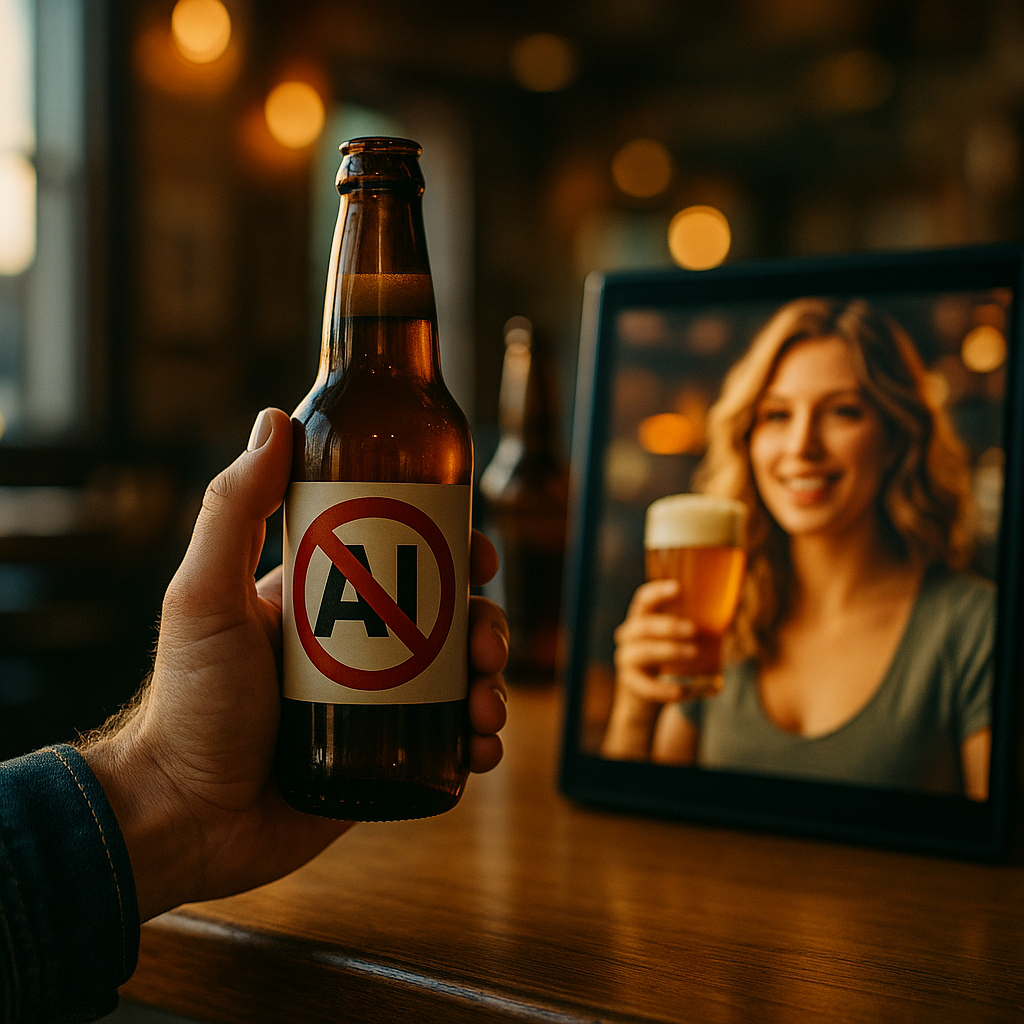
63% of consumers say they trust brands less when they suspect an ad was made with AI. Now a beer company has built an entire campaign around that distrust, mocking synthetic slop while pouring real actors into real bars. Is this a marketing gimmick, or the first real signal of where 2026 sentiment is headed?
The backlash against AI-generated ads isn’t theoretical anymore. It’s showing up in campaign briefs, in comment sections, and now, in campaigns explicitly built to reject the technology. Brands that spent the last two years racing to automate creative production are suddenly facing a market that wants proof of humanity, not proof of efficiency.
The Beer Campaign That Bet Against the Machine
A regional beer brand recently ran a campaign with a blunt tagline: no AI, no filters, no synthetic actors — just people who actually drink the product. The ads leaned hard into visible imperfections: shaky camera work, real bar noise, unscripted laughter. It was almost aggressively low-fi, a deliberate rejection of the polished, slightly-too-perfect look that’s become a giveaway for AI-assisted production.
The campaign didn’t just perform well. It became a talking point. Trade press covered it, competitors quietly watched, and social feeds filled with comments praising the brand for “keeping it real.” That reaction is the real story here, not the beer.
When a brand can generate buzz simply by promising its ads weren’t made with AI, that’s not a quirky marketing stunt — it’s a market correction.
This mirrors what recent trust data has already shown: consumers are actively penalizing brands for AI-generated content, even when the output is technically flawless. Perfection, it turns out, is starting to read as suspicious.
Why Consumers Turned So Fast
Two years ago, AI-generated ads were a novelty. People marveled at what the tools could do. Now the same tools are everywhere, and the novelty has curdled into fatigue, then into skepticism, then into something closer to resentment.
A few forces converged to get us here:
- Volume without variation. AI made it cheap to produce infinite ad variants, but most brands used that capacity to flood feeds with near-identical creative. Consumers noticed the sameness before they noticed the technology behind it.
- The uncanny valley moved to marketing. Synthetic actors with slightly-off blinking patterns, voiceovers with unnatural cadence, product shots that look airbrushed into oblivion — these tells have become memes in their own right.
- Detection got easier. Browser extensions, watermark analysis, and community-driven callouts mean an AI-generated ad rarely stays anonymous for long. The detection arms race has made deception a much shorter-lived strategy than it used to be.
- Trust in institutions is already low. Layer AI skepticism onto existing brand distrust, and you get a consumer base primed to assume the worst about any polished, too-perfect ad.
None of this means AI creative is dead. It means the tolerance for lazy or undisclosed use of it has collapsed. Data covered in our piece on AI ad skepticism shows this isn’t a niche complaint from a vocal minority — it’s a mainstream sentiment shift with real purchase-intent consequences.
The Data Behind the Backlash
Skepticism toward AI marketing isn’t just anecdotal outrage on social media. Industry trackers have been logging the shift for months. Ad fatigue studies referenced in our analysis of creative rethinking found that AI-heavy campaigns saw measurably lower engagement and completion rates compared to human-shot equivalents, even when spend and targeting were identical.
Meanwhile, governance-focused research from Kantar’s content governance report pointed to a widening gap between what brands think they’re disclosing and what consumers believe they’re owed in terms of transparency. Most brands aren’t lying about AI use. They’re just not saying anything, and silence reads as concealment.
Third-party industry data reinforces the trend. Analysts at eMarketer have tracked declining engagement on synthetic-heavy creative formats, while Statista surveys consistently show consumer discomfort rising alongside AI ad adoption. This isn’t a fringe reaction. It’s a broad, measurable pattern.
What This Means for Brand Strategy
If you’re running a creative operation that leans on generative AI, the beer campaign should read as a warning shot, not a curiosity. The lesson isn’t “stop using AI.” It’s “stop hiding it, and stop letting it replace the parts of your brand that people actually connect with.”
A few practical shifts worth considering:
- Disclose proactively. Brands that label AI-assisted content upfront are seeing less backlash than those caught after the fact. Regulatory pressure is heading this direction too — the FTC has signaled increasing scrutiny of undisclosed synthetic media in advertising, and the Digital Services Act is already reshaping disclosure norms in influencer content.
- Reserve AI for scale, not soul. Use it for variant testing, localization, and production efficiency. Keep the emotional core of a campaign, the parts meant to build trust, rooted in real people and real footage.
- Audit your creative pipeline for “tells.” If your internal team can’t immediately tell whether a given ad was AI-assisted, don’t assume your audience can’t either. They increasingly can.
- Rewrite briefs to specify human elements. This is already happening industry-wide, as detailed in coverage of how skepticism is reshaping briefs. Creative directors are now required to justify AI use case-by-case rather than defaulting to it.
The brands winning right now aren’t the ones with the most advanced AI stack — they’re the ones who know exactly where to draw the line between automation and authenticity.
The In-House Angle Nobody’s Talking About
There’s a quieter trend running parallel to this backlash: brands pulling creative production back in-house, partly to control costs, partly to control authenticity signals. Our reporting on why brands are ditching agencies for in-house AI teams shows this isn’t purely a cost play. It’s also a trust play. In-house teams can move faster to correct course when a campaign reads as too synthetic, without the layered accountability problems of an external agency defending its own AI-heavy workflow.
The same dynamic showed up in the Intuit agency shakeup, where the shift toward internal teams was framed explicitly around tighter creative control. Control, in this context, increasingly means control over how “AI” a piece of content is allowed to look.
UGC and Creator Content: The Authenticity Premium
It’s not a coincidence that this backlash coincides with renewed brand investment in creator and UGC content. Real people, filming with their own phones, saying things in their own words, are the functional opposite of a synthetic ad. Our breakdown of the UGC authenticity premium shows brands are now willing to pay measurably more for content that reads as unmistakably human, and they’re building reporting frameworks to prove that premium is earned.
Platform-specific standards are hardening around this too. Guidance on authenticity standards across major platforms shows Reddit, TikTok, and Instagram are each developing their own signals for flagging content that looks manufactured, whether AI-generated or simply over-produced UGC dressed up to look organic. Brands playing both sides, claiming authenticity while quietly polishing everything into a formula, are getting caught by the same detection tools built for AI slop.
Where Sentiment Goes From Here
Don’t expect this to be a temporary correction. The trajectory points toward AI disclosure becoming table stakes, not a differentiator, within the next couple of buying cycles. Brands that get ahead of that now, by building disclosure and human-verification into their creative process, will avoid the credibility hit that’s currently landing on latecomers.
The beer campaign worked because it named the discomfort everyone was already feeling. Expect more brands, across categories far beyond alcohol, to follow that playbook: turning AI skepticism itself into the marketing hook. It’s a clever move, but it only works once per category before it becomes its own cliché. The brands that survive the next wave of sentiment shifts will be the ones who built genuine authenticity into their process, not just their tagline.
FAQs
Frequently Asked Questions
Why are consumers pushing back against AI-generated ads specifically now?
The novelty phase of generative AI marketing has ended, and audiences have gotten better at spotting the visual and tonal tells of synthetic content. Combined with broader institutional distrust and a flood of near-identical AI-generated creative, the backlash represents a saturation point rather than a sudden reversal.
Does the anti-AI beer campaign mean brands should stop using AI in advertising?
No. It signals that undisclosed or poorly executed AI use carries real reputational risk. Brands can still use AI for efficiency and scale, but the emotional core of a campaign, particularly anything meant to build trust, performs better when it’s clearly human.
How can brands disclose AI use without undermining the campaign?
Proactive, plain-language disclosure tends to outperform silence. Framing AI as a production tool rather than a replacement for human creativity, and pairing it with visibly human elements elsewhere in the campaign, helps maintain trust while still capturing efficiency gains.
What role does regulation play in this shift?
Regulatory bodies including the FTC and frameworks like the EU’s Digital Services Act are increasing scrutiny of undisclosed synthetic media in advertising. Brands that build disclosure into their workflow now are better positioned for compliance as rules tighten.
Is this backlash limited to certain industries, or is it universal?
Early signals suggest it’s broad-based, spanning CPG, retail, and B2B categories. Any brand relying heavily on AI-generated visuals or voiceovers without disclosure faces similar risk, regardless of sector.
The next campaign brief you write should answer one question before anything else: can a customer tell what’s real? If you can’t answer that confidently, fix your process before you fix your creative.
Top Influencer Marketing Agencies
The leading agencies shaping influencer marketing in 2026
Agencies ranked by campaign performance, client diversity, platform expertise, proven ROI, industry recognition, and client satisfaction. Assessed through verified case studies, reviews, and industry consultations.
Moburst

-
2

The Shelf
Boutique Beauty & Lifestyle Influencer AgencyA data-driven boutique agency specializing exclusively in beauty, wellness, and lifestyle influencer campaigns on Instagram and TikTok. Best for brands already focused on the beauty/personal care space that need curated, aesthetic-driven content.Clients: Pepsi, The Honest Company, Hims, Elf Cosmetics, Pure LeafVisit The Shelf → -
3

Audiencly
Niche Gaming & Esports Influencer AgencyA specialized agency focused exclusively on gaming and esports creators on YouTube, Twitch, and TikTok. Ideal if your campaign is 100% gaming-focused — from game launches to hardware and esports events.Clients: Epic Games, NordVPN, Ubisoft, Wargaming, Tencent GamesVisit Audiencly → -
4

Viral Nation
Global Influencer Marketing & Talent AgencyA dual talent management and marketing agency with proprietary brand safety tools and a global creator network spanning nano-influencers to celebrities across all major platforms.Clients: Meta, Activision Blizzard, Energizer, Aston Martin, WalmartVisit Viral Nation → -
5

The Influencer Marketing Factory
TikTok, Instagram & YouTube CampaignsA full-service agency with strong TikTok expertise, offering end-to-end campaign management from influencer discovery through performance reporting with a focus on platform-native content.Clients: Google, Snapchat, Universal Music, Bumble, YelpVisit TIMF → -
6

NeoReach
Enterprise Analytics & Influencer CampaignsAn enterprise-focused agency combining managed campaigns with a powerful self-service data platform for influencer search, audience analytics, and attribution modeling.Clients: Amazon, Airbnb, Netflix, Honda, The New York TimesVisit NeoReach → -
7

Ubiquitous
Creator-First Marketing PlatformA tech-driven platform combining self-service tools with managed campaign options, emphasizing speed and scalability for brands managing multiple influencer relationships.Clients: Lyft, Disney, Target, American Eagle, NetflixVisit Ubiquitous → -
8

Obviously
Scalable Enterprise Influencer CampaignsA tech-enabled agency built for high-volume campaigns, coordinating hundreds of creators simultaneously with end-to-end logistics, content rights management, and product seeding.Clients: Google, Ulta Beauty, Converse, AmazonVisit Obviously →