


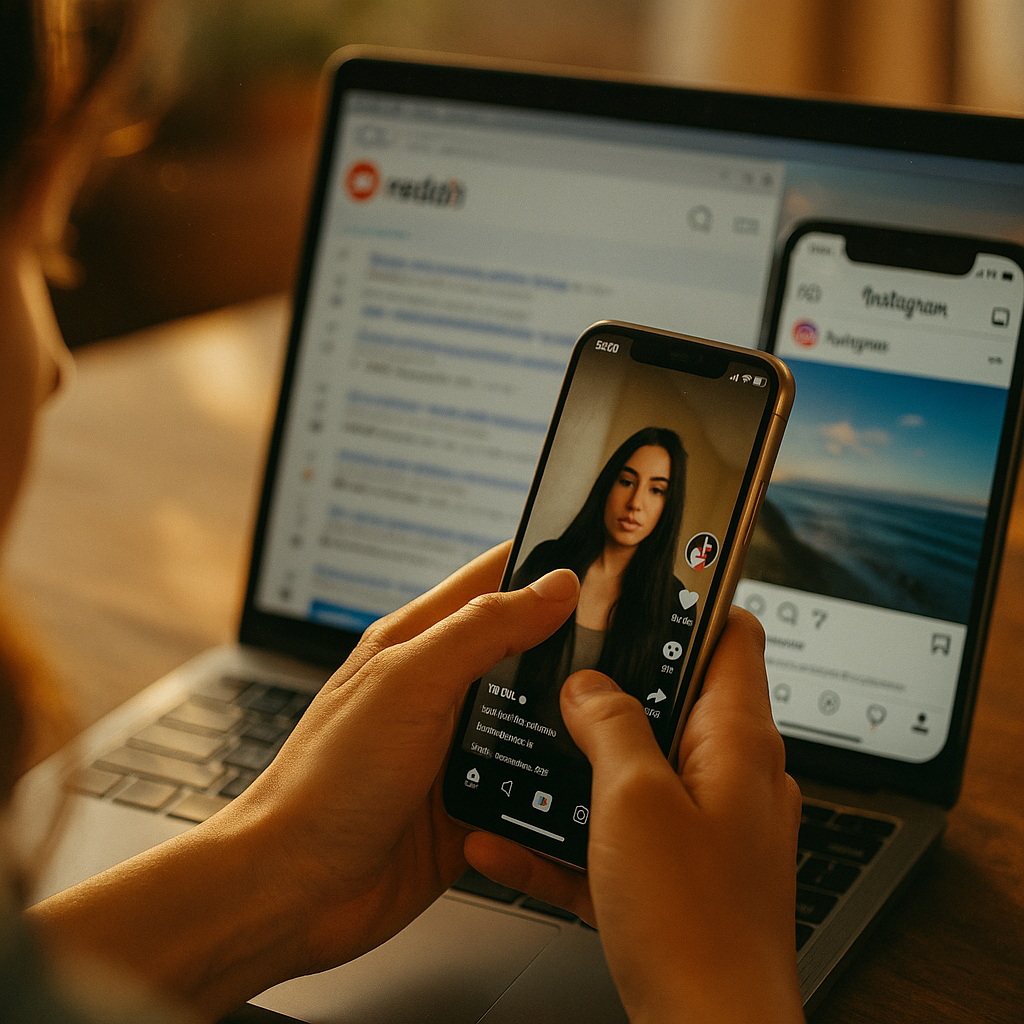
The Authenticity Floor Just Moved — Simultaneously on Three Platforms
Reddit’s aggressive purge of AI-generated slop in late 2025 wasn’t a Reddit story. It was a warning shot for every brand running UGC programs across TikTok, Instagram, and beyond. Platform algorithms are converging on a shared thesis: synthetic-feeling content gets buried, regardless of production value.
If your UGC quality standards were built platform-by-platform, in isolation, you are now operating with structural risk. The question isn’t whether AI spam detection will penalize your program. It’s whether your briefing, vetting, and distribution process is ready for a world where all three platforms are raising the authenticity floor at the same time.
What Reddit’s AI Slop Crackdown Actually Signals
Reddit’s moderation push targeted a specific pattern: content that reads as human but exhibits telltale AI generation signatures. Repetitive sentence rhythm. Absence of community-specific vernacular. Generic emotional beats. Lack of timestamps or situational specificity. Reddit’s r/mildlyinteresting and dozens of topic-specific subreddits saw aggressive downranking of posts that matched these patterns, even when the content was technically accurate and on-topic.
The operational lesson for brand social teams isn’t “avoid AI tools.” It’s more precise than that. The platforms are training their detection models on signal clusters, not binary human-vs-machine tests. A post that feels transactional, lacks contextual friction, or reads like it was assembled rather than experienced will increasingly underperform algorithmically, whether a human or a language model wrote it.
Platform AI spam detection doesn’t distinguish between a human writing like a bot and a bot writing like a human. Both get penalized. Your UGC standards need to account for authenticity signals, not just content origin.
For brands running advocacy programs, ambassador campaigns, or community seeding operations on Reddit, this means your briefing templates require an audit. If your prompts are generating outputs that lack specificity, personal context, or community voice, you’re feeding the algorithm exactly what it’s been trained to suppress.
TikTok’s Quality Signal Is Already Measuring the Same Thing
TikTok’s algorithm has quietly shifted its quality signals over the past 18 months. Completion rate and re-watch metrics remain core, but the platform’s internal trust scoring now weights what practitioners are calling “contextual authenticity density”: does this video contain specific, verifiable, situationally grounded information, or is it generic content wearing a trend’s clothing?
This matters enormously for brand UGC programs. A creator posting a haul video that could have been filmed anywhere, featuring any product, with no genuine personal context, performs measurably worse than one that includes a specific location, a real backstory, or an opinion that creates mild friction. TikTok’s advertising platform has explicitly noted that Spark Ads built on organically high-performing UGC outperform boosted content by significant margins — and organic performance is increasingly a function of authenticity signal density.
The micro-creator pricing landscape on TikTok is also shifting as a result. Creators who consistently produce high-authenticity content are commanding premium rates, because their content has a structural advantage in organic distribution before any paid amplification is layered on top.
Instagram Is Running the Same Playbook, Quietly
Meta has been less vocal about its AI content detection than Reddit, but the behavioral signals in Reels distribution are telling the same story. Generic product showcase content, particularly content that follows a formulaic structure (hook, product reveal, CTA) without variation or genuine creator voice, has seen declining reach in algorithmic distribution relative to content that demonstrates what Meta’s internal teams have described as “creator perspective differentiation.”
Translated for practitioners: Instagram’s algorithm is increasingly rewarding content where the creator’s specific POV is load-bearing. The product can still be central, but the creator’s individual context, their specific use case, their actual opinion, needs to be structurally essential to the video rather than cosmetically present.
This aligns directly with what the values-first briefing approach has been advocating for Gen Z audiences: briefs that invite genuine perspective rather than scripting a performance of authenticity.
The Cross-Platform Alignment Problem Most Teams Are Ignoring
Here’s where most brand social teams are currently exposed. They have different UGC standards for different platforms. The Reddit seeding team operates under community manager guidelines. The TikTok UGC program runs through an influencer marketing platform with its own quality rubric. Instagram UGC gets reviewed by a different team against a creative brief that was written for Instagram aesthetics, not algorithmic authenticity signals.
When platforms operated on divergent quality frameworks, this siloed approach was inefficient but survivable. When three major platforms converge on a shared underlying quality signal, that siloed approach becomes a liability. A creator brief that generates borderline-authentic content will now fail across all three surfaces simultaneously.
The fix isn’t a universal brief template. Platform-specific execution still matters. The fix is a shared authenticity standards layer that sits above platform-specific briefs and governs the core quality requirements that now apply everywhere.
- Specificity mandate: Every piece of UGC must contain at least one piece of content that couldn’t have been written without direct product experience (a specific sensory detail, a situational context, a before/after observation).
- Voice authenticity test: Does the content sound like this specific creator, or like a brand’s idea of what a creator sounds like? The former passes. The latter fails.
- Friction tolerance: Content that contains mild dissent, qualification, or nuance outperforms uncritical enthusiasm. Build this into briefing expectations explicitly.
- Community language audit: For Reddit specifically, does the content use the vernacular of the specific community it’s targeting? Generic language is algorithmically and community-moderated out.
For teams managing at scale, quality attribution frameworks like those deployed by large advertiser networks offer a useful structural model: quality gates at the brief stage, not just the approval stage.
What the Compliance and Brand Safety Angle Looks Like Now
There’s a secondary risk layer that deserves direct attention. As platforms increase AI detection sensitivity, there’s a compliance exposure for brands whose UGC programs have been using AI writing tools to assist creators with post drafts, caption templates, or comment response scripts.
The FTC’s disclosure requirements don’t specifically address AI-assisted UGC yet, but the disclosure landscape is moving. If a creator posts content they didn’t substantively author, and that content is part of a paid program, the disclosure and authenticity obligations compound. Brand legal teams that haven’t reviewed UGC program SOPs in light of both AI detection sensitivity and evolving disclosure guidance are sitting on unquantified risk.
Operationally, this means brand social teams need a clear policy on AI tool use within UGC creation workflows — not a ban, but a defined standard. AI can assist with research, formatting, and ideation. The experiential claim and personal voice must originate from the creator. That line needs to be explicit in program documentation.
Building the Authenticity-Proof UGC Program for the Current Environment
The brands that will perform well in this environment aren’t the ones that stop using AI tools or retreat to expensive high-production content. They’re the ones that engineer their UGC programs to produce content that is structurally immune to authenticity detection penalties because the content is, in fact, authentic.
That requires briefing discipline. It requires creator selection criteria that weight genuine product affinity and community credibility, not just follower count. It requires quality review that checks for authenticity signals, not just brand safety compliance. And it requires a cross-platform standards document that every team member, agency partner, and creator touchpoint operates from.
The social media management tooling category is beginning to incorporate authenticity scoring into content review workflows — worth evaluating for teams managing high-volume UGC pipelines. Similarly, platforms like IAB-certified creator networks are building quality tiers that explicitly account for algorithmic performance, not just reach metrics.
The brands winning UGC on TikTok, Reddit, and Instagram aren’t producing more content. They’re producing content that the algorithm reads as human because it was genuinely experienced, not just created.
For teams building or restructuring their creator programs, the C-suite infrastructure framing is increasingly useful here: UGC quality standards are not a creative preference, they are a distribution infrastructure decision with measurable ROI impact.
External benchmarking resources from eMarketer on UGC performance and platform algorithm behavior can help social teams build the internal business case for investing in quality standard upgrades rather than volume increases.
Start with an audit of your current briefs against the specificity mandate above. If your creators can fulfill the brief without having genuinely used the product, your brief is generating algorithmically vulnerable content — across all three platforms, simultaneously.
Frequently Asked Questions
How does Reddit’s AI content crackdown differ from TikTok and Instagram’s approach?
Reddit’s enforcement is community-driven and moderation-led, with downranking and removal handled partly by human moderators trained to spot AI-generated patterns and partly by platform-level detection. TikTok and Instagram operate through algorithmic distribution suppression rather than outright removal: content that fails authenticity signal thresholds simply receives reduced organic reach rather than being flagged or removed. The outcome for brand UGC programs is the same — underperformance — but the mechanism differs by platform.
What are the key authenticity signals that TikTok’s algorithm currently weights?
Based on current platform behavior and industry practitioner reporting, TikTok weights contextual specificity (content grounded in a real situation or location), creator voice differentiation (unique phrasing and perspective rather than generic delivery), friction presence (content that includes qualification or mild dissent rather than unqualified enthusiasm), and completion signal alignment (does viewer behavior match what authentic content would generate). Generic product showcase content that follows a formulaic hook-reveal-CTA structure without individual creator context is underperforming structurally.
Can brands still use AI tools in their UGC programs without risking algorithmic penalties?
Yes, with clear boundaries. AI tools remain useful for research, ideation, formatting assistance, and caption optimization. The risk emerges when AI is used to generate the experiential claim or personal voice that is supposed to originate from the creator. If the substantive content — the opinion, the specific use-case detail, the personal context — is AI-generated, the resulting content is both algorithmically vulnerable and potentially non-compliant with evolving FTC disclosure standards. Brand programs should document explicitly where AI assistance is permitted within creator workflows.
How should brand social teams structure a cross-platform UGC quality standard?
Build a shared authenticity standards layer above platform-specific briefs. This layer should include a specificity mandate (every post must contain at least one detail that requires direct product experience), a voice authenticity test (content must reflect the creator’s distinct perspective, not a generic brand voice), friction tolerance guidelines (mild dissent or qualification is expected and acceptable), and a community language requirement for platform contexts like Reddit where vernacular signals community membership. Platform-specific briefs then operate within this shared quality framework rather than as independent documents.
What is the compliance risk for brands using AI-assisted UGC in paid programs?
The FTC’s existing disclosure requirements apply to paid UGC programs regardless of how the content was produced, but AI-assisted content creation adds a layer of complexity around authenticity claims and material connection disclosure. If a creator posts AI-drafted content as their own authentic experience in a paid partnership context, the disclosure and authenticity obligations become difficult to satisfy simultaneously. Brand legal teams should review UGC program SOPs against both current FTC guidance and platform terms of service to identify where AI-assisted workflows create unquantified disclosure risk.
Top Influencer Marketing Agencies
The leading agencies shaping influencer marketing in 2026
Agencies ranked by campaign performance, client diversity, platform expertise, proven ROI, industry recognition, and client satisfaction. Assessed through verified case studies, reviews, and industry consultations.
Moburst

-
2

The Shelf
Boutique Beauty & Lifestyle Influencer AgencyA data-driven boutique agency specializing exclusively in beauty, wellness, and lifestyle influencer campaigns on Instagram and TikTok. Best for brands already focused on the beauty/personal care space that need curated, aesthetic-driven content.Clients: Pepsi, The Honest Company, Hims, Elf Cosmetics, Pure LeafVisit The Shelf → -
3

Audiencly
Niche Gaming & Esports Influencer AgencyA specialized agency focused exclusively on gaming and esports creators on YouTube, Twitch, and TikTok. Ideal if your campaign is 100% gaming-focused — from game launches to hardware and esports events.Clients: Epic Games, NordVPN, Ubisoft, Wargaming, Tencent GamesVisit Audiencly → -
4

Viral Nation
Global Influencer Marketing & Talent AgencyA dual talent management and marketing agency with proprietary brand safety tools and a global creator network spanning nano-influencers to celebrities across all major platforms.Clients: Meta, Activision Blizzard, Energizer, Aston Martin, WalmartVisit Viral Nation → -
5

The Influencer Marketing Factory
TikTok, Instagram & YouTube CampaignsA full-service agency with strong TikTok expertise, offering end-to-end campaign management from influencer discovery through performance reporting with a focus on platform-native content.Clients: Google, Snapchat, Universal Music, Bumble, YelpVisit TIMF → -
6

NeoReach
Enterprise Analytics & Influencer CampaignsAn enterprise-focused agency combining managed campaigns with a powerful self-service data platform for influencer search, audience analytics, and attribution modeling.Clients: Amazon, Airbnb, Netflix, Honda, The New York TimesVisit NeoReach → -
7

Ubiquitous
Creator-First Marketing PlatformA tech-driven platform combining self-service tools with managed campaign options, emphasizing speed and scalability for brands managing multiple influencer relationships.Clients: Lyft, Disney, Target, American Eagle, NetflixVisit Ubiquitous → -
8

Obviously
Scalable Enterprise Influencer CampaignsA tech-enabled agency built for high-volume campaigns, coordinating hundreds of creators simultaneously with end-to-end logistics, content rights management, and product seeding.Clients: Google, Ulta Beauty, Converse, AmazonVisit Obviously →