


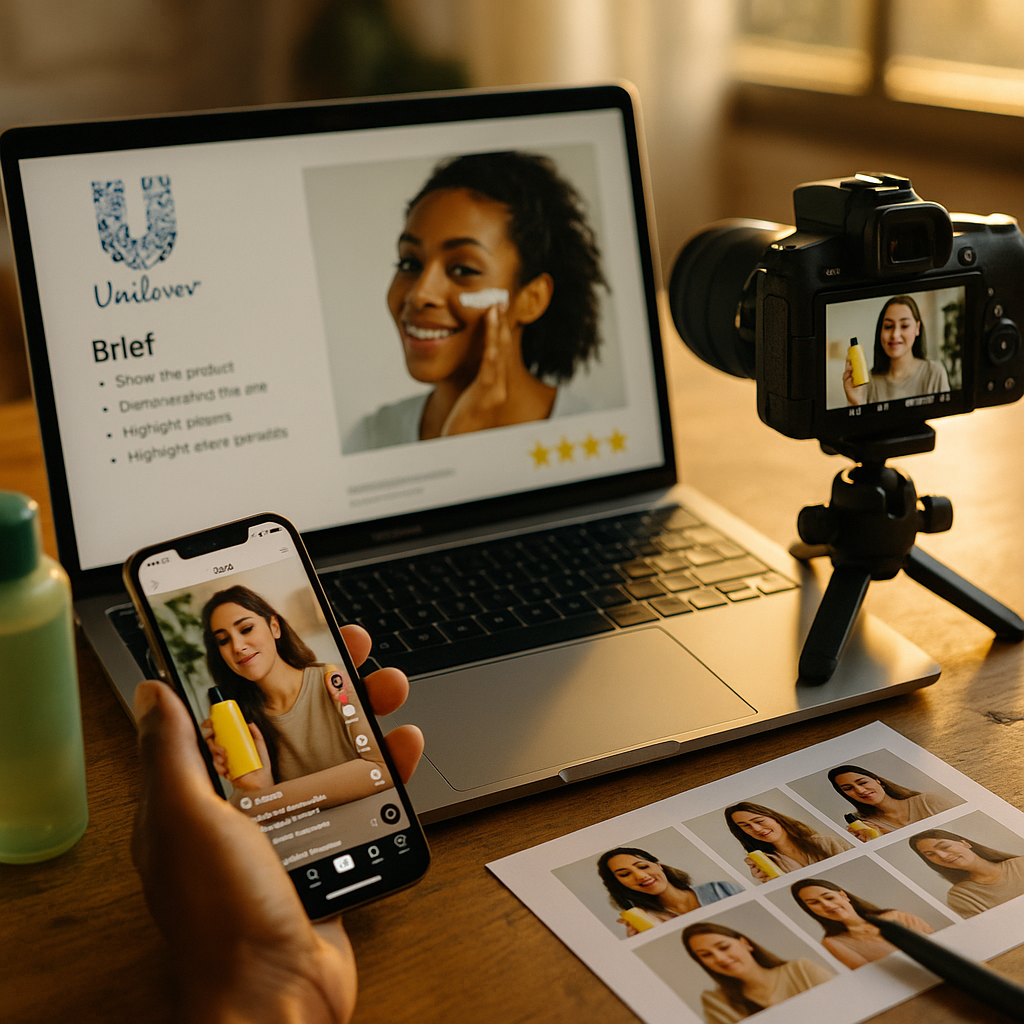
Unilever manages relationships with over 500,000 creators globally. That number isn’t a boast — it’s a structural challenge. The Unilever creator network operational model raises a question every CMO running a scaled influencer program should be asking: how do you maintain brand coherence, compliance, and measurable ROI when your creator roster grows faster than your team can manage it?
The Scale Problem Nobody Talks About Honestly
Most brand teams think about influencer scale in terms of discovery — finding more creators, vetting more profiles, running more campaigns. That’s the easy part. The harder problem is operational: brief distribution, content review workflows, legal compliance, and attribution infrastructure. When you’re managing dozens of creators, a spreadsheet and a few Slack channels work fine. When you’re managing tens of thousands, those systems collapse.
Unilever’s move away from traditional agency-of-record contracts toward a more distributed creator model (detailed in their widely-reported restructuring) isn’t just a procurement decision. It’s a signal that large-scale creator programs require purpose-built operational infrastructure, not scaled-up versions of what worked for five macro-influencers in 2019. For a closer look at how this shift affects agency relationships, the Unilever AOR and agency model breakdown is worth reading alongside this piece.
Brief Distribution: The First Place Large Programs Break
A brief written for one creator is a creative document. A brief written for ten thousand creators is a system architecture problem.
Unilever’s approach, as reported through their internal “People Data Centers” and marketing technology investments, involves templated brief frameworks that preserve brand guardrails while allowing localized creative latitude. The logic is sound: you cannot write bespoke briefs at that volume, but you also cannot send the same rigid script to a beauty micro-influencer in Jakarta and a lifestyle creator in São Paulo and expect authentic content from either.
The practical infrastructure this requires includes modular brief templates with locked brand parameters (logo usage, key message, legal disclosures) and open creative fields (hook style, format, cultural reference). Platforms like creator brief architecture frameworks built for specificity at scale are increasingly how sophisticated programs handle this. Tools like CreatorIQ, Grin, and Sprinklr have developed brief distribution modules specifically because email-and-PDF workflows cannot scale past a few hundred creators without significant error rates and compliance exposure.
Brief distribution is not a creative problem at scale — it’s a systems problem. The brands winning at creator volume have treated their brief templates as living infrastructure, not one-time documents.
Quality Control Without a Proportional Review Team
Here’s the arithmetic that should alarm any brand manager: if a team of five is reviewing creator content for a program with 500 active creators each posting twice a month, that’s 200 pieces of content per reviewer per month. Add in revisions, legal checks, and FTC disclosure verification, and you’re looking at a workflow that either creates bottlenecks or cuts corners.
Unilever’s operational answer involves a tiered review model. Not every creator gets the same level of scrutiny. Content from established partners with clean compliance histories moves through lighter-touch automated review. New creators, higher-profile campaigns, or regulated product categories (think personal care with medical claims) route to human review queues. This risk-stratified approach is the only way to run quality control at volume without proportional headcount growth.
AI-assisted review is now central to how this works. Tools trained on brand guidelines can flag non-compliant color usage, unapproved claims, missing disclosures, and competitor mentions before content goes live. Quality control at studio scale increasingly depends on this kind of automated first-pass filtering. The human team’s job shifts from reviewing everything to reviewing exceptions — which is a fundamentally different, and more sustainable, operating model.
Brand safety is the other dimension here. At Unilever’s scale, a creator posting brand-adjacent content that contradicts a brand’s values (even organically, not in a paid post) creates reputational risk. Continuous creator monitoring — not just pre-campaign vetting — is now table stakes for programs of this size. Platforms like Traackr and Meltwater offer brand safety scoring updated in near-real-time.
The Attribution Problem at Creator Volume
Attribution in influencer marketing has always been messy. At scale, it becomes a genuine infrastructure question.
Unilever uses a combination of creator-specific UTM parameters, unique promo codes, pixel-based tracking where platform policies allow, and brand lift studies run against creator cohorts rather than individual posts. That last point matters: at tens of thousands of creators, you cannot run individual attribution studies. You cluster creators by tier, format, platform, and category, then measure lift at the cohort level. It’s statistically valid and operationally feasible in a way that post-by-post attribution never could be.
The conversion data from micro-influencers consistently shows that small creators punch above their weight on conversion metrics, but only when attribution infrastructure is in place to capture the signal. Without it, the sales lift from a thousand micro-influencers looks like noise in the aggregate data, and the program gets defunded.
For brands considering this model, the attribution stack needs to be defined before creator recruitment begins — not retrofitted after the fact. FTC disclosure requirements also interact with attribution setup: if creators use affiliate links, those links require disclosure, which affects URL structure, which affects tracking. Getting legal and data teams aligned at program design stage is not optional at this scale.
Headcount Math: How Unilever Avoids Linear Scaling
The instinct when a program grows is to hire proportionally. More creators, more managers. That model has a ceiling, and Unilever appears to have recognized it early.
The actual staffing model that makes tens of thousands of creator relationships manageable involves three distinct layers. First, a small strategic layer of senior marketers who own brief architecture, cohort strategy, and attribution framework design — this team stays small by design. Second, a technology layer: the creator management platforms, AI review tools, and analytics infrastructure that does the volume processing. Third, a managed services layer, often via specialized agencies or platform-native creator management services, that handles creator communication, payment, and first-pass relationship management at volume.
The CMO-level framing for this is worth understanding. As covered in the CMO budget framework for Unilever’s creator shift, the budget allocation shifts from headcount-heavy to technology-heavy as programs scale. The per-creator cost of management drops significantly with the right stack in place — but the upfront investment in that stack is real and needs to be justified to finance before the program grows, not after it’s already unwieldy.
The brands that scale creator programs without scaling headcount proportionally have made one critical decision upfront: they treated creator operations as a technology investment, not a staffing problem.
What This Means for Brands That Aren’t Unilever
You don’t need half a million creators to face these operational challenges. Brands running programs with 200-500 active creators are already hitting brief distribution bottlenecks and attribution gaps. The Unilever model is instructive precisely because it represents a scaled-up version of problems that appear much earlier in the growth curve.
The practical takeaways are straightforward. Invest in brief template architecture before you need it. Implement tiered content review early, even when manual review is still feasible — the process discipline will pay off. Build your attribution stack at program launch, not after you’ve already lost the data from your first six months. And think about creator programs as strategic infrastructure rather than campaign-by-campaign tactical spends.
For context on how platform dynamics affect creator program planning, Sprout Social’s research on creator engagement benchmarks and eMarketer’s influencer marketing spending data both provide useful external anchors for internal budget conversations. The Statista influencer marketing market size figures are particularly useful for justifying technology investment to finance teams unfamiliar with creator program economics.
The brands building this infrastructure now — before they’re forced to by program complexity — will have a significant operational advantage over competitors who are still managing large creator rosters with tools designed for small ones.
Next step: Audit your current brief distribution and content review workflows against your creator roster size. If your review process cannot handle 10x your current creator volume without breaking, your program’s growth ceiling is closer than you think.
Frequently Asked Questions
How does Unilever manage relationships with tens of thousands of creators without a massive team?
Unilever uses a layered operational model combining a small strategic team, creator management technology platforms (such as CreatorIQ), and managed service agencies. AI-assisted content review handles volume processing, while human reviewers focus on exceptions and high-risk content. This technology-first approach allows creator volume to scale without proportional headcount growth.
What is the most common operational failure point in large-scale creator programs?
Brief distribution breaks down first. As creator roster size grows, manually customizing briefs becomes impossible, but sending identical rigid briefs produces inauthentic content. Programs that succeed at scale build modular brief templates with locked brand parameters and open creative fields, distributed via creator management platforms rather than email.
How do large brands handle content quality control across thousands of creator posts?
The most effective model is tiered, risk-stratified review. AI tools handle first-pass review for compliance issues — missing FTC disclosures, unapproved claims, brand guideline violations — and flag exceptions for human review. New creators and regulated product categories receive more intensive scrutiny. Established creators with clean compliance histories move through lighter automated workflows.
What attribution infrastructure is required to measure ROI across a large creator network?
At scale, individual post-level attribution is not feasible. Leading brands use creator-specific UTM parameters, unique promo codes, and pixel tracking where available, combined with brand lift studies run at the creator cohort level rather than individually. Cohort-based attribution — clustering creators by tier, platform, and category — provides statistically valid measurement without requiring one study per creator.
At what creator program size do these operational infrastructure investments become necessary?
Operational bottlenecks in brief distribution, content review, and attribution typically emerge around 200-500 active creators. While the Unilever model represents extreme scale, the same structural failures occur much earlier in program growth. Brands running programs with more than 100-150 active creators should evaluate their brief and review workflows against projected volume, not current volume.
Top Influencer Marketing Agencies
The leading agencies shaping influencer marketing in 2026
Agencies ranked by campaign performance, client diversity, platform expertise, proven ROI, industry recognition, and client satisfaction. Assessed through verified case studies, reviews, and industry consultations.
Moburst

-
2

The Shelf
Boutique Beauty & Lifestyle Influencer AgencyA data-driven boutique agency specializing exclusively in beauty, wellness, and lifestyle influencer campaigns on Instagram and TikTok. Best for brands already focused on the beauty/personal care space that need curated, aesthetic-driven content.Clients: Pepsi, The Honest Company, Hims, Elf Cosmetics, Pure LeafVisit The Shelf → -
3

Audiencly
Niche Gaming & Esports Influencer AgencyA specialized agency focused exclusively on gaming and esports creators on YouTube, Twitch, and TikTok. Ideal if your campaign is 100% gaming-focused — from game launches to hardware and esports events.Clients: Epic Games, NordVPN, Ubisoft, Wargaming, Tencent GamesVisit Audiencly → -
4

Viral Nation
Global Influencer Marketing & Talent AgencyA dual talent management and marketing agency with proprietary brand safety tools and a global creator network spanning nano-influencers to celebrities across all major platforms.Clients: Meta, Activision Blizzard, Energizer, Aston Martin, WalmartVisit Viral Nation → -
5

The Influencer Marketing Factory
TikTok, Instagram & YouTube CampaignsA full-service agency with strong TikTok expertise, offering end-to-end campaign management from influencer discovery through performance reporting with a focus on platform-native content.Clients: Google, Snapchat, Universal Music, Bumble, YelpVisit TIMF → -
6

NeoReach
Enterprise Analytics & Influencer CampaignsAn enterprise-focused agency combining managed campaigns with a powerful self-service data platform for influencer search, audience analytics, and attribution modeling.Clients: Amazon, Airbnb, Netflix, Honda, The New York TimesVisit NeoReach → -
7

Ubiquitous
Creator-First Marketing PlatformA tech-driven platform combining self-service tools with managed campaign options, emphasizing speed and scalability for brands managing multiple influencer relationships.Clients: Lyft, Disney, Target, American Eagle, NetflixVisit Ubiquitous → -
8

Obviously
Scalable Enterprise Influencer CampaignsA tech-enabled agency built for high-volume campaigns, coordinating hundreds of creators simultaneously with end-to-end logistics, content rights management, and product seeding.Clients: Google, Ulta Beauty, Converse, AmazonVisit Obviously →