


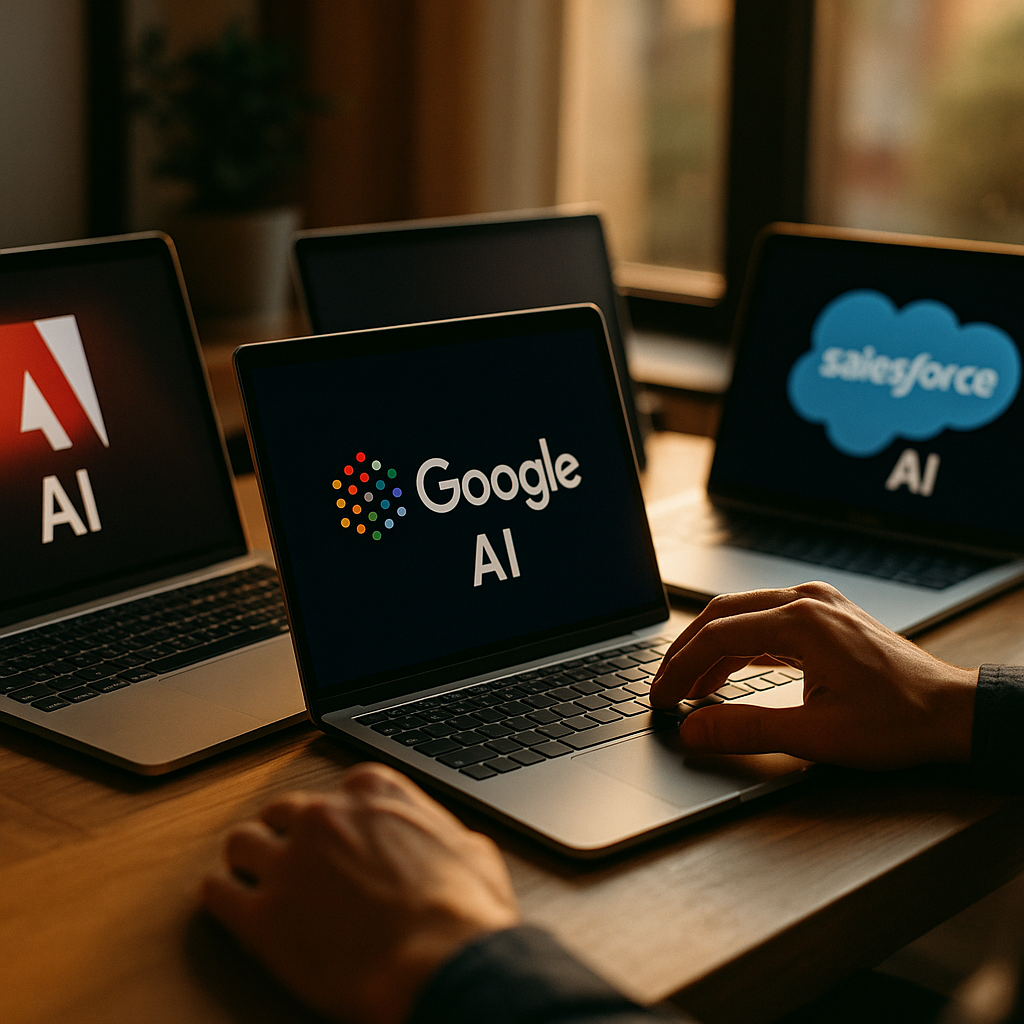
Three of the largest martech vendors on earth want to become the operating system your entire marketing org runs on. Not a tool. Not a platform. The layer everything else plugs into. If that sounds like a land grab, it is — and picking wrong could lock your team into a walled garden for the next five years.
An AI marketing operating system isn’t just another campaign tool. It’s the substrate that decides how your data, your agents, and your workflows connect — or don’t. Adobe GenStudio, Google’s agentic suite, and Salesforce Agentforce are each making a version of that pitch. CMOs evaluating them right now need a framework sharper than “which demo looked cooler.”
Why This Decision Is Bigger Than a Tool Swap
Most martech purchases are additive. You bolt on a new tool, integrate it via API, move on. Operating system bets are different. They ask you to route identity, content generation, campaign orchestration, and increasingly autonomous decision-making through one vendor’s agent framework. Get it right and you compound efficiency gains across every campaign. Get it wrong and you’ve built a five-year dependency on infrastructure that doesn’t talk to your other systems.
That’s not hypothetical. Marketing teams already report drowning in point solutions that don’t communicate — a problem we’ve covered in depth in our tool sprawl audit framework. The promise of an agentic operating system is that it fixes fragmentation. The risk is that it just moves fragmentation somewhere more expensive to unwind.
The vendor pitching you “one AI brain for all of marketing” is also the vendor with the most to gain from you never leaving.
What Each Vendor Is Actually Selling
Strip away the keynote language and each platform has a distinct center of gravity.
Adobe GenStudio is content-first. It’s built on Firefly for generation, tied tightly to Adobe Experience Platform for personalization at scale, and optimized for brands with heavy creative production needs — think retail, CPG, and any org running thousands of localized asset variants. Its strength is design fidelity and brand-consistent generation. Its weakness is that it assumes you’re already deep in the Adobe ecosystem; ripping it out later is expensive.
Google’s agentic suite — spanning Vertex AI agents, Performance Max automation, and the Gemini layer threading through Google Ads and Analytics — is media-and-signal-first. It’s strongest where your spend and measurement already live inside Google’s walls. The agentic layer here is less about creative production and more about autonomous bidding, audience construction, and cross-channel optimization decisions made at machine speed. That’s powerful, but it also means trusting Google’s black box with budget allocation logic you can’t fully audit.
Salesforce Agentforce is CRM-first, and that matters more than it sounds. Agentforce agents live where customer data and pipeline already sit, meaning marketing agents can theoretically hand off directly to sales agents without a human touching a spreadsheet. It’s the most “operational” of the three — less about generating a beautiful asset, more about executing a decision (send this offer, escalate this lead, trigger this journey) and writing it back to the record.
The Real Evaluation Criteria (Not the Ones in the Sales Deck)
Every vendor will show you a slick agent orchestrating a campaign end-to-end. That’s not the evaluation. Here’s what actually determines whether this becomes an asset or a liability.
- Data portability. Can you export your audience models, prompts, and agent configurations if you leave? Or are they proprietary formats trapped in the platform?
- Write access boundaries. What can the agent actually change without a human sign-off — budget, CRM records, live campaigns? This is the single biggest risk vector and deserves its own audit, similar to what we outlined in the agentic CRM buyer’s checklist.
- Interoperability with your existing stack. Does the agent play nicely with tools outside its own ecosystem, or does it quietly punish you for using a non-native CDP, ad server, or creator platform?
- Governance and audit trails. Can you reconstruct why an agent made a decision six weeks after the fact, for legal or compliance reasons?
- Model transparency. Whose LLM is actually running under the hood, and does that change based on task?
None of these show up cleanly in a demo. All of them show up in year two, usually during an audit or a crisis.
Governance Is Where the Three Platforms Actually Diverge
This is the part CMOs underweight. The marketing pitch for all three platforms sounds nearly identical: autonomous agents, faster campaigns, less manual work. The governance models underneath are not identical at all.
Adobe’s approach leans on Experience Platform’s existing consent and data-residency controls, which are mature but were built for a pre-agentic world and are still catching up to autonomous execution. Google’s governance is bundled into its broader ad platform policies, which means marketing teams inherit Google’s compliance posture whether they’ve reviewed it or not. Salesforce has invested the most visibly in permissioning — Agentforce actions can be scoped tightly by role — but tighter scoping also means more configuration overhead before you get value.
We ran a side-by-side on exactly this in our Adobe vs Salesforce vs Google data governance comparison, and the short version is: none of them have solved cross-platform audit trails. If your agent stack spans more than one of these vendors — which is increasingly common — you’re the one stitching together the compliance story, not them.
Governance maturity, not creative output, is becoming the real differentiator between agentic marketing platforms — and it’s the one CMOs are least equipped to evaluate quickly.
For a broader lens on what “good” governance looks like across the category, our enterprise AI governance comparison and AI vendor scorecard are worth running alongside any vendor evaluation you’re doing right now.
The Interoperability Trap
Here’s the uncomfortable truth vendors don’t lead with: none of these three operating systems were designed to work seamlessly with each other. Adobe GenStudio assumes Adobe-native data. Google’s agentic suite assumes Google Ads and Analytics as the source of truth. Agentforce assumes Salesforce is your CRM of record.
If your org already runs a mixed stack — Salesforce for CRM, Google for paid media, a separate CDP for identity — you’re not choosing “an operating system.” You’re choosing which vendor becomes the dominant node and negotiating everyone else’s connection into it. That’s a meaningfully different decision, and it’s the exact interoperability gap we’ve documented across the martech industry more broadly in why marketing AI tools still refuse to talk to each other and the martech interoperability gap.
Practically, this means asking each vendor a blunt question during procurement: “Show me a working integration where your agent hands off a task to a competitor’s agent, with full audit logging intact.” Most sales engineers will not have a clean answer. That silence tells you something a feature matrix won’t.
Where Identity and Measurement Fit In
An agentic operating system is only as good as the identity data it’s reasoning over. If your agents are making budget or targeting decisions on fragmented or stale identity graphs, you’re automating bad decisions faster — which is worse than making them slowly. This is where CDP architecture decisions become inseparable from the OS decision; see our breakdown of where AI-enriched identity should live and our deeper look at identity resolution for AI-driven referrals.
Measurement discipline matters just as much. According to eMarketer, marketers continue to cite attribution and cross-channel measurement as top barriers to scaling AI-driven marketing investment, and Statista data on martech budget allocation shows measurement tooling remains one of the fastest-growing line items even as generative AI spend surges. Don’t let an operating system decision get made in isolation from your incrementality testing setup — cross-reference it against frameworks like the ones in our incrementality testing comparison.
A Practical Scoring Approach for CMOs
Skip the 40-tab RFP spreadsheet. Score each platform on five dimensions, one to five, and be honest about where your org already has sunk cost:
- Ecosystem fit — how much of your stack already lives in this vendor’s world?
- Governance maturity — can you audit every agent decision after the fact?
- Portability — what’s the actual cost to leave in three years?
- Write-access risk — what can the agent break without a human catching it first?
- Talent readiness — does your team actually know how to operate this, or are you buying a Ferrari for a driver’s ed class?
A platform that scores a five on ecosystem fit and a two on governance is a short-term win and a long-term liability. Weight governance and portability higher than the sales deck wants you to.
Next Step
Don’t pick an AI marketing operating system based on which demo generated the flashiest ad in thirty seconds. Run each vendor through a governance and portability stress test first, using your own data and your riskiest use case, and let that — not the keynote — decide who earns the budget.
Frequently Asked Questions
What is an AI marketing operating system, and how is it different from a martech tool?
An AI marketing operating system is an infrastructure layer that coordinates data, content generation, and autonomous agent decisions across marketing functions, rather than solving one isolated task like a standalone tool does. Adobe GenStudio, Google’s agentic suite, and Salesforce Agentforce are each positioning themselves this way.
Which platform is best for a brand with heavy creative production needs?
Adobe GenStudio tends to fit best for brands producing high volumes of localized creative assets, since it’s built on Firefly and tightly integrated with Adobe Experience Platform for brand-consistent generation at scale.
Is Salesforce Agentforce only useful for CRM teams, or does it help marketing too?
Agentforce is CRM-first, but that’s precisely what makes it valuable for marketing teams whose campaigns need to hand off directly into sales pipelines without manual data transfer. It’s strongest for organizations where marketing and sales operations are already tightly linked.
What’s the biggest risk in adopting one of these agentic platforms?
The biggest risk is write-access sprawl: agents making changes to budgets, CRM records, or live campaigns without clear audit trails or human sign-off. Governance maturity, not creative capability, is where these platforms currently diverge most.
Can these three platforms work together, or do CMOs need to pick one?
They can technically integrate, but none were designed for seamless cross-vendor agent handoffs with full audit logging. Most organizations end up choosing a dominant node and negotiating how the other platforms connect into it, rather than running all three as true equals.
FAQPage Schema
Top Influencer Marketing Agencies
The leading agencies shaping influencer marketing in 2026
Agencies ranked by campaign performance, client diversity, platform expertise, proven ROI, industry recognition, and client satisfaction. Assessed through verified case studies, reviews, and industry consultations.
Moburst

-
2

The Shelf
Boutique Beauty & Lifestyle Influencer AgencyA data-driven boutique agency specializing exclusively in beauty, wellness, and lifestyle influencer campaigns on Instagram and TikTok. Best for brands already focused on the beauty/personal care space that need curated, aesthetic-driven content.Clients: Pepsi, The Honest Company, Hims, Elf Cosmetics, Pure LeafVisit The Shelf → -
3

Audiencly
Niche Gaming & Esports Influencer AgencyA specialized agency focused exclusively on gaming and esports creators on YouTube, Twitch, and TikTok. Ideal if your campaign is 100% gaming-focused — from game launches to hardware and esports events.Clients: Epic Games, NordVPN, Ubisoft, Wargaming, Tencent GamesVisit Audiencly → -
4

Viral Nation
Global Influencer Marketing & Talent AgencyA dual talent management and marketing agency with proprietary brand safety tools and a global creator network spanning nano-influencers to celebrities across all major platforms.Clients: Meta, Activision Blizzard, Energizer, Aston Martin, WalmartVisit Viral Nation → -
5

The Influencer Marketing Factory
TikTok, Instagram & YouTube CampaignsA full-service agency with strong TikTok expertise, offering end-to-end campaign management from influencer discovery through performance reporting with a focus on platform-native content.Clients: Google, Snapchat, Universal Music, Bumble, YelpVisit TIMF → -
6

NeoReach
Enterprise Analytics & Influencer CampaignsAn enterprise-focused agency combining managed campaigns with a powerful self-service data platform for influencer search, audience analytics, and attribution modeling.Clients: Amazon, Airbnb, Netflix, Honda, The New York TimesVisit NeoReach → -
7

Ubiquitous
Creator-First Marketing PlatformA tech-driven platform combining self-service tools with managed campaign options, emphasizing speed and scalability for brands managing multiple influencer relationships.Clients: Lyft, Disney, Target, American Eagle, NetflixVisit Ubiquitous → -
8

Obviously
Scalable Enterprise Influencer CampaignsA tech-enabled agency built for high-volume campaigns, coordinating hundreds of creators simultaneously with end-to-end logistics, content rights management, and product seeding.Clients: Google, Ulta Beauty, Converse, AmazonVisit Obviously →