


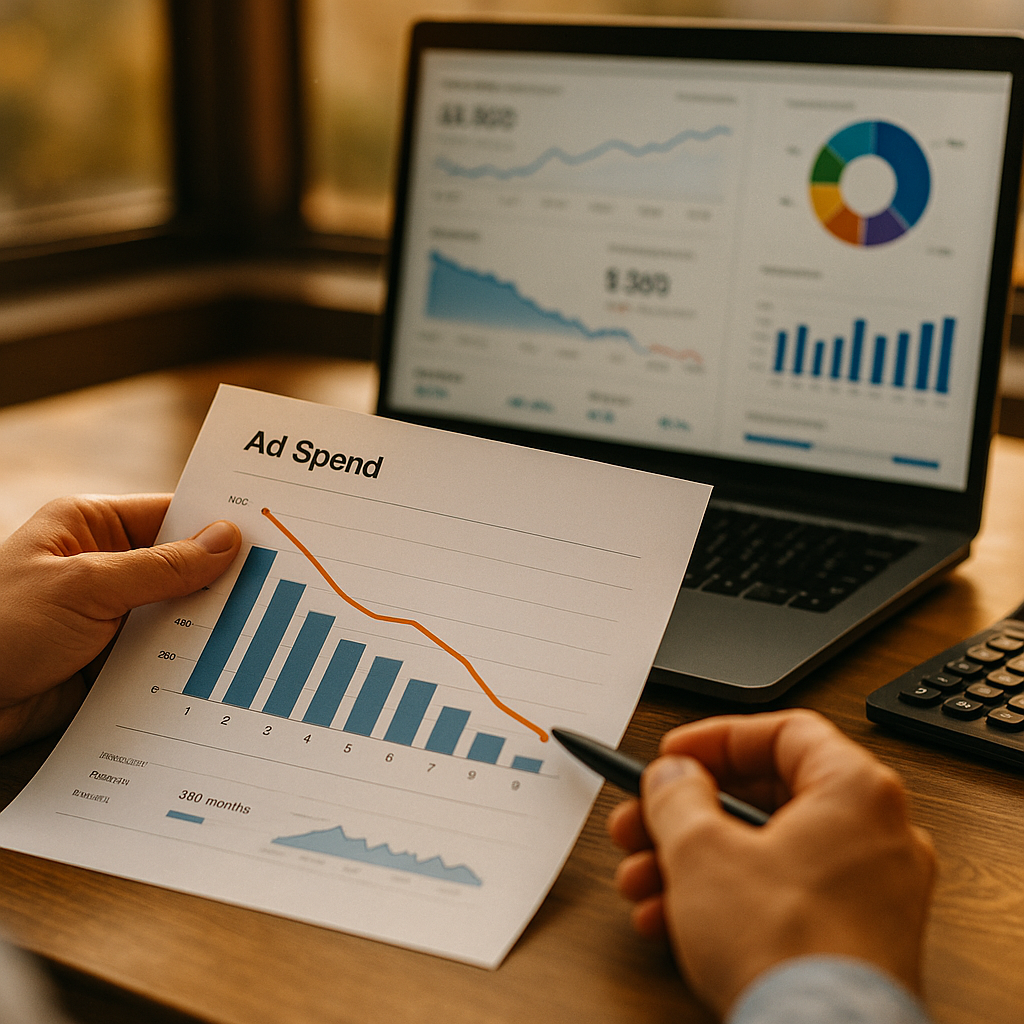
Global ad spend growth is downshifting, and eMarketer’s latest revision puts a number on what media buyers have felt for months: the easy growth era is over. The firm trimmed its worldwide ad spend growth projection again, marking the second consecutive downgrade in less than a year. For brands still planning 2026 budgets around last cycle’s assumptions, that’s a problem. This isn’t a downturn. It’s a deceleration — and the two require very different playbooks.
The Numbers Behind the Slowdown
eMarketer’s revised outlook shows global ad spend still growing, just not at the pace forecasters expected even two quarters ago. The deceleration is broad-based: linear TV continues its long decline, search growth is flattening as AI-driven zero-click search reshapes query behavior, and even social platforms, long the growth engine of the media mix, are seeing more measured increases. Retail media remains the standout, still posting double-digit growth, but it’s growing off a smaller base and can’t single-handedly offset softness everywhere else.
Why the downgrade? A few forces are converging. Macroeconomic uncertainty has made CFOs more conservative about marketing as a discretionary line item. Platform costs, particularly CPMs on Meta and TikTok, have climbed enough that advertisers are getting less reach per dollar. And there’s a quieter factor too: measurement fatigue. Marketers are questioning whether reported growth in some channels reflects real incremental value or just better attribution capture. That skepticism is showing up in budget conservatism, not just spreadsheets.
The takeaway isn’t that advertising is shrinking — it’s that the marginal dollar now has to work harder to justify itself, and brands still allocating budget on last cycle’s assumptions will overspend on underperforming channels.
Why “Deceleration” Isn’t the Same as “Recession”
Let’s be precise about language, because it matters for how finance teams read your budget requests. A deceleration means spend is still increasing, just at a slower rate than before. That’s fundamentally different from a contraction, and conflating the two leads to panicked, reactive cuts that damage brand equity for no good reason.
Think of it like a car easing off the accelerator rather than braking. You’re still moving forward. But if your media plan assumed you’d be accelerating at last year’s rate, you’re going to overshoot your budget efficiency targets and underdeliver on reach. This is exactly the dynamic covered in our earlier piece on how ad spend growth slows and where smart reallocation should happen first. The lesson holds: slower aggregate growth doesn’t mean every channel slows equally. Some are decelerating hard. Others are still accelerating and absorbing share from the laggards.
Where the Growth Is Actually Going
Retail media networks, connected TV, and creator-driven commerce are still expanding at rates well above the market average, even as the overall figure cools. That divergence is the real story eMarketer’s data tells. Aggregate deceleration masks a sharper internal reshuffling of where dollars are actually effective.
- CTV inventory keeps expanding faster than social feeds, pulling budget from linear and, increasingly, from underperforming programmatic display, a shift we detailed in our analysis of CTV inventory growth outpacing social.
- Retail media continues to command premium CPMs because it sits closest to purchase intent, giving CFOs the attribution clarity they’re demanding.
- Creator and influencer spend is proving more resilient than open-web programmatic, partly because it’s harder to automate away and partly because trust in creator content remains higher than trust in traditional ad formats.
None of this is speculative. It tracks with what Statista and eMarketer have both published on channel-level growth divergence, and it lines up with what agency media planners are reporting anecdotally: the “spray and pray” era of programmatic is over, replaced by tighter, more accountable channel bets.
What This Means for Budget Allocation Next Year
If you’re building 2026 media plans right now, treat eMarketer’s downgrade as a forcing function, not a footnote. Three practical shifts should follow.
First, stop funding channels on inertia. A lot of ad budgets are shaped by “what we spent last year plus five percent.” That logic breaks down in a decelerating market. Every channel needs to re-earn its allocation based on current performance data, not historical habit. If display CPMs are up and click-through is down, that’s not a channel to auto-renew at scale.
Second, prioritize channels with built-in attribution clarity. Part of why retail media and CTV are outperforming is that buyers can actually see what’s working. In a slower-growth environment, finance teams want proof, not promises. This is also why the shift away from last-click models matters so much right now; if your measurement framework can’t isolate incremental lift, you’re vulnerable to budget cuts regardless of actual performance. Our piece on how last-click attribution broke is a useful primer if your measurement stack hasn’t caught up.
Third, don’t cut creator and influencer budgets reflexively. It’s tempting, in belt-tightening mode, to treat influencer spend as a nice-to-have. That’s backwards. Creator content is outperforming traditional social ad units on trust metrics, and with linear reach eroding, creator inventory is increasingly core reach, not supplementary reach. The upfronts conversation has already shifted this way; see our coverage of why creator inventory as core reach is becoming standard planning language for buyers.
The Always-On Budget Question
Deceleration also strengthens the case against rigid quarterly budget cycles. When growth is unpredictable, locking 90% of spend into a Q1 plan and hoping the market cooperates is a bad bet. More brands are moving toward always-on, flexible allocation models that let them shift 15-20% of budget mid-quarter based on real-time performance signals. We covered this shift in detail in our piece on why always-on budgets are replacing quarterly planning, and eMarketer’s downgrade only reinforces the logic: rigid budgets are a liability when the growth curve itself keeps getting revised.
The Risk Mitigation Angle CFOs Care About
Here’s the part brand strategists sometimes underweight: a slower ad market increases scrutiny on every dollar, and increased scrutiny means increased compliance and governance risk. When budgets tighten, marketers get more aggressive with AI-generated creative and automated media buying to cut costs, and that’s precisely when brand safety incidents spike. If you’re leaning harder into AI tools to stretch a flatter budget, pair that with governance, not instead of it. Our recent coverage on why AI ad trust is falling makes the case that creative governance can’t be an afterthought, especially when consumer skepticism toward AI-generated ads is already well documented in eMarketer’s own consumer trust research.
There’s also a talent dimension here that’s easy to miss. Slower spend growth means marketing teams are expected to do more analysis with the same headcount, and most teams aren’t actually equipped for that. The skills gap isn’t about needing more people; it’s about needing people who can interpret attribution data and reallocate budget quickly. That’s the core argument in our piece on the analytics talent shortage, and it’s directly relevant here: a deceleration environment punishes teams that can’t move fast on data.
A Quick Gut Check for Your Media Plan
Before you finalize next year’s channel mix, run through this list:
- Does your current channel allocation reflect this year’s performance data, or last year’s habits?
- Can you attribute incremental lift by channel, or are you relying on platform-reported metrics that inflate performance?
- Is creator/influencer spend treated as core reach, or still bucketed as “test budget”?
- Do you have flexibility to shift 15%+ of budget mid-cycle if a channel underperforms?
- Have you audited AI-generated creative for brand safety and compliance exposure before scaling it as a cost-saving measure?
If you answered “no” to more than two of these, your 2026 plan is built on last cycle’s assumptions, and eMarketer’s downgrade is telling you that’s exactly the wrong foundation right now.
FAQs
Frequently Asked Questions
What does eMarketer’s revised ad spend forecast actually say?
eMarketer lowered its projected global ad spend growth rate for the second consecutive forecast cycle, citing softer performance in search, display, and linear TV, offset partially by continued strength in retail media and connected TV. Total spend is still growing, but at a meaningfully slower rate than earlier projections anticipated.
Does a slower growth forecast mean brands should cut ad budgets?
Not necessarily. Deceleration means slower growth, not contraction. The smarter response is reallocating budget toward channels with proven attribution and resilience, like retail media, CTV, and creator partnerships, rather than making across-the-board cuts.
Which channels are most resilient in a decelerating ad market?
Retail media, connected TV, and creator-driven content have shown more resilience than open-web programmatic, display, and linear TV. These channels tend to offer clearer attribution and stronger consumer trust, which matters more when budgets face greater scrutiny.
Should influencer marketing budgets be cut during a slowdown?
Reflexively cutting creator budgets is a common mistake. Data shows creator content often outperforms traditional social ads on trust and engagement metrics, making it a poor candidate for blanket cuts compared to lower-performing legacy channels.
How often should brands revisit channel allocation given forecast volatility?
Given how frequently forecasts like eMarketer’s are being revised, quarterly reviews are no longer sufficient for many brands. An always-on budget model that allows for mid-cycle reallocation based on real-time performance data is increasingly the more resilient approach.
Top Influencer Marketing Agencies
The leading agencies shaping influencer marketing in 2026
Agencies ranked by campaign performance, client diversity, platform expertise, proven ROI, industry recognition, and client satisfaction. Assessed through verified case studies, reviews, and industry consultations.
Moburst

-
2

The Shelf
Boutique Beauty & Lifestyle Influencer AgencyA data-driven boutique agency specializing exclusively in beauty, wellness, and lifestyle influencer campaigns on Instagram and TikTok. Best for brands already focused on the beauty/personal care space that need curated, aesthetic-driven content.Clients: Pepsi, The Honest Company, Hims, Elf Cosmetics, Pure LeafVisit The Shelf → -
3

Audiencly
Niche Gaming & Esports Influencer AgencyA specialized agency focused exclusively on gaming and esports creators on YouTube, Twitch, and TikTok. Ideal if your campaign is 100% gaming-focused — from game launches to hardware and esports events.Clients: Epic Games, NordVPN, Ubisoft, Wargaming, Tencent GamesVisit Audiencly → -
4

Viral Nation
Global Influencer Marketing & Talent AgencyA dual talent management and marketing agency with proprietary brand safety tools and a global creator network spanning nano-influencers to celebrities across all major platforms.Clients: Meta, Activision Blizzard, Energizer, Aston Martin, WalmartVisit Viral Nation → -
5

The Influencer Marketing Factory
TikTok, Instagram & YouTube CampaignsA full-service agency with strong TikTok expertise, offering end-to-end campaign management from influencer discovery through performance reporting with a focus on platform-native content.Clients: Google, Snapchat, Universal Music, Bumble, YelpVisit TIMF → -
6

NeoReach
Enterprise Analytics & Influencer CampaignsAn enterprise-focused agency combining managed campaigns with a powerful self-service data platform for influencer search, audience analytics, and attribution modeling.Clients: Amazon, Airbnb, Netflix, Honda, The New York TimesVisit NeoReach → -
7

Ubiquitous
Creator-First Marketing PlatformA tech-driven platform combining self-service tools with managed campaign options, emphasizing speed and scalability for brands managing multiple influencer relationships.Clients: Lyft, Disney, Target, American Eagle, NetflixVisit Ubiquitous → -
8

Obviously
Scalable Enterprise Influencer CampaignsA tech-enabled agency built for high-volume campaigns, coordinating hundreds of creators simultaneously with end-to-end logistics, content rights management, and product seeding.Clients: Google, Ulta Beauty, Converse, AmazonVisit Obviously →