


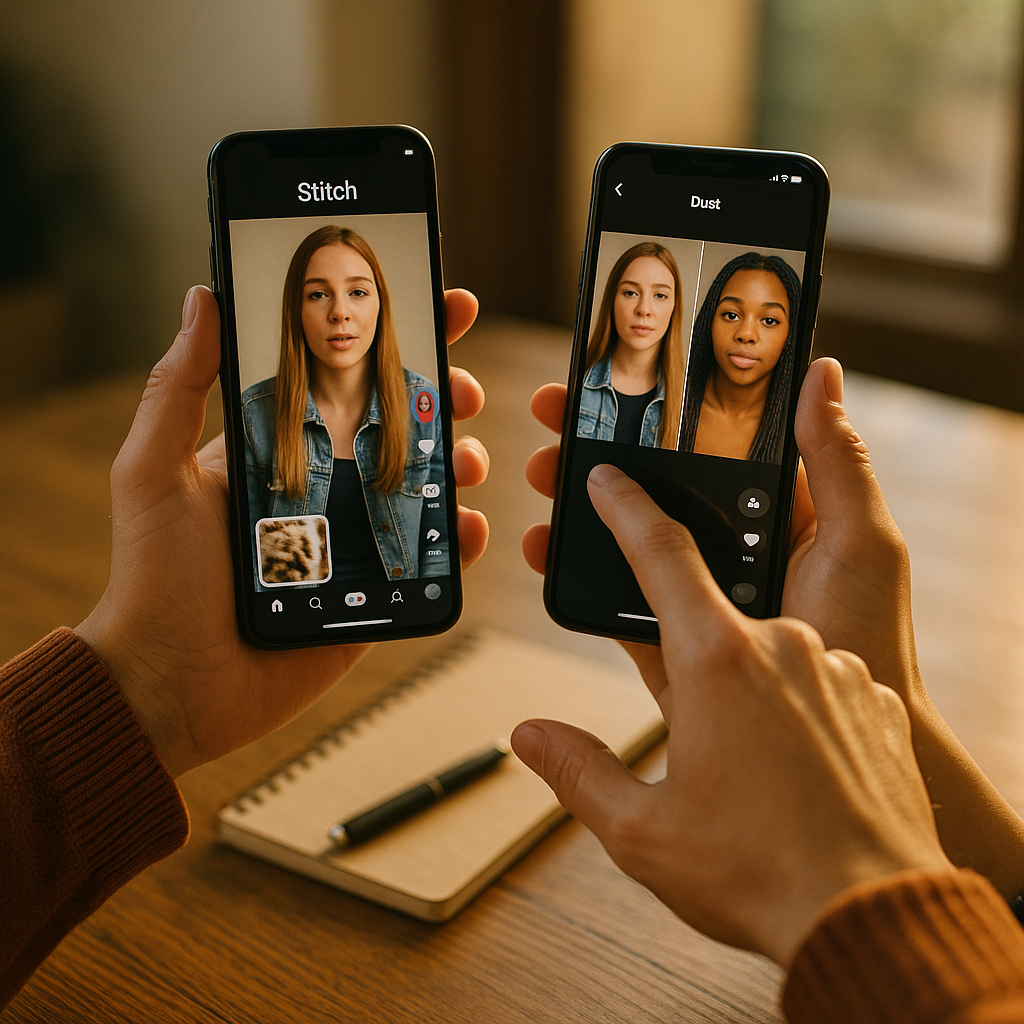
Only a fraction of branded hashtag challenges ever generate meaningful remix volume — most just collect views and disappear. TikTok Stitch and Duet mechanics flip that math, because they hand creators a built-in reason to participate instead of asking them to invent one. If your last challenge fizzled at a few hundred entries, the structure was probably the problem, not the concept.
Why Remix Mechanics Outperform Standard Hashtag Challenges
Standard hashtag challenges ask creators to do unpaid creative labor from scratch. Film something, edit it, caption it, hope it lands. That’s a lot of friction for a stranger with no stake in your brand.
Stitch and Duet remove most of that friction. A creator reacts to, remixes, or builds directly on top of existing content — yours or another creator’s. The cognitive load drops from “invent a video” to “respond to a video.” That’s a fundamentally lower bar, and lower bars get crossed more often.
Remix-native formats convert passive scrollers into active participants because the creative direction is already half-done for them. You’re not asking for a blank page; you’re asking for a punchline.
This matters even more now that TikTok’s algorithm favors watch-through and interaction signals over raw follower counts. A Duet chain with genuine back-and-forth reads as engagement gold to the recommendation system. A one-off branded video, however polished, doesn’t generate that same compounding signal.
What Actually Makes a Challenge “Remixable”
Not every piece of branded content invites a Stitch or Duet. Some formats practically beg for it. Others shut the door without meaning to.
- Leave a gap. A video that answers its own question completely gives creators nothing to add. A video that poses a challenge, a reaction prompt, or an unfinished scenario invites completion.
- Keep it short. Stitches cap at a few seconds of source clip. If your key moment is buried at the 40-second mark, most creators won’t scrub for it.
- Show, don’t explain. A visual bit (a transformation, a reveal, a reaction shot) remixes better than a talking-head explainer.
- Make failure fun. The best remix challenges reward creators for doing it “wrong” — a bad lip sync, an exaggerated reaction, a chaotic attempt. Perfection is boring to duplicate.
Duolingo’s owl skits work as a remix template because the format is instantly legible: react to the owl, escalate the bit, done. That’s the level of simplicity most brand briefs need to aim for.
The Seed Video Is Your Most Important Asset
Everything downstream depends on the seed video — the original clip creators Stitch or Duet from. Treat it like a product spec, not a one-off ad.
Brief your seed video creator (whether that’s an in-house team or a paid partner) with the remix in mind. Ask: what’s the three-second moment someone can react to? Where does the “gap” sit in the timeline? Is there a clear visual or audio cue marking where a Duet split-screen should begin?
Brands that skip this step end up with technically fine content that nobody remixes, because the invitation was never built in.
Structuring the Incentive Layer
Remix mechanics lower the creative barrier. They don’t remove the participation barrier entirely — creators still need a reason to spend even thirty seconds on your brand instead of someone else’s trend.
Three incentive models tend to work, often layered together:
- Tiered commission or affiliate bonuses for Stitches/Duets that drive TikTok Shop clicks, similar to the tiered structures brands are already using in affiliate commission programs.
- Featured placement — the promise that top remixes get reposted on the brand’s own account, which is often more motivating to mid-tier creators than a small cash payout.
- Direct prize pools for the highest-performing remix by views, shares, or a judged creativity metric.
The mistake most brands make is announcing a challenge with no incentive structure at all and hoping virality does the recruiting. It won’t. Even organic-feeling challenges from major brands usually have seeded creator partnerships and paid placement behind the first wave of Stitches, which is what makes the second and third waves feel organic.
Rights, Usage, and the Compliance Gap Nobody Budgets For
Here’s the part legal teams flag late, usually after the challenge has already gone live: when a creator Stitches or Duets your seed video, who owns the resulting asset, and what can you do with it?
TikTok’s platform terms grant the platform broad license to distribute Stitched/Duet content, but that’s not the same as granting the brand rights to repurpose that remix in paid ads, on other platforms, or in a case study deck. If you want to run a top-performing Duet as a paid unit, you need explicit creator consent, usually documented via a contract or in-app usage rights tool, not assumed from the act of participation.
Assuming implied usage rights from a public Stitch or Duet is one of the most common compliance gaps in influencer marketing right now, and it’s an easy one for legal to catch after the fact.
Build this into your brief from day one:
- Specify usage rights terms in the official challenge rules, not buried in a separate document.
- Clarify whether entering the challenge constitutes consent for paid amplification, and for how long.
- Disclose material connections per FTC endorsement guidelines if you’re compensating creators for seed content or featured remixes.
- Keep records of consent for every remix you plan to repost or boost, not just the top three.
This isn’t paperwork for its own sake. Brands that get caught boosting a creator’s remix without consent face public callouts that undo weeks of positive campaign sentiment in a single viral complaint thread.
Measuring What Remix Participation Actually Buys You
Views are the vanity metric here. What you actually want to track:
- Stitch/Duet volume relative to seed video views — this ratio tells you whether the format itself is remixable, independent of reach.
- Completion rate on remixes versus your standalone branded content, since remix videos often have different pacing and drop-off patterns.
- Attributable Shop clicks or conversions from top-performing remixes, especially if you’re layering in affiliate links.
- Creator tier distribution — are nano and micro creators participating, or is it only the paid partners you seeded? A challenge that only your paid roster touches isn’t actually a viral mechanic; it’s a slightly disguised sponsored content batch.
Most brands under-invest in the second wave of measurement: what happens 48-72 hours after launch, when organic creators start Stitching the Stitches. That secondary and tertiary remix activity is the real signal of whether your challenge escaped the seeded network or stayed contained within it.
For brands running parallel livestream or Shop campaigns, remix-driven traffic often shows up as a spike in referral clicks that doesn’t map cleanly to a single creator, which is exactly why UTM discipline and Shop-side tagging matter here as much as they do in livestream selling programs.
A Simple Rollout Sequence
For teams building their first remix-native challenge, a phased rollout beats a single big-bang launch:
- Week one: seed the original video with 8-12 creators across tiers, briefed specifically on the remix gap you’ve built in.
- Week one-two: monitor which creators’ Duets/Stitches get the most secondary remix activity, and feature those on your brand account within 24-48 hours (speed matters for algorithmic momentum).
- Week two-three: open a public incentive (commission bump, prize, or feature guarantee) tied to a branded hashtag so unaffiliated creators can join without a direct contract.
- Week three-four: compile top remixes, secure usage rights from top performers, and repurpose into paid social or a case study for future briefs.
Notice what’s missing: a single “launch day.” Remix challenges build momentum in waves, and trying to force virality in a 24-hour window usually just burns budget on paid boosts for content that hadn’t found its audience yet.
Brands running influencer programs across multiple short-form platforms should also look at how remix-adjacent formats work on YouTube Shorts, since cross-posting a successful Stitch template there can extend the challenge’s shelf life well past its TikTok peak.
Common Ways These Challenges Fail
A few patterns show up again and again in post-mortems:
- Overproduced seed videos. If your original clip looks like a TV commercial, creators feel like they’re vandalizing it rather than collaborating with it.
- No clear remix instruction. “Duet this!” isn’t a brief. Tell creators what reaction, answer, or continuation you’re looking for, even loosely.
- Ignoring early remixers. The creators who Stitch your content in the first six hours are your best amplification lever. Reply, repost, comment. Silence from the brand account kills momentum fast.
- No plan for negative or off-brand remixes. Open challenges invite parody. Decide in advance what you’ll ignore, what you’ll engage with humor, and what crosses into a takedown request.
Compare this to how brands approach community-building on platforms like Discord or Reddit, where the audience actively polices tone. TikTok remix culture is looser, but the same principle applies: you don’t control the narrative once you open participation, you can only shape the conditions around it.
For deeper platform mechanics on TikTok Shop-linked campaigns, TikTok’s own TikTok Ads Manager resources and creator marketplace documentation are worth cross-referencing before finalizing incentive tiers, and firms like Sprout Social and eMarketer regularly publish benchmark data on short-form engagement rates worth pulling into your post-campaign report.
Next step: before your next challenge brief goes out, build the remix gap into the seed video first, then design the incentive and rights structure around it — not the other way around. That sequencing alone separates challenges that generate a few hundred derivative videos from ones that generate tens of thousands.
FAQs
What’s the difference between Stitch and Duet for brand campaigns?
Stitch lets a creator clip a few seconds of the original video and build a new video around it, which works well for reaction or “answer this” formats. Duet runs the original alongside the new content side by side, better suited for challenges, tutorials, or synchronized bits. Most remix campaigns benefit from allowing both rather than restricting to one.
Do we need creator permission to repost a Stitch or Duet in paid ads?
Yes. Public visibility on TikTok does not equal usage rights for paid amplification. Secure explicit consent, ideally documented in the challenge rules or a follow-up agreement, before boosting or repurposing a creator’s remix in ads or on other channels.
How many creators should we seed a remix challenge with initially?
Most successful launches start with 8-15 creators spanning nano, micro, and mid-tier accounts. A smaller, more diverse seed group tends to generate more varied remix styles than a handful of large creators alone, which broadens the pool of formats other creators can then remix from.
How do we measure ROI on a remix-based challenge versus a standard sponsored post?
Track Stitch/Duet volume relative to seed views, completion rate on remixes, attributable Shop clicks, and the ratio of organic-to-seeded participation. A high organic remix ratio signals the format escaped your paid network, which is the clearest sign the mechanic is working beyond the initial spend.
What happens if a remix goes off-brand or negative?
Decide your response tiers before launch: ignore minor parody, engage playfully with lighthearted misses, and reserve takedown requests for content that violates platform policy or misrepresents the brand materially. Trying to control every remix defeats the purpose of an open participation format.
Top Influencer Marketing Agencies
The leading agencies shaping influencer marketing in 2026
Agencies ranked by campaign performance, client diversity, platform expertise, proven ROI, industry recognition, and client satisfaction. Assessed through verified case studies, reviews, and industry consultations.
Moburst

-
2

The Shelf
Boutique Beauty & Lifestyle Influencer AgencyA data-driven boutique agency specializing exclusively in beauty, wellness, and lifestyle influencer campaigns on Instagram and TikTok. Best for brands already focused on the beauty/personal care space that need curated, aesthetic-driven content.Clients: Pepsi, The Honest Company, Hims, Elf Cosmetics, Pure LeafVisit The Shelf → -
3

Audiencly
Niche Gaming & Esports Influencer AgencyA specialized agency focused exclusively on gaming and esports creators on YouTube, Twitch, and TikTok. Ideal if your campaign is 100% gaming-focused — from game launches to hardware and esports events.Clients: Epic Games, NordVPN, Ubisoft, Wargaming, Tencent GamesVisit Audiencly → -
4

Viral Nation
Global Influencer Marketing & Talent AgencyA dual talent management and marketing agency with proprietary brand safety tools and a global creator network spanning nano-influencers to celebrities across all major platforms.Clients: Meta, Activision Blizzard, Energizer, Aston Martin, WalmartVisit Viral Nation → -
5

The Influencer Marketing Factory
TikTok, Instagram & YouTube CampaignsA full-service agency with strong TikTok expertise, offering end-to-end campaign management from influencer discovery through performance reporting with a focus on platform-native content.Clients: Google, Snapchat, Universal Music, Bumble, YelpVisit TIMF → -
6

NeoReach
Enterprise Analytics & Influencer CampaignsAn enterprise-focused agency combining managed campaigns with a powerful self-service data platform for influencer search, audience analytics, and attribution modeling.Clients: Amazon, Airbnb, Netflix, Honda, The New York TimesVisit NeoReach → -
7

Ubiquitous
Creator-First Marketing PlatformA tech-driven platform combining self-service tools with managed campaign options, emphasizing speed and scalability for brands managing multiple influencer relationships.Clients: Lyft, Disney, Target, American Eagle, NetflixVisit Ubiquitous → -
8

Obviously
Scalable Enterprise Influencer CampaignsA tech-enabled agency built for high-volume campaigns, coordinating hundreds of creators simultaneously with end-to-end logistics, content rights management, and product seeding.Clients: Google, Ulta Beauty, Converse, AmazonVisit Obviously →