


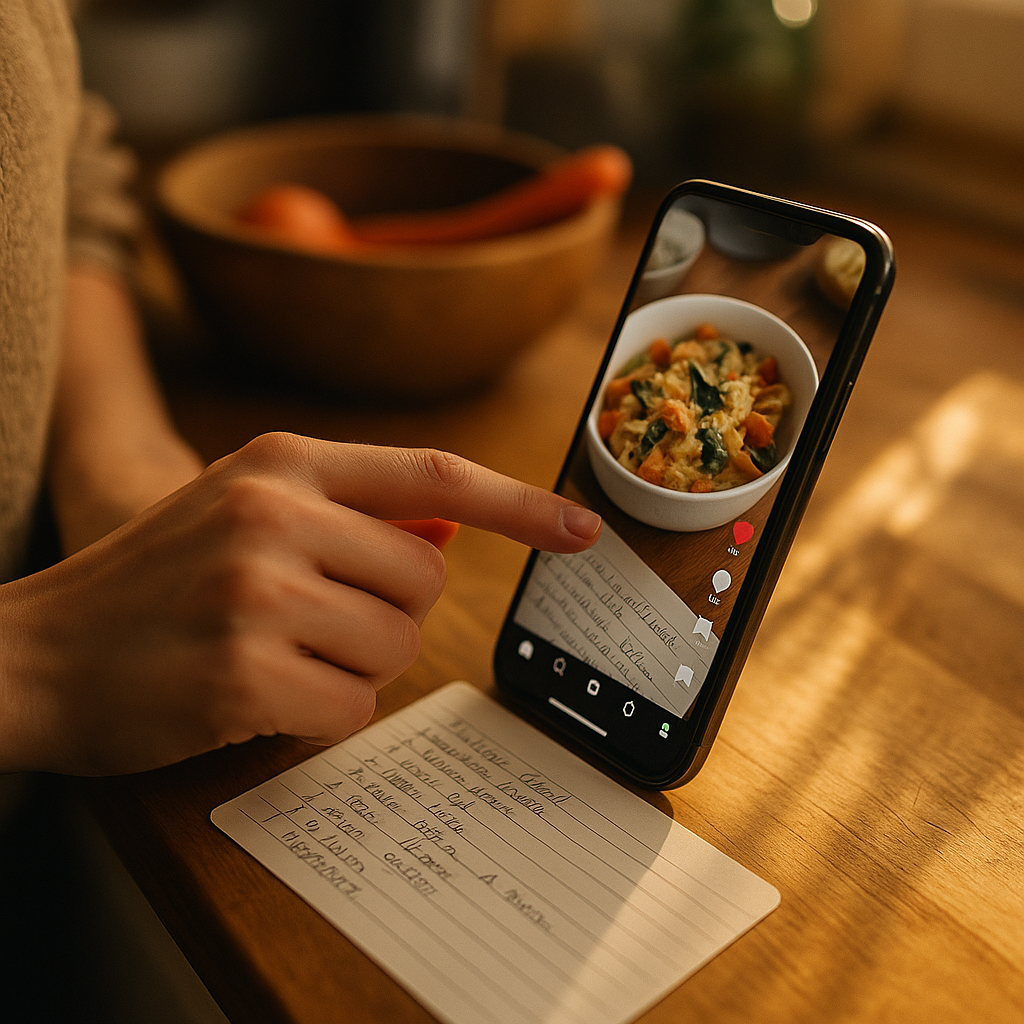
Recipe content gets 3x the saves of average food posts on Pinterest, yet most brands let that engagement evaporate the moment the video stops playing. The recipe card remix format fixes that by converting UGC recipe videos into clean, branded static assets built for saving, printing, and pinning — not just watching once and forgetting.
If your influencer program is still measuring recipe content by views alone, you’re leaving the highest-intent asset type on the table.
Why Video Isn’t Enough for Recipe Content
Recipe videos perform well on TikTok and Reels. That’s not in question. But cooking content has a behavior problem baked into the format: people watch a recipe video once, maybe twice, then they need the ingredient list and steps in a format they can actually reference while their hands are covered in flour. Nobody wants to scrub back through a 45-second clip mid-recipe to check if it was a tablespoon or a teaspoon.
That’s where static recipe cards come in. They’re the format people actually save, screenshot, print, and return to. Pinterest itself has built an entire discovery engine around this behavior — recipe pins consistently rank among the platform’s most-saved content categories, and Pinterest’s own data has long shown recipe and food content driving outsized repin rates compared to other verticals.
A video earns a view. A recipe card earns a save — and a save is a second, third, and fourth touchpoint with your brand that costs you nothing extra to generate.
What the Recipe Card Remix Format Actually Is
The format is simple in concept, more nuanced in execution. You take a creator’s UGC recipe video — the one that performed well organically, the one with strong comment engagement or saves — and you extract it into a static, branded card: ingredients list, numbered steps, a hero photo, your logo, maybe a QR code linking back to the full video or your recipe hub.
Think of it as content repurposing with a purpose. You’re not just chopping a video into a carousel. You’re translating an ephemeral format into a permanent, reference-grade asset that lives comfortably on Pinterest, in an email newsletter, on a blog post, or printed and stuck to a fridge with a magnet (yes, that still happens, and yes, brands should want it to happen).
This isn’t a new idea in food media — recipe cards predate the internet by decades. What’s new is treating UGC as the raw material and static repurposing as a deliberate owned-channel strategy, not an afterthought handled by whoever’s free on a Friday.
The Operational Case: Why This Belongs in Your Content Calendar
From a brand operations standpoint, the recipe card remix format solves three problems at once.
First, it extends the shelf life of creator content well past the algorithm’s attention span. A TikTok recipe video has maybe a 48-hour window of meaningful reach. A recipe card pinned to a well-organized Pinterest board can drive traffic for months, sometimes years, according to audience behavior research from eMarketer.
Second, it gives you an owned-channel asset that doesn’t depend on any single platform’s whims. If TikTok gets banned, throttled, or algorithmically reshuffled tomorrow, your recipe card library still lives on your blog, your email list, your Pinterest boards. That’s not a hypothetical risk anymore — it’s basic platform diversification, the same logic that should be driving your seasonal content planning decisions.
Third — and this is the part most brand teams underweight — it creates a low-cost, high-output content pipeline. One well-performing creator video can be remixed into four or five recipe cards: a full-recipe card, an ingredient-swap variant, a “5-minute version,” a shopping-list graphic. You’re multiplying your content output without commissioning new creator work.
Sourcing the Right UGC to Remix
Not every recipe video deserves the remix treatment. Picking the wrong source content wastes design hours on an asset nobody wants.
Look for these signals before greenlighting a remix:
- High save-to-view ratio. A video with modest views but disproportionate saves is signaling recipe intent, not just entertainment value.
- Comment questions about measurements or substitutions. If people are asking “how much garlic?” in the comments, that’s a sign the video format failed to communicate specifics clearly — exactly what a static card fixes.
- Clear, replicable steps. Highly stylized or heavily edited videos (fast cuts, trick photography, ASMR-style sound design) don’t always translate cleanly to a step-by-step card. Save those for process-driven video formats instead.
- Creator willingness to grant extended usage rights. This is the part brands skip and regret.
That last point deserves its own section, because it’s where most recipe card remix programs get legally sloppy.
The Rights and Compliance Layer Nobody Wants to Deal With (But Must)
Repurposing UGC into a static, branded, owned-channel asset is a materially different use than a paid boost or a simple repost. You’re not just amplifying the creator’s video — you’re extracting their intellectual property (the recipe, the photography style, sometimes their voice or likeness in a thumbnail) and repackaging it as your own branded content.
This means your standard influencer contract’s “usage rights” clause probably isn’t sufficient. Most creator agreements grant usage rights for the content as delivered — meaning the video itself, not a derivative static asset built from it. If your contract doesn’t explicitly cover derivative works, remix rights, or evergreen owned-channel usage, you’re exposed.
Build this into your briefing process from day one. Specify:
- Whether you can extract and republish the recipe (recipes themselves generally aren’t copyrightable, but the specific written expression and photography often is)
- Whether the creator’s name, handle, or likeness can appear on the card
- Duration of usage rights (30 days? in perpetuity? this changes your rate)
- Whether the creator gets a cut or bonus for high-performing remix assets
The FTC’s endorsement guidance also still applies once you repurpose the content — if the original video disclosed a paid partnership, the remixed static asset needs equivalent disclosure, even if it’s just a small “in partnership with” tag on the card. Compliance doesn’t disappear because the format changed. This same discipline is why brands running before-and-after content and taste-test formats build disclosure language into the brief itself, not as an afterthought.
If your legal team hasn’t reviewed a derivative-works clause for UGC remixing, assume you don’t have permission to do it — even if the creator tagged your brand willingly in the original post.
Building the Card: Design Principles That Actually Convert Saves
A recipe card that looks like a stock template gets scrolled past. A few design fundamentals separate the cards people actually save from the ones that die in the feed:
- Lead with the finished dish, not the process. The hero image needs to make someone hungry within half a second of seeing it.
- Keep ingredient lists scannable. Bullet points, not paragraphs. Measurements in both metric and imperial if your audience skews international.
- Number the steps distinctly from the ingredients. This sounds obvious. A surprising number of brand-designed recipe cards muddle the two.
- Brand subtly. Logo in a corner, not stamped across the hero shot. Nobody saves an ad. They save a recipe that happens to be well-branded.
- Optimize dimensions per platform. Pinterest favors a 2:3 vertical ratio. Instagram carousels perform better square or 4:5. Don’t force one asset to do both jobs poorly.
Tools matter less than most teams assume — Canva templates, a simple Figma system, or a design contractor can all execute this well. What matters is consistency: a recognizable card template across your whole library builds brand recall the same way a consistent podcast intro does.
Distribution: Where These Assets Actually Earn Their Keep
Pinterest is the obvious home, and probably your highest-ROI channel for this format given the platform’s search-driven, long-tail discovery model (unlike Instagram or TikTok, a Pinterest pin can surface in search results for years). But don’t stop there.
Email newsletters see strong click-through on recipe content, particularly seasonal batches — holiday baking, back-to-school lunches, summer grilling. HubSpot’s content marketing research consistently shows visual, save-worthy assets outperforming plain-text CTAs in email engagement.
Blog embeds matter too, especially for SEO. A recipe card embedded in a blog post with proper schema markup (Recipe structured data) can earn rich snippets in Google search results — a genuine traffic driver that a video alone can’t replicate. Static, text-extractable content is also simply more indexable than video, full stop.
And don’t sleep on printable formats. A downloadable PDF recipe card, gated behind an email signup or just offered as a free download, is a low-friction lead magnet that food and CPG brands have underused for years.
Measuring What Actually Matters
Views and impressions tell you almost nothing useful about recipe card performance. Track these instead:
- Save rate (Pinterest repins, Instagram saves) as your primary engagement signal
- Click-through to full recipe or shop page from the card’s CTA or QR code
- Organic search impressions for blog-embedded cards with recipe schema
- Email download or open rate for gated printable versions
- Longevity — how many weeks or months post-publish the asset continues driving traffic, a metric video content rarely sustains
If a remixed card isn’t outperforming its source video on save rate within the first month, revisit your design or your sourcing criteria. The format only works if the static asset earns its own engagement, not just borrowed goodwill from the original creator post.
Start small: pick your three best-performing recipe UGC videos from the last quarter, secure derivative-use rights retroactively if needed, and build one recipe card template to test across Pinterest and email. Measure save rate against your video benchmarks before scaling the format further.
FAQs
What is the recipe card remix format?
It’s the practice of converting UGC recipe videos into static, branded assets — ingredient lists, numbered steps, and hero photography — designed for saving, pinning, and printing rather than one-time video viewing.
Do I need extra permission to turn a creator’s video into a static recipe card?
In most cases, yes. Standard usage rights clauses typically cover the video as delivered, not derivative static assets. Confirm derivative-works rights explicitly in your creator contract before remixing.
Which platform performs best for recipe card distribution?
Pinterest generally delivers the strongest long-tail results due to its search-driven discovery model, but email newsletters and SEO-optimized blog embeds also perform well, especially with Recipe structured data markup.
How do I measure success for a recipe card asset?
Prioritize save rate, click-through to full recipes or shop pages, organic search impressions, and content longevity over raw views or impressions.
Does FTC disclosure still apply to a remixed static asset?
Yes. If the original UGC video disclosed a paid partnership, the remixed card needs equivalent disclosure language, even in a smaller or simplified form.
Top Influencer Marketing Agencies
The leading agencies shaping influencer marketing in 2026
Agencies ranked by campaign performance, client diversity, platform expertise, proven ROI, industry recognition, and client satisfaction. Assessed through verified case studies, reviews, and industry consultations.
Moburst

-
2

The Shelf
Boutique Beauty & Lifestyle Influencer AgencyA data-driven boutique agency specializing exclusively in beauty, wellness, and lifestyle influencer campaigns on Instagram and TikTok. Best for brands already focused on the beauty/personal care space that need curated, aesthetic-driven content.Clients: Pepsi, The Honest Company, Hims, Elf Cosmetics, Pure LeafVisit The Shelf → -
3

Audiencly
Niche Gaming & Esports Influencer AgencyA specialized agency focused exclusively on gaming and esports creators on YouTube, Twitch, and TikTok. Ideal if your campaign is 100% gaming-focused — from game launches to hardware and esports events.Clients: Epic Games, NordVPN, Ubisoft, Wargaming, Tencent GamesVisit Audiencly → -
4

Viral Nation
Global Influencer Marketing & Talent AgencyA dual talent management and marketing agency with proprietary brand safety tools and a global creator network spanning nano-influencers to celebrities across all major platforms.Clients: Meta, Activision Blizzard, Energizer, Aston Martin, WalmartVisit Viral Nation → -
5

The Influencer Marketing Factory
TikTok, Instagram & YouTube CampaignsA full-service agency with strong TikTok expertise, offering end-to-end campaign management from influencer discovery through performance reporting with a focus on platform-native content.Clients: Google, Snapchat, Universal Music, Bumble, YelpVisit TIMF → -
6

NeoReach
Enterprise Analytics & Influencer CampaignsAn enterprise-focused agency combining managed campaigns with a powerful self-service data platform for influencer search, audience analytics, and attribution modeling.Clients: Amazon, Airbnb, Netflix, Honda, The New York TimesVisit NeoReach → -
7

Ubiquitous
Creator-First Marketing PlatformA tech-driven platform combining self-service tools with managed campaign options, emphasizing speed and scalability for brands managing multiple influencer relationships.Clients: Lyft, Disney, Target, American Eagle, NetflixVisit Ubiquitous → -
8

Obviously
Scalable Enterprise Influencer CampaignsA tech-enabled agency built for high-volume campaigns, coordinating hundreds of creators simultaneously with end-to-end logistics, content rights management, and product seeding.Clients: Google, Ulta Beauty, Converse, AmazonVisit Obviously →