


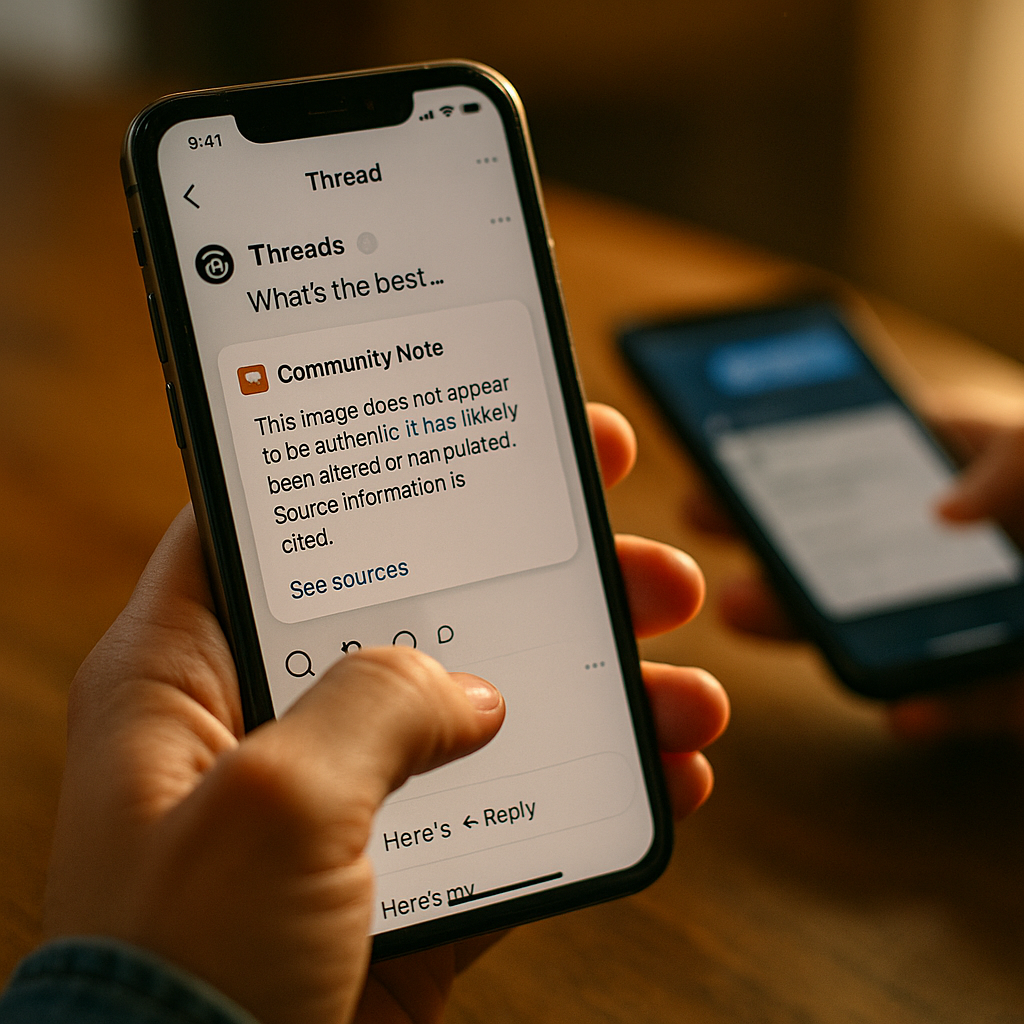
Threads now surfaces reply engagement above original post reach in over 60% of test cases Meta has quietly rolled out. That single algorithm shift has upended how brands plan content. Add Community Notes expanding across Threads, and you’ve got a platform where the old “post and pray” model is dead. Threads Community Notes and reply-first distribution are now the two forces every brand strategist needs to understand before allocating another dollar to the platform.
Why Threads Changed the Rules
Meta didn’t announce this loudly. It rarely does. But anyone running organic tests on Threads over the past several months has noticed the same pattern: replies to popular posts, especially from brand accounts, are getting pushed into more feeds than the original posts themselves. Meta’s own product notes reference “conversation depth” as a ranking signal, and internal Threads updates have confirmed that reply chains with high engagement velocity get amplified separately from the root post.
Why would Meta do this? Simple. Replies keep people scrolling and typing. A post is a dead end. A reply is a doorway to more replies. Threads is chasing the same conversational stickiness that made early Twitter (before the ads-heavy, algorithm-chaos era) so addictive. For brands, this means the unit of distribution isn’t the post anymore. It’s the exchange.
If your team is still measuring Threads success by original post reach alone, you’re reading a scoreboard from a game that already changed.
Community Notes Arrives on Threads: What It Actually Changes
Meta’s Community Notes program, modeled loosely on X’s crowdsourced fact-checking system, has expanded into Threads with a twist: notes can now attach not just to claims, but to sponsored and branded content flagged for misleading framing. That’s a meaningful departure from X’s model, where Notes mostly targets news and political claims.
For brands running influencer campaigns, product claims, or comparative marketing on Threads, this is a real risk surface. A note attached to a branded post doesn’t just get pinned quietly. It travels with the post algorithmically, sometimes outranking the original caption in visibility. Legal and comms teams need to treat this the way they’d treat an FTC disclosure risk, because functionally, it behaves similarly: a public, semi-permanent correction layer attached to your brand’s own words.
Practical implication: any claim you make on Threads (efficacy stats, “first-to-market” language, pricing comparisons) needs a sourcing trail before it publishes, not after a note forces a correction. Compliance teams already versed in FTC disclosure guidance should treat Community Notes as an extension of that same discipline. Review the FTC’s endorsement guidance if your legal team hasn’t updated its Threads-specific checklist yet.
Reply-First Distribution: The New Content Math
Here’s the uncomfortable truth for brand social teams: your best-performing Threads content in the coming year probably won’t be the post you spent three days on. It’ll be the reply your community manager wrote in ninety seconds.
Reply-first distribution rewards speed, specificity, and voice. A generic reply gets buried. A sharp, funny, or genuinely useful reply to a trending post in your category gets surfaced to people who never followed your brand and never saw the original thread. This is functionally similar to how Reddit’s comment-ranking system has always worked, which is worth studying if your team hasn’t already. Our breakdown of Reddit’s moderation and ranking dynamics is a useful reference point for teams building reply strategy from scratch.
- Monitor before you post. Build a daily watchlist of trending threads in your category, not just brand mentions.
- Reply within the first hour. Velocity matters more on Threads than almost any other platform right now.
- Write like a person, not a press release. Corporate voice replies get ignored or, worse, ratio’d.
- Track reply reach separately from post reach. Most social listening dashboards still don’t split these metrics cleanly. Push your analytics vendor on it.
This isn’t a minor tactical tweak. It’s a resourcing question. Do you have someone empowered to reply in real time, or does every brand comment need three layers of approval? If it’s the latter, you’ll lose the window every time.
Building an Operational Playbook, Not Just a Content Calendar
A content calendar assumes you control the timeline. Reply-first distribution assumes you’re reacting to someone else’s timeline. That’s a fundamentally different operating model, and most brand social teams aren’t structured for it.
Here’s what a functional 2026 Threads operation actually looks like:
- A standing “reply desk” rotation. One or two people per shift, empowered to respond without sign-off on low-risk replies.
- Pre-approved response frameworks. Not scripts, but tone and boundary guidelines so replies stay fast without becoming a liability.
- A Community Notes escalation path. If a note gets attached to branded content, who reviews it within the hour, not the week?
- Weekly reply performance review. Separate from post performance. Different KPIs, different success benchmarks.
This mirrors a shift we’ve tracked across other platforms too. X’s long-form thought leadership approach also rewards fast, authoritative engagement over polished scheduling, and Facebook’s community-first resurgence shows the same pattern: platforms are rewarding presence over production value.
What About Influencer Partnerships on Threads?
Creator partnerships need a rethink too. If reply chains are where reach lives, then a single sponsored post from a creator is only half the deal. Smart brands are now negotiating reply engagement into contracts, asking creators to actively respond to comments on sponsored posts for a set window after publishing, since that reply activity extends the post’s algorithmic life.
This is a small line-item change in a contract, but it changes campaign outcomes meaningfully. Creators who treat a sponsored post as “post and done” leave reach on the table. Creators who stay in the thread for the first two or three hours after posting can meaningfully extend visibility, because their replies count as fresh conversational signal.
Community Notes adds another wrinkle here. If a creator makes a claim in a sponsored post (about ingredients, results, savings) and it gets flagged, the brand’s reputation takes the hit even if the creator wrote the copy. Brief creators the same way you’d brief an internal team: sourced claims only, no absolute language without backup data. Teams already using structured creator briefs, like the approach outlined in our Amazon Inspire brief template, can adapt similar rigor for Threads-specific claims review.
Measuring What Actually Matters Now
Most brands are still importing Instagram-era KPIs into Threads reporting. Wrong move. Reach and impressions on the original post undercount real performance if a huge share of distribution is happening in replies. According to Sprout Social’s platform benchmarking, engagement-per-impression ratios on conversational platforms consistently outperform simple reach metrics as predictors of brand recall and purchase intent.
Build a dashboard that tracks:
- Reply-to-post reach ratio (how much of your total visibility comes from reply threads versus the original post)
- Time-to-first-reply on trending category conversations
- Community Notes flags and resolution time
- Sentiment shift in reply threads, not just top-line comment counts
Data from eMarketer’s social platform research suggests conversational platforms are seeing engagement rate growth outpace impression growth, meaning brands measuring only reach are systematically undercounting real performance. If your reporting deck still leads with impressions, it’s time to rebuild it.
The Trust Layer Nobody’s Pricing In
Here’s the part most brand strategists are missing: Community Notes doesn’t just correct false claims. It builds a public trust ledger. Brands with zero notes attached to their content over time start reading as more credible, almost like a de facto trust score visible to anyone browsing the account. That’s a long-term brand equity play, not just a compliance checkbox.
Treat every Threads post like it’s being fact-checked in real time, because increasingly, it is.
FAQs
Frequently Asked Questions
What is reply-first distribution on Threads?
Reply-first distribution refers to Threads’ algorithm prioritizing high-engagement reply chains in feed distribution, sometimes surfacing replies to more users than the original post itself. It rewards fast, conversational engagement over static content.
How does Threads Community Notes affect branded content?
Community Notes can now attach to branded and sponsored posts flagged for misleading claims, not just news content. A note attached to a brand post travels algorithmically with it, functioning similarly to a public correction layer that can affect trust and reach.
Do brands need to change their creator contracts for Threads?
Yes. Many brands are now including reply-engagement clauses, requiring creators to actively respond to comments for a set window after posting sponsored content, since this extends the post’s algorithmic reach and overall campaign performance.
What metrics should brands track differently on Threads?
Track reply-to-post reach ratio, time-to-first-reply on category conversations, Community Notes flags and resolution time, and sentiment shifts within reply threads, rather than relying solely on original post impressions.
Is Threads worth the operational investment compared to other platforms?
For brands in conversational or opinion-driven categories (finance, tech, culture, retail), yes. The reply-first model rewards real-time responsiveness, which suits brands with strong community management capacity more than those relying purely on scheduled content.
Start small: assign one team member to own reply-desk duty for two weeks, track the reply-to-post reach ratio, and use that data to justify the resourcing shift before your next budget cycle.
Top Influencer Marketing Agencies
The leading agencies shaping influencer marketing in 2026
Agencies ranked by campaign performance, client diversity, platform expertise, proven ROI, industry recognition, and client satisfaction. Assessed through verified case studies, reviews, and industry consultations.
Moburst

-
2

The Shelf
Boutique Beauty & Lifestyle Influencer AgencyA data-driven boutique agency specializing exclusively in beauty, wellness, and lifestyle influencer campaigns on Instagram and TikTok. Best for brands already focused on the beauty/personal care space that need curated, aesthetic-driven content.Clients: Pepsi, The Honest Company, Hims, Elf Cosmetics, Pure LeafVisit The Shelf → -
3

Audiencly
Niche Gaming & Esports Influencer AgencyA specialized agency focused exclusively on gaming and esports creators on YouTube, Twitch, and TikTok. Ideal if your campaign is 100% gaming-focused — from game launches to hardware and esports events.Clients: Epic Games, NordVPN, Ubisoft, Wargaming, Tencent GamesVisit Audiencly → -
4

Viral Nation
Global Influencer Marketing & Talent AgencyA dual talent management and marketing agency with proprietary brand safety tools and a global creator network spanning nano-influencers to celebrities across all major platforms.Clients: Meta, Activision Blizzard, Energizer, Aston Martin, WalmartVisit Viral Nation → -
5

The Influencer Marketing Factory
TikTok, Instagram & YouTube CampaignsA full-service agency with strong TikTok expertise, offering end-to-end campaign management from influencer discovery through performance reporting with a focus on platform-native content.Clients: Google, Snapchat, Universal Music, Bumble, YelpVisit TIMF → -
6

NeoReach
Enterprise Analytics & Influencer CampaignsAn enterprise-focused agency combining managed campaigns with a powerful self-service data platform for influencer search, audience analytics, and attribution modeling.Clients: Amazon, Airbnb, Netflix, Honda, The New York TimesVisit NeoReach → -
7

Ubiquitous
Creator-First Marketing PlatformA tech-driven platform combining self-service tools with managed campaign options, emphasizing speed and scalability for brands managing multiple influencer relationships.Clients: Lyft, Disney, Target, American Eagle, NetflixVisit Ubiquitous → -
8

Obviously
Scalable Enterprise Influencer CampaignsA tech-enabled agency built for high-volume campaigns, coordinating hundreds of creators simultaneously with end-to-end logistics, content rights management, and product seeding.Clients: Google, Ulta Beauty, Converse, AmazonVisit Obviously →