


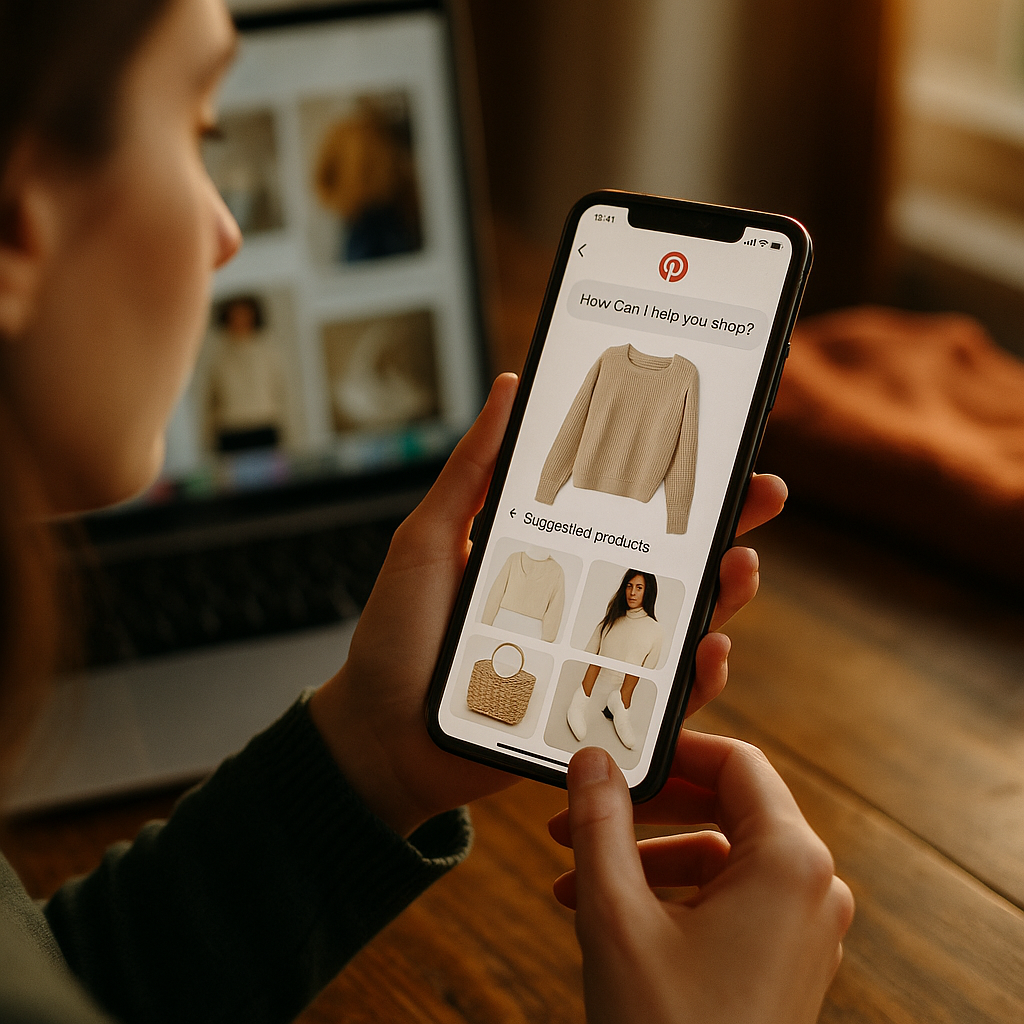
Pinterest just quietly became a shopping engine with an AI brain — and most brands haven’t noticed. With over 570 million monthly users already searching with commercial intent, the platform’s new AI shopping assistant threatens to reroute product discovery away from Google and straight into a conversational, visual-first checkout flow. If your brand still treats Pinterest as a moodboard for pins, you’re about to miss the next big shift in product discovery.
Why Pinterest, Why Now
Pinterest has always been a search engine wearing a scrapbook’s clothing. Users don’t scroll for entertainment; they scroll with intent. Someone pinning “small bathroom remodel ideas” isn’t idly browsing. They’re planning a purchase, often months out. That’s a fundamentally different behavioral signal than a TikTok swipe or an Instagram double-tap.
The AI shopping assistant builds directly on that intent layer. Instead of forcing users to click through dozens of pins to compare products, the assistant lets them ask natural-language questions — “show me minimalist gold hoop earrings under $50” — and get a curated, shoppable response pulled from the platform’s product catalog and merchant partners. It’s less a chatbot bolted onto search and less like Google’s shopping tab, and more like a stylist who actually remembers your taste.
Pinterest’s own data shows shopping-related searches have grown steadily year over year, and the platform reports that a majority of weekly users say they’ve made a purchase because of content they saw there. That’s a conversion signal most social platforms would kill for.
For product-led brands — DTC labels, home goods, beauty, fashion — this isn’t a nice-to-have feature. It’s a new discovery channel with commercial intent baked in from the first query.
What the AI Assistant Actually Does Differently
Most platform “AI shopping” rollouts amount to recommendation engines with a chat wrapper. Pinterest’s version leans harder into personalization because it has something few platforms do: years of explicit taste signals from boards, saves, and searches.
Here’s the practical breakdown:
- Conversational refinement: Users can narrow results by style, price, material, or occasion in plain language, instead of clicking filter checkboxes.
- Visual-first results: Responses surface as pin-style product cards, not text lists, keeping the browsing experience native to the platform.
- Catalog-dependent accuracy: The assistant pulls from merchant product feeds. If your catalog metadata is thin, you simply won’t surface, no matter how good your creative is.
- Cross-session memory: Boards and past saves inform future assistant recommendations, meaning a user’s history with your brand (or your competitor’s) shapes what gets shown next.
That last point matters more than it sounds. Brands with strong pin engagement and consistent visual branding compound their advantage over time. Weak, inconsistent product imagery gets quietly filtered out of the recommendation pool.
The Catalog Is the New Creative Brief
Here’s the uncomfortable truth for a lot of marketing teams: your product feed is now a ranking factor, not a backend afterthought. If your Pinterest catalog integration through Shopify, BigCommerce, or a direct feed hasn’t been audited recently, the AI assistant will simply skip you in favor of merchants with cleaner data.
That means:
- Titles and descriptions need natural-language phrasing, not keyword-stuffed SEO relics from 2019.
- Attributes (color, material, size, occasion) must be filled out completely — the assistant uses these to match conversational queries.
- High-resolution, lifestyle-context images outperform plain product-on-white shots, since the assistant seems to favor pins with strong historical engagement.
- Pricing and availability need real-time accuracy. Nothing kills trust in an AI shopping flow faster than a “buy now” that leads to an out-of-stock page.
This is genuinely a cross-functional problem. Marketing can’t fix a bad catalog alone; it needs e-commerce ops, merchandising, and sometimes engineering at the table. Brands that treat this as a one-off “Pinterest project” instead of an ongoing data discipline will lose ground to competitors who don’t.
Where This Fits in the Broader AI Shopping Shift
Pinterest isn’t moving in isolation. Amazon’s Rufus, Google’s AI Overviews for shopping, and TikTok’s search expansion are all part of the same broader pattern: AI intermediaries are inserting themselves between brand and buyer. If you’ve already adapted creator content for Rufus-driven Amazon traffic or optimized UGC for Google’s AI Overviews, the muscle memory transfers here.
The common thread across all of these: structured data and authentic engagement signals now matter as much as ad spend. You can’t buy your way into a good AI recommendation the way you could buy your way into a search ads slot. The assistant is trying to serve the *best* answer, not the highest bidder — at least for now.
That said, Pinterest hasn’t abandoned paid media. Shopping ads and promoted pins still exist alongside organic assistant results, and early indications suggest sponsored placements may get woven into assistant responses similarly to how Google blends ads into AI Overviews. Brands should expect a hybrid model, not a purely organic one.
Creators Still Matter — Just Differently
It’s tempting to think an AI shopping assistant makes creators less relevant. The opposite seems truer. Pinterest’s assistant leans on engagement and save data to judge quality, and creator-produced pins historically outperform brand-only content on both metrics.
Idea pins, styled product shots, and creator collaborations that show real use-cases (a serum applied on-camera, a couch styled in an actual living room) feed the exact signals the AI needs to rank confidently. Brands running influencer programs on other visual platforms already understand this instinct — it’s the same logic behind shoppable carousel storytelling on Instagram or the shift toward algorithm-friendly shoppable Reels. Pinterest is simply applying it to a search-and-shop context instead of a feed-scroll context.
Practical move: brief creators specifically for Pinterest-native formats rather than repurposing TikTok or Reels cuts. Vertical video works, but static, high-detail product pins with strong styling context often perform just as well, sometimes better, in assistant-surfaced results.
Risk, Compliance, and the Boring Stuff That Actually Matters
AI-driven shopping surfaces raise real compliance questions, and brand and legal teams should be looped in early, not after launch.
Key considerations:
- Pricing accuracy and FTC guidance: Automated recommendation flows need airtight price and claims accuracy. Review current FTC guidance on endorsements and automated commerce disclosures before scaling creator-linked shopping content.
- Data feed liability: If your catalog misrepresents materials, sizing, or sustainability claims, an AI assistant will happily amplify that error to thousands of shoppers. Audit before you scale, not after a complaint.
- UK and EU advertising rules: Brands operating across regions should check ICO guidance on data use in personalized recommendation systems, particularly around behavioral profiling.
- Attribution ambiguity: Conversational assistants blur the line between organic discovery and paid placement. Make sure your measurement stack can distinguish assistant-driven conversions from standard pin clicks.
None of this should scare brands off the platform. It should just discourage the “launch fast, fix later” instinct that tends to backfire with anything touching automated recommendations and consumer trust.
Building the Playbook: A Practical Sequence
For teams wanting a starting framework rather than a vague “get on Pinterest” directive, here’s a reasonable rollout sequence:
- Audit the catalog first. Fix titles, attributes, and images before touching creative strategy. This is the unglamorous work that actually moves the needle.
- Test conversational queries manually. Search your own product category the way a customer would. See who shows up. If it’s not you, figure out why.
- Brief creators for native formats. Prioritize styled, high-context imagery and idea pins over repurposed short-form video.
- Layer in paid shopping ads selectively. Use them to fill gaps where organic assistant visibility is still building, not as a permanent crutch.
- Set up assistant-specific tracking. Work with your analytics team to separate this traffic source from general Pinterest referral data.
Brands that treat this as a quarter-long test, rather than a permanent campaign from day one, tend to make smarter budget calls. Pinterest’s ad ecosystem is still evolving around the assistant, and pricing models will likely shift as adoption grows. For deeper platform benchmarking, eMarketer’s ongoing coverage of retail media and social commerce trends is worth tracking alongside Pinterest’s own release notes.
Marketing teams juggling multiple AI-driven shopping surfaces might also find it useful to compare notes with adjacent playbooks — the operational lessons from TikTok Shop livestream scripting or Facebook Marketplace strategy aren’t identical, but the underlying discipline (clean data, native creative, tight measurement) repeats across every one of these platforms.
Frequently Asked Questions
FAQs
What is Pinterest’s AI shopping assistant?
It’s a conversational discovery tool that lets Pinterest users search for products using natural language and receive curated, shoppable pin results pulled from merchant catalogs, rather than browsing static search results.
How is this different from Pinterest’s existing shopping ads?
Shopping ads are paid placements shown based on targeting and bids. The AI assistant surfaces results based primarily on catalog data quality and engagement signals, blending organic and (increasingly) sponsored results in a single conversational flow.
Do brands need a Pinterest Shopify or catalog integration to appear in assistant results?
Yes. The assistant pulls from structured product feeds, so brands without an active, well-maintained catalog integration through platforms like Shopify or BigCommerce are unlikely to surface consistently.
Does creator content still matter if Pinterest has an AI shopping assistant?
Very much so. Creator-produced pins tend to generate stronger engagement and save rates, and those signals appear to influence how confidently the assistant recommends a product.
What’s the biggest compliance risk with AI shopping assistants like this one?
Inaccurate catalog data (pricing, sizing, material claims) can get amplified automatically at scale. Brands should audit feeds regularly and review FTC and regional advertising guidance before scaling AI-surfaced shopping content.
Should brands prioritize Pinterest over other AI shopping surfaces like Amazon’s Rufus?
It depends on category and audience. Pinterest tends to over-index on home, fashion, beauty, and DIY categories with high-intent, planning-stage shoppers, while Rufus captures more immediate, transaction-ready intent. Most product-led brands will want a presence across both.
The brands that win here won’t be the ones with the biggest Pinterest ad budgets — they’ll be the ones with the cleanest product data and the best-briefed creators. Start with a catalog audit this week; everything else in the playbook depends on it.
Top Influencer Marketing Agencies
The leading agencies shaping influencer marketing in 2026
Agencies ranked by campaign performance, client diversity, platform expertise, proven ROI, industry recognition, and client satisfaction. Assessed through verified case studies, reviews, and industry consultations.
Moburst

-
2

The Shelf
Boutique Beauty & Lifestyle Influencer AgencyA data-driven boutique agency specializing exclusively in beauty, wellness, and lifestyle influencer campaigns on Instagram and TikTok. Best for brands already focused on the beauty/personal care space that need curated, aesthetic-driven content.Clients: Pepsi, The Honest Company, Hims, Elf Cosmetics, Pure LeafVisit The Shelf → -
3

Audiencly
Niche Gaming & Esports Influencer AgencyA specialized agency focused exclusively on gaming and esports creators on YouTube, Twitch, and TikTok. Ideal if your campaign is 100% gaming-focused — from game launches to hardware and esports events.Clients: Epic Games, NordVPN, Ubisoft, Wargaming, Tencent GamesVisit Audiencly → -
4

Viral Nation
Global Influencer Marketing & Talent AgencyA dual talent management and marketing agency with proprietary brand safety tools and a global creator network spanning nano-influencers to celebrities across all major platforms.Clients: Meta, Activision Blizzard, Energizer, Aston Martin, WalmartVisit Viral Nation → -
5

The Influencer Marketing Factory
TikTok, Instagram & YouTube CampaignsA full-service agency with strong TikTok expertise, offering end-to-end campaign management from influencer discovery through performance reporting with a focus on platform-native content.Clients: Google, Snapchat, Universal Music, Bumble, YelpVisit TIMF → -
6

NeoReach
Enterprise Analytics & Influencer CampaignsAn enterprise-focused agency combining managed campaigns with a powerful self-service data platform for influencer search, audience analytics, and attribution modeling.Clients: Amazon, Airbnb, Netflix, Honda, The New York TimesVisit NeoReach → -
7

Ubiquitous
Creator-First Marketing PlatformA tech-driven platform combining self-service tools with managed campaign options, emphasizing speed and scalability for brands managing multiple influencer relationships.Clients: Lyft, Disney, Target, American Eagle, NetflixVisit Ubiquitous → -
8

Obviously
Scalable Enterprise Influencer CampaignsA tech-enabled agency built for high-volume campaigns, coordinating hundreds of creators simultaneously with end-to-end logistics, content rights management, and product seeding.Clients: Google, Ulta Beauty, Converse, AmazonVisit Obviously →