


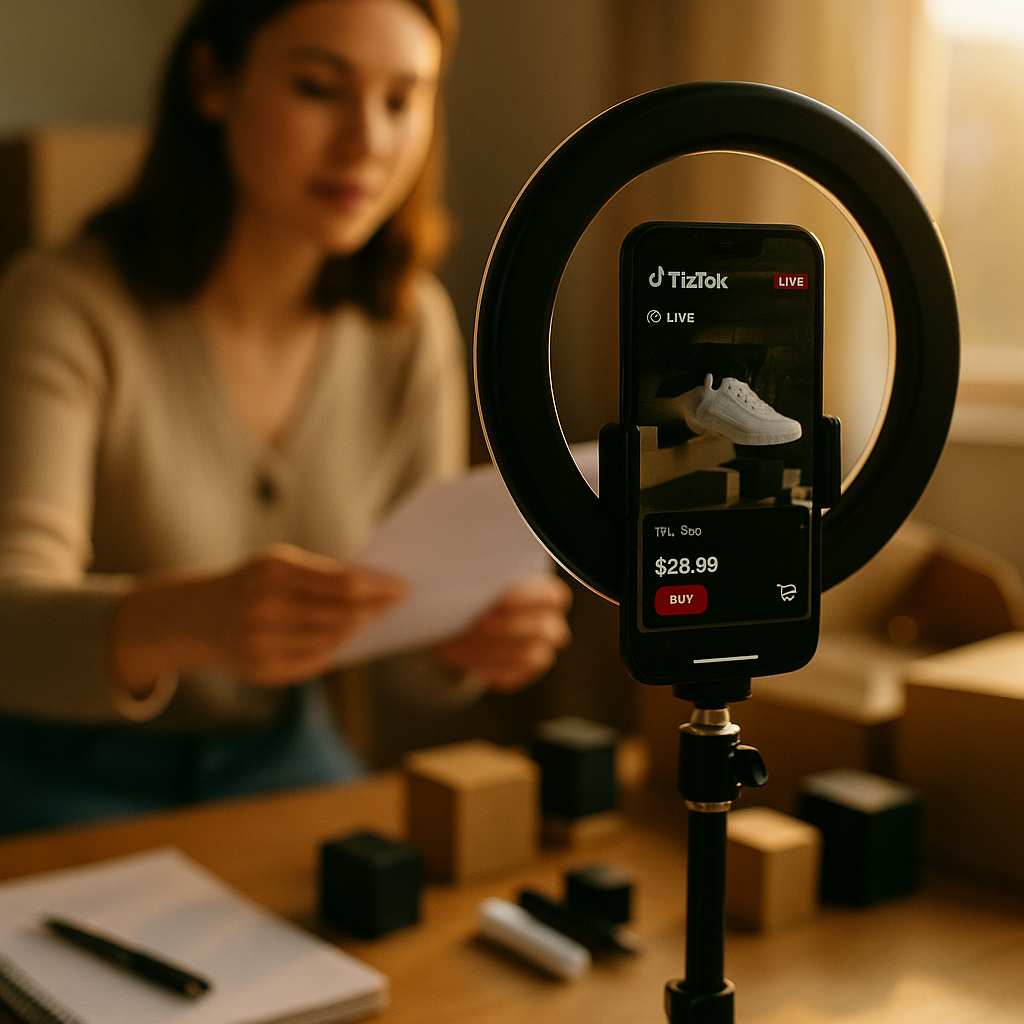
Eighty-two percent of viewers decide whether to stay on a livestream within the first thirty seconds, according to internal TikTok Shop seller data shared with creator partners. That means your TikTok Shop livestream lives or dies before you’ve even mentioned the product name twice. Most hosts waste that window on “hey guys, welcome, let me just set up my camera.” Don’t be that host.
This playbook gives you a script framework, second by second, for the first ninety seconds of a broadcast. No fluff, no theory. Just a structure you can hand to any host and expect results.
Why the First 90 Seconds Decide the Whole Stream
TikTok’s live algorithm rewards watch time and engagement velocity almost immediately. If your room shows weak retention in the opening minute, the platform quietly deprioritizes your stream in the For You feed distribution for live content. Fewer impressions mean fewer buyers, and the spiral compounds fast. A slow open doesn’t just lose the viewers already there — it caps how many new viewers ever show up.
This is different from static content strategy. On Instagram or YouTube, a mediocre first few seconds costs you one video’s performance. On TikTok Shop live, it costs you the entire session’s algorithmic ceiling. That’s the risk brands underestimate when they treat livestream hosting like a nice-to-have add-on for creators, rather than a scripted, rehearsed sales function.
Treat the first 90 seconds of a TikTok Shop livestream like a paid ad’s first three seconds: scripted, tested, and non-negotiable — not improvised.
For a deeper look at retention mechanics past the opening minute, see our earlier breakdown of the first five minutes that matter on TikTok Shop live.
The Four-Beat Framework: Hook, Proof, Offer, Loop
Every high-converting opening breaks into four beats. Each has a job. Miss one and the whole sequence underperforms, even if the others are strong.
- Beat 1 (0–15 seconds): The Hook. Name the product and the outcome in the same breath. No greetings.
- Beat 2 (15–40 seconds): The Proof. A visual demo, a stat, or a scarcity signal that justifies attention.
- Beat 3 (40–65 seconds): The Offer. State the price, the discount, and the urgency mechanism clearly.
- Beat 4 (65–90 seconds): The Loop. Direct viewers to the yellow cart, then tease what’s coming next to hold them past the first minute and a half.
Let’s break each beat down into an actual script skeleton you can adapt.
Beat 1: The Hook (Seconds 0–15)
Skip “welcome to my live.” Skip “give me a second to fix my lighting.” Open mid-sentence, as if the viewer just walked in on something already happening. That’s literally what’s happening algorithmically: most viewers arrive via the feed, mid-stream, not at your official start time.
Script example: “Okay, this is the serum that sold out three times last month, and I’ve got twenty units left at half price for the next ten minutes.”
Notice what’s absent: no “hi everyone,” no name-checking every new viewer. Save the pleasantries. The hook needs a product, a number, and a time constraint, all inside one breath. If your host can’t say it in under twelve seconds, trim it.
Beat 2: The Proof (Seconds 15–40)
Now you earn the attention you just captured. This is where hosts either lose the room or lock it in. Proof beats generic enthusiasm every time — show, don’t tell.
Options that work well in this window:
- A live product demo (apply the serum, unbox the item, wear the garment on camera)
- A screen-recorded stat overlay (“4.8 stars, 12,000 reviews”)
- A scarcity cue tied to real inventory (“last batch before we restock next month”)
Avoid vague claims like “this is literally the best thing ever.” Viewers on livestream shopping are more skeptical than viewers on short-form video, mostly because they’ve seen sellers oversell before. Specificity is what separates a credible host from a hype machine.
Beat 3: The Offer (Seconds 40–65)
State the deal like you’re reading it off a receipt, not selling it. Clarity converts better than excitement here. Say the original price, the discounted price, and exactly how to claim it.
Script example: “It’s normally $48. Right now, through the live-only bundle, it’s $29 — tap the yellow basket, add to cart, and the discount applies automatically at checkout.”
Repeat the mechanism once, not five times. Over-repeating the call-to-action in the first 90 seconds can feel desperate and actually suppress trust. State it once clearly, then move into the loop.
Beat 4: The Loop (Seconds 65–90)
This beat does double duty: it converts the viewers already primed to buy, and it seeds a reason for everyone else to stick around. Tell them what’s coming in the next segment. Give them a reason not to swipe away.
Script example: “Grab it now while stock lasts — and in about five minutes I’m doing a bundle reveal that’s going to save you even more if you’re buying more than one.”
That single sentence does more retention work than ten minutes of small talk. It converts urgency into a forward-looking hook, which is exactly what the algorithm is measuring when it decides whether to keep boosting your room.
What Most Hosts Get Wrong
The most common mistake isn’t a bad script. It’s no script at all. Brands hand creators a product and assume charisma will cover the gap. Charisma helps, but it doesn’t replace structure. A charismatic host with no framework rambles charismatically — and rambling, however likeable, still tanks retention curves.
The second mistake is over-indexing on the greeting. Hosts trained on traditional livestreaming (Twitch, YouTube Live) default to community-building openers: “hey everyone, thanks for joining, how’s everyone doing tonight?” That works for a Twitch audience settling in for two hours. It’s fatal for TikTok Shop, where most viewers give you a five-second trial before deciding to stay. If you’re building creator-hosted livestreams across formats, it’s worth comparing how Twitch sponsorship structures differ from commerce-first platforms — the retention expectations are completely different.
Third mistake: burying the price. Some hosts treat price reveal like a game show twist, saving it for the end of a long pitch. On TikTok Shop, that’s backwards. Price-shy openings read as evasive, not exciting.
Building a Repeatable Script Library
One script isn’t enough. You need variants for different product categories, because a beauty demo opens differently than a kitchen gadget or an apparel drop. Build a swipe file of hooks, organized by category, and require hosts to pull from it rather than freestyle every session.
A practical structure for your internal playbook:
- Five hook variants per product category, tested and ranked by average 30-second retention
- Three proof formats (demo, stat overlay, scarcity cue) mapped to each product type
- Two offer phrasings — one for flat discounts, one for bundle deals
- A rotating loop line updated per session so returning viewers don’t hear the same tease twice
This is the same operational logic brands apply to shoppable carousel story arcs on Instagram — a repeatable structure that different creators can execute consistently, rather than reinventing the format every time.
Measuring If Your Opening Actually Works
Don’t just watch GMV at the end of the stream. Pull the retention curve from TikTok Shop’s analytics dashboard and look specifically at the drop-off point in the first two minutes. If you see a cliff at 20–30 seconds, your hook is weak. If retention holds through the hook but craters after the offer, your proof beat isn’t convincing enough to justify the price.
Track these metrics per session, not per week:
- Viewer retention at 15, 40, 65, and 90 seconds (map directly to your four beats)
- Click-through rate on the product card within the first two minutes
- New viewer join rate during minutes one through three (a proxy for algorithmic boost)
According to eMarketer, livestream commerce in the US is projected to keep growing at double-digit rates, which means the competitive bar for a strong opening only gets higher each quarter. Platforms like TikTok are also tightening TikTok Shop seller guidelines around disclosure and claims, so make sure your proof beat stays compliant, especially with health, beauty, and financial products where the FTC’s endorsement guidance applies directly to livestream demos.
If you’re scaling this across multiple hosts or agencies, standardize your compliance language the same way you’d standardize a brief — see how brands structure creator direction in our UGC brief template for a comparable framework applied to Amazon Inspire content.
A Quick Word on Compliance and Risk
Fast-paced scripts can tempt hosts into overstating claims to hit the urgency beat. Don’t let ninety seconds of hype create a legal headache. Build a compliance checklist into your script review: no unverified health claims, no fake countdown timers, no “limited stock” language unless inventory genuinely supports it. Livestream is recorded, searchable, and increasingly scrutinized by regulators and platforms alike.
This is also where brand safety and creator vetting matter. If you’re running programs across international markets, review how disclosure rules differ, since UK guidance from the ICO and ad standards bodies can diverge meaningfully from US FTC expectations.
Next Step
Pull your last three livestream recordings and time your own opening against the four beats above. If you’re past ninety seconds before the offer even lands, you’ve already lost half the viewers who mattered most — rewrite the script this week, not next quarter.
FAQs
How long should the opening hook be on a TikTok Shop livestream?
Keep the hook under 15 seconds. It should name the product and the outcome or deal immediately, without a greeting or setup period.
What’s the biggest mistake hosts make in the first 90 seconds?
Opening with small talk or a lengthy welcome instead of the product hook. TikTok Shop viewers decide to stay or scroll within seconds, so any delay before the hook costs retention and algorithmic reach.
Should the price be mentioned early in the stream?
Yes. State the price and discount clearly within the first 60–65 seconds. Burying the price or treating it as a reveal reduces trust and conversion on commerce-focused livestreams.
How do I measure whether my opening script is working?
Check viewer retention at the 15, 40, 65, and 90-second marks in TikTok Shop analytics. A sharp drop at any point indicates which script beat — hook, proof, offer, or loop — needs revision.
Can the same script work across different product categories?
Not directly. Build category-specific hook and proof variants, since a beauty demo, an apparel try-on, and a kitchen gadget each need different proof formats to feel credible on camera.
FAQs
How long should the opening hook be on a TikTok Shop livestream?
Keep the hook under 15 seconds. It should name the product and the outcome or deal immediately, without a greeting or setup period.
What’s the biggest mistake hosts make in the first 90 seconds?
Opening with small talk or a lengthy welcome instead of the product hook. TikTok Shop viewers decide to stay or scroll within seconds, so any delay before the hook costs retention and algorithmic reach.
Should the price be mentioned early in the stream?
Yes. State the price and discount clearly within the first 60–65 seconds. Burying the price or treating it as a reveal reduces trust and conversion on commerce-focused livestreams.
How do I measure whether my opening script is working?
Check viewer retention at the 15, 40, 65, and 90-second marks in TikTok Shop analytics. A sharp drop at any point indicates which script beat — hook, proof, offer, or loop — needs revision.
Can the same script work across different product categories?
Not directly. Build category-specific hook and proof variants, since a beauty demo, an apparel try-on, and a kitchen gadget each need different proof formats to feel credible on camera.
Top Influencer Marketing Agencies
The leading agencies shaping influencer marketing in 2026
Agencies ranked by campaign performance, client diversity, platform expertise, proven ROI, industry recognition, and client satisfaction. Assessed through verified case studies, reviews, and industry consultations.
Moburst

-
2

The Shelf
Boutique Beauty & Lifestyle Influencer AgencyA data-driven boutique agency specializing exclusively in beauty, wellness, and lifestyle influencer campaigns on Instagram and TikTok. Best for brands already focused on the beauty/personal care space that need curated, aesthetic-driven content.Clients: Pepsi, The Honest Company, Hims, Elf Cosmetics, Pure LeafVisit The Shelf → -
3

Audiencly
Niche Gaming & Esports Influencer AgencyA specialized agency focused exclusively on gaming and esports creators on YouTube, Twitch, and TikTok. Ideal if your campaign is 100% gaming-focused — from game launches to hardware and esports events.Clients: Epic Games, NordVPN, Ubisoft, Wargaming, Tencent GamesVisit Audiencly → -
4

Viral Nation
Global Influencer Marketing & Talent AgencyA dual talent management and marketing agency with proprietary brand safety tools and a global creator network spanning nano-influencers to celebrities across all major platforms.Clients: Meta, Activision Blizzard, Energizer, Aston Martin, WalmartVisit Viral Nation → -
5

The Influencer Marketing Factory
TikTok, Instagram & YouTube CampaignsA full-service agency with strong TikTok expertise, offering end-to-end campaign management from influencer discovery through performance reporting with a focus on platform-native content.Clients: Google, Snapchat, Universal Music, Bumble, YelpVisit TIMF → -
6

NeoReach
Enterprise Analytics & Influencer CampaignsAn enterprise-focused agency combining managed campaigns with a powerful self-service data platform for influencer search, audience analytics, and attribution modeling.Clients: Amazon, Airbnb, Netflix, Honda, The New York TimesVisit NeoReach → -
7

Ubiquitous
Creator-First Marketing PlatformA tech-driven platform combining self-service tools with managed campaign options, emphasizing speed and scalability for brands managing multiple influencer relationships.Clients: Lyft, Disney, Target, American Eagle, NetflixVisit Ubiquitous → -
8

Obviously
Scalable Enterprise Influencer CampaignsA tech-enabled agency built for high-volume campaigns, coordinating hundreds of creators simultaneously with end-to-end logistics, content rights management, and product seeding.Clients: Google, Ulta Beauty, Converse, AmazonVisit Obviously →