


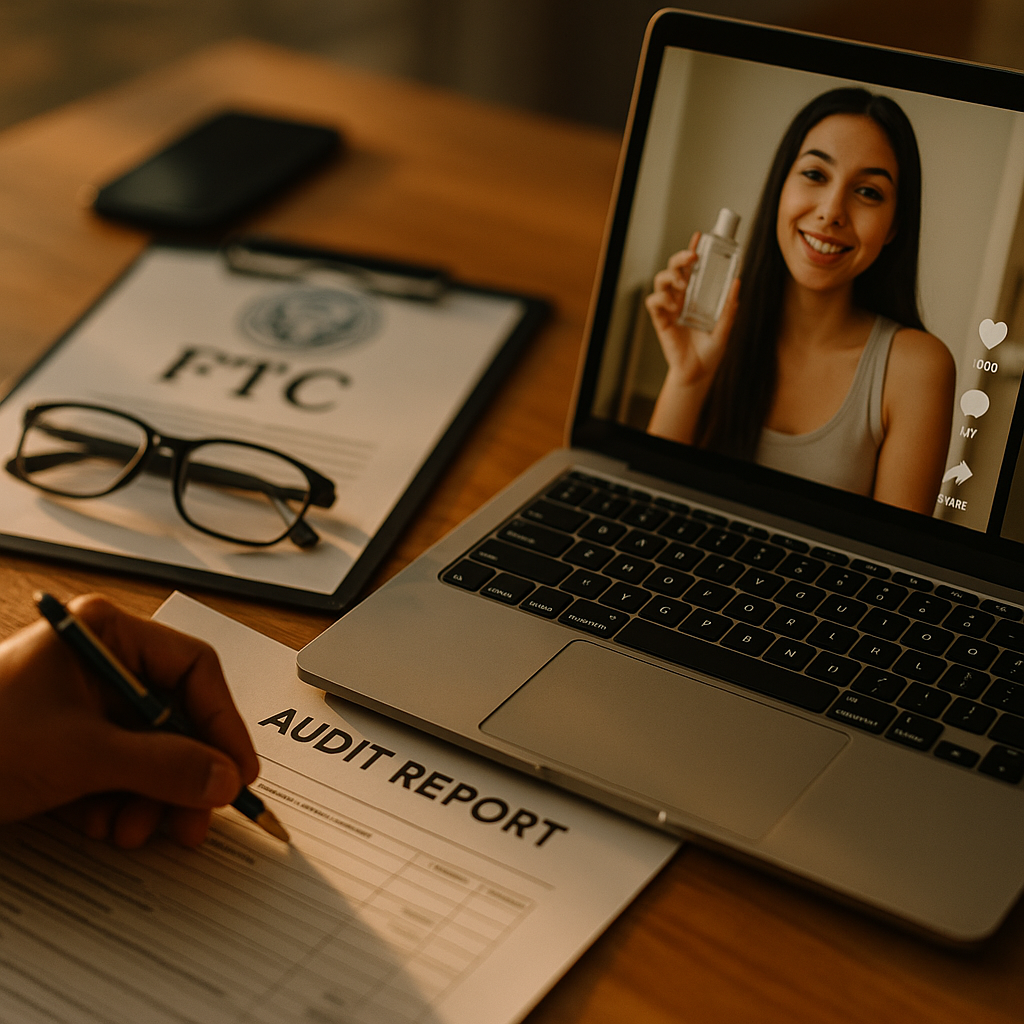
ChatGPT now cites brand and creator content directly in its answers, no click required, no context added. If an unsubstantiated claim from a sponsored post gets pulled into an AI Overview or a Perplexity answer, the FTC doesn’t care that a creator wrote it. Your brand is still on the hook. That’s why a GEO content compliance layer — a systematic audit process for creator claims before they get optimized for AI citation — is quickly becoming non-negotiable for brands playing in generative engine optimization.
Generative engine optimization (GEO) is the new SEO battleground. Brands are racing to get creator content cited inside AI Overviews, ChatGPT responses, and Perplexity summaries. But almost nobody is asking the harder question first: is the underlying claim even substantiated? Speed-to-citation is meaningless if the content underneath it collapses under an FTC inquiry.
Why GEO Changes the Risk Calculus on Creator Claims
Traditional influencer compliance focused on disclosure — did the creator say “#ad”? Did they tag the post as a partnership? Those questions still matter. But GEO introduces a second layer of exposure: amplification without context.
When a human reads a sponsored TikTok, they see the caption, the disclosure, the comment section pushback if the claim is dubious. When an AI answer engine ingests that same content and surfaces a summarized claim inside a chat response, all of that context disappears. The user sees “Brand X’s serum reduces wrinkles by 40% in two weeks” with no disclosure, no source hierarchy, no nuance. If that stat was never substantiated in the first place, you’ve just handed a regulator a screenshot.
AI answer engines strip away the framing that made a claim feel like opinion. What was a creator’s enthusiastic aside becomes, in an AI-generated answer, a flat factual statement attributed to your brand.
This is the crux of the problem. GEO rewards content that reads as authoritative, structured, and fact-dense — the exact qualities that make weak substantiation more dangerous, not less. Optimizing unverified claims for citation isn’t a growth hack. It’s a liability amplifier.
What FTC Substantiation Standards Actually Require
The FTC’s guidance on endorsements and testimonials has never required perfection — it requires a “reasonable basis” for any objective claim before it’s made public. For health, safety, or efficacy claims, that bar rises to “competent and reliable scientific evidence.” The rule doesn’t bend because a claim came from a creator instead of a brand’s own marketing team. Brands remain liable for claims made in sponsored content, including claims a creator improvised on camera without brand approval.
Three categories of creator claims should trigger automatic scrutiny:
- Efficacy claims — “clears acne in 3 days,” “boosts energy instantly,” “doubles battery life”
- Comparative claims — “better than [competitor],” “the only supplement that actually works”
- Statistical claims — any percentage, ranking, or study reference the creator cites without a source
None of these are inherently prohibited. They’re prohibited without substantiation. That distinction is the entire audit.
Building the Audit Workflow: A Practical Sequence
A GEO content compliance layer isn’t a single checkbox. It’s a workflow that sits between creator submission and publishing approval, and again before any GEO optimization push. Here’s a sequence that scales across a creator roster without turning into a bottleneck.
Step 1: Claim extraction before creative review
Before anyone looks at production quality or brand voice, someone should be pulling every factual claim out of the script or draft caption. Treat this as a separate pass. Marketing teams naturally focus on tone and CTA; claims slip through because they’re reading for brand fit, not legal exposure.
Step 2: Map each claim to a substantiation source
Every extracted claim needs a paper trail — an internal study, a third-party lab result, a published peer-reviewed source, or an approved brand claims library. If a creator says “clinically proven,” there needs to be an actual clinical citation on file, not a vague reference to “our formula team.” No source, no green light. This is also where brands should flag claims that sound like they came from a competitor’s marketing rather than verified brand data.
Step 3: Score claims by GEO exposure risk
Not every claim carries equal downstream risk. A claim buried in a 90-second video that nobody transcribes is lower risk than a claim sitting in a caption or blog excerpt that’s structured, quotable, and likely to get scraped by an AI crawler. Score claims on two axes: substantiation strength and citation likelihood. High citation likelihood plus weak substantiation is your red zone — prioritize those for either sourcing or removal before publishing.
The content most likely to get cited by an AI answer engine is often the content least likely to have been legally reviewed — short, punchy, stat-driven captions written fast for engagement.
Step 4: Version-lock approved claims language
Once a claim is substantiated, lock the exact wording. Creators paraphrase. A substantiated claim like “reduced visible redness in a 4-week consumer study” can drift into “clears redness instantly” after two rounds of creative edits. Give creators an approved claims glossary, not just a list of banned words. This mirrors the same discipline used in NAD-to-FTC escalation systems, where wording precision determines whether a challenge escalates or gets resolved quietly.
Step 5: Re-audit before GEO optimization, not just before publishing
This is the step most teams skip. Content gets legal sign-off at launch, then six months later a growth team decides to restructure it for AI answer engine citation — adding FAQ schema, tightening it into question-answer pairs, feeding it into a GEO tool. That restructuring can amplify a claim’s visibility without anyone re-checking whether the underlying substantiation still holds, especially if the product formula or ingredient list changed in the interim.
Who Owns This? The Org Chart Problem
Most brands don’t have a clean answer for who owns creator claim substantiation. Legal owns FTC risk. Marketing owns creator relationships. A growth or SEO team increasingly owns GEO strategy. None of them talk to each other on a claim-by-claim basis, and that gap is exactly where liability lives.
The fix isn’t hiring a fourth team. It’s a shared claims register — a living document or lightweight tool where every creator claim, its source, its risk score, and its GEO status are tracked in one place. Think of it as the compliance equivalent of a creative asset library. Vendors offering AI creator-matching platforms are starting to build claim-tracking features directly into their tools, which is a signal worth watching if you’re evaluating new vendors this cycle.
Brands already juggling multiple regulatory frameworks — EU disclosure mandates, state-level AI ad laws, platform-specific labeling rules — should fold GEO claim auditing into that same governance structure rather than spinning up a separate process. The unified compliance framework approach that’s worked for EU and US state law overlap applies just as well here.
The AI Answer Engine Wrinkle Nobody’s Litigated Yet
Here’s the open question keeping compliance leads up at night: when ChatGPT or an AI Overview cites a creator’s unsubstantiated claim and attributes it to the brand, who’s liable — the brand, the creator, or the platform that generated the summary? The FTC hasn’t issued specific guidance on AI-mediated claim amplification yet. But its existing endorsement guides already establish that brands can’t outsource liability to a creator’s individual post, and there’s no reason to expect an AI intermediary changes that logic. Regulators tend to apply existing rules to new distribution channels rather than wait for perfect fit legislation — we’ve seen the same pattern with disclosure rules for sponsored products in ChatGPT answers.
Brands betting that AI-summarized content is somehow “once removed” from liability are making a bet regulators have historically punished. Treat AI citation as an amplification channel, not a liability shield.
What This Means for Your GEO Strategy
None of this means brands should slow-walk GEO adoption. Generative engines are becoming a real discovery channel — eMarketer’s research on AI-driven search behavior shows meaningful traffic shifting away from traditional blue-link search, and brands that ignore AI answer engine citation are ceding visibility to competitors. The point is sequencing: substantiate first, optimize second.
A practical rule of thumb: don’t feed any creator content into a GEO optimization workflow — schema markup, FAQ restructuring, citation-bait formatting — until it’s cleared the claims audit. Treat the audit as a gate, not a parallel track. Tools like HubSpot’s content workflows or Sprout Social’s approval pipelines can be configured to enforce this sequencing automatically, flagging content for legal review before it hits any GEO-focused publishing queue.
This also intersects with disclosure liability more broadly. Brands already navigating brand-directed FTC liability tests should recognize that GEO citation just adds a new distribution vector to an existing risk framework, not an entirely new one.
A Quick Gut-Check List for Marketing Leads
- Do you have a claims register separate from your creative asset library?
- Can you trace every efficacy or comparative claim in your top 20 creator posts to a substantiation source?
- Does your GEO or SEO team know to check claim status before restructuring content for AI citation?
- Is there a re-audit trigger when product formulas, ingredient lists, or claims libraries change?
If you answered no to more than one of these, your GEO strategy is currently running ahead of your compliance layer. That gap closes fastest when legal, marketing, and growth share one claims tracking system instead of three separate spreadsheets.
Next step: Audit your five most-cited or highest-performing creator posts this week, trace every factual claim to a source, and hold any GEO optimization work until that trail is clean. That single exercise will tell you more about your real exposure than any policy document sitting in a shared drive.
Frequently Asked Questions
What is a GEO content compliance layer?
It’s an audit process inserted between creator content approval and generative engine optimization work, designed to verify that factual claims meet FTC substantiation standards before that content is structured or promoted for citation by AI answer engines like ChatGPT, Perplexity, or Google AI Overviews.
Does the FTC treat AI-cited claims differently than regular sponsored content?
No specific guidance exists yet for AI-mediated citation, but the FTC’s existing endorsement guides hold brands liable for claims made in sponsored creator content regardless of distribution channel, and there’s no indication AI summarization would be treated as a liability shield.
Who is legally responsible if a creator makes an unsubstantiated claim?
The brand generally shares liability with the creator, even if the creator improvised the claim without brand pre-approval, because the FTC evaluates whether the brand exercised reasonable oversight over endorsement content.
What counts as a claim requiring substantiation?
Any objective, measurable statement — efficacy claims, comparative claims against competitors, statistics, or references to studies — requires a reasonable evidentiary basis before publication, distinct from subjective opinion statements like “I love this product.”
How often should brands re-audit previously approved creator claims?
Re-audit whenever content is repurposed for GEO optimization, whenever the underlying product or formula changes, and at minimum on a quarterly basis for evergreen content still driving traffic or citations.
FAQ Schema
Top Influencer Marketing Agencies
The leading agencies shaping influencer marketing in 2026
Agencies ranked by campaign performance, client diversity, platform expertise, proven ROI, industry recognition, and client satisfaction. Assessed through verified case studies, reviews, and industry consultations.
Moburst

-
2

The Shelf
Boutique Beauty & Lifestyle Influencer AgencyA data-driven boutique agency specializing exclusively in beauty, wellness, and lifestyle influencer campaigns on Instagram and TikTok. Best for brands already focused on the beauty/personal care space that need curated, aesthetic-driven content.Clients: Pepsi, The Honest Company, Hims, Elf Cosmetics, Pure LeafVisit The Shelf → -
3

Audiencly
Niche Gaming & Esports Influencer AgencyA specialized agency focused exclusively on gaming and esports creators on YouTube, Twitch, and TikTok. Ideal if your campaign is 100% gaming-focused — from game launches to hardware and esports events.Clients: Epic Games, NordVPN, Ubisoft, Wargaming, Tencent GamesVisit Audiencly → -
4

Viral Nation
Global Influencer Marketing & Talent AgencyA dual talent management and marketing agency with proprietary brand safety tools and a global creator network spanning nano-influencers to celebrities across all major platforms.Clients: Meta, Activision Blizzard, Energizer, Aston Martin, WalmartVisit Viral Nation → -
5

The Influencer Marketing Factory
TikTok, Instagram & YouTube CampaignsA full-service agency with strong TikTok expertise, offering end-to-end campaign management from influencer discovery through performance reporting with a focus on platform-native content.Clients: Google, Snapchat, Universal Music, Bumble, YelpVisit TIMF → -
6

NeoReach
Enterprise Analytics & Influencer CampaignsAn enterprise-focused agency combining managed campaigns with a powerful self-service data platform for influencer search, audience analytics, and attribution modeling.Clients: Amazon, Airbnb, Netflix, Honda, The New York TimesVisit NeoReach → -
7

Ubiquitous
Creator-First Marketing PlatformA tech-driven platform combining self-service tools with managed campaign options, emphasizing speed and scalability for brands managing multiple influencer relationships.Clients: Lyft, Disney, Target, American Eagle, NetflixVisit Ubiquitous → -
8

Obviously
Scalable Enterprise Influencer CampaignsA tech-enabled agency built for high-volume campaigns, coordinating hundreds of creators simultaneously with end-to-end logistics, content rights management, and product seeding.Clients: Google, Ulta Beauty, Converse, AmazonVisit Obviously →