


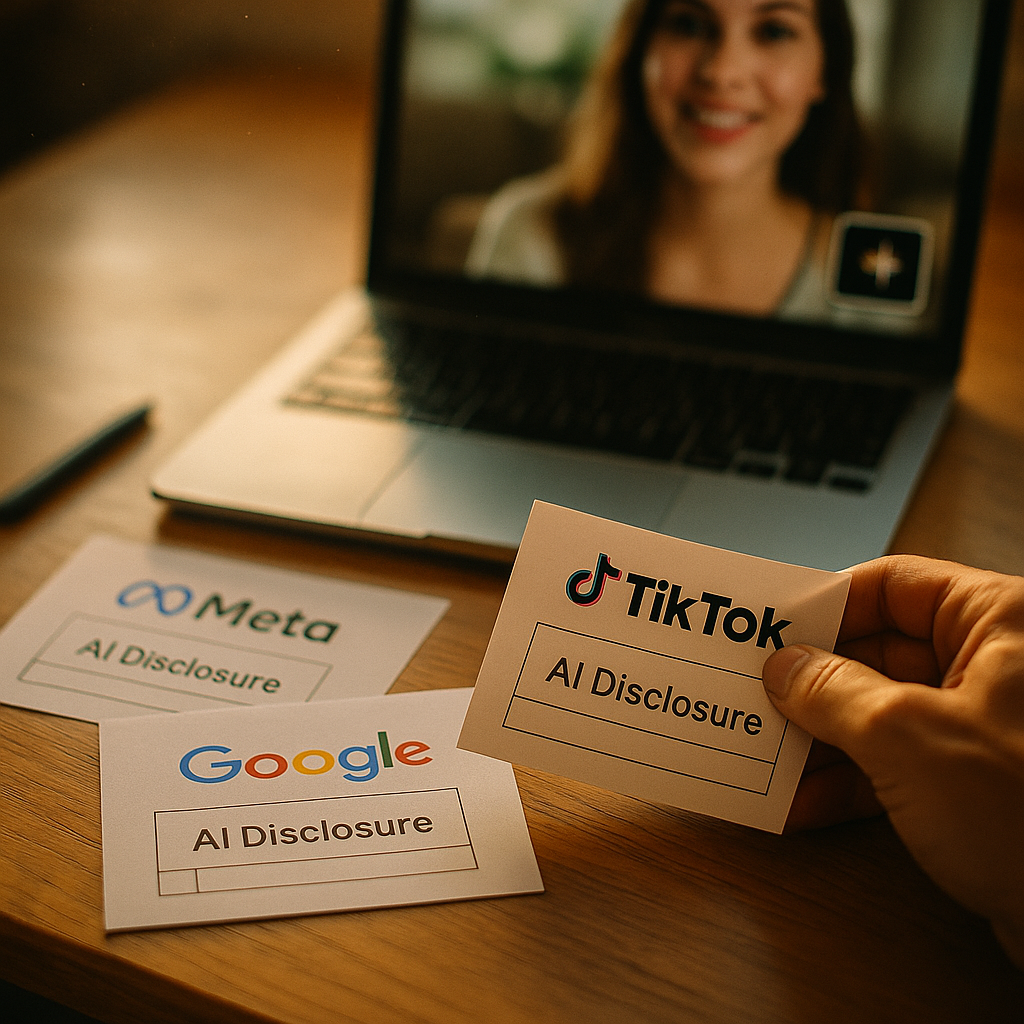
Three platforms, three different definitions of “AI-generated,” and one very expensive gap in between. Google now requires disclosure for “digitally altered or generated” political and synthetic content, Meta flags anything touching a face or voice, and TikTok’s threshold sits somewhere in the middle. If your creative team is applying one AI ad disclosure requirements checklist across all three, you’re already out of compliance somewhere.
This isn’t a theoretical risk. Ad account suspensions tied to undisclosed synthetic media have jumped across all major platforms as enforcement teams get better tooling. The bigger problem for brands running multi-platform campaigns: what passes Google’s review can get flagged on Meta, and what Meta approves can trip TikTok’s newer synthetic media filters. Let’s break down where each platform actually stands.
Why This Suddenly Matters More Than It Did Last Year
AI-generated ad creative stopped being a novelty around eighteen months ago. Now it’s a default production method for a huge share of paid social. eMarketer estimates that AI-assisted ad creative now touches a majority of paid social spend among mid-market and enterprise advertisers. That volume forced platforms to move from vague “be honest” guidance to specific, enforceable disclosure mechanics.
The regulatory backdrop pushed this too. The FTC has been explicit that synthetic endorsers and AI-generated testimonials fall under existing endorsement guides, no new rulemaking required. Platforms don’t want to be the reason a brand gets an FTC inquiry, so they’ve built their own layers on top of federal rules. That’s why you’re now seeing three distinct compliance regimes instead of one shared standard.
The core compliance risk isn’t ignorance of AI disclosure rules — it’s assuming one platform’s disclosure satisfies another’s requirements. It rarely does.
Google’s Approach: Broad, Automated, and Political-Ad Heavy
Google’s disclosure framework leans hardest on two categories: election-related content and “realistic” synthetic media that could deceive a viewer. Per Google’s advertising policies, advertisers must clearly disclose when an ad contains digitally altered content depicting real or realistic-looking people or events, particularly in political contexts. The disclosure has to be “clear and conspicuous” — not buried in a description field.
Outside of politics, Google’s enforcement is more automated than human. Its AI-content detection systems scan for synthetic voice, synthetic faces, and manipulated video, then prompt advertisers to self-label during upload. Miss that prompt, and the ad can get rejected before it ever serves. This matters operationally: unlike Meta, Google doesn’t rely heavily on post-publication user reports to catch violations. It’s front-loaded into the ad review pipeline.
For brands running programmatic display alongside YouTube creator partnerships, this creates a two-speed compliance problem. Your programmatic AI-generated banner ads get caught by Google’s own scanners. Your YouTube creator content, especially anything using AI-remixed clips or synthetic voiceover, often slips through because it’s technically organic content wrapped in a paid partnership, not a direct ad buy. That gap is exactly where brands have been getting burned, and it’s a big reason legal teams are pushing for a sign-off gate before any AI-touched creative goes live, regardless of channel.
Meta’s Rules Are Stricter on Paper, Looser in Practice
Meta’s policy, laid out through Meta for Business, requires disclosure whenever AI or digital tools are used to alter a real person’s likeness, create a realistic-but-fake person, or fabricate events that didn’t happen. On paper, this is the broadest definition of the three platforms. It covers face swaps, voice cloning, and photorealistic generative backgrounds involving people.
In practice, enforcement is inconsistent. Meta relies on a mix of advertiser self-disclosure (checkboxes during ad creation) and reactive moderation triggered by user reports or competitor flags. A well-produced AI ad without an obvious “tell” can run for weeks before anyone notices. That’s not a compliance strategy, though — it’s a liability sitting on a timer. Meta has shown it will retroactively pull ads and, in repeat cases, restrict ad account spending limits.
Brands whitelisting creator content through Meta’s Partnership Ads tool face an added wrinkle. If a creator used AI tools to generate part of their content and the brand whitelists it without checking, the brand inherits the disclosure gap. This is the same blind spot covered in whitelisted creator ad audits — except now it’s AI-specific, not just influencer-relationship specific. If your creator agreements don’t address AI remix rights explicitly, you’re exposed on both the platform and the FTC side simultaneously, a risk mapped out in detail in this AI remix rights risk model.
Meta’s honor-system disclosure checkbox means most enforcement happens after the ad has already run, not before. Don’t mistake “it launched fine” for “it’s compliant.”
TikTok’s Middle Ground (And Where It’s Tightening)
TikTok’s TikTok for Business policy requires an “AI-generated content” label for ads and organic branded content that includes synthetic voices, realistic AI-generated people, or manipulated footage of real individuals. TikTok’s platform-native label (similar to the one used on organic Creative Center uploads) has become the default disclosure mechanism, and TikTok pushes creators and advertisers toward using it rather than writing custom disclosure text.
Where TikTok differs meaningfully from Google and Meta: its enforcement is tied closely to Spark Ads and creator whitelisting, given how much of TikTok’s ad revenue flows through creator-fronted content rather than traditional brand-produced ads. That means TikTok Shop livestreams, a huge and growing commerce channel, fall under the same disclosure scrutiny as static image ads. Brands running commerce-heavy TikTok programs should treat AI disclosure as part of the same due diligence covered in TikTok Shop livestream compliance audits, not a separate checklist bolted on afterward.
TikTok has also been more aggressive than Meta about geographic layering. A disclosure that satisfies TikTok’s US policy might not satisfy the EU’s Digital Services Act transparency requirements, which is the same cross-border trap flagged in coverage of DSA enforcement risk. If your creative runs in both markets, one label rarely covers both regulatory regimes.
Side-by-Side: What Actually Triggers Disclosure
Here’s the practical comparison brand teams need when briefing creative or media buying teams:
- Google: Triggers on political/civic content, realistic synthetic depictions of real people, and manipulated audio/video presented as authentic. Enforcement is largely automated and happens pre-publication.
- Meta: Triggers on any AI alteration of a real person’s likeness, fabricated realistic people, or fabricated events. Enforcement leans on self-disclosure checkboxes plus reactive, post-publication moderation.
- TikTok: Triggers on synthetic voice, AI-generated realistic people, and manipulated footage, with heavy emphasis on the native “AI-generated content” label across both ads and creator-fronted branded content.
Notice what’s missing from all three: a shared technical standard for what counts as “AI-generated.” No universal watermarking requirement, no shared metadata standard (C2PA adoption is inconsistent), no cross-platform label that travels with the asset. That means every repurposed piece of creative needs a fresh compliance check per platform, not a one-time review at production.
The Operational Fix: Build One Workflow, Not Three
Trying to manage three separate disclosure policies ad-hoc is how brands end up with inconsistent labeling and, eventually, an account-level enforcement action. The better approach is a single internal compliance layer that maps every AI-touched asset against all three platforms’ requirements before it ships, similar in structure to the GEO content compliance layer approach used for claims-based FTC risk.
Practically, that means:
- Tagging every asset at production with what AI tools touched it (voice clone, face generation, background synthesis, script generation only, etc.)
- Running that tag sheet against each platform’s disclosure trigger list before media buying, not after
- Requiring creators to disclose their own AI tool use contractually, closing the gap covered in AI-remixed content contract clauses
- Logging every disclosure decision so you have a paper trail if a platform or the FTC asks later, mirroring the practice detailed in FTC-compliant escalation logs
This isn’t just risk mitigation theater. Ad accounts with clean, consistent disclosure histories tend to get less algorithmic friction during ad review. Platforms are increasingly using disclosure compliance as a trust signal, not just a legal checkbox. That’s a real ROI angle, not just a defensive one, and it’s worth pointing out to finance stakeholders who see compliance spend as pure cost.
What Happens When You Get It Wrong
The penalties scale with severity and repetition. First-time, minor disclosure gaps usually get a warning and creative rejection. Repeated violations trigger ad account spending caps, and in the worst cases, permanent suspension of the ad account. Google and Meta have both shown willingness to suspend accounts entirely for coordinated undisclosed synthetic political content, which is the highest-scrutiny category across all three platforms.
There’s also downstream reputational risk that outlasts any platform penalty. A brand caught running undisclosed AI-generated testimonials doesn’t just face an FTC inquiry risk, similar to what’s documented in creative brief liability cases — it faces the PR cycle that comes with “brand caught using fake AI spokesperson” headlines. That story writes itself, and it spreads faster than any platform penalty ever will.
Next Step
Don’t wait for a platform rejection to find your gaps. Pull every AI-touched asset from the last quarter, run it against all three platforms’ disclosure triggers side by side, and fix the mismatches before your next campaign flight goes live.
Frequently Asked Questions
Do all three platforms require the same AI disclosure label?
No. TikTok pushes advertisers toward its native “AI-generated content” label, Meta relies on a self-disclosure checkbox during ad creation, and Google requires clear on-ad disclosure primarily for political and realistic synthetic content. There’s no shared technical standard across platforms.
Does AI disclosure only apply to political ads?
No, though political and election-related content faces the strictest scrutiny, especially on Google. Meta and TikTok both require disclosure for AI-altered depictions of real people and fabricated realistic content in standard commercial ads too.
What happens if a creator uses AI tools without telling the brand?
The brand still bears compliance risk, particularly for whitelisted or Partnership Ads content. This is why AI tool disclosure needs to be a contractual requirement, not an assumption, in creator agreements.
Can one disclosure satisfy requirements across multiple countries?
Rarely. A label that satisfies US platform policy may not meet EU Digital Services Act transparency standards or other regional rules, so cross-border campaigns need market-specific review.
Is watermarking or metadata tagging required by any platform?
Adoption is inconsistent. Some platforms use metadata standards like C2PA internally for detection, but there’s no universal requirement forcing advertisers to embed specific watermarks across all three platforms.
Frequently Asked Questions
Do all three platforms require the same AI disclosure label?
No. TikTok pushes advertisers toward its native “AI-generated content” label, Meta relies on a self-disclosure checkbox during ad creation, and Google requires clear on-ad disclosure primarily for political and realistic synthetic content. There’s no shared technical standard across platforms.
Does AI disclosure only apply to political ads?
No, though political and election-related content faces the strictest scrutiny, especially on Google. Meta and TikTok both require disclosure for AI-altered depictions of real people and fabricated realistic content in standard commercial ads too.
What happens if a creator uses AI tools without telling the brand?
The brand still bears compliance risk, particularly for whitelisted or Partnership Ads content. This is why AI tool disclosure needs to be a contractual requirement, not an assumption, in creator agreements.
Can one disclosure satisfy requirements across multiple countries?
Rarely. A label that satisfies US platform policy may not meet EU Digital Services Act transparency standards or other regional rules, so cross-border campaigns need market-specific review.
Is watermarking or metadata tagging required by any platform?
Adoption is inconsistent. Some platforms use metadata standards like C2PA internally for detection, but there’s no universal requirement forcing advertisers to embed specific watermarks across all three platforms.
Top Influencer Marketing Agencies
The leading agencies shaping influencer marketing in 2026
Agencies ranked by campaign performance, client diversity, platform expertise, proven ROI, industry recognition, and client satisfaction. Assessed through verified case studies, reviews, and industry consultations.
Moburst

-
2

The Shelf
Boutique Beauty & Lifestyle Influencer AgencyA data-driven boutique agency specializing exclusively in beauty, wellness, and lifestyle influencer campaigns on Instagram and TikTok. Best for brands already focused on the beauty/personal care space that need curated, aesthetic-driven content.Clients: Pepsi, The Honest Company, Hims, Elf Cosmetics, Pure LeafVisit The Shelf → -
3

Audiencly
Niche Gaming & Esports Influencer AgencyA specialized agency focused exclusively on gaming and esports creators on YouTube, Twitch, and TikTok. Ideal if your campaign is 100% gaming-focused — from game launches to hardware and esports events.Clients: Epic Games, NordVPN, Ubisoft, Wargaming, Tencent GamesVisit Audiencly → -
4

Viral Nation
Global Influencer Marketing & Talent AgencyA dual talent management and marketing agency with proprietary brand safety tools and a global creator network spanning nano-influencers to celebrities across all major platforms.Clients: Meta, Activision Blizzard, Energizer, Aston Martin, WalmartVisit Viral Nation → -
5

The Influencer Marketing Factory
TikTok, Instagram & YouTube CampaignsA full-service agency with strong TikTok expertise, offering end-to-end campaign management from influencer discovery through performance reporting with a focus on platform-native content.Clients: Google, Snapchat, Universal Music, Bumble, YelpVisit TIMF → -
6

NeoReach
Enterprise Analytics & Influencer CampaignsAn enterprise-focused agency combining managed campaigns with a powerful self-service data platform for influencer search, audience analytics, and attribution modeling.Clients: Amazon, Airbnb, Netflix, Honda, The New York TimesVisit NeoReach → -
7

Ubiquitous
Creator-First Marketing PlatformA tech-driven platform combining self-service tools with managed campaign options, emphasizing speed and scalability for brands managing multiple influencer relationships.Clients: Lyft, Disney, Target, American Eagle, NetflixVisit Ubiquitous → -
8

Obviously
Scalable Enterprise Influencer CampaignsA tech-enabled agency built for high-volume campaigns, coordinating hundreds of creators simultaneously with end-to-end logistics, content rights management, and product seeding.Clients: Google, Ulta Beauty, Converse, AmazonVisit Obviously →