


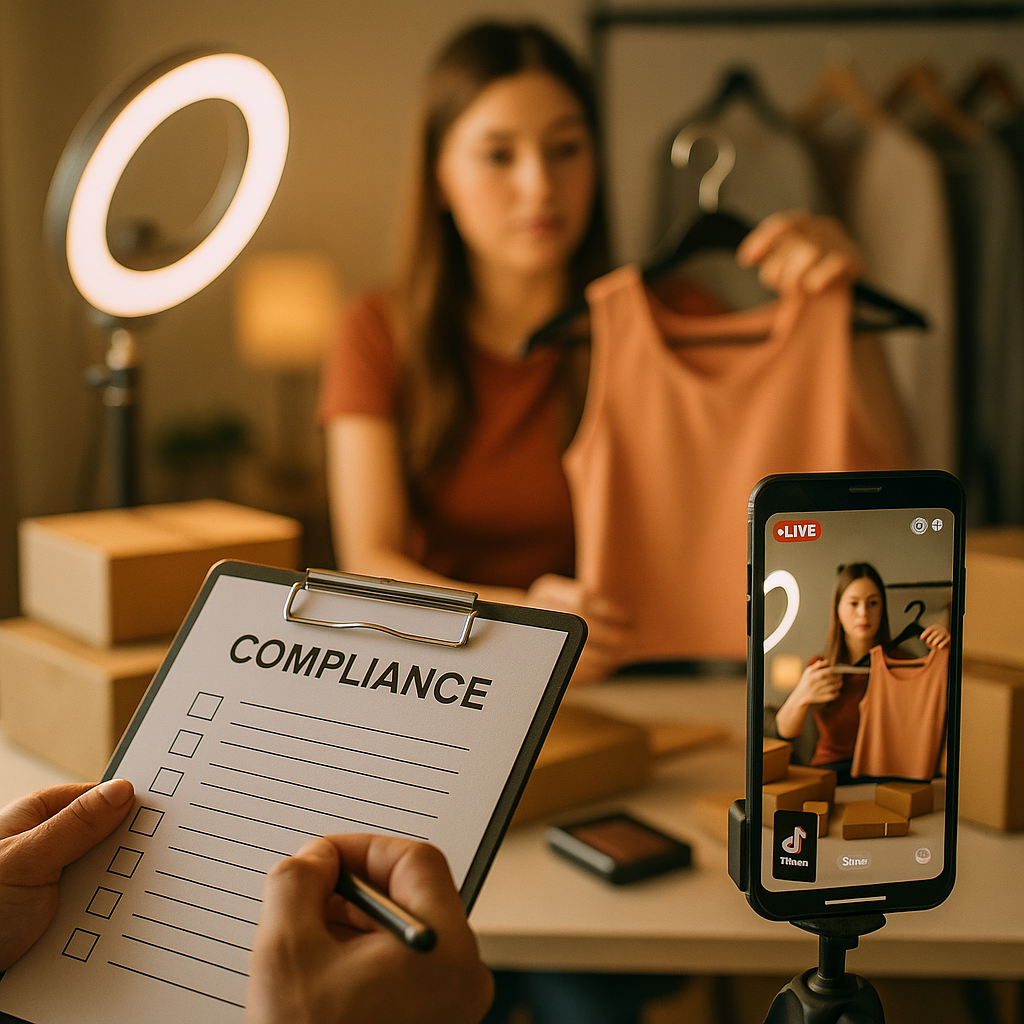
A brand can rack up six figures in GMV during a single 90-minute TikTok Shop livestream — and violate FTC endorsement guidance a dozen times before the confetti animation even plays. That’s the uncomfortable math behind livestream commerce compliance: the format that drives the fastest conversion in social commerce also strips out the safety nets brands rely on for pre-recorded content. No editing pass. No legal review window. No caption field sitting quietly above the fold.
If your influencer program has moved budget into live shopping events, this is your audit checklist. Not a theoretical one — a practical walk-through of where brand-directed livestreams actually break FTC rules, and how to fix it before your legal team finds out from a regulator instead of you.
Why Live Shopping Events Are a Different Risk Category
Standard influencer content gets reviewed. A brand approves a script, checks the caption, maybe runs it through a compliance layer before it goes live. Livestream commerce inverts that sequence entirely. The content is the review. There’s no “before it goes live” — it’s already live, host improvising, chat scrolling, product cards popping up in real time.
The FTC’s Endorsement Guides don’t carve out an exception for real-time formats. A material connection still has to be “clearly and conspicuously” disclosed, regardless of whether the endorsement happens in a static post or a 45-minute unscripted sales pitch. The agency has been explicit that disclosure obligations apply to livestreaming, gaming, and any format where a creator talks about a product they’re paid to promote.
The FTC doesn’t grade on a curve for spontaneity. “It was live and things move fast” is not a defense — it’s an admission you didn’t build a compliance process for the format you’re using.
Brands that treat livestream commerce like an extension of their existing UGC program are the ones getting burned. It needs its own audit framework, because the failure points are different.
Where Brand-Directed Livestreams Actually Break Disclosure Rules
Run your next event against these five failure points. Most brands fail at least two.
- Disclosure appears once, at the start, then disappears. A host says “this is sponsored” in minute one, then spends the next 89 minutes never mentioning it again. Viewers who join mid-stream — which is most of them, given how TikTok’s algorithm pushes live content to new viewers continuously — never see it. The FTC’s guidance on clear and conspicuous disclosure implies repetition for exactly this reason.
- On-screen text disclosure is buried under UI elements. TikTok Shop overlays product cards, comment feeds, and gift animations on top of the stream. A small disclosure banner in the corner gets covered within seconds of a viewer joining.
- Multi-host events lose accountability. Brand hosts a shared stream with three or four creators. Each assumes someone else is handling disclosure. Nobody actually says it consistently, and the brand — as the party directing the event — carries the liability regardless of who forgot.
- Real-time claims go unchecked. A host live-improvising product benefits (“this cleared my skin in three days”) makes an unsubstantiated claim that no one catches until the VOD is already up and monetizing.
- The archived replay keeps selling without ongoing disclosure. TikTok Shop lets brands push replays into product pages and For You feeds long after the live event ends. If the original disclosure was verbal and buried mid-stream, the replay inherits that failure and keeps distributing it.
Each of these maps to the same underlying issue: brands are applying static-content compliance thinking to a dynamic, unscripted, algorithmically amplified format.
The Five-Question Framework, Applied to Live Commerce
We’ve written before about the five-question test for brand-directed FTC liability, and it holds up well when adapted to livestream events. The core question is always: who directed this, and how much control did the brand exert?
For livestream commerce specifically, brand direction usually includes: providing the product, setting a discount code or affiliate structure, scripting talking points, choosing the platform event slot, and promoting the stream through paid media. That’s a lot of control — enough that regulators would almost certainly view the brand as directing the endorsement, not merely sponsoring an independent creator’s spontaneous content.
More control means more liability. A brand that hands a host bullet points and a discount code, then walks away during the live event, still owns the disclosure failure that happens on camera.
Pre-Event: Build Disclosure Into the Format, Not the Script
Scripts don’t survive contact with live chat. Hosts go off-book to answer questions, react to gifts, or address objections in real time. So don’t rely on a scripted disclosure line — build disclosure into the stream’s persistent visual layer instead.
Practical steps:
- Require a persistent on-screen disclosure overlay (“Paid Partnership” or “#ad”) that stays visible for the full stream duration, positioned where TikTok Shop’s UI won’t cover it.
- Brief hosts to restate the sponsorship verbally at fixed intervals — every 10-15 minutes, and again whenever viewer count spikes noticeably.
- Pre-approve a claims list for the specific products being sold, with hard “do not say” language flagged (health claims, efficacy percentages, comparative claims against competitors).
- Confirm TikTok’s own branded content tools are toggled on for the event, not just used as a substitute for verbal disclosure.
During the Event: Someone Has to Be Watching Live
This is the step most brands skip, and it’s the one that actually catches problems before they compound. Assign a live compliance monitor — not the social media manager posting engagement bait in the comments, a separate person watching specifically for disclosure lapses and claim violations.
If a host makes an unsubstantiated claim, the monitor needs the authority to flag it immediately, either through a producer earpiece or a direct message, so the host can walk it back on camera before thousands more viewers see it unchallenged. Waiting for the VOD review is too late; by then the clip’s already been screen-recorded and reposted without the caveat.
Post-Event: The Replay Is a New Compliance Event
Treat the archived replay as its own asset requiring its own review, not an automatic extension of the live approval. Add persistent text-overlay disclosure to the VOD if the live version relied heavily on verbal cues. Scrub the replay for claims that need substantiation documentation, and log any corrections made during the live event so there’s a paper trail showing the brand caught and addressed the issue.
That paper trail matters more than most brands realize. It’s the same logic behind FTC-compliant escalation logs — regulators and self-regulatory bodies like NAD respond very differently to brands that can show active monitoring versus brands caught flat-footed with no record at all.
Affiliate Codes and Commission Structures Complicate Things Further
TikTok Shop’s affiliate infrastructure means hosts are frequently earning commission on every sale during the event, on top of any flat fee. That’s a second material connection that needs its own disclosure, separate from “this is a paid partnership.” Viewers should understand the host earns money specifically from purchases made through the live link, not just that the brand paid for the appearance.
Most livestream hosts don’t disclose the commission structure at all. They’ll say “use my code” a dozen times without ever framing it as a financial incentive tied to volume. That’s a distinct disclosure gap from the sponsorship disclosure, and auditors should check for both separately.
Two material connections exist in most affiliate livestreams — the sponsorship and the commission — and brands routinely disclose only one of them, if that.
This also intersects with identity verification. Bot-driven engagement and fake account participation in live shopping events distort both the sales numbers and the perceived social proof driving purchase decisions. If you haven’t already, run your event traffic against a framework like the TikTok Shop real IP verification checklist to confirm the audience — and the urgency it creates — is actually real.
Building This Into Your Standing Compliance Program
A one-off audit is useful, but livestream commerce should get a permanent slot in whatever compliance layer your brand already runs for creator content. If you’ve built out a compliance layer to cut FTC risk, extend it to cover live formats explicitly, since most existing frameworks were designed around static posts and pre-recorded video.
That extension should include:
- A pre-event checklist signed off by legal or compliance, not just the brand marketing lead.
- A designated live monitor role, staffed for every brand-directed livestream regardless of scale.
- A standard disclosure overlay template that meets platform placement requirements and doesn’t get obscured by TikTok Shop’s native UI.
- A post-event audit log documenting claims made, corrections issued, and replay edits, mirroring the escalation-log approach used elsewhere in your program.
- Contract language with hosts specifying disclosure obligations for both sponsorship and affiliate commission, with remedies if they’re skipped on camera.
Industry data backs up why this matters operationally, not just legally. eMarketer and Statista have both tracked accelerating growth in U.S. live shopping spend, and TikTok Shop is a major driver of that curve. Regulatory scrutiny tends to follow ad spend growth with a lag — the FTC doesn’t need to police a channel until it’s big enough to generate consumer complaints. Live commerce just crossed that threshold.
The Next Step
Don’t wait for a complaint to test whether your livestream program holds up. Run one upcoming TikTok Shop event through this audit end-to-end — pre-event checklist, live monitor, post-event log — and use the gaps you find to rewrite your host contracts before the next sales event, not after one goes sideways in front of an audience of thousands.
FAQs
Does FTC endorsement guidance actually apply to live, unscripted content?
Yes. The FTC has been clear that disclosure obligations apply regardless of format, including livestreams. Spontaneity or lack of a script doesn’t remove the requirement for clear and conspicuous disclosure of material connections.
Who is liable if a host forgets to disclose during a brand-directed livestream?
The brand typically carries significant liability when it directs the event — provides the product, sets commission terms, or scripts talking points — even if the host is the one who forgot to disclose on camera.
Does a disclosure at the start of the stream cover the entire event?
Generally, no. Viewers join a livestream continuously, and a disclosure shown only in the first minute won’t reach viewers who join later. Repeated verbal disclosure plus a persistent on-screen overlay is the safer approach.
Do affiliate commissions need separate disclosure from sponsorship?
Yes. A host paid a flat fee and also earning commission on sales has two material connections. Both should be disclosed, since viewers need to understand the financial incentive tied to purchases specifically.
What happens to disclosure requirements once the livestream ends and becomes a replay?
The replay should be treated as its own compliance asset. If disclosure during the live event relied mostly on verbal cues, add persistent text overlay to the archived version before it continues driving sales.
FAQs
Does FTC endorsement guidance actually apply to live, unscripted content?
Yes. The FTC has been clear that disclosure obligations apply regardless of format, including livestreams. Spontaneity or lack of a script doesn’t remove the requirement for clear and conspicuous disclosure of material connections.
Who is liable if a host forgets to disclose during a brand-directed livestream?
The brand typically carries significant liability when it directs the event — provides the product, sets commission terms, or scripts talking points — even if the host is the one who forgot to disclose on camera.
Does a disclosure at the start of the stream cover the entire event?
Generally, no. Viewers join a livestream continuously, and a disclosure shown only in the first minute won’t reach viewers who join later. Repeated verbal disclosure plus a persistent on-screen overlay is the safer approach.
Do affiliate commissions need separate disclosure from sponsorship?
Yes. A host paid a flat fee and also earning commission on sales has two material connections. Both should be disclosed, since viewers need to understand the financial incentive tied to purchases specifically.
What happens to disclosure requirements once the livestream ends and becomes a replay?
The replay should be treated as its own compliance asset. If disclosure during the live event relied mostly on verbal cues, add persistent text overlay to the archived version before it continues driving sales.
Top Influencer Marketing Agencies
The leading agencies shaping influencer marketing in 2026
Agencies ranked by campaign performance, client diversity, platform expertise, proven ROI, industry recognition, and client satisfaction. Assessed through verified case studies, reviews, and industry consultations.
Moburst

-
2

The Shelf
Boutique Beauty & Lifestyle Influencer AgencyA data-driven boutique agency specializing exclusively in beauty, wellness, and lifestyle influencer campaigns on Instagram and TikTok. Best for brands already focused on the beauty/personal care space that need curated, aesthetic-driven content.Clients: Pepsi, The Honest Company, Hims, Elf Cosmetics, Pure LeafVisit The Shelf → -
3

Audiencly
Niche Gaming & Esports Influencer AgencyA specialized agency focused exclusively on gaming and esports creators on YouTube, Twitch, and TikTok. Ideal if your campaign is 100% gaming-focused — from game launches to hardware and esports events.Clients: Epic Games, NordVPN, Ubisoft, Wargaming, Tencent GamesVisit Audiencly → -
4

Viral Nation
Global Influencer Marketing & Talent AgencyA dual talent management and marketing agency with proprietary brand safety tools and a global creator network spanning nano-influencers to celebrities across all major platforms.Clients: Meta, Activision Blizzard, Energizer, Aston Martin, WalmartVisit Viral Nation → -
5

The Influencer Marketing Factory
TikTok, Instagram & YouTube CampaignsA full-service agency with strong TikTok expertise, offering end-to-end campaign management from influencer discovery through performance reporting with a focus on platform-native content.Clients: Google, Snapchat, Universal Music, Bumble, YelpVisit TIMF → -
6

NeoReach
Enterprise Analytics & Influencer CampaignsAn enterprise-focused agency combining managed campaigns with a powerful self-service data platform for influencer search, audience analytics, and attribution modeling.Clients: Amazon, Airbnb, Netflix, Honda, The New York TimesVisit NeoReach → -
7

Ubiquitous
Creator-First Marketing PlatformA tech-driven platform combining self-service tools with managed campaign options, emphasizing speed and scalability for brands managing multiple influencer relationships.Clients: Lyft, Disney, Target, American Eagle, NetflixVisit Ubiquitous → -
8

Obviously
Scalable Enterprise Influencer CampaignsA tech-enabled agency built for high-volume campaigns, coordinating hundreds of creators simultaneously with end-to-end logistics, content rights management, and product seeding.Clients: Google, Ulta Beauty, Converse, AmazonVisit Obviously →