


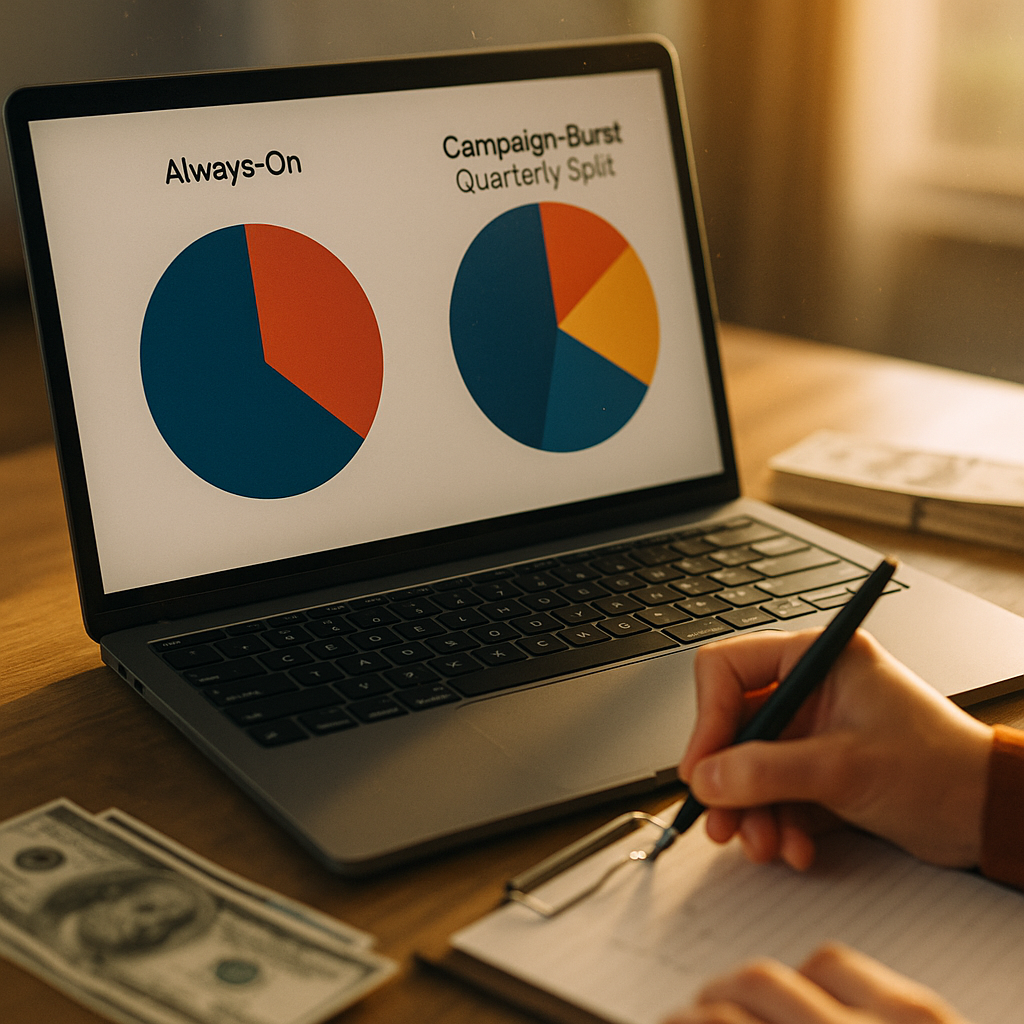
Organic reach on branded content has dropped for six straight quarters on most major platforms, and the always-on vs campaign-burst budget question is no longer academic. It’s the difference between a creator program that compounds and one that resets to zero every quarter. So which model wins when the algorithm keeps moving the goalposts?
Here’s the uncomfortable truth: most brands haven’t actually chosen. They’ve defaulted into campaign bursts because that’s how procurement cycles and agency retainers were built a decade ago. Structural reach decline just made the cost of that default visible.
Why This Decision Got Urgent
Organic reach isn’t dipping because of a bad quarter. It’s a structural shift. Meta, TikTok, and Instagram have all leaned harder into recommendation-driven feeds over follower-graph distribution, which means brand pages and even creator posts increasingly need paid amplification to hit meaningful audiences. eMarketer’s tracking of platform ad load and reach trends has shown this pattern accelerating, not stabilizing.
That changes the math on campaign bursts entirely. A burst campaign used to rely on a spike of organic sharing to extend its life past the paid flight. Now, without continuous paid support, that spike dies within 48 to 72 hours. You’re paying campaign-level costs for days-long visibility windows.
If your creator program still assumes organic carry-through after the paid flight ends, you’re budgeting for a platform reality that stopped existing two years ago.
Brands that haven’t updated their planning assumptions are essentially funding a media strategy built for 2019 distribution mechanics. That’s not a minor inefficiency. It’s a structural budget leak.
Always-On: What It Actually Buys You
Always-on creator programs aren’t just “more consistent.” They buy three things campaign bursts structurally can’t: algorithmic favor from posting cadence, compounding creator-audience trust, and data continuity for attribution modeling.
Platforms reward accounts that post consistently with better distribution curves — not because of some secret formula, but because recommendation engines optimize for predictable engagement signals. A creator or brand account posting three times a week for a full quarter trains the algorithm differently than one that posts twenty times in a two-week burst then goes dark.
There’s also a compounding trust effect. Audiences build parasocial familiarity with creators over repeated exposure, and that familiarity is what eventually converts to purchase intent. One-off campaign appearances rarely get past the awareness stage. This is part of why so many brands are actively shifting budget structures — see the quarter-by-quarter plan to shift creator budgets always-on for a tactical breakdown of how that transition typically unfolds.
The catch? Always-on requires organizational patience most finance teams don’t naturally have. It’s harder to point to a single “campaign result” and say the spend worked. That’s a measurement problem, not a strategy problem, but it kills a lot of always-on pitches in the boardroom anyway.
Where Campaign Bursts Still Win
Bursts aren’t dead. Product launches, live events, seasonal moments, culturally-timed activations — these still benefit from concentrated spend and creator saturation in a tight window. If Nike wants to own the conversation around a shoe drop, always-on cadence doesn’t help; a coordinated burst across fifteen creators in 72 hours does.
The mistake isn’t using bursts. It’s using bursts as the *only* mode, then wondering why brand equity resets every quarter.
The Quarterly Reallocation Framework
Rather than picking one model permanently, the more resilient approach treats always-on and campaign-burst as a ratio you actively manage every quarter, not a one-time strategic decision. Here’s the operating structure:
- Set a floor for always-on spend (typically 55-70% of total creator budget). This funds the baseline cadence — regular creator content, ongoing UGC-style partnerships, ambassador programs — that keeps algorithmic favor and audience trust compounding.
- Reserve 20-35% for planned bursts tied to a calendar of known moments. Product launches, major sales events, seasonal pushes. These get mapped a full quarter in advance, not decided reactively.
- Hold 10-15% as an unallocated reserve for reactive bursts. Cultural moments, viral trend windows, competitive responses. This is the money that lets you move fast when a TikTok trend suddenly aligns with your brand.
- Review the ratio every quarter against reach and conversion data, not vibes. If organic reach on always-on content dropped last quarter, that’s a signal to either increase paid amplification within the always-on line or shift a few points toward burst spend where saturation still works.
This isn’t a static split. It’s a rebalancing exercise, and it should be treated with the same rigor as a media mix model. Brands doing this well are running the same discipline they’d apply to shifting linear TV budget to CTV and creator spend: incremental moves, tested each cycle, not a single big-bang reallocation.
What Triggers a Mid-Quarter Adjustment?
Three signals should trigger an off-cycle review rather than waiting for the next quarterly planning meeting:
- Organic reach on always-on content drops more than 15% month-over-month with no corresponding algorithm update explanation.
- A burst campaign underperforms its historical benchmark by more than 20%, suggesting saturation fatigue in that channel.
- A competitor’s burst campaign captures disproportionate share of voice in your category, forcing a reactive response from reserve funds.
Building these triggers into the governance model matters more than the initial ratio itself. Static budgets without adjustment triggers are just campaign bursts with extra paperwork.
Measurement: The Part Everyone Skips
Always-on and burst spend need different KPIs, and conflating them is where most measurement frameworks fall apart. Burst campaigns should be judged on reach concentration, share of voice, and short-window conversion lift. Always-on programs need to be judged on trend lines: sentiment over time, repeat engagement rate, and creator-attributed conversion that accumulates across the quarter rather than spiking once.
Trying to fit both into a single dashboard with one set of KPIs is a recipe for killing the wrong budget line. A CFO looking only at “cost per engagement” will always favor bursts, because bursts produce louder short-term numbers. Always-on programs need a different story, one built on retention and compounding lift, not single-moment spikes. The creator spend measurement framework that proves sales lift to CFOs is a useful reference for building that case in finance-friendly language.
A dashboard that measures always-on programs by single-campaign ROI is measuring the wrong thing entirely — it’s judging a marathon by mile-one pace.
This is also where identity resolution and data hygiene start to matter more than most creator teams expect. If you can’t stitch together a creator’s audience overlap across a full quarter, you’re guessing at incrementality rather than proving it. Teams struggling here should look at data hygiene and identity resolution practices before trying to defend an always-on budget increase to the board.
Governance: Who Actually Owns the Ratio?
Reallocation frameworks fail more often from unclear ownership than from bad math. Someone needs explicit authority to move dollars between always-on and burst lines mid-quarter, and that authority needs documented thresholds, not verbal agreements in a Slack channel.
Most organizations that get this right have a governance charter that specifies who can trigger a reallocation, what data justifies it, and what the approval chain looks like above a certain dollar threshold. This mirrors the logic already established in creator program governance charters for other spend decisions, and it should sit alongside similar override thresholds used for AI-driven creator ad spend decisions, since many brands now use automated bidding tools to manage the burst-side amplification.
Without this, you get the worst version of both models: always-on budgets that never get touched even when reach data says they should, and burst budgets deployed reactively by whoever screams loudest in a Monday meeting.
A Realistic Example
Consider a mid-size DTC skincare brand running roughly $2M in annual creator spend. Under the old campaign-burst-only model, they ran four major quarterly bursts, each with a 10-15 creator cohort, heavy paid amplification, and a two-week visibility window. Organic reach on their brand account had fallen 40% year-over-year, per their own Sprout Social analytics, and each burst was starting from a colder baseline than the last.
Shifting to a 60/25/15 always-on/planned-burst/reserve split didn’t eliminate bursts. It changed their function. Bursts became amplifiers of an existing warm audience rather than the entire strategy. Six months in, engagement rate on baseline content rose because the algorithm had more consistent signal to work with, and the bursts converted better because they weren’t starting cold every time.
That’s the pattern worth internalizing: always-on isn’t the opposite of burst campaigns. It’s the infrastructure that makes bursts work again.
Budgeting for the Next Two Quarters
If you’re building this into next quarter’s planning cycle, start with an honest audit of current spend allocation, not a theoretical ideal split. Most brands are surprised to find they’re running 80-90% burst spend without ever deciding to. Use a creator audit framework to establish the real baseline before setting new ratios, then build the reallocation triggers into your next budget cycle rather than waiting for a full annual planning reset. Quarterly cadence, not annual, is what lets you actually respond to reach decline as it happens rather than six months after the fact.
The always-on vs campaign-burst debate isn’t really about picking a winner. It’s about building a budget structure flexible enough to survive a platform environment that keeps changing the rules on you. Set your quarterly floor, protect your reserve, and review the split with the same discipline you’d apply to any other line of media spend — not once a year, but every ninety days.
FAQs
What’s the ideal always-on to campaign-burst budget ratio?
There’s no universal number, but most brands managing structural reach decline land somewhere between 55/45 and 70/30 in favor of always-on spend, with a small reserve (10-15%) held back for reactive bursts. The right ratio depends on category volatility and how event-driven your product calendar is.
How often should brands reallocate between always-on and burst budgets?
Quarterly at minimum, with defined triggers for mid-quarter adjustments if reach or conversion data moves sharply outside historical norms. Annual budget cycles are too slow to respond to platform algorithm shifts that can happen within weeks.
Does always-on spend still need paid amplification?
Yes. Organic reach decline affects always-on content too, just more gradually. Most successful always-on programs pair consistent creator cadence with modest, continuous paid boosting rather than relying purely on organic distribution.
How do you measure always-on creator programs differently from bursts?
Always-on programs should be judged on trend lines across the quarter: sentiment shift, repeat engagement, and cumulative conversion lift. Bursts should be judged on reach concentration and short-window conversion. Using the same KPI for both misrepresents performance for one or the other.
Who should own the decision to shift budget between always-on and burst spend?
This should be defined in a governance charter with explicit thresholds for who can approve a reallocation and what data justifies it, rather than left to informal agreement during planning meetings.
FAQs
What’s the ideal always-on to campaign-burst budget ratio?
There’s no universal number, but most brands managing structural reach decline land somewhere between 55/45 and 70/30 in favor of always-on spend, with a small reserve (10-15%) held back for reactive bursts. The right ratio depends on category volatility and how event-driven your product calendar is.
How often should brands reallocate between always-on and burst budgets?
Quarterly at minimum, with defined triggers for mid-quarter adjustments if reach or conversion data moves sharply outside historical norms. Annual budget cycles are too slow to respond to platform algorithm shifts that can happen within weeks.
Does always-on spend still need paid amplification?
Yes. Organic reach decline affects always-on content too, just more gradually. Most successful always-on programs pair consistent creator cadence with modest, continuous paid boosting rather than relying purely on organic distribution.
How do you measure always-on creator programs differently from bursts?
Always-on programs should be judged on trend lines across the quarter: sentiment shift, repeat engagement, and cumulative conversion lift. Bursts should be judged on reach concentration and short-window conversion. Using the same KPI for both misrepresents performance for one or the other.
Who should own the decision to shift budget between always-on and burst spend?
This should be defined in a governance charter with explicit thresholds for who can approve a reallocation and what data justifies it, rather than left to informal agreement during planning meetings.
Top Influencer Marketing Agencies
The leading agencies shaping influencer marketing in 2026
Agencies ranked by campaign performance, client diversity, platform expertise, proven ROI, industry recognition, and client satisfaction. Assessed through verified case studies, reviews, and industry consultations.
Moburst

-
2

The Shelf
Boutique Beauty & Lifestyle Influencer AgencyA data-driven boutique agency specializing exclusively in beauty, wellness, and lifestyle influencer campaigns on Instagram and TikTok. Best for brands already focused on the beauty/personal care space that need curated, aesthetic-driven content.Clients: Pepsi, The Honest Company, Hims, Elf Cosmetics, Pure LeafVisit The Shelf → -
3

Audiencly
Niche Gaming & Esports Influencer AgencyA specialized agency focused exclusively on gaming and esports creators on YouTube, Twitch, and TikTok. Ideal if your campaign is 100% gaming-focused — from game launches to hardware and esports events.Clients: Epic Games, NordVPN, Ubisoft, Wargaming, Tencent GamesVisit Audiencly → -
4

Viral Nation
Global Influencer Marketing & Talent AgencyA dual talent management and marketing agency with proprietary brand safety tools and a global creator network spanning nano-influencers to celebrities across all major platforms.Clients: Meta, Activision Blizzard, Energizer, Aston Martin, WalmartVisit Viral Nation → -
5

The Influencer Marketing Factory
TikTok, Instagram & YouTube CampaignsA full-service agency with strong TikTok expertise, offering end-to-end campaign management from influencer discovery through performance reporting with a focus on platform-native content.Clients: Google, Snapchat, Universal Music, Bumble, YelpVisit TIMF → -
6

NeoReach
Enterprise Analytics & Influencer CampaignsAn enterprise-focused agency combining managed campaigns with a powerful self-service data platform for influencer search, audience analytics, and attribution modeling.Clients: Amazon, Airbnb, Netflix, Honda, The New York TimesVisit NeoReach → -
7

Ubiquitous
Creator-First Marketing PlatformA tech-driven platform combining self-service tools with managed campaign options, emphasizing speed and scalability for brands managing multiple influencer relationships.Clients: Lyft, Disney, Target, American Eagle, NetflixVisit Ubiquitous → -
8

Obviously
Scalable Enterprise Influencer CampaignsA tech-enabled agency built for high-volume campaigns, coordinating hundreds of creators simultaneously with end-to-end logistics, content rights management, and product seeding.Clients: Google, Ulta Beauty, Converse, AmazonVisit Obviously →