


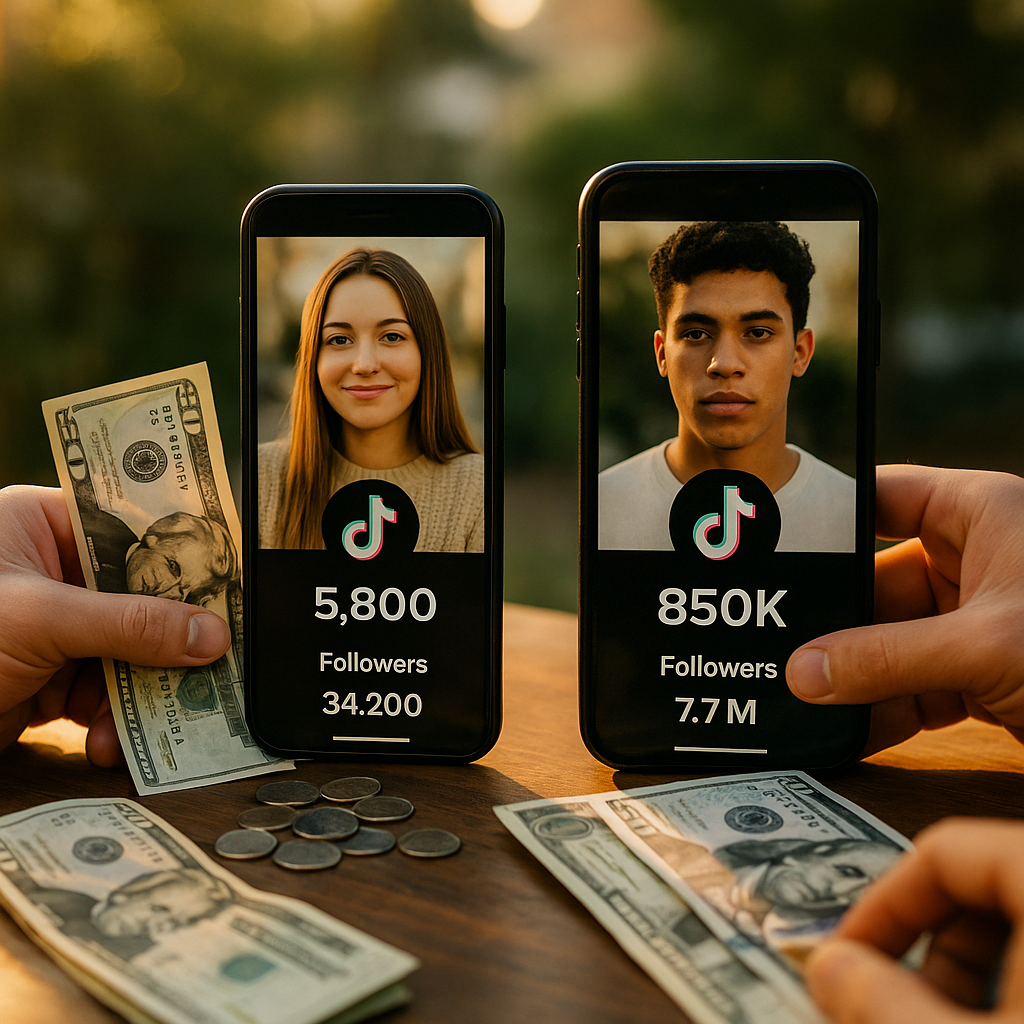
A creator with 8,000 followers is now out-earning one with 400,000 on a per-post basis. That’s not a typo, and it’s not an anomaly. The micro-creator middle class pricing reset is underway, and it’s rewriting the rate card every brand marketer thought they understood. If your media plan still assumes follower count equals negotiating power, you’re already overpaying for the wrong thing.
What’s Actually Happening to Creator Rates
For years, the pricing logic was simple: more followers, more money. Macro-influencers with six-figure audiences commanded premium rates because reach was scarce and expensive to manufacture any other way. That logic is breaking down fast, and TikTok’s distribution model is the primary reason why.
TikTok doesn’t distribute content based on follower count. It distributes based on relevance, watch time, and completion rate. A creator with 12,000 followers in a hyper-specific niche, say, ultralight backpacking gear or gluten-free meal prep for shift workers, can outperform a broad-lifestyle macro account with 500,000 followers because the algorithm rewards precision, not scale. That single mechanical fact has cascaded into a full pricing realignment across the creator economy.
Brands paying macro rates for broad reach are discovering that reach without algorithmic relevance is now the least efficient dollar in the media plan.
The result is a bifurcated market. Macro creators are seeing rate compression, some agencies report negotiated fees down 15-25% year over year for accounts above 250K followers, while niche micro-creators (typically 5K-50K followers with tight topical focus) are commanding fee increases that would have seemed absurd three years ago. This isn’t a temporary correction. It’s a structural shift tied directly to how TikTok’s recommendation engine, and increasingly Instagram Reels and YouTube Shorts, actually surfaces content.
The Long-Tail Amplification Mechanic, Explained Simply
Long-tail amplification means the platform will push a piece of content far beyond a creator’s own follower base if the content performs well with a narrow, high-intent audience segment. This is not new theory. It’s the same long-tail principle that reshaped e-commerce and media two decades ago, now applied to organic social distribution.
Here’s the practical implication for buyers: a micro-creator’s “real” audience isn’t their follower count. It’s the size of the interest graph TikTok can match them against. A creator focused on home espresso setups might have 9,000 followers, but if TikTok’s system identifies 4 million users with demonstrated interest in specialty coffee content, that creator’s effective reach ceiling is dramatically higher than their follower count suggests. Macro accounts, by contrast, often skew toward broad, diluted interest graphs that the algorithm can’t target as precisely, which caps their organic amplification per post relative to their audience size.
This is why brand teams evaluating creators purely on follower count are, frankly, using a metric that stopped predicting performance around the time TikTok’s For You Page became the dominant discovery surface. Publications covering this shift, including our own reporting on how follower counts are losing relevance to engagement and brand lift, have been flagging this for a while. The pricing market is just now catching up.
Why Macro Rates Are Compressing
Three forces are squeezing macro-creator pricing simultaneously.
- Diminishing organic amplification per follower. Macro accounts increasingly rely on paid boosting or whitelisting to hit the reach numbers they used to get organically, and brands are pricing that cost into negotiations.
- Brand safety fatigue. Larger creators carry more historical content, more scrutiny, and more risk exposure. Compliance teams have gotten sharper about auditing this, particularly post the wave of youth safety and platform accountability legislation. Our audit guide on closing the brand linkage gap covers how procurement teams are now vetting creator history far more rigorously than two years ago.
- Attribution pressure. Finance and performance-marketing stakeholders want to see revenue lift, not impressions. Macro creators, whose audiences are broader and less purchase-intent-driven, often underperform on last-touch attribution relative to their fee, which weakens their negotiating position at renewal.
None of this means macro creators are obsolete. Top-tier macro talent with genuine cultural cachet, think creators who function more like media brands than individuals, still command premium pricing because they’re buying something other platforms can’t replicate: mainstream cultural distribution and earned media pickup. But the “mid-tier macro” bracket, the 200K-800K follower range that used to be the default safe buy, is the segment absorbing most of the pricing pain.
The Niche Fee Inflation Nobody Priced In
Meanwhile, micro-creators with tightly defined verticals are raising rates 20-40% at renewal, and brands are paying it. Why? Because the ROI math actually supports it once you look past cost-per-post and toward cost-per-qualified-engagement.
Take a B2B SaaS brand targeting supply chain managers. A micro-creator with 6,000 followers who exclusively covers warehouse automation content delivers an audience with near-zero waste. Compare that to a general business-influencer macro account: the SaaS brand is paying a reach premium for an audience that’s 90% irrelevant to the buying committee. Procurement teams doing real math on cost-per-qualified-view are landing on the micro-creator every time, even at inflated per-post fees.
This dynamic mirrors what’s happening with mid-tier brand compression more broadly, squeezed from both directions, generalist scale and specialist precision are both winning while the undifferentiated middle loses ground. Creator pricing is simply following the same market logic that’s reshaping brand positioning.
How Brands Should Actually Respond
This isn’t a reason to panic. It’s a reason to rebuild your creator tiering model. A few practical shifts worth making this quarter:
- Stop tiering by follower count alone. Build tiers around audience specificity and platform amplification potential. A media buyer at a mid-size DTC brand told us they now weight “niche density score” (a proprietary blend of topical focus and engagement concentration) more heavily than raw reach in vendor selection.
- Budget for a barbell strategy. Allocate spend toward a small number of high-cultural-cachet macro anchors for brand awareness, and a much larger bench of niche micro-creators for consideration and conversion. The compressed middle tier gets the smallest allocation.
- Renegotiate macro contracts around performance guarantees. If a macro creator wants pre-compression rates, tie payment to view-through or engagement benchmarks rather than flat fees.
- Get ahead of niche fee inflation with multi-post retainers. Locking in micro-creators on 6-12 month retainers before their rates catch up to their performance is currently one of the better arbitrage opportunities in the market.
The brands winning this reset aren’t the ones spending less on creators. They’re the ones spending more precisely.
It’s also worth revisiting how you’re measuring success across this reshuffled tier structure. If your team is still reporting on reach and impressions as primary KPIs, you’re going to misread the ROI of this shift entirely. The industry’s broader move toward decision-grade measurement over vanity metrics is directly relevant here, because the whole case for paying niche creators more rests on metrics that go beyond follower count and impressions.
A Global Wrinkle Worth Watching
This pricing reset isn’t happening in isolation. Creator economy budgets are also shifting geographically, with more spend moving toward APAC and LATAM creator markets, where niche micro-creator ecosystems are earlier in their pricing maturity curve. Brands running global campaigns should expect the macro-compression, micro-inflation pattern to arrive in these markets on a delay, which creates a window for early movers to lock in favorable niche rates before local pricing catches up to U.S. and UK benchmarks.
Platforms themselves are aware of this dynamic. TikTok’s own advertising and creator marketplace resources increasingly emphasize audience relevance signals over raw follower metrics, a tacit acknowledgment that the platform’s distribution logic is what’s driving the pricing behavior brands are now navigating. Industry data from eMarketer and Statista on creator economy spend trends both point to the same bifurcation, macro budgets flattening while micro and nano segments grow disproportionately.
Visible FAQs
Why are micro-creators charging more than some macro-influencers now?
TikTok and similar platforms distribute content based on audience relevance and engagement depth, not follower count. Micro-creators with tightly focused niches often generate higher-intent engagement per post, so brands are willing to pay a premium for that precision, even when the raw follower number is small.
Is macro-influencer marketing becoming obsolete?
No, but the mid-tier macro segment (roughly 200K-800K followers) is under the most pricing pressure. Top-tier macro and celebrity-adjacent creators with genuine cultural cachet still command premium rates for broad brand awareness campaigns.
How should brands adjust creator budgets given this pricing shift?
Move away from follower-count-based tiering. Build a barbell allocation: a small number of high-cachet macro creators for awareness, plus a larger bench of niche micro-creators for consideration and conversion, with performance-based terms for the compressed middle tier.
What metrics matter more than follower count when evaluating creator fees?
Engagement concentration within a defined niche, audience-interest-graph size (not just follower count), cost-per-qualified-engagement, and view-through or conversion performance all matter more than raw reach for predicting ROI.
Will niche micro-creator fees keep rising?
Likely in the near term, as demand catches up to the performance data supporting these creators. Brands can mitigate this by locking in multi-post retainers now, before niche rates fully reprice to match their demonstrated ROI.
The pricing floor has already moved. Audit your creator roster this quarter using niche density and engagement concentration, not follower tiers, and renegotiate your mid-macro contracts before your next renewal cycle locks in yesterday’s rate logic.
Top Influencer Marketing Agencies
The leading agencies shaping influencer marketing in 2026
Agencies ranked by campaign performance, client diversity, platform expertise, proven ROI, industry recognition, and client satisfaction. Assessed through verified case studies, reviews, and industry consultations.
Moburst

-
2

The Shelf
Boutique Beauty & Lifestyle Influencer AgencyA data-driven boutique agency specializing exclusively in beauty, wellness, and lifestyle influencer campaigns on Instagram and TikTok. Best for brands already focused on the beauty/personal care space that need curated, aesthetic-driven content.Clients: Pepsi, The Honest Company, Hims, Elf Cosmetics, Pure LeafVisit The Shelf → -
3

Audiencly
Niche Gaming & Esports Influencer AgencyA specialized agency focused exclusively on gaming and esports creators on YouTube, Twitch, and TikTok. Ideal if your campaign is 100% gaming-focused — from game launches to hardware and esports events.Clients: Epic Games, NordVPN, Ubisoft, Wargaming, Tencent GamesVisit Audiencly → -
4

Viral Nation
Global Influencer Marketing & Talent AgencyA dual talent management and marketing agency with proprietary brand safety tools and a global creator network spanning nano-influencers to celebrities across all major platforms.Clients: Meta, Activision Blizzard, Energizer, Aston Martin, WalmartVisit Viral Nation → -
5

The Influencer Marketing Factory
TikTok, Instagram & YouTube CampaignsA full-service agency with strong TikTok expertise, offering end-to-end campaign management from influencer discovery through performance reporting with a focus on platform-native content.Clients: Google, Snapchat, Universal Music, Bumble, YelpVisit TIMF → -
6

NeoReach
Enterprise Analytics & Influencer CampaignsAn enterprise-focused agency combining managed campaigns with a powerful self-service data platform for influencer search, audience analytics, and attribution modeling.Clients: Amazon, Airbnb, Netflix, Honda, The New York TimesVisit NeoReach → -
7

Ubiquitous
Creator-First Marketing PlatformA tech-driven platform combining self-service tools with managed campaign options, emphasizing speed and scalability for brands managing multiple influencer relationships.Clients: Lyft, Disney, Target, American Eagle, NetflixVisit Ubiquitous → -
8

Obviously
Scalable Enterprise Influencer CampaignsA tech-enabled agency built for high-volume campaigns, coordinating hundreds of creators simultaneously with end-to-end logistics, content rights management, and product seeding.Clients: Google, Ulta Beauty, Converse, AmazonVisit Obviously →