


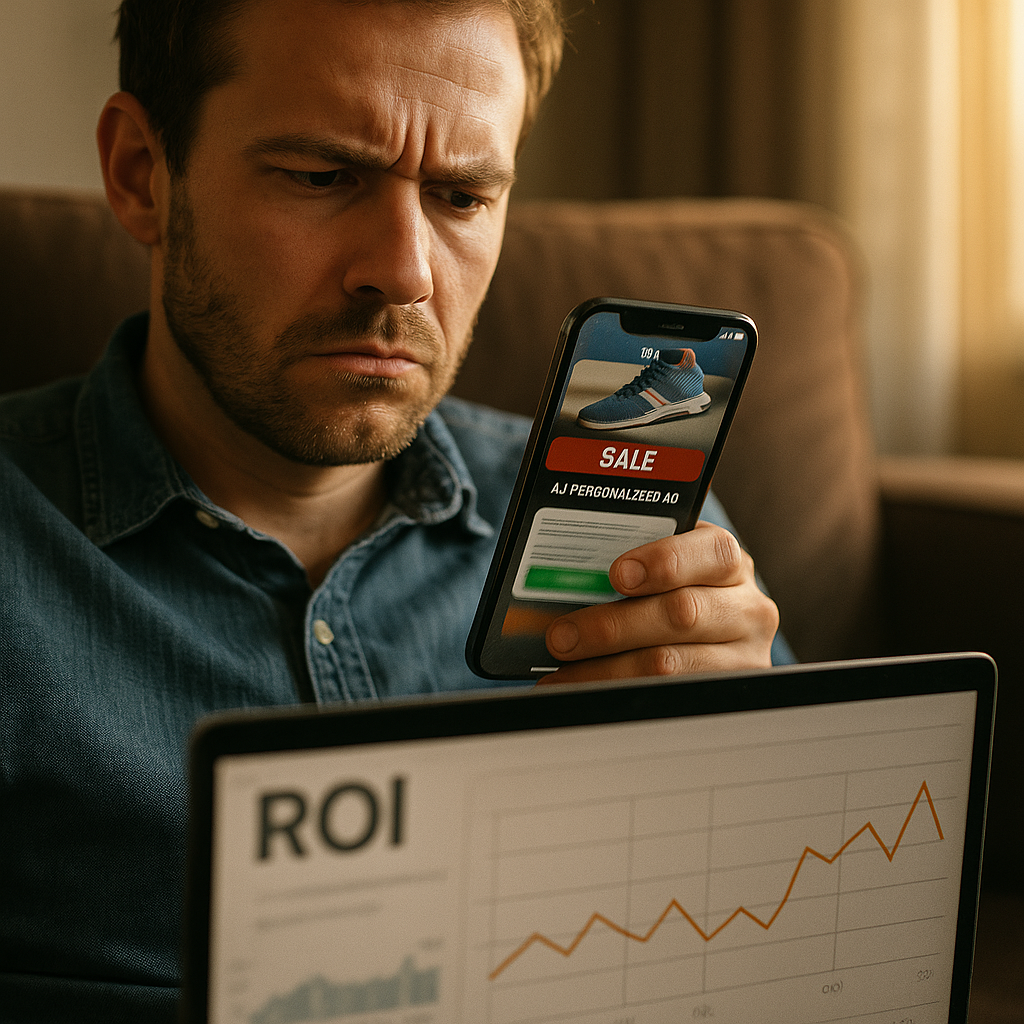
Marketers are pouring budget into AI-personalized ads at record speed. Consumers are pulling back trust just as fast. A recent Cisco survey found 76% of consumers are concerned about how brands use their data for AI targeting — yet spend on AI-driven personalization keeps climbing. That’s the trust gap in AI-personalized ads, and it’s quietly capping your ROI.
Here’s the uncomfortable truth: the more sophisticated your targeting gets, the more it can feel like surveillance to the person on the receiving end. CMOs who treat this as a PR footnote rather than a structural problem are going to watch conversion rates stagnate while media costs rise. This isn’t a hypothetical. It’s happening in your dashboards right now, buried under vanity metrics that don’t measure confidence.
The Demand-Confidence Divide, Defined
Demand for personalized experiences hasn’t disappeared. Consumers still say they want relevant offers, timely recommendations, ads that don’t waste their time. What’s collapsed is confidence in the mechanism delivering that relevance. People want the outcome of AI personalization without trusting the process behind it.
Think of it as two curves moving in opposite directions. One tracks expectation: consumers assume brands already know their browsing history, purchase patterns, even their mood based on scroll behavior. The other tracks trust: whether they believe that data is being used responsibly, transparently, and in their interest rather than purely the brand’s.
When expectation rises faster than trust, every personalized touchpoint reads as either impressively accurate or unsettlingly invasive — often within the same campaign.
This mirrors a pattern Influencers Time has tracked closely. Our earlier analysis of the AI trust paradox found that brand trust actually falls as AI usage increases, even when the AI performs well. Accuracy alone doesn’t buy goodwill. Transparency does.
Why This Isn’t a Consumer Perception Problem — It’s a Design Problem
Too many CMOs frame the trust gap as a communications issue. Add a privacy disclaimer, run a “how we use your data” explainer video, problem solved. It isn’t. The trust gap originates in how personalization systems are architected, not how they’re explained after the fact.
Three structural issues drive most of the erosion:
- Opaque data sourcing. Consumers can’t distinguish between first-party data they knowingly shared and third-party inference stitched together behind the scenes. When an ad feels “too accurate,” suspicion spikes even if the targeting was entirely first-party.
- Inconsistent creative signals. AI-generated or AI-optimized ad creative that looks slightly off — uncanny valley faces, generic stock-photo energy, oddly plastic product shots — triggers distrust even when the targeting logic behind it is sound. We covered this dynamic in depth after a viral beer ad backlash exposed just how fast AI imagery can tank brand credibility.
- No visible off-ramp. If a user can’t easily see, edit, or delete the profile driving their ad experience, the personalization feels done to them rather than for them.
Fix the architecture, and the perception follows. Fix only the perception, and you’re building on sand.
What the Data Actually Shows
Look past the headline trust stats and the pattern gets more specific. Research aggregated by Statista shows a majority of consumers across major markets say they’re more likely to distrust a brand that over-personalizes without clear consent mechanisms. Meanwhile, eMarketer data on ad spend shows AI-driven programmatic and personalization budgets continuing to grow, even as engagement quality metrics plateau or dip in some verticals.
That divergence is the whole story in one sentence: spend up, confidence down, engagement flat.
Our own reporting on the AI usage up, trust down dynamic found the same pattern extending into attribution. Marketers trust their AI models to tell them what worked, but can’t explain the “why” to consumers or, frankly, to their own CFOs. Attribution transparency and personalization transparency are two sides of the same coin. If you can’t explain your model internally, you definitely can’t explain it externally.
Ad Age’s move toward engagement and brand lift metrics over raw reach numbers — covered in our piece on how Ad Age is ditching follower counts — signals where the industry is heading: quality and trust signals over volume.
Where CMOs Are Getting It Wrong Right Now
A few patterns show up repeatedly in brand audits worth naming directly.
Personalization without permission architecture. Many brands run sophisticated lookalike modeling and dynamic creative optimization without a clear, visible consent layer. Legally compliant under most current frameworks? Often, yes. Trust-building? No. Compliance is the floor, not the ceiling.
Treating AI creative as a cost-cutting shortcut rather than a craft tool. When AI-generated ad variants get pushed to market without human review purely to hit volume targets, quality suffers and consumers notice. This ties directly into the content volume pressures we detailed in the volume crisis facing lean marketing teams. Speed without oversight is how trust erodes fastest.
No feedback loop for creative fatigue or backlash. If your team isn’t actively monitoring sentiment on AI-personalized campaigns in real time, you’re flying blind on the exact metric that predicts churn: confidence decay.
Spokesperson and testimonial ambiguity. As AI-generated avatars and synthetic spokespeople proliferate, audiences increasingly can’t tell what’s real. Our analysis of the spokesperson strategy rethink found that unclear disclosure around AI-assisted endorsements is now a top driver of brand skepticism, especially among younger, more media-literate audiences.
The Fix: A Practical Framework, Not a Slogan
Closing the demand-confidence divide requires operational changes, not another values statement on your website. Here’s what actually moves the needle.
1. Make data provenance visible, not just compliant
Don’t just meet FTC or ICO disclosure minimums. Build a simple, user-facing layer showing what data informed a given ad experience, and let users adjust it. Platforms like Meta and TikTok already offer ad preference controls; the brands that actively surface and promote these tools, rather than burying them, see measurably higher trust scores in post-campaign surveys.
2. Separate “AI-assisted” from “AI-generated” in every disclosure
These are not the same thing to consumers, and treating them as interchangeable in your disclosure language is a mistake. AI-assisted means a human directed, reviewed, and approved the output. AI-generated implies less human oversight. Say which one it is. Ambiguity here is exactly what fueled the backlash we tracked in our piece on AI-generated ad backlash becoming a permanent trust problem.
3. Rebuild your creative approval workflow around trust checkpoints
Most creative approval bottlenecks focus on brand safety and legal review. Add a trust review: does this ad feel like it was built for the viewer, or extracted from them? That single question, asked consistently, catches most of the creative missteps that trigger backlash. Our breakdown of fixing creative waste in approval workflows offers a useful starting template for teams retrofitting this into existing processes.
4. Shift budget toward creators and formats consumers already trust
Micro-creator content consistently outperforms polished, algorithmically optimized brand ads on trust metrics, precisely because it reads as human first. That’s part of why micro-creators now claim roughly half of influencer budgets at many brands. Pairing AI-driven targeting with human-first creative, rather than AI-driven targeting and AI-driven creative, is one of the fastest ways to narrow the confidence gap without sacrificing scale.
5. Report trust metrics to your board the way you report ROAS
If confidence and trust indicators only show up in a footnote of your quarterly marketing report, they’ll never get budget or attention. Track brand lift, sentiment shift, and opt-out rates on personalized campaigns with the same rigor you apply to CPA. What gets measured at the board level gets fixed at the operational level.
The brands closing the demand-confidence divide aren’t the ones with the most advanced AI. They’re the ones willing to show their work.
What This Means for Budget Allocation
None of this argues against AI personalization. It argues against deploying it without a trust infrastructure underneath it. As overall digital ad spend growth slows — a trend we unpacked in our channel planning analysis — every dollar needs to work harder. Trust isn’t a soft metric anymore. It’s a hard multiplier on everything else you’re already spending against.
CMOs who get ahead of this will spend less chasing incremental targeting precision and more building the transparency layer that makes precision welcome rather than creepy. That’s the actual arbitrage opportunity in 2026: not better algorithms, but better disclosure.
Next step: Audit your top five AI-personalized campaigns this quarter against three questions: Is the data source visible to the user? Is the creative clearly labeled AI-assisted or human-made? Is there a real off-ramp? Fix what fails, and you’ll close more of the confidence gap in one quarter than a year of targeting optimization ever could.
FAQs
What is the trust gap in AI-personalized ads?
It’s the widening distance between consumer demand for relevant, personalized advertising and their actual confidence in how brands collect and use the data behind it. Consumers want relevance but increasingly distrust the mechanisms delivering it.
Why does AI personalization reduce trust even when it improves targeting accuracy?
Accuracy without transparency reads as invasive rather than helpful. When consumers can’t see or control the data driving an ad, highly accurate targeting often feels like surveillance, which erodes trust regardless of performance metrics.
How can CMOs measure the trust gap internally?
Track opt-out rates, sentiment shifts, and brand lift alongside standard performance metrics like ROAS and CPA on every AI-personalized campaign. Treat trust indicators as board-level KPIs, not footnotes.
Does disclosing AI use in ads actually hurt performance?
Not when done well. Clear, specific disclosure (distinguishing AI-assisted from AI-generated content) tends to preserve or improve trust metrics. Vague or absent disclosure is what drives backlash, not disclosure itself.
What role do influencers and creators play in closing the trust gap?
Creator content, especially from micro-creators, tends to score higher on trust metrics than polished algorithmic ad creative because it reads as human-made. Pairing AI-driven targeting with creator-led, human-first content is an effective hybrid strategy.
Is this trust gap a regulatory risk as well as a brand risk?
Yes. Regulators including the FTC and UK’s ICO are increasing scrutiny of data use transparency and AI disclosure. Brands that build trust infrastructure proactively reduce both reputational and compliance risk simultaneously.
Top Influencer Marketing Agencies
The leading agencies shaping influencer marketing in 2026
Agencies ranked by campaign performance, client diversity, platform expertise, proven ROI, industry recognition, and client satisfaction. Assessed through verified case studies, reviews, and industry consultations.
Moburst

-
2

The Shelf
Boutique Beauty & Lifestyle Influencer AgencyA data-driven boutique agency specializing exclusively in beauty, wellness, and lifestyle influencer campaigns on Instagram and TikTok. Best for brands already focused on the beauty/personal care space that need curated, aesthetic-driven content.Clients: Pepsi, The Honest Company, Hims, Elf Cosmetics, Pure LeafVisit The Shelf → -
3

Audiencly
Niche Gaming & Esports Influencer AgencyA specialized agency focused exclusively on gaming and esports creators on YouTube, Twitch, and TikTok. Ideal if your campaign is 100% gaming-focused — from game launches to hardware and esports events.Clients: Epic Games, NordVPN, Ubisoft, Wargaming, Tencent GamesVisit Audiencly → -
4

Viral Nation
Global Influencer Marketing & Talent AgencyA dual talent management and marketing agency with proprietary brand safety tools and a global creator network spanning nano-influencers to celebrities across all major platforms.Clients: Meta, Activision Blizzard, Energizer, Aston Martin, WalmartVisit Viral Nation → -
5

The Influencer Marketing Factory
TikTok, Instagram & YouTube CampaignsA full-service agency with strong TikTok expertise, offering end-to-end campaign management from influencer discovery through performance reporting with a focus on platform-native content.Clients: Google, Snapchat, Universal Music, Bumble, YelpVisit TIMF → -
6

NeoReach
Enterprise Analytics & Influencer CampaignsAn enterprise-focused agency combining managed campaigns with a powerful self-service data platform for influencer search, audience analytics, and attribution modeling.Clients: Amazon, Airbnb, Netflix, Honda, The New York TimesVisit NeoReach → -
7

Ubiquitous
Creator-First Marketing PlatformA tech-driven platform combining self-service tools with managed campaign options, emphasizing speed and scalability for brands managing multiple influencer relationships.Clients: Lyft, Disney, Target, American Eagle, NetflixVisit Ubiquitous → -
8

Obviously
Scalable Enterprise Influencer CampaignsA tech-enabled agency built for high-volume campaigns, coordinating hundreds of creators simultaneously with end-to-end logistics, content rights management, and product seeding.Clients: Google, Ulta Beauty, Converse, AmazonVisit Obviously →