


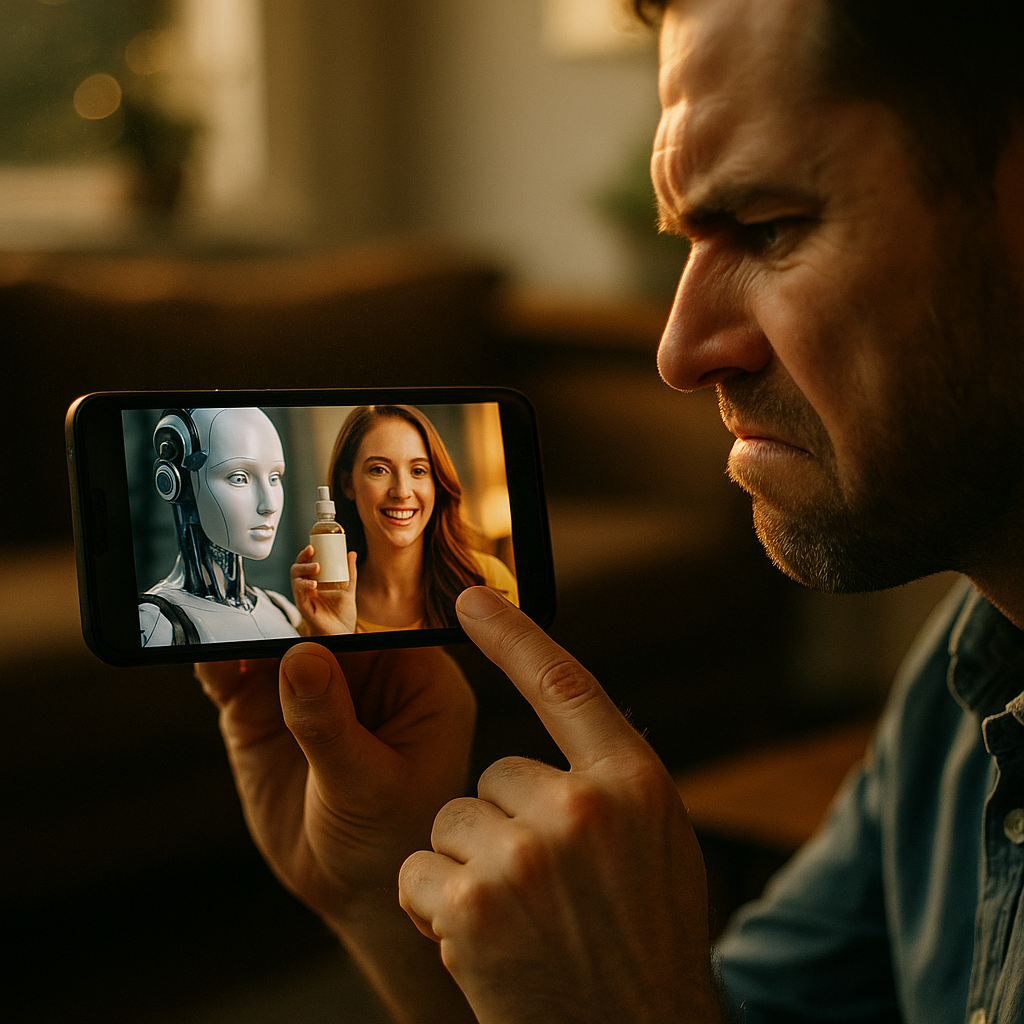
Sixty-one percent of consumers say they trust brands less after learning an ad used AI-generated imagery, according to recent survey data circulating among agency researchers. That’s not a fluke reaction to one bad campaign. Consumer backlash against AI-generated advertising is calcifying into something structural, and brands still treating it as a PR blip are going to get blindsided.
This isn’t about one clumsy beer commercial or a fashion brand’s uncanny-valley model. It’s a pattern. And patterns require different responses than crisis management does.
The Data Says This Isn’t a Phase
Marketers love to assume backlash fatigues itself out. Consumers get outraged, the news cycle moves on, everyone forgets. That playbook worked for plenty of controversies. It is not working here.
Sentiment tracking firms and social listening platforms are now reporting sustained, not spiking, negative sentiment around AI-generated ad content. The distinction matters. A spike suggests an event-driven reaction that fades. Sustained sentiment suggests a values shift, the kind that reshapes purchase behavior and brand perception over quarters, not days.
Look at what happened with the viral beer ad backlash. The initial controversy was predictable: consumers spotted AI-generated hands, uncanny facial symmetry, the telltale signs of synthetic imagery. What wasn’t predictable was how long the negative association stuck around in brand tracking studies. Weeks later, unaided brand recall surveys were still surfacing “fake” and “lazy” as top-of-mind associations for that campaign.
Consumers aren’t just reacting to bad AI ads anymore. They’re developing a standing suspicion toward all AI-adjacent brand content, even when it’s disclosed and well-executed.
That’s the structural piece. It’s not “this ad was bad.” It’s “I now scrutinize every ad for signs of AI,” which is a fundamentally different consumer posture and a much harder one to market around.
Why Trust, Not Aesthetics, Is the Real Casualty
Early coverage of AI-ad backlash focused on quality: weird hands, melted faces, dead-eyed models. Fixable problems, in theory. Better tools, better prompting, better human oversight in post. Solve the uncanny valley, solve the backlash. That was the assumption.
It turns out the aesthetic problem was a symptom, not the disease. Even technically flawless AI-generated ads are drawing skepticism once consumers learn AI was involved. Disclosure itself now functions as a trust signal, and it’s often a negative one. That’s a much harder problem than fixing rendering artifacts, because it means the backlash follows the label, not the flaws.
Our earlier reporting on the AI trust paradox facing CMOs flagged this shift before it fully crystallized: brands were adopting AI to cut production costs and speed timelines, while consumers were quietly building an internal detector for synthetic content. Those two curves were always going to intersect badly. We’re now in the intersection.
Consider the mechanics. Generative AI tools from OpenAI, Midjourney, and Adobe Firefly have made production dramatically cheaper. A brand can generate a full campaign’s worth of imagery in an afternoon for a fraction of a traditional shoot’s cost. The economics are irresistible for CFOs. But every dollar saved in production is now potentially a dollar lost in brand equity if consumers clock the shortcut.
What the Sentiment Data Actually Shows
Brands need more than a gut feeling here. A few data points worth building into your tracking dashboards:
- Disclosure penalty: Ads labeled as AI-generated or AI-assisted see measurably lower favorability scores than unlabeled equivalents in blind tests, even when creative quality is rated the same.
- Category sensitivity varies widely: Food, beverage, and personal care brands face steeper backlash than software or B2B tech, where AI use is more normalized and expected.
- Generational split is narrowing: Skepticism toward AI-generated ads was initially concentrated among older consumers. Recent data shows Gen Z closing that gap fast, largely because they’re the most sophisticated at spotting synthetic content in the first place.
- Trust recovery is slow: Brands that get caught in AI-ad controversy don’t bounce back to baseline sentiment quickly. Recovery timelines are running longer than typical ad-complaint cycles.
None of this means AI has no place in advertising production. It means the tolerance threshold is narrower than most brand teams assumed twelve months ago, and it’s still narrowing.
Where This Intersects With the Broader Trust Deficit
This backlash doesn’t exist in isolation. It’s landing on top of an already fragile trust environment for institutional marketing. Recent trust research has shown consumers increasingly favor peer voices and creators over corporate messaging precisely because corporate messaging feels manufactured. AI-generated imagery is, almost by definition, the most manufactured form of content a brand can produce. It’s compounding a trust problem that was already brand marketing’s biggest liability.
There’s a reason creator-led content keeps outperforming polished brand campaigns on trust metrics, even as follower counts get deprioritized in favor of engagement and brand lift measurement. Authenticity, or at least the perception of it, is the scarce resource now. AI-generated content, however polished, reads as the opposite of scarce authenticity. It reads as infinite, cheap, and interchangeable.
That’s a brand positioning problem as much as a production one. If your entire value proposition rests on feeling premium, handcrafted, or trustworthy, synthetic imagery actively undercuts your own pitch.
What “Structural” Means for Budget and Process
If this were temporary, the right move would be to wait it out. Structural backlash requires operational changes instead. Here’s what forward-looking brand and agency teams are actually doing about it.
Building AI-disclosure review into legal and compliance sign-off. Not just because regulators like the FTC are increasingly attentive to synthetic media disclosure, but because getting caught without disclosure is now a bigger reputational risk than the disclosure penalty itself. The UK’s ICO has also signaled closer scrutiny of AI-generated content practices affecting consumer data and imagery rights, which brands operating internationally can’t ignore.
Reserving AI generation for lower-stakes assets. Background elements, internal mockups, rapid concept testing. Save human-shot, human-performed content for hero campaigns and anything touching product efficacy claims, especially in food, beauty, and health categories where trust is the whole game.
Auditing creator partnerships for AI use too. This isn’t just a brand-owned-content issue. Sponsored creator content that uses AI-generated visuals or voice cloning without disclosure carries the same backlash risk, arguably worse, because it violates the implicit authenticity contract that makes creator marketing work in the first place. Brands should be asking creator partners directly about AI tool use in briefs and contracts, not assuming it’s not happening.
The brands treating AI-ad backlash as a production-quality issue are optimizing the wrong variable. The fix isn’t better AI. It’s better judgment about when AI has no business being there at all.
There’s also a measurement gap worth naming. Most brand tracking studies still don’t include an AI-content-awareness variable. If you’re not asking “did you notice or suspect AI involvement in this ad, and how did that affect your perception,” you’re missing a variable that’s actively moving your other brand health numbers. Add it to your next wave of tracking. It’s a small survey addition with outsized diagnostic value.
A Note on Category and Context Sensitivity
Not every AI use case triggers the same reaction, and brands shouldn’t overcorrect into blanket AI-avoidance. Data visualization, product configurators, personalized recommendation engines, none of that draws the same suspicion as AI-generated human likenesses or lifestyle imagery. The backlash is concentrated specifically around synthetic representations of people, faces, bodies, voices, because that’s where the authenticity stakes are highest and the deception potential feels most personal to consumers.
Tools and platforms tracked by research firms like eMarketer and Statista are starting to segment AI-ad sentiment by use case rather than treating “AI in advertising” as one monolithic category. Brands should do the same in their own tracking. A blanket AI policy is blunt. A use-case-specific policy, calibrated to where trust risk actually concentrates, is the smarter operational move.
The Takeaway
Treat AI-generated ad backlash as a permanent input into creative strategy, not a controversy to wait out. Add AI-awareness questions to your next brand tracking wave, set category-specific rules for where synthetic imagery is and isn’t acceptable, and require AI-disclosure transparency from creator partners the same way you’d require FTC-compliant sponsorship disclosure. The brands that build this into process now will avoid becoming next quarter’s cautionary case study.
FAQs
Is consumer backlash against AI-generated advertising really permanent, or will it fade?
Sentiment tracking shows sustained negative associations rather than short-term spikes, which suggests a values-based shift in how consumers evaluate brand content rather than a passing controversy cycle. Brands should plan for this as an ongoing constraint, not a temporary headwind.
Does disclosing AI use in ads make backlash worse?
Current data shows disclosed AI-generated ads score lower on favorability than unlabeled equivalents, even at matched creative quality. However, non-disclosure carries greater regulatory and reputational risk if discovered later, so disclosure remains the safer long-term strategy despite the short-term trust cost.
Which product categories face the highest risk from AI-ad backlash?
Food, beverage, personal care, and health-adjacent categories see the steepest sentiment penalties, largely because trust and authenticity are central to purchase decisions in those categories. Software and B2B tech brands face comparatively less backlash since AI use is more normalized in those spaces.
How should brands adjust their creator marketing to account for this trend?
Brands should require creator partners to disclose any AI-generated visuals, voice cloning, or synthetic elements used in sponsored content, and build this requirement into contracts and briefs. Undisclosed AI use in creator content risks the same trust erosion as brand-owned AI advertising, arguably with higher stakes given creator marketing’s reliance on perceived authenticity.
What metrics should brands add to track this risk?
Add an AI-content-awareness variable to brand tracking surveys, asking whether consumers noticed or suspected AI involvement and how it affected their perception. This single addition often explains movement in broader brand favorability and trust scores that would otherwise look unexplained.
Top Influencer Marketing Agencies
The leading agencies shaping influencer marketing in 2026
Agencies ranked by campaign performance, client diversity, platform expertise, proven ROI, industry recognition, and client satisfaction. Assessed through verified case studies, reviews, and industry consultations.
Moburst

-
2

The Shelf
Boutique Beauty & Lifestyle Influencer AgencyA data-driven boutique agency specializing exclusively in beauty, wellness, and lifestyle influencer campaigns on Instagram and TikTok. Best for brands already focused on the beauty/personal care space that need curated, aesthetic-driven content.Clients: Pepsi, The Honest Company, Hims, Elf Cosmetics, Pure LeafVisit The Shelf → -
3

Audiencly
Niche Gaming & Esports Influencer AgencyA specialized agency focused exclusively on gaming and esports creators on YouTube, Twitch, and TikTok. Ideal if your campaign is 100% gaming-focused — from game launches to hardware and esports events.Clients: Epic Games, NordVPN, Ubisoft, Wargaming, Tencent GamesVisit Audiencly → -
4

Viral Nation
Global Influencer Marketing & Talent AgencyA dual talent management and marketing agency with proprietary brand safety tools and a global creator network spanning nano-influencers to celebrities across all major platforms.Clients: Meta, Activision Blizzard, Energizer, Aston Martin, WalmartVisit Viral Nation → -
5

The Influencer Marketing Factory
TikTok, Instagram & YouTube CampaignsA full-service agency with strong TikTok expertise, offering end-to-end campaign management from influencer discovery through performance reporting with a focus on platform-native content.Clients: Google, Snapchat, Universal Music, Bumble, YelpVisit TIMF → -
6

NeoReach
Enterprise Analytics & Influencer CampaignsAn enterprise-focused agency combining managed campaigns with a powerful self-service data platform for influencer search, audience analytics, and attribution modeling.Clients: Amazon, Airbnb, Netflix, Honda, The New York TimesVisit NeoReach → -
7

Ubiquitous
Creator-First Marketing PlatformA tech-driven platform combining self-service tools with managed campaign options, emphasizing speed and scalability for brands managing multiple influencer relationships.Clients: Lyft, Disney, Target, American Eagle, NetflixVisit Ubiquitous → -
8

Obviously
Scalable Enterprise Influencer CampaignsA tech-enabled agency built for high-volume campaigns, coordinating hundreds of creators simultaneously with end-to-end logistics, content rights management, and product seeding.Clients: Google, Ulta Beauty, Converse, AmazonVisit Obviously →