


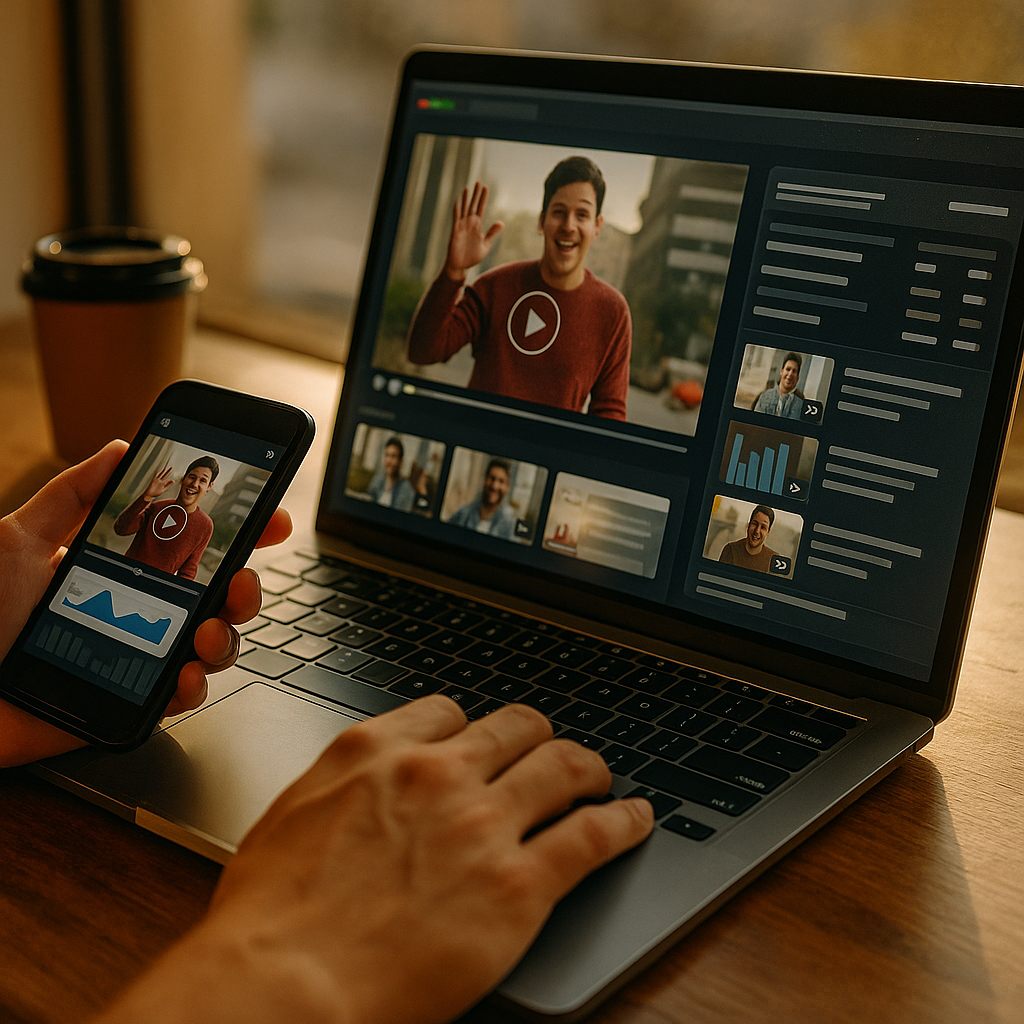
Forty percent. That’s the share of digital ad inventory industry forecasters expect generative video to occupy by year end. Not test units. Not experimental placements. Actual working inventory running against real budgets. If your production calendar still assumes quarterly shoots and six-figure agency retainers, you’re planning for a market that’s already gone.
The question isn’t whether generative video ads will scale. That’s settled. The question is how fast you can sequence your production budget away from traditional shoots without breaking creative quality, brand safety, or your finance team’s patience.
Why 40% Isn’t a Fluke Number
Platforms have quietly rebuilt their ad infrastructure around synthetic and AI-assisted video over the past two years. Meta’s Advantage+ creative tools, Google’s asset generation inside Performance Max, and TikTok’s Smart Creative suite all default toward generative variants now, not as an add-on but as the primary path. Meta’s advertising platform alone processes billions of ad variations weekly, and a growing share never touched a camera.
Add in the CTV and retail media expansion, both of which lean heavily on templated, generative formats to fill long-tail inventory cheaply, and the math adds up fast. Analysts at eMarketer have been tracking the shift in ad format mix for a few cycles now, and the trajectory has been consistently steeper than most brand-side planning documents account for.
This isn’t a niche shift confined to DTC startups either. Enterprise CPG brands, auto dealers, and financial services firms are all in the mix. We covered how a dealership-style production model is already reshaping how CPG teams think about creative output at scale — smaller batches, faster iteration, less dependency on any single hero shoot.
If generative video hits 40% of inventory by year end, brands still budgeting on an annual shoot calendar are effectively bidding for 60% of the available placements with production built for a different era.
What “Sequencing” Actually Means Here
Sequencing isn’t code for “cut your production budget.” It’s about reallocating spend across a timeline so traditional shoots handle what only they can do well — brand films, hero campaigns, anything requiring real human performance or complex physical production — while generative tools absorb the volume work: variant testing, localization, seasonal refreshes, and platform-specific cuts.
Here’s a rough sequencing framework that’s working for mid-market and enterprise teams right now:
- Phase one (immediate): Redirect the budget currently spent on shooting minor creative variants — different backgrounds, alternate CTAs, market-specific voiceovers — into generative production. This is the lowest-risk, highest-ROI move because the quality bar for these assets was never that high to begin with.
- Phase two (next quarter): Pilot generative video for top-of-funnel prospecting ads where format experimentation matters more than polish. Run these alongside traditional creative to build a real performance comparison, not a vendor demo.
- Phase three (mid-year): Reserve traditional shoots almost exclusively for flagship campaigns, brand safety-sensitive categories, and anything requiring talent likeness or regulated disclosures.
- Phase four (ongoing): Build a hybrid pipeline where raw footage from traditional shoots feeds generative tools for endless remixing, rather than treating the two as separate budgets entirely.
Notice what this framework doesn’t say: it doesn’t say kill the shoot budget. It says stop treating every creative need as shoot-worthy.
The Real Cost Comparison Nobody’s Running Correctly
Most finance teams still compare generative video costs against traditional production costs on a per-asset basis. That’s the wrong unit of comparison. A single traditional shoot might produce twenty finished assets over three months. A generative pipeline can produce two hundred variants in a week, tested and iterated in near real time.
The comparison that matters is cost-per-tested-variant, not cost-per-finished-asset. Once you run the math that way, generative video usually wins by a wide margin, especially for lower-funnel and retargeting creative where volume and freshness matter more than production value.
That said, don’t ignore the hidden costs: model licensing fees, rights clearance for training data, and the internal review cycles needed to catch hallucinated details (a product with the wrong logo, a hand with six fingers, a background sign in the wrong language). Teams that skip building a QA layer into their generative pipeline end up spending the savings on damage control later.
Where Brands Are Already Getting Burned
A few recurring failure patterns worth flagging before you scale spend:
- Treating generative output as “set and forget.” Models drift, training data updates, and outputs shift subtly over time. What passed brand review last quarter might not pass this quarter without a fresh check.
- No clear override authority. When a generative ad underperforms or triggers a compliance flag, who has the authority to pull it? Teams without a defined escalation path lose days to internal debate. This mirrors the governance gaps we’ve written about in human override thresholds for AI media buying — the same logic applies to creative production, not just spend decisions.
- Underestimating platform-specific format rules. What renders correctly on Meta may get flagged on TikTok or CTV inventory. Format selection isn’t cosmetic; it determines whether your creative even gets served. This is covered in more depth in how AI format recommendations decide ad placement.
Provenance and Disclosure Aren’t Optional Anymore
As generative video scales, so does regulatory and platform scrutiny. The FTC has made clear that synthetic media used in advertising falls under existing truth-in-advertising rules, and platforms are moving faster than regulators in some cases. TikTok’s rollout of C2PA content credentials is a good example — provenance metadata is becoming table stakes, not a nice-to-have. We broke down what that rollout requires from brand teams in TikTok’s C2PA rollout, and the operational lift is bigger than most legal teams expect.
If you’re sequencing budget toward generative production, build the disclosure and provenance tagging into the workflow from day one. Retrofitting compliance after scaling is far more expensive than building it in from the start.
Building the Internal Case for the Shift
Getting budget reallocated internally is often harder than the technical execution. Finance teams like predictable line items; a traditional shoot has a clear invoice trail. Generative production costs are more variable, tied to compute, licensing, and iteration cycles, which makes some CFOs nervous.
The pitch that tends to land: frame it as risk diversification, not cost-cutting. A single shoot is a single point of failure — bad weather, talent availability, one flubbed take, and the whole timeline slips. A generative pipeline spreads that risk across dozens of smaller, faster iterations. Bring performance data early. Even a small pilot showing lower cost-per-tested-variant and faster time-to-market builds a case that survives budget review season.
It also helps to connect this to the broader shift already happening in media buying itself. Agentic systems are increasingly making format and placement decisions in real time, and creative production needs to move at the same speed to keep up. That dynamic is well documented in the agentic advertising stack — production and buying are converging into a single, faster-moving loop.
The brands winning this transition aren’t the ones spending the most on generative tools. They’re the ones that redesigned their approval and QA workflows before scaling volume.
What This Means for Creative Teams, Not Just Budgets
There’s an understandable anxiety running through creative departments right now. Will generative tools replace directors, editors, and producers? Mostly, no — but the job is changing shape. Producers are becoming pipeline managers. Editors are becoming QA reviewers and prompt engineers. Directors are shifting toward fewer, higher-stakes flagship shoots rather than a constant churn of smaller projects.
Teams that resist this shift entirely tend to lose budget and headcount over time, not because generative video is objectively superior creatively, but because it’s operationally faster and cheaper for the 80% of ad inventory that doesn’t require a director’s eye. Save the human craft for where it actually moves the needle: brand campaigns, emotionally complex storytelling, anything where authenticity is the entire point.
A Practical Timeline for the Rest of the Year
If you haven’t started sequencing yet, here’s a compressed version that still works with a shortened runway:
- Audit your current production spend by asset type. Identify which categories are pure volume plays versus flagship creative.
- Move volume-tier budget into a generative pilot within the next 60 days. Don’t wait for a perfect vendor evaluation; start with a contained test.
- Build QA and disclosure checkpoints into the pipeline before scaling past pilot volume.
- Reserve traditional shoot budget for the top 10-15% of campaigns where human craft is non-negotiable.
- Reassess quarterly. This market is moving fast enough that annual planning cycles are already too slow.
Frequently Asked Questions
What percentage of digital ad inventory is expected to be generative video by year end?
Industry estimates put generative video at roughly 40% of total ad inventory by year end, driven largely by platform-native tools like Meta’s Advantage+, Google’s Performance Max asset generation, and TikTok’s Smart Creative suite.
Should brands stop traditional video shoots entirely?
No. Traditional shoots remain the right choice for flagship campaigns, brand storytelling, and anything requiring real talent performance or regulated disclosures. The shift is about reallocating volume-tier and variant production to generative tools, not eliminating traditional production.
How do brands measure ROI on generative video ads accurately?
Compare cost-per-tested-variant rather than cost-per-finished-asset. Generative pipelines produce far more iterations per dollar, so a per-asset comparison undervalues their real efficiency for testing and localization work.
What compliance risks come with scaling generative video ads?
Provenance disclosure, content authenticity labeling (such as C2PA credentials), and truth-in-advertising rules from bodies like the FTC all apply to synthetic media. Brands should build disclosure tagging into their production workflow rather than adding it after scaling.
How should creative teams adapt as generative video scales?
Roles shift rather than disappear. Producers move toward pipeline management, editors take on QA and prompt-engineering responsibilities, and directors focus on fewer, higher-stakes flagship productions instead of constant smaller shoots.
Start with a 60-day generative pilot funded entirely by your current variant-production budget, not new money. If cost-per-tested-variant beats your traditional benchmark by even 20%, you’ve got the internal case built for phase two.
Top Influencer Marketing Agencies
The leading agencies shaping influencer marketing in 2026
Agencies ranked by campaign performance, client diversity, platform expertise, proven ROI, industry recognition, and client satisfaction. Assessed through verified case studies, reviews, and industry consultations.
Moburst

-
2

The Shelf
Boutique Beauty & Lifestyle Influencer AgencyA data-driven boutique agency specializing exclusively in beauty, wellness, and lifestyle influencer campaigns on Instagram and TikTok. Best for brands already focused on the beauty/personal care space that need curated, aesthetic-driven content.Clients: Pepsi, The Honest Company, Hims, Elf Cosmetics, Pure LeafVisit The Shelf → -
3

Audiencly
Niche Gaming & Esports Influencer AgencyA specialized agency focused exclusively on gaming and esports creators on YouTube, Twitch, and TikTok. Ideal if your campaign is 100% gaming-focused — from game launches to hardware and esports events.Clients: Epic Games, NordVPN, Ubisoft, Wargaming, Tencent GamesVisit Audiencly → -
4

Viral Nation
Global Influencer Marketing & Talent AgencyA dual talent management and marketing agency with proprietary brand safety tools and a global creator network spanning nano-influencers to celebrities across all major platforms.Clients: Meta, Activision Blizzard, Energizer, Aston Martin, WalmartVisit Viral Nation → -
5

The Influencer Marketing Factory
TikTok, Instagram & YouTube CampaignsA full-service agency with strong TikTok expertise, offering end-to-end campaign management from influencer discovery through performance reporting with a focus on platform-native content.Clients: Google, Snapchat, Universal Music, Bumble, YelpVisit TIMF → -
6

NeoReach
Enterprise Analytics & Influencer CampaignsAn enterprise-focused agency combining managed campaigns with a powerful self-service data platform for influencer search, audience analytics, and attribution modeling.Clients: Amazon, Airbnb, Netflix, Honda, The New York TimesVisit NeoReach → -
7

Ubiquitous
Creator-First Marketing PlatformA tech-driven platform combining self-service tools with managed campaign options, emphasizing speed and scalability for brands managing multiple influencer relationships.Clients: Lyft, Disney, Target, American Eagle, NetflixVisit Ubiquitous → -
8

Obviously
Scalable Enterprise Influencer CampaignsA tech-enabled agency built for high-volume campaigns, coordinating hundreds of creators simultaneously with end-to-end logistics, content rights management, and product seeding.Clients: Google, Ulta Beauty, Converse, AmazonVisit Obviously →