


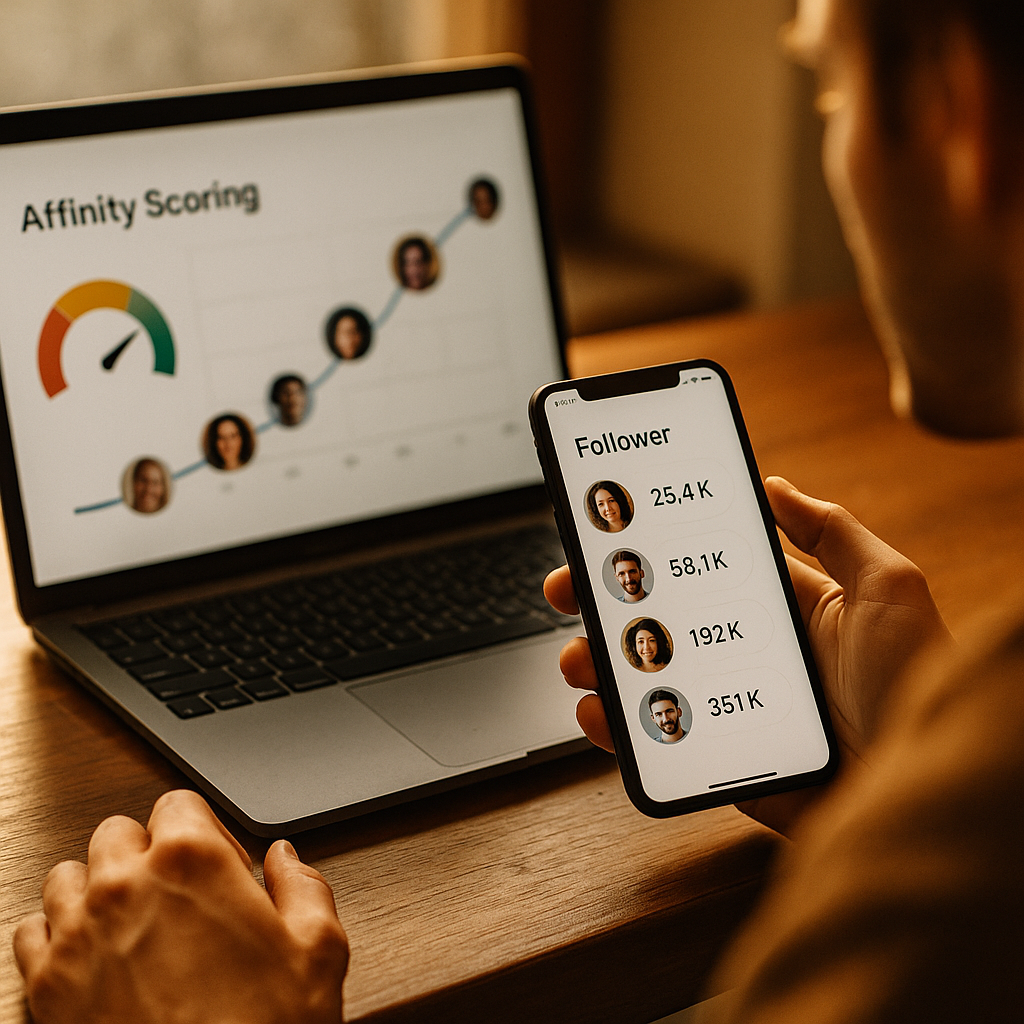
A creator with 40,000 followers and an 8% affinity match to your brand will outsell one with 400,000 followers and no contextual fit. Every time. Yet most procurement teams still shortlist AI-powered creator discovery platforms based on database size and follower filters — the exact metrics that no longer predict performance.
Follower count was always a proxy, never a signal. It told you reach, not relevance. Now that affinity-scoring algorithms can model audience overlap, content sentiment, and purchase intent at scale, the vendors clinging to follower-tier filters are selling you yesterday’s tool with a new dashboard skin.
Why Follower Filters Stopped Working
Follower count made sense when influencer marketing meant sponsored posts and reach-based media math. Brands bought impressions, and impressions scaled with audience size. That logic collapsed once platforms shifted to algorithmic distribution — a creator’s content now reaches people who never followed them, and a follower who hasn’t engaged in six months counts the same as one who buys every product they recommend.
Nano and micro-creators consistently post higher engagement rates than mega-influencers, according to data cited across multiple eMarketer influencer benchmarking reports. Brands that kept filtering by follower tiers were, in effect, screening out their best-performing partners before an agency even reached the outreach stage.
Follower count answers “how many people could see this?” Affinity scoring answers “how many of the right people will act on it?” Only one of those questions matters for ROI.
The deeper problem: follower filters are trivially gameable. Bot farms, engagement pods, and purchased followings have made raw audience size an unreliable signal for at least the past five years. Brand safety teams know this. Procurement teams evaluating discovery vendors, oddly, often don’t ask about it.
What Affinity Scoring Actually Measures
Affinity-scoring algorithms combine several data layers that follower counts never touched:
- Audience-brand overlap: the percentage of a creator’s followers who already engage with your category, competitors, or adjacent brands.
- Content-sentiment alignment: whether a creator’s historical tone, values, and visual style match your brand guidelines — not just whether they’ve posted about your product category before.
- Behavioral intent signals: comment-level purchase language, click-through patterns on past sponsored content, and save/share ratios that correlate with bottom-funnel action.
- Topical authority depth: how consistently a creator covers a niche versus posting one-off sponsored content that reads as an ad, not an endorsement.
Platforms like Upfluence, CreatorIQ, and Grin have all rebuilt their matching engines around some version of this stack in the past two years, layering machine learning models on top of historical campaign data instead of static audience demographics. The output isn’t a follower count. It’s a match score, usually 0-100, that predicts likely engagement or conversion lift for your specific brand.
That specificity matters. A creator can score high affinity for a skincare brand and low affinity for a fintech app, even with an identical audience. The algorithm is modeling context, not just demographics.
Vendor Selection: The Questions Follower Filters Never Made You Ask
If you’re running an RFP for a creator discovery platform, follower-count capability shouldn’t even make the checklist anymore. Here’s what should replace it.
How is the affinity score trained, and on whose data? Some vendors train models on aggregated cross-client campaign outcomes. Others rely primarily on public social signals (likes, comments, hashtag usage) without ever validating against actual conversion data. Ask which one you’re buying. A score that’s never been backtested against real sales lift is just a fancier follower filter.
Can the platform explain its scoring, or is it a black box? Explainability matters for two reasons: internal buy-in from skeptical stakeholders, and regulatory defensibility. If a creator gets rejected by an algorithm and later claims bias, “the model said so” is not a defense you want to give legal.
Does the score update in near-real time? Audience composition shifts fast, especially for creators experiencing rapid growth or backlash. A static affinity score calculated once a quarter is barely better than a follower count snapshot from last year.
How does the platform handle cross-platform identity resolution? A creator’s affinity on TikTok might differ meaningfully from their affinity on Instagram or YouTube. Vendors that treat a creator as one unified score across platforms are hiding useful nuance.
The best affinity-scoring platforms will tell you when they’re uncertain. If a vendor’s tool never flags low-confidence matches, it’s probably overfitting to look impressive in the demo.
The ROI Case, Not Just the Feature Case
Procurement teams love feature comparisons. Finance teams want to know what changes on the P&L. Affinity scoring’s real pitch isn’t “better matching” in the abstract — it’s fewer wasted campaign dollars on creators who looked right on paper and underperformed in market.
Consider the math: if your team currently vets 50 creators manually per campaign at an average of 20 minutes each just to check audience relevance, that’s roughly 16-17 hours of strategist time. An affinity-scoring platform that pre-ranks candidates by predicted performance can cut that vetting time by more than half, freeing strategists to focus on negotiation and creative briefing instead of spreadsheet audits.
There’s also a downstream attribution benefit. When you can tie campaign performance back to affinity-score tiers instead of just follower tiers, you get a cleaner variable for optimization. Over multiple campaigns, that data becomes a proprietary benchmark: which affinity ranges actually convert for your specific brand, category, and price point. That’s more useful than any generic vendor benchmark, because it’s trained on your outcomes.
This connects to a broader shift happening across marketing tech: the move from reach-based buying to prediction-based buying. The same logic reshaping influencer budget allocation toward real sales signals is what’s driving affinity scoring in creator discovery. Both are responses to the same pressure — prove ROI or lose budget.
Risk and Compliance: The Part Vendors Don’t Lead With
Affinity scoring introduces new governance questions that follower filters never raised, mostly because follower filters were too blunt an instrument to trigger them.
Bias is the big one. If a scoring model was trained predominantly on campaign data from certain creator demographics or content categories, it can systematically under-rank creators outside that training distribution, even when they’d perform well. This isn’t hypothetical; it’s the same pattern seen in hiring algorithms and credit-scoring models, and it applies just as directly to influencer discovery tools. Ask vendors directly how they audit for demographic skew in their scoring outputs.
Disclosure and labeling compliance also intersects here. As platforms increasingly flag AI-influenced content, brands need discovery tools that account for a creator’s compliance history, not just their audience fit. A creator with a strong affinity score but a pattern of FTC disclosure violations is a liability the algorithm should be weighting, not ignoring. Some of the same labeling and governance logic applies here as in TikTok’s C2PA AI labeling requirements, where transparency about content origin is becoming a baseline expectation, not a nice-to-have.
Data provenance matters too. Where is the platform sourcing the behavioral data feeding its affinity model? First-party creator opt-in data is different, legally and ethically, from scraped public data. Brands operating in the EU or UK should confirm vendor compliance postures against guidance from bodies like the ICO before signing anything.
What This Means for Governance Frameworks Broadly
Creator discovery doesn’t exist in isolation. It’s increasingly one node in a broader AI-driven marketing stack that includes automated media buying, generative creative tools, and predictive ad-format selection. Brands building governance frameworks for one layer of that stack should be building it for all of them consistently.
The same override thresholds and human-in-the-loop principles outlined in human override thresholds for AI media-buying governance apply directly to creator discovery: at what affinity-score confidence level does a human strategist need to review the match before outreach begins? Most teams haven’t defined this yet. They should, before affinity scoring becomes the default rather than the differentiator.
Vendor sprawl is another quiet risk. As more platforms bolt affinity scoring onto existing follower-count databases, brands can end up running three overlapping tools with three different scoring methodologies and no reconciliation process. Before adding another platform, map it against your existing AI marketing automation decision engine criteria to confirm it’s actually additive, not redundant.
Finally, don’t underestimate the internal change-management lift. Strategists who’ve spent years trusting their gut on follower tiers need training and, frankly, some convincing that a black-box-feeling score deserves trust. Vendors with strong onboarding and explainability tooling will see faster internal adoption — and faster ROI realization — than those that just hand over an API and a dashboard.
The Takeaway
Stop scoring vendors on database size or follower-filter granularity. Score them on how transparently they explain affinity matching, how frequently they update scores, and whether they can show backtested performance data tied to real campaign outcomes — not just engagement rate estimates. Run a 90-day pilot against your current process before signing an annual contract, and measure vetting-time savings and conversion lift side by side.
FAQs
What is an affinity-scoring algorithm in creator discovery?
It’s a machine learning model that predicts how well a creator’s audience, content style, and engagement behavior align with a specific brand, generating a match score rather than relying on raw follower counts or generic engagement rates.
Why are follower-count filters considered outdated for vendor selection?
Follower counts are easily inflated, don’t account for algorithmic distribution, and have no predictive relationship with conversion. Affinity scores incorporate behavioral and contextual data that correlates more directly with campaign performance.
How do I evaluate whether a vendor’s affinity score is trustworthy?
Ask how the model was trained, whether it’s been validated against real campaign outcomes, how often scores refresh, and whether the platform can explain individual score components rather than presenting a black-box number.
Can affinity scoring introduce bias into creator selection?
Yes. If training data skews toward certain creator demographics or content categories, the model can under-rank creators outside that distribution. Brands should request bias audits and diversity-of-training-data disclosures from vendors.
Does affinity scoring replace the need for human review in creator vetting?
No. It should reduce manual vetting time and surface stronger candidates faster, but human strategists still need to review brand fit, negotiate terms, and confirm compliance history before finalizing partnerships.
Top Influencer Marketing Agencies
The leading agencies shaping influencer marketing in 2026
Agencies ranked by campaign performance, client diversity, platform expertise, proven ROI, industry recognition, and client satisfaction. Assessed through verified case studies, reviews, and industry consultations.
Moburst

-
2

The Shelf
Boutique Beauty & Lifestyle Influencer AgencyA data-driven boutique agency specializing exclusively in beauty, wellness, and lifestyle influencer campaigns on Instagram and TikTok. Best for brands already focused on the beauty/personal care space that need curated, aesthetic-driven content.Clients: Pepsi, The Honest Company, Hims, Elf Cosmetics, Pure LeafVisit The Shelf → -
3

Audiencly
Niche Gaming & Esports Influencer AgencyA specialized agency focused exclusively on gaming and esports creators on YouTube, Twitch, and TikTok. Ideal if your campaign is 100% gaming-focused — from game launches to hardware and esports events.Clients: Epic Games, NordVPN, Ubisoft, Wargaming, Tencent GamesVisit Audiencly → -
4

Viral Nation
Global Influencer Marketing & Talent AgencyA dual talent management and marketing agency with proprietary brand safety tools and a global creator network spanning nano-influencers to celebrities across all major platforms.Clients: Meta, Activision Blizzard, Energizer, Aston Martin, WalmartVisit Viral Nation → -
5

The Influencer Marketing Factory
TikTok, Instagram & YouTube CampaignsA full-service agency with strong TikTok expertise, offering end-to-end campaign management from influencer discovery through performance reporting with a focus on platform-native content.Clients: Google, Snapchat, Universal Music, Bumble, YelpVisit TIMF → -
6

NeoReach
Enterprise Analytics & Influencer CampaignsAn enterprise-focused agency combining managed campaigns with a powerful self-service data platform for influencer search, audience analytics, and attribution modeling.Clients: Amazon, Airbnb, Netflix, Honda, The New York TimesVisit NeoReach → -
7

Ubiquitous
Creator-First Marketing PlatformA tech-driven platform combining self-service tools with managed campaign options, emphasizing speed and scalability for brands managing multiple influencer relationships.Clients: Lyft, Disney, Target, American Eagle, NetflixVisit Ubiquitous → -
8

Obviously
Scalable Enterprise Influencer CampaignsA tech-enabled agency built for high-volume campaigns, coordinating hundreds of creators simultaneously with end-to-end logistics, content rights management, and product seeding.Clients: Google, Ulta Beauty, Converse, AmazonVisit Obviously →