


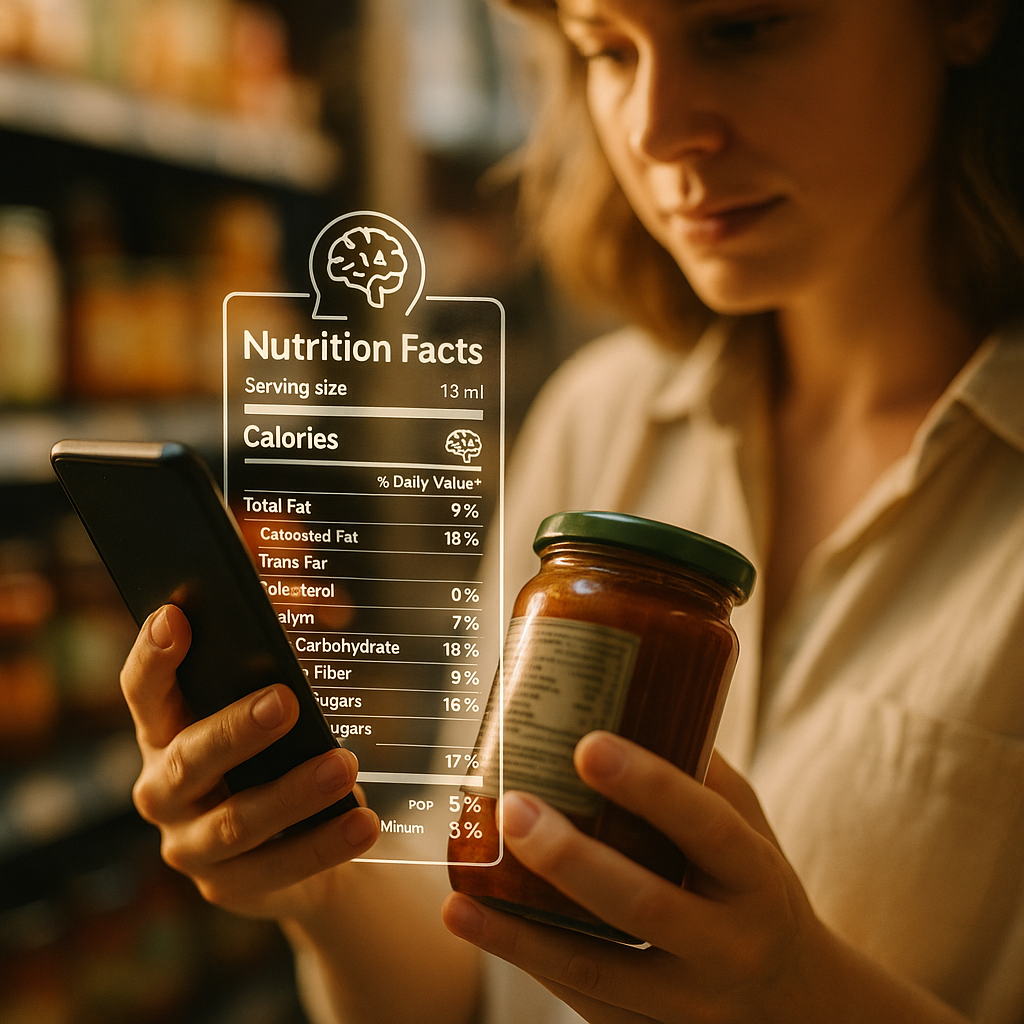
Only 38% of consumers say they trust influencer product claims without visual proof, according to recent Sprout Social research on branded content credibility. That gap is exactly why the AI nutrition-facts overlay format is gaining traction fast among food, beverage, and supplement brands. It stacks hard data directly on the screen while a creator reacts to the actual taste. No script can fake that combination. Skeptical audiences respond to it because it feels like proof, not persuasion.
What This Format Actually Is
Picture a fifteen-second clip: a creator opens a protein bar, takes a bite, and mid-chew an AI-generated overlay populates with sugar content, protein grams, or allergen flags pulled straight from the product’s label data. The overlay isn’t static text slapped on in post — it’s timed to sync with the reaction. A raised eyebrow at “3g sugar” lands the second the number appears. A satisfied nod follows the protein count. The visual and emotional beats move together.
This isn’t just a nutrition label screenshot with a face reacting next to it. The AI component matters because it can pull live data from a product database, auto-generate label-accurate graphics, and adjust formatting per platform (vertical for TikTok Shop, square for Instagram feed placements) without a designer touching every asset. Brands running high-SKU catalogs — think snack companies with a dozen flavor variants — get real efficiency here.
The format works because it removes the biggest objection to influencer food content: “Sure, but does it actually taste good, and what’s really in it?” Answering both questions in one frame is the entire value proposition.
Why Brands Are Prioritizing It Now
Three forces are converging. First, GLP-1 medications and broader health-conscious shopping have made ingredient transparency a purchase driver, not a nice-to-have. Second, retail media networks are pushing brands toward shoppable, data-rich content that performs inside Amazon and Walmart placements — see our breakdown of interactive retail media ad units for how this plays out operationally. Third, AI tools have gotten cheap and fast enough that generating accurate, on-brand nutrition overlays no longer requires a motion graphics team.
eMarketer has flagged food and beverage as one of the fastest-growing verticals for creator spend this cycle, and category buyers are asking for more substantiation in briefs, not less. That’s a compliance signal as much as a creative one.
The Taste-Test Half Isn’t Optional
Here’s where a lot of brands get the brief wrong. They overweight the data overlay and treat the taste reaction as filler. Flip that. The data builds credibility; the reaction builds relatability and watch time. TikTok’s own creative guidance consistently shows that authentic facial reaction and unscripted commentary outperform polished delivery on completion rate. If the creator’s face doesn’t sell the moment, the nutrition panel is just a screenshot with extra steps.
Brief creators to react first, genuinely, before they know what the overlay will say. Some brands are experimenting with blind taste tests where the creator doesn’t see the nutrition data until the overlay populates on their own screen in real time — capturing a live reaction to the numbers, not just the food. That’s the format at its sharpest.
How to Brief It Without Losing Authenticity
A rigid script kills this format instantly. Audiences can smell a fed line from three seconds away, especially when it’s supposedly a spontaneous “wow, only 2g of sugar” moment. Instead, brief around structure, not dialogue:
- Beat one: Unscripted first bite, no data on screen yet.
- Beat two: Overlay populates with one to three key data points, timed to a natural pause in the reaction.
- Beat three: Creator responds to the specific number, not a generic “so good.”
- Beat four: Optional comparison point (competitor sugar content, daily value percentage) if the brand wants a stronger claim.
Give creators the raw label data, not a pre-designed overlay, whenever possible. Let the AI tool generate the graphic based on approved data fields. This keeps every video accurate and legally defensible, while still letting each creator’s on-screen personality drive the pacing.
Where the FTC Lines Actually Sit
This is where legal teams should be looped in early, not after the content ships. Nutrition and health claims carry more regulatory weight than a typical lifestyle endorsement. The FTC’s endorsement guidance still applies in full — disclosure requirements don’t soften because the claim is “just showing the label.” If a brand or its AI tool is making any comparative or superiority claim (“half the sugar of leading brands”), that number needs to be substantiated and sourced, ideally with the source cited on screen or in caption.
Brands that have already built FTC-safe frameworks for adjacent formats will recognize the discipline required here. The approach used in our ingredient swap challenge brief translates well: get legal sign-off on every claim category before creators start filming, not after a video’s already live. The same logic applies to the ghost ad confession format, where transparency itself became the creative hook. Nutrition overlays should borrow that instinct: make the disclosure part of the content’s value, not an afterthought bolted onto the caption.
If your overlay makes any claim a regulator could challenge, treat it like an ad claim — because legally, it is one.
Choosing the Right Creators for This Format
Not every creator can pull this off. The format rewards people who react honestly on camera and can hold a beat without over-explaining. Skip the polished, script-perfect talent here. Nano and micro-creators with food-focused audiences often outperform bigger names because their reactions read as unfiltered. That mirrors what we’ve seen play out in grocery-aisle walkthrough briefs, where smaller creators consistently drove higher trust scores than mega-influencers doing the same walkthrough.
Look for creators who already film in kitchens, at desks, or in cars — anywhere the lighting is consistent and the AI overlay tool can track their face without glitching. Overlay tracking tools (many built on the same computer vision stack as AR filters) need stable framing to sync data reveals with reaction beats. Wobbly handheld footage in low light will produce sloppy timing, and sloppy timing kills the format’s core appeal.
Platform Fit Matters More Than People Assume
TikTok and Instagram Reels reward the format’s snackable pace. YouTube Shorts works too, but long-form YouTube reviews can extend the format into a fuller “ingredient deep dive” with multiple products compared side by side. Retail media placements on Amazon and Walmart increasingly accept UGC-style video with data overlays as enhanced content on product pages, which gives this format a second life beyond the original post. That’s a meaningful ROI multiplier: one piece of content, several distribution windows, no reshoot required.
Measuring Whether It’s Actually Working
Standard engagement metrics only tell half the story here. Track these specifically:
- Retention at the overlay moment — does viewership hold or drop when the data appears?
- Saves and shares — nutrition-data content tends to get saved for reference, a strong purchase-intent signal.
- Comment sentiment around specific numbers — are people debating the sugar count or protein claim? That’s engagement with your actual product substance, not just the creator.
- Add-to-cart lift on retail media placements where the content is repurposed.
HubSpot’s content benchmarking work consistently shows that specificity drives conversion better than vague enthusiasm, and this format is specificity by design. If retention dips hard right as the overlay populates, that’s a signal the data reveal feels like an ad interruption rather than a payoff. Adjust timing before blaming the creator.
Common Mistakes That Undercut the Format
A few patterns show up repeatedly in early campaigns:
- Overloading the overlay with five or six data points instead of the two or three that actually matter to the audience.
- Using stock reaction footage instead of a live taste test, which audiences increasingly can spot.
- Skipping legal review on comparative claims because “it’s just the label.”
- Briefing every creator with identical dialogue, producing a wall of near-identical videos that feel like an ad blitz rather than organic reactions.
Brands that treat this like the two-truths-and-a-lie format — building genuine surprise into the structure rather than flattening it into a template — tend to see stronger completion rates and better comment quality.
Start small: pick one SKU, brief three creators with the four-beat structure above, and get legal sign-off on the specific claims before filming. Measure retention at the overlay moment before scaling to your full catalog.
FAQs
What makes the AI nutrition-facts overlay format different from a standard product review?
The overlay syncs real label data to the exact moment of an unscripted taste reaction, rather than presenting nutrition information separately from the creator’s genuine response. That timing is what builds credibility.
Do FTC disclosure rules change for nutrition or health claims?
The core disclosure requirement (clear, conspicuous #ad or #sponsored labeling) stays the same, but comparative or superiority claims about ingredients need substantiation. Loop in legal review before any “less sugar than” or “more protein than” claim ships.
What creator profile works best for this format?
Nano and micro-creators with established food or wellness audiences tend to outperform larger names, since their reactions read as more authentic and less produced.
Can this format work for supplements or only food and beverage?
It works well for supplements too, though claims around efficacy (not just ingredient content) require even tighter legal review, since health outcome claims carry higher regulatory scrutiny than nutrition facts alone.
How many data points should appear in one overlay?
Two to three. Overloading the frame with every label detail dilutes the moment and tends to hurt retention right as the overlay appears.
Top Influencer Marketing Agencies
The leading agencies shaping influencer marketing in 2026
Agencies ranked by campaign performance, client diversity, platform expertise, proven ROI, industry recognition, and client satisfaction. Assessed through verified case studies, reviews, and industry consultations.
Moburst

-
2

The Shelf
Boutique Beauty & Lifestyle Influencer AgencyA data-driven boutique agency specializing exclusively in beauty, wellness, and lifestyle influencer campaigns on Instagram and TikTok. Best for brands already focused on the beauty/personal care space that need curated, aesthetic-driven content.Clients: Pepsi, The Honest Company, Hims, Elf Cosmetics, Pure LeafVisit The Shelf → -
3

Audiencly
Niche Gaming & Esports Influencer AgencyA specialized agency focused exclusively on gaming and esports creators on YouTube, Twitch, and TikTok. Ideal if your campaign is 100% gaming-focused — from game launches to hardware and esports events.Clients: Epic Games, NordVPN, Ubisoft, Wargaming, Tencent GamesVisit Audiencly → -
4

Viral Nation
Global Influencer Marketing & Talent AgencyA dual talent management and marketing agency with proprietary brand safety tools and a global creator network spanning nano-influencers to celebrities across all major platforms.Clients: Meta, Activision Blizzard, Energizer, Aston Martin, WalmartVisit Viral Nation → -
5

The Influencer Marketing Factory
TikTok, Instagram & YouTube CampaignsA full-service agency with strong TikTok expertise, offering end-to-end campaign management from influencer discovery through performance reporting with a focus on platform-native content.Clients: Google, Snapchat, Universal Music, Bumble, YelpVisit TIMF → -
6

NeoReach
Enterprise Analytics & Influencer CampaignsAn enterprise-focused agency combining managed campaigns with a powerful self-service data platform for influencer search, audience analytics, and attribution modeling.Clients: Amazon, Airbnb, Netflix, Honda, The New York TimesVisit NeoReach → -
7

Ubiquitous
Creator-First Marketing PlatformA tech-driven platform combining self-service tools with managed campaign options, emphasizing speed and scalability for brands managing multiple influencer relationships.Clients: Lyft, Disney, Target, American Eagle, NetflixVisit Ubiquitous → -
8

Obviously
Scalable Enterprise Influencer CampaignsA tech-enabled agency built for high-volume campaigns, coordinating hundreds of creators simultaneously with end-to-end logistics, content rights management, and product seeding.Clients: Google, Ulta Beauty, Converse, AmazonVisit Obviously →