


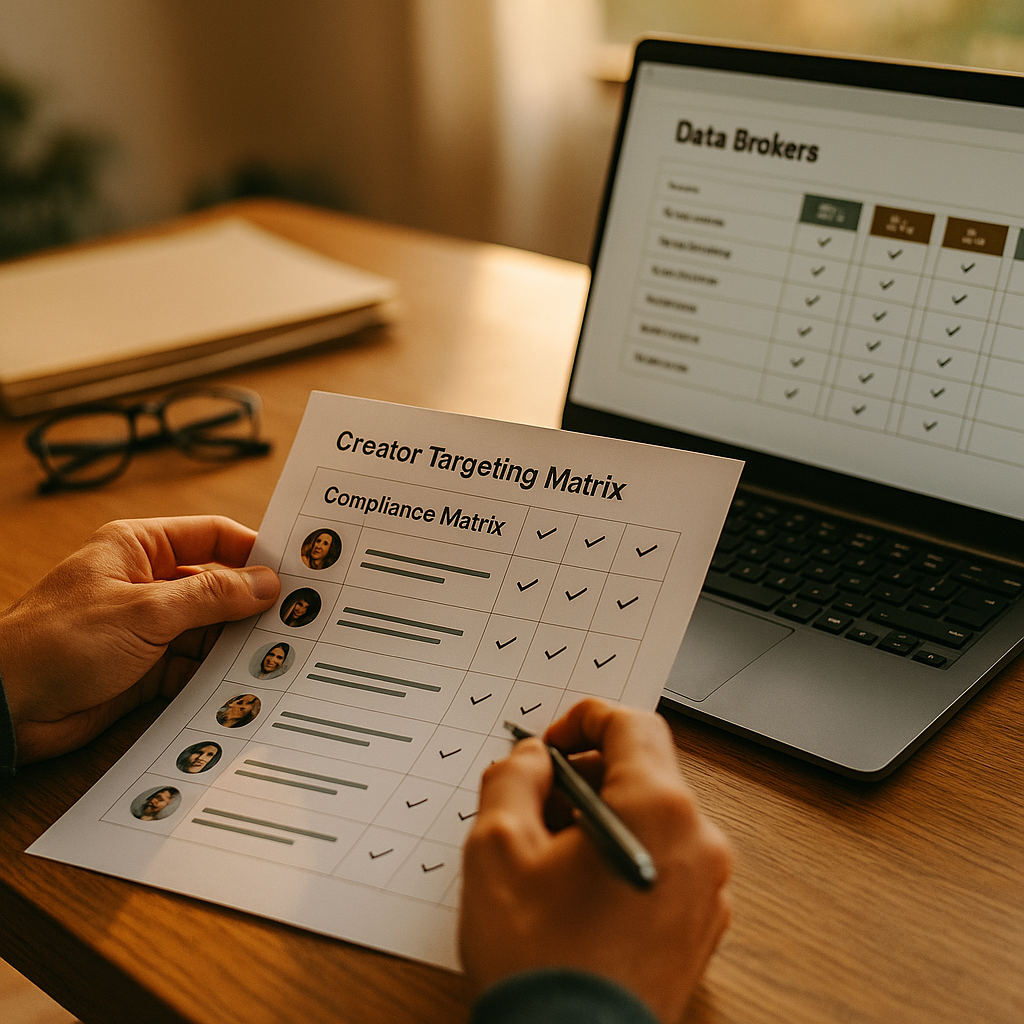
Three states. Three definitions of “data broker.” One creator campaign spinning up next week. If your legal team can’t answer whether your lookalike-audience vendor qualifies as a broker under Vermont law versus Colorado’s, you’re not alone — and that gap is exactly where enforcement actions start. Data broker laws written for ad-tech resellers are now colliding head-on with creator audience targeting stacks, and 2026 is the year regulators stop giving brands the benefit of the doubt.
Why This Suddenly Matters to Creator Marketing Teams
Data broker statutes were built with a mental image of shadowy data resellers trading consumer profiles in bulk. Nobody was picturing a TikTok Shop affiliate platform matching creators to lookalike audiences pulled from a brand’s CRM. But the statutory language doesn’t care about intent — it cares about function. If your influencer platform collects consumer data it didn’t directly gather from the individual, and sells or licenses access to it, several state definitions now sweep that activity in.
That’s the trap. Brand legal teams have spent two years building consent workflows for first-party creator content. Meanwhile, the audience-matching layer underneath — the part that decides which micro-influencer’s followers look like your target buyer — often runs on third-party data pipelines that nobody mapped against broker registration rules.
Vermont, Colorado, and Delaware each define “data broker” differently enough that a single creator targeting vendor can be compliant in one state and unregistered-and-liable in another, simultaneously.
The Three-State Problem, Broken Down
Let’s get specific, because vague comparisons are how compliance gaps happen.
- Vermont was first out of the gate with a data broker registration law, and it defines a broker broadly as any business that knowingly collects and sells personal information of consumers with whom it has no direct relationship. Creator targeting platforms that ingest third-party audience segments to power lookalike matching fit this definition more often than brands assume. Vermont also requires annual registration and specific data-security disclosures — miss the deadline and you’re operating an unregistered broker relationship by proxy.
- Colorado folds broker-like obligations into its broader privacy act framework, with heightened requirements around sensitive data categories and a universal opt-out mechanism. Colorado’s angle isn’t just “are you a broker” — it’s whether your creator targeting vendor honors browser-level opt-out signals before it ever hands your brand a segment. Most creator platforms weren’t built with universal opt-out recognition in mind.
- Delaware takes a narrower registration approach but pairs it with aggressive enforcement posture through its Department of Justice, and its definition of “sale” is broad enough to capture data-sharing arrangements that brands assumed were mere “service provider” pass-throughs.
Put those three next to each other and you get a matrix, not a checklist. A vendor that’s clean in Delaware because it structured itself as a processor might still trip Vermont’s broker registration threshold because Vermont doesn’t recognize the same processor carve-out for audience-matching functions.
Where Creator Targeting Programs Actually Break the Rules
Brand teams tend to assume risk lives in the influencer contract. It doesn’t — not primarily. The real exposure sits one layer up, in the targeting and matching infrastructure that decides which creators get briefed against which audience segments.
Here’s where it typically breaks down:
- Lookalike audience sourcing. If your agency builds creator audience segments from a data co-op or clean room that includes broker-sourced data, you inherit broker exposure even if you never touch raw consumer records.
- Cross-platform identity resolution. Matching a creator’s follower base to your CRM using a third-party identity graph is functionally data brokering in Vermont’s reading, especially if that graph vendor sells matched segments to multiple brands.
- Retargeting pools built from creator content engagement. Once you start building a paid retargeting audience off organic creator engagement data and licensing that pool to another advertiser or agency partner, Delaware’s broad “sale” definition likely applies.
None of this shows up in a standard influencer agreement review. It shows up in a data flow audit — which is precisely why legal teams keep getting surprised by it.
A Quick Gut-Check Question for Legal Teams
Ask your MarTech lead this: “Does any vendor in our creator targeting stack sell or license audience segments derived from our campaigns to a third party?” If nobody can answer definitively in under thirty seconds, you have a documentation problem before you even get to a legal one. This is precisely the gap covered in our creator audience targeting compliance audit guide, which walks through the vendor-mapping exercise brand teams keep skipping.
Building the 2026 Compliance Matrix
A workable matrix isn’t a fifty-tab spreadsheet nobody opens. It’s a decision tree your legal and media teams can run in under an hour per vendor. Structure it around four axes:
- Data origin. First-party (collected directly from your customer), second-party (shared via partnership), or third-party (aggregated/broker-sourced)?
- Transfer mechanism. Is data sold, licensed, or processed under a service agreement with no onward transfer rights?
- State nexus. Does the targeting activity touch Vermont, Colorado, or Delaware residents specifically, triggering that state’s threshold?
- Opt-out honoring. Does the vendor recognize universal opt-out signals (required under Colorado, increasingly expected elsewhere)?
Score each creator targeting vendor against those four axes, and you get a heat map, not a guess. Vendors scoring high-risk on state nexus plus third-party origin need registration review immediately. This mirrors the approach we outlined for Vermont privacy law consent workflows, which is worth pairing with this matrix since Vermont’s consent and broker obligations often overlap in the same vendor contract.
Treat multi-state data broker compliance as a vendor-scoring exercise, not a one-time legal memo. Vendor terms and state thresholds both shift yearly.
What Brand Legal Teams Should Demand From Vendors Now
Stop accepting boilerplate DPAs that were drafted for CCPA and never updated. Specifically push for:
- Written confirmation of the vendor’s data broker registration status in Vermont and Delaware, with registration numbers where applicable.
- Contractual warranties that the vendor honors Colorado’s universal opt-out mechanism at the point of audience segment creation, not just at the point of ad delivery.
- A data lineage attestation — essentially a signed statement tracing where audience-matching data originated, refreshed at least annually.
- Indemnification language specific to broker misclassification risk, not generic data breach indemnification. These are different risks and most existing contracts only cover the latter.
If a vendor balks at any of these, that’s information too. It usually means they haven’t done the internal legal work themselves, which means you’re the first brand asking, which means you’re also the first brand exposed when a regulator asks. Our related breakdown on indemnification for AI creator-matching platforms covers how to structure that liability language so it actually holds up.
Don’t Forget the Adjacent Geolocation Angle
Audience targeting rarely stops at demographic and interest data — geolocation signals are baked into most creator platform matching engines, and that’s a separate compliance thread worth checking against your DPAs. We’ve covered the mechanics of this in our piece on the Virginia geolocation amendment, and the same audit logic applies when Vermont or Colorado residents’ location data flows through a creator matching tool.
The Practical Rollout Timeline
Realistically, most brand legal teams can’t audit every vendor simultaneously. Sequence it:
- Weeks one and two: Inventory every vendor touching audience data for creator campaigns — including sub-processors your agency uses that you’ve never directly contracted with.
- Weeks three and four: Score each against the four-axis matrix above.
- Month two: Send updated DPA riders to high-risk vendors, prioritizing anything touching Vermont or Delaware residents given their registration mechanisms.
- Ongoing: Re-score annually, or whenever a vendor changes its data sourcing model — which, per eMarketer’s tracking of ad-tech consolidation, happens more often than brands expect given the pace of M&A among identity resolution vendors.
This isn’t busywork. State attorneys general in Colorado and Delaware have both signaled increased enforcement staffing for privacy and broker statutes, and FTC guidance continues to treat data broker practices as a consumer protection priority at the federal level too, which means overlapping jurisdiction risk on top of the state-by-state patchwork.
None of this exists in isolation from your broader creator compliance program, either. If you haven’t already run a full audit of disclosure practices alongside this data question, our compliance audit guide is the natural next document to pull up.
Frequently Asked Questions
Does a creator marketing platform count as a data broker under Vermont law?
It can, if the platform collects and sells or licenses consumer data from people it has no direct relationship with. Many audience-matching and lookalike tools fall into this category even when brands don’t realize their vendor is functioning as a broker.
How does Colorado’s law differ from Vermont’s on creator targeting?
Colorado emphasizes universal opt-out signal recognition and sensitive data handling within its broader privacy act, rather than a standalone broker registration requirement like Vermont’s. A vendor can meet Vermont’s registration bar and still fail Colorado’s opt-out enforcement standard.
What makes Delaware’s data broker enforcement different?
Delaware pairs a narrower broker definition with an unusually broad interpretation of “sale,” meaning data-sharing arrangements brands assumed were simple vendor pass-throughs can still trigger registration and disclosure obligations.
Who is liable if our creator targeting vendor is an unregistered broker?
Liability often extends to the brand, not just the vendor, especially where the brand directed the targeting activity or benefited from the audience segment. This is why indemnification language specific to broker misclassification matters in vendor contracts.
How often should brands re-audit their creator targeting vendors for broker compliance?
At minimum annually, and immediately after any vendor changes its data sourcing model, adds new sub-processors, or expands into new states with different broker or privacy thresholds.
Next step: pull your current list of creator targeting vendors this week, run each through the four-axis matrix above, and flag anything touching Vermont, Colorado, or Delaware residents for immediate DPA review before your next campaign launch.
Top Influencer Marketing Agencies
The leading agencies shaping influencer marketing in 2026
Agencies ranked by campaign performance, client diversity, platform expertise, proven ROI, industry recognition, and client satisfaction. Assessed through verified case studies, reviews, and industry consultations.
Moburst

-
2

The Shelf
Boutique Beauty & Lifestyle Influencer AgencyA data-driven boutique agency specializing exclusively in beauty, wellness, and lifestyle influencer campaigns on Instagram and TikTok. Best for brands already focused on the beauty/personal care space that need curated, aesthetic-driven content.Clients: Pepsi, The Honest Company, Hims, Elf Cosmetics, Pure LeafVisit The Shelf → -
3

Audiencly
Niche Gaming & Esports Influencer AgencyA specialized agency focused exclusively on gaming and esports creators on YouTube, Twitch, and TikTok. Ideal if your campaign is 100% gaming-focused — from game launches to hardware and esports events.Clients: Epic Games, NordVPN, Ubisoft, Wargaming, Tencent GamesVisit Audiencly → -
4

Viral Nation
Global Influencer Marketing & Talent AgencyA dual talent management and marketing agency with proprietary brand safety tools and a global creator network spanning nano-influencers to celebrities across all major platforms.Clients: Meta, Activision Blizzard, Energizer, Aston Martin, WalmartVisit Viral Nation → -
5

The Influencer Marketing Factory
TikTok, Instagram & YouTube CampaignsA full-service agency with strong TikTok expertise, offering end-to-end campaign management from influencer discovery through performance reporting with a focus on platform-native content.Clients: Google, Snapchat, Universal Music, Bumble, YelpVisit TIMF → -
6

NeoReach
Enterprise Analytics & Influencer CampaignsAn enterprise-focused agency combining managed campaigns with a powerful self-service data platform for influencer search, audience analytics, and attribution modeling.Clients: Amazon, Airbnb, Netflix, Honda, The New York TimesVisit NeoReach → -
7

Ubiquitous
Creator-First Marketing PlatformA tech-driven platform combining self-service tools with managed campaign options, emphasizing speed and scalability for brands managing multiple influencer relationships.Clients: Lyft, Disney, Target, American Eagle, NetflixVisit Ubiquitous → -
8

Obviously
Scalable Enterprise Influencer CampaignsA tech-enabled agency built for high-volume campaigns, coordinating hundreds of creators simultaneously with end-to-end logistics, content rights management, and product seeding.Clients: Google, Ulta Beauty, Converse, AmazonVisit Obviously →