


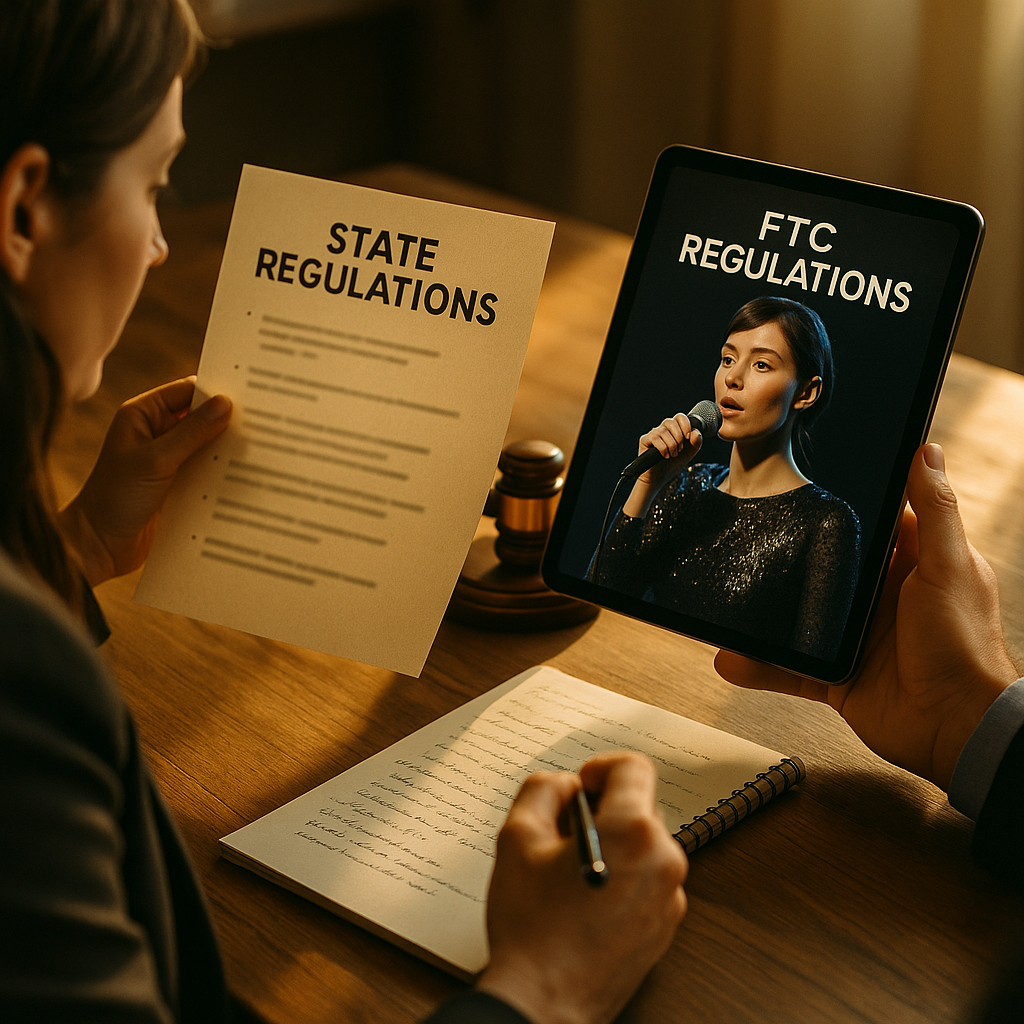
One national ad. One AI-generated spokesperson. And now, potentially, a dozen different disclosure standards depending on where the viewer happens to be sitting. That’s the mess brands face in 2026 as states race ahead of the FTC on synthetic performer disclosure rules, leaving legal and marketing teams to reconcile requirements that were never designed to talk to each other.
California has one rule. New York has another. The FTC has a third, older standard that predates most of this technology. If your media plan runs national, you’re not choosing one set of rules to follow. You’re following all of them, simultaneously, in a single 30-second spot.
Why This Problem Snuck Up on Marketing Teams
Synthetic performers used to be a novelty — a background extra in a low-budget spot, or a stylized mascot nobody mistook for a real person. Not anymore. AI-generated talent now anchors national campaigns for retail, finance, and CPG brands, often indistinguishable from a human presenter until someone tells you otherwise. That’s precisely the problem regulators are chasing.
States started passing synthetic performer and digital replica laws largely in response to entertainment industry pressure (think SAG-AFTRA’s fights over AI likeness rights), but the language in several statutes is broad enough to sweep in advertising. Meanwhile, the FTC has stuck with its existing “clear and conspicuous” framework under the endorsement guides, which doesn’t specifically name AI-generated performers but arguably already covers them under material connection and deception principles.
The result: two regulatory tracks moving at different speeds, with different definitions of disclosure, different placement rules, and different penalty structures. Legal teams are stuck translating between them ad by ad.
A single national ad featuring AI talent can trigger FTC scrutiny plus a patchwork of state-level disclosure mandates — and satisfying one doesn’t guarantee compliance with the other.
What “Clear and Conspicuous” Actually Requires
The FTC’s standard isn’t new, but applying it to synthetic performers requires some translation. Under the endorsement guides, a disclosure must be:
- Difficult to miss (size, placement, contrast, duration on screen)
- In language consumers understand — no legal jargon
- Presented in the same medium as the claim (a verbal disclosure alone doesn’t cut it for a silent scrolling video)
- Unavoidable, not buried in a description box or end-card that flashes for half a second
Nothing in that list mentions “AI” specifically. But the FTC has been clear in enforcement actions and public statements that using a synthetic figure to imply a real, credible human endorsement — without disclosure — is a deception issue, not just a labeling nicety. Our earlier breakdown of the FTC disclosure standard for AI shopping agents covers the same underlying logic applied to a different format.
The practical takeaway: if a reasonable consumer might believe they’re watching a real person’s genuine opinion or performance, and it’s actually synthetic, you need a disclosure that meets all four criteria above. That’s the FTC floor. States are building on top of it, not replacing it.
The State Layer: Where It Gets Messy
Here’s where a national campaign turns into a compliance obstacle course. States are not aligned on:
- Trigger definitions — some laws apply only to “digital replicas” of real, identifiable people; others apply more broadly to any synthetic or AI-generated performer, real-seeming or not.
- Disclosure placement — a few states require an on-screen label for a minimum duration; others allow audio disclosure or a persistent watermark.
- Industry scope — some statutes are entertainment-specific and arguably don’t touch advertising at all; others explicitly include commercial and promotional content.
- Enforcement mechanism — private right of action in some states, AG enforcement only in others, which changes your litigation risk calculus significantly.
This isn’t just theoretical variance. It changes your creative. A disclosure that sits comfortably in a corner of the screen for two seconds might satisfy the FTC’s “same medium” test but fail a state law requiring a minimum on-screen duration or specific font size. Run the wrong version in the wrong state and you’ve got a live legal exposure, even if your national creative team thought they nailed it.
The Reconciliation Checklist
Treat this as a pre-flight list before any AI-talent creative goes to air. Skipping steps here isn’t a minor process gap — it’s the difference between a defensible compliance posture and a regulatory target.
- Map every state where the ad will run, not just where the brand is headquartered. Streaming and CTV buys often run wider than teams assume. Cross-reference against current synthetic performer statutes state by state — this list changes quarterly, so don’t rely on last year’s memo.
- Identify the strictest applicable standard across all target states, then build your disclosure to that bar. It’s more efficient to over-comply nationally than maintain 12 creative variants.
- Confirm the disclosure satisfies FTC’s four-part test independently. State compliance doesn’t automatically satisfy federal law, and vice versa. Check both boxes separately.
- Document the material connection analysis — is the AI talent being used in a way that implies genuine endorsement, or is it clearly stylized/animated? This determines whether disclosure is even required, and it needs a paper trail. Our piece on AI scriptwriting and material connection walks through how the FTC evaluates this line.
- Lock disclosure specs into the creative brief before production, not after. Retrofitting a label onto finished footage is expensive and often looks like an afterthought to regulators, which itself signals bad faith.
- Version control by market if full harmonization isn’t feasible. Some brands genuinely need state-specific cuts for platform, budget, or brand-safety reasons. If so, build a matrix tracking which cut runs where, and audit media buys against it.
- Get sign-off from both compliance and media buying before launch. Media buyers often don’t know state disclosure quirks; compliance teams often don’t know geo-targeting logic. This handoff is where things fall through cracks.
- Retain records for the FTC’s typical look-back window and any state-specific retention requirements, whichever is longer. If you get a demand letter eighteen months from now, you want the creative brief, legal sign-off, and final cut all in one file.
Building disclosures to the strictest state standard, then verifying FTC compliance separately, is more efficient than maintaining a dozen creative variants for a single national campaign.
Where Brands Get Tripped Up
A few recurring failure patterns show up across enforcement actions and NAD referrals:
Assuming a small “AI-generated” watermark counts as disclosure. It often doesn’t, particularly if it’s not “clear and conspicuous” by FTC standards — too small, too brief, wrong contrast. A watermark satisfying a platform’s content policy (say, YouTube’s synthetic media labeling) isn’t automatically sufficient for FTC or state law purposes. These are three different bars.
Treating disclosure as a legal problem instead of a creative one. The most durable disclosures are baked into the concept — a visual style, a recurring on-screen tag, a narrative frame that makes it obvious the “spokesperson” is synthetic. Trying to bolt a disclosure onto creative that was built to look maximally human is a losing battle, both legally and aesthetically.
Ignoring the agency’s exposure. If your agency of record produced the AI talent and didn’t flag disclosure requirements, that’s a contract issue, not just a brand issue. Review indemnification language now, not after a complaint lands. See our related coverage on indemnification clauses for AI-driven media buying for how to structure that risk allocation.
Forgetting the international layer. If the same creative runs in EU markets, the AI Act’s transparency obligations for synthetic content add another compliance layer entirely, with different thresholds than any US state law. Our comparison of the EU AI Act and US synthetic performer laws is worth reviewing before any cross-border media buy.
A Note on Enforcement Momentum
The FTC has signaled repeatedly, including through public statements and its ongoing rulemaking activity, that AI-generated endorsements are a priority area. State attorneys general are watching the same headlines about deepfake fraud and synthetic celebrity endorsements that consumers are, which means political pressure to enforce aggressively is building, not fading. According to eMarketer research on AI adoption in advertising, spend on AI-generated creative is accelerating faster than most legal teams can build review processes for it — a gap regulators are increasingly eager to close.
Industry self-regulatory bodies are also stepping up. NAD referrals involving synthetic talent disclosure are becoming more common, and as we’ve covered in the NAD-to-FTC referral escalation trigger, a self-regulatory complaint that goes unresolved can escalate to full federal scrutiny fast. Don’t assume “nobody’s filed a complaint yet” means you’re safe. It usually means nobody’s looked closely yet.
For teams building internal governance around this, tying synthetic performer disclosure into a broader AI oversight structure — similar to what’s outlined in our AI governance charter guidance — gives you a repeatable review process instead of a one-off legal scramble every time a new AI-talent campaign comes up. Guidance from the FTC itself remains the primary federal reference point, and it’s worth checking for updates before every major AI-talent launch, since this area is evolving quarter over quarter.
Frequently Asked Questions
FAQs
Does FTC disclosure automatically satisfy state synthetic performer laws?
No. FTC compliance addresses deception and material connection at the federal level, but several state laws impose additional or different requirements around placement, duration, and scope. You need to check both independently.
What triggers a synthetic performer disclosure requirement?
Generally, if a reasonable viewer could believe they’re watching a real person delivering a genuine endorsement or performance, and the talent is actually AI-generated, disclosure is likely required. Purely stylized or obviously animated content typically falls outside the requirement, but the line varies by state statute.
Can one disclosure format work across all states?
Often yes, if you build to the strictest applicable state standard and verify it independently meets the FTC’s clear-and-conspicuous test. This avoids maintaining separate creative cuts for every market, though some brands still choose state-specific versions for other creative reasons.
Who is liable if the disclosure fails to meet a state’s standard?
Liability can extend to the brand, the agency of record, and in some cases the platform running the ad, depending on contract terms and each state’s enforcement mechanism. Indemnification clauses should explicitly address AI talent and disclosure compliance.
How often do these state laws change?
Frequently. New synthetic performer and digital replica bills are introduced in state legislatures on a rolling basis, and existing laws are amended as enforcement experience accumulates. Legal review should happen before every national AI-talent campaign launch, not on an annual cycle.
The fix isn’t waiting for federal and state law to align, because they won’t anytime soon. Build your disclosure to the strictest state standard, verify it against the FTC’s four-part test independently, and get that sign-off documented before the ad ever airs.
FAQs
Does FTC disclosure automatically satisfy state synthetic performer laws?
No. FTC compliance addresses deception and material connection at the federal level, but several state laws impose additional or different requirements around placement, duration, and scope. You need to check both independently.
What triggers a synthetic performer disclosure requirement?
Generally, if a reasonable viewer could believe they’re watching a real person delivering a genuine endorsement or performance, and the talent is actually AI-generated, disclosure is likely required. Purely stylized or obviously animated content typically falls outside the requirement, but the line varies by state statute.
Can one disclosure format work across all states?
Often yes, if you build to the strictest applicable state standard and verify it independently meets the FTC’s clear-and-conspicuous test. This avoids maintaining separate creative cuts for every market, though some brands still choose state-specific versions for other creative reasons.
Who is liable if the disclosure fails to meet a state’s standard?
Liability can extend to the brand, the agency of record, and in some cases the platform running the ad, depending on contract terms and each state’s enforcement mechanism. Indemnification clauses should explicitly address AI talent and disclosure compliance.
How often do these state laws change?
Frequently. New synthetic performer and digital replica bills are introduced in state legislatures on a rolling basis, and existing laws are amended as enforcement experience accumulates. Legal review should happen before every national AI-talent campaign launch, not on an annual cycle.
Top Influencer Marketing Agencies
The leading agencies shaping influencer marketing in 2026
Agencies ranked by campaign performance, client diversity, platform expertise, proven ROI, industry recognition, and client satisfaction. Assessed through verified case studies, reviews, and industry consultations.
Moburst

-
2

The Shelf
Boutique Beauty & Lifestyle Influencer AgencyA data-driven boutique agency specializing exclusively in beauty, wellness, and lifestyle influencer campaigns on Instagram and TikTok. Best for brands already focused on the beauty/personal care space that need curated, aesthetic-driven content.Clients: Pepsi, The Honest Company, Hims, Elf Cosmetics, Pure LeafVisit The Shelf → -
3

Audiencly
Niche Gaming & Esports Influencer AgencyA specialized agency focused exclusively on gaming and esports creators on YouTube, Twitch, and TikTok. Ideal if your campaign is 100% gaming-focused — from game launches to hardware and esports events.Clients: Epic Games, NordVPN, Ubisoft, Wargaming, Tencent GamesVisit Audiencly → -
4

Viral Nation
Global Influencer Marketing & Talent AgencyA dual talent management and marketing agency with proprietary brand safety tools and a global creator network spanning nano-influencers to celebrities across all major platforms.Clients: Meta, Activision Blizzard, Energizer, Aston Martin, WalmartVisit Viral Nation → -
5

The Influencer Marketing Factory
TikTok, Instagram & YouTube CampaignsA full-service agency with strong TikTok expertise, offering end-to-end campaign management from influencer discovery through performance reporting with a focus on platform-native content.Clients: Google, Snapchat, Universal Music, Bumble, YelpVisit TIMF → -
6

NeoReach
Enterprise Analytics & Influencer CampaignsAn enterprise-focused agency combining managed campaigns with a powerful self-service data platform for influencer search, audience analytics, and attribution modeling.Clients: Amazon, Airbnb, Netflix, Honda, The New York TimesVisit NeoReach → -
7

Ubiquitous
Creator-First Marketing PlatformA tech-driven platform combining self-service tools with managed campaign options, emphasizing speed and scalability for brands managing multiple influencer relationships.Clients: Lyft, Disney, Target, American Eagle, NetflixVisit Ubiquitous → -
8

Obviously
Scalable Enterprise Influencer CampaignsA tech-enabled agency built for high-volume campaigns, coordinating hundreds of creators simultaneously with end-to-end logistics, content rights management, and product seeding.Clients: Google, Ulta Beauty, Converse, AmazonVisit Obviously →